Cretan Hieroglyphic
Cretan Hieroglyphic is the name Arthur Evans gave to the picture-like signs he found on Minoan seals and, from 1900, on clay documents in the palace at Knossos; he published the first sign list of 135 signs in Scripta Minoa in 1909 and thought the script had been inspired by Egypt[1][2]. The script was in use from the end of the Prepalatial period to the end of the Protopalatial palaces, about 1900 to 1600 BC, and for most of that time it ran alongside Linear A, the other Minoan script, which has its own entry on this site[3][4]. The two share many sign shapes but are distinct systems, kept apart in the same administrations, and the question of how they relate, parent and child or sisters from one source, is still open[4][5][6]. The Phaistos Disc, also on this site, is a third script with a few shared shapes and is not part of this corpus[7].
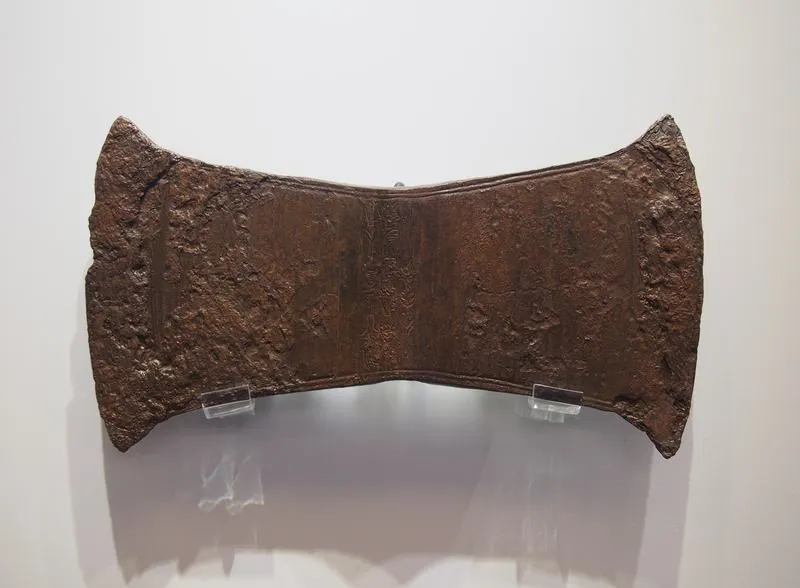
The standard edition is the Corpus Hieroglyphicarum Inscriptionum Cretae (CHIC) of 1996 by Jean-Pierre Olivier and Louis Godart with Jean-Claude Poursat, which gathers 331 objects: fewer than 150 inscriptions on clay, about 200 seals, and a few painted or incised vessels and stone objects, among them the Malia altar stone and the Arkalochori axe, whose membership of the script is uncertain[8][2][9]. CHIC set out 144 signs in five classes: 96 syllabograms, logograms for commodities, numerals, nine fraction signs and punctuation[2]. It admitted a seal graph to the sign list only if the same graph was also attested on clay, so a large number of seal motifs were set aside as decoration; this decision has been the main point of contention since[2][10][11][12].
What is known is limited to structure. The number of signs is right for a syllabary, the numerals are decimal and readable, the clay documents are short accounts, and a few recurring sign groups, above all the Archanes formula found on seals from the late third millennium onward, repeat across sites[13][14][15]. A 2021 reassessment of the sign list argued that CHIC's 144 signs reduce to about 98 once variants are merged, and that the split between syllabic and logographic signs was assumed from Linear B rather than shown[16]. Proposed readings in Luwian, in a Sumerian-named proto-syllabary and in a Uralic language have been published outside the specialist literature and have not been taken up; the only widely discussed hypothesis about the language is that it is the same Minoan language as Linear A, which Brent Davis tested statistically in 2024 with a method that reviewers found hard to evaluate[17][18][19][20][21].
The 2024 Cambridge volume edited by Civitillo, Ferrara and Meissner is the first collective statement on the script since CHIC and records a changed consensus: seal signs and clay signs form one signary, the seals probably name their owners, and the Archanes group is no longer taken for early Linear A[13][21]. There is no machine-readable corpus, the script is not in Unicode, and the ERC INSCRIBE project's 3D models are viewable but not downloadable[22][23]. The long ivory inscription found in the Knossos cult centre and published in 2024 to 2025 is Linear A, not Cretan Hieroglyphic, though its signs are carved in the hieroglyphic seal-cutters' style[24]. Of the 8 questions on this site, 0 are answered.
Key questionsset by the editors
Research sessions1 so far · last 31 Oct
S-001Cretan Hieroglyphic seeded: corpus, readings and open data
The object
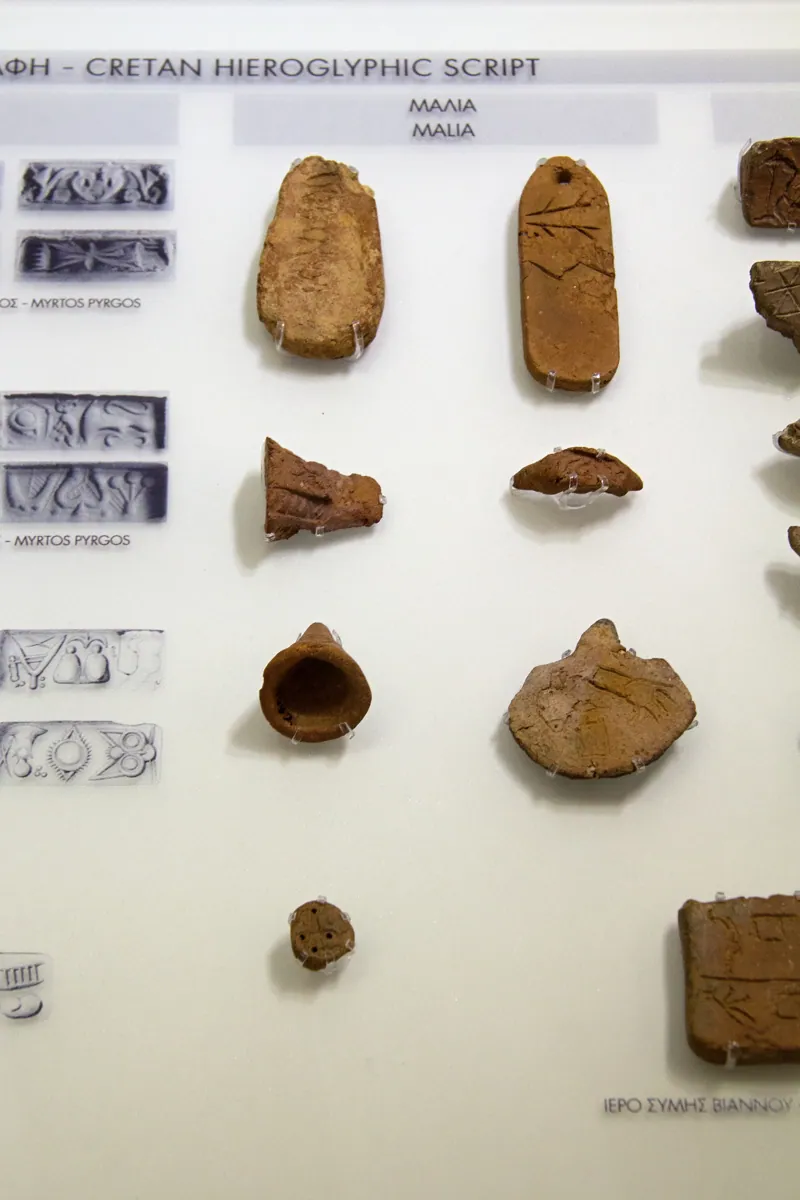
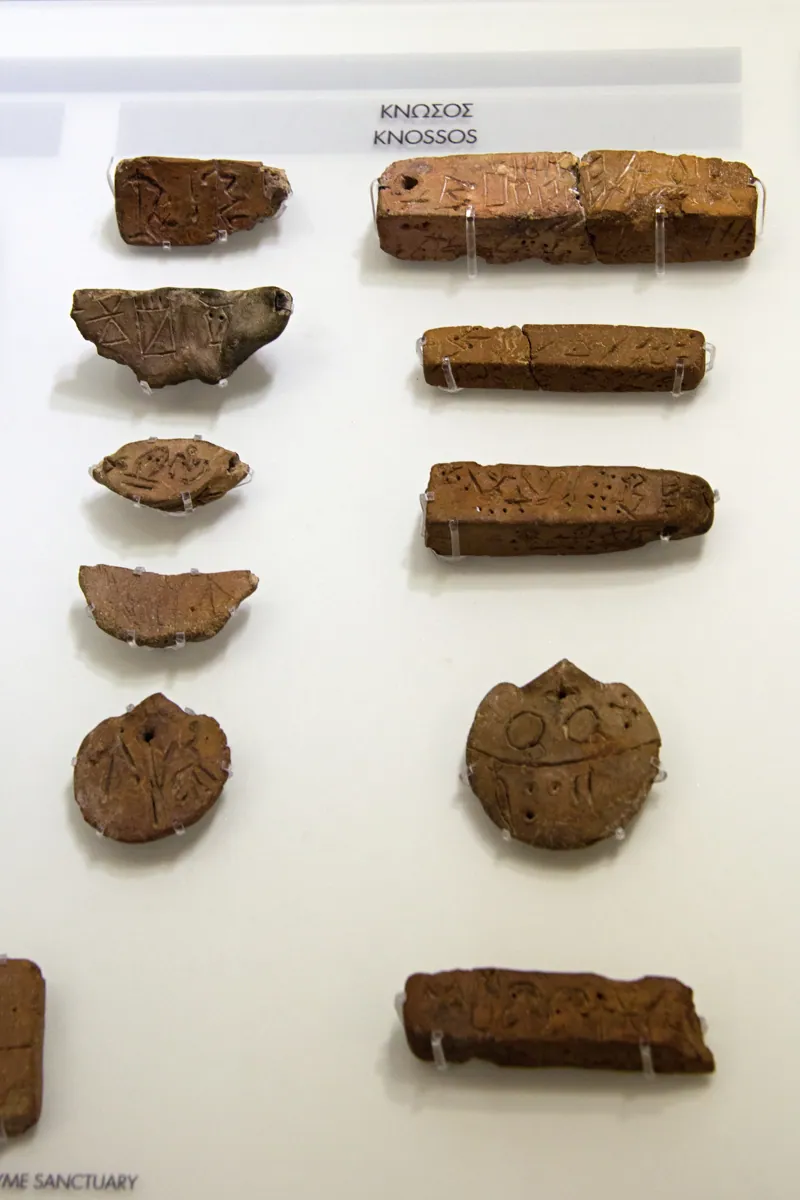
The documents are of two kinds. The first is seals: small engraved stones, and a few of bone or metal, with one to four faces cut with signs, meant to be pressed into clay; about 200 of them survive, from residential quarters and graves as well as palaces[2][13]. The second is clay: fewer than 150 inscribed pieces, mostly four-sided bars, round medallions with a suspension hole, crescent-shaped nodules and a few page-shaped tablets, together with sealings that carry the impressions of seals[2][8]. A count made in 1989 gave 150 seals and sealings with 832 signs and 120 other clay documents with 723 signs, about 1,550 signs in all; finds since then have added a little[9].
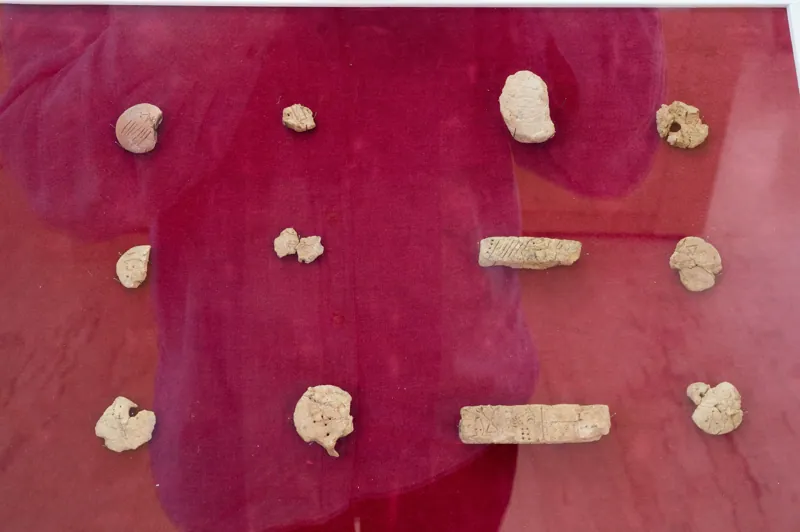
The clay comes chiefly from four deposits. Evans found the Hieroglyphic Deposit in the palace at Knossos in 1900. The French excavations at Malia produced documents from the palace and, in the 1960s and 1970s, the largest group, from the Middle Minoan II building complex called Quartier Mu[8][2]. At Petras in eastern Crete, a Middle Minoan IIB archive of clay documents, seal impressions and seals was excavated from 1995 in a sealed destruction level and published in 2010; it is the only hieroglyphic archive dug with modern methods[25]. Phaistos has sealings and a few inscribed pieces[13]. Isolated finds at Vrysinas near Rethymno in 2011, at the Knossos cult centre in the 2010s and on Samothrace show the script reached beyond the central and eastern palaces[26][15][13].
CHIC publishes the whole corpus with photographs, drawings and transcriptions, and numbers the documents H 1 to 122 for clay, I 123 to 179 for impressions and S 180 to 314 for seals, with a few miscellaneous objects after them[8][9]. Most of the material is in the Heraklion Archaeological Museum, with the Petras finds in Sitia and a few seals abroad[27]. There is no open digital edition. The Florence DBAS-CHS database indexes the seals by sign, motif, material and context for personal and scientific use; the INSCRIBE project at Bologna has made 3D models of seals, bars and nodules that can be viewed but not downloaded[28][23].
Timeline
What is known
The script is almost certainly a syllabary with logograms, that is, a system in which most signs stand for a syllable and some for a whole word such as a commodity. Evans already saw that 135 signs were too few for a purely word-based script, and the 2024 volume records broad agreement that the system rendered speech systematically[13][2]. CHIC's inventory is 96 syllabograms, logograms, numerals, nine fraction signs and two punctuation marks[8][9]. The numerals are decimal, with signs for units, tens, hundreds and thousands, and are read without difficulty[9]. Reading direction is mostly left to right on clay; on seals it has to be worked out face by face[9].
The inventory is less secure than CHIC's numbering suggests. Montecchi, Ferrara and Valério reviewed every sign in 2021 by three tests: whether two shapes share the features that matter, whether they never occur on the same kind of document, and whether they swap with each other inside the same sign group. They proposed eleven groups of mergers, removed a sign known only from a lost document, reassigned three to Linear A, and found that 33 signs attested once would fall to about 18; the list would then hold about 98 signs[16]. They also dropped the division into syllabic and logographic classes, which CHIC had taken over from Linear B without evidence from the hieroglyphic texts themselves[16].
Something is known of use. The clay documents are accounts: sign groups followed by logograms and numbers, like the Linear A tablets but shorter[8][29]. The seals carry short sign groups, and the 2024 volume reports growing agreement that these name the seal's owner or office rather than the goods stamped[30][21]. One group, the Archanes formula, recurs from the late Prepalatial seals of Archanes-Phourni to the Neopalatial seal from the Knossos cult centre, which also links it to fraction signs[14][15]. Sound values are not known. Where a hieroglyphic sign has a Linear A look-alike, the Linear B value is sometimes written beside it, but the catalogue sites that do this warn that the values are hypotheses[27][31].
What has been tested
The seals-as-writing question has been argued on the evidence of layout. Decorte's 2017 study treated every mark on a seal face, including the fillers and dots CHIC set aside, as part of one graphic syntax and concluded that the line between script and ornament was drawn by the editors, not the Minoans[11]. Jasink had already restored more than thirty seal motifs to the status of candidate signs[10]. Ferrara, Montecchi and Valério in 2023 asked which excluded motifs behave like signs, by their position, their combinations and their association with recognised signs, and argued that some of them are writing[12]. The counter-position, that the seals were luxury ornaments whose script was displayed more than read, was put by Jasink and Weingarten in 2024; it does not deny that the signs are script[30][21]. No test has yet shown which excluded motifs carry sound.
The relation to Linear A has been tested by comparison of sign shapes and of sign behaviour. Owens argued in 1996 from shared shapes and shared groups for a common Prepalatial source[5]. Ferrara, Valério and Montecchi compared the two scripts sign by sign in 2022[6]. Davis in 2024 applied the method he had used on the Phaistos Disc, comparing how the two scripts combine their shared signs within words, to ask whether they write one language; Donnelly's review found the result hard to assess and objected that excluding the cat-face sign AB 80 from the data was over-cautious[20][32][21].
Decipherments have been few and none has been accepted. Best and Woudhuizen derived individual signs from Egyptian hieroglyphs and read texts as Luwian; the derivations are disputed sign by sign and the readings have not been taken up by Anatolian or Aegean specialists[17][21]. Kenanidis and Papakitsos treat the script as an ornamental form of a reconstructed syllabary with Sumerian sign names, and Revesz places it in a script family read through Uralic; both rest on resemblance of shapes and neither has been tested against the corpus by others[18][19]. There has been no published statistical or machine-learning decipherment attempt specific to Cretan Hieroglyphic, which reflects the lack of a machine-readable corpus.
The readings
On the language, the only position with a specialist following is that Cretan Hieroglyphic writes the same Minoan language as Linear A. It rests on the scripts' coexistence in the same palaces, their shared signs and the same kinds of document, and on Davis's syllabotactic comparison[4][5][20]. It is not established: the two scripts were kept apart by the same administrations, which has been read as a sign of two languages or two communities, and the shared signs need not share values[4][6]. The Luwian reading of Best and Woudhuizen, the Sumerian-named proto-syllabary of Kenanidis and Papakitsos and the Uralic family of Revesz are the published alternatives[17][18][19]. The default among epigraphers is that the language cannot be identified from this corpus, whatever it is[13].
On the seals, three positions stand. CHIC's is that some seal graphs are writing and the rest decoration, the test being attestation on clay[8][2]. Decorte's, shared in substance by Jasink and by the INSCRIBE team, is that the whole seal face is script or belongs to its syntax[11][10][12]. Jasink and Weingarten's is that the seals were ornaments carrying names in a script meant to be seen, which is compatible with either of the others[30].
On origins, Evans's Egyptian stimulus is no longer accepted as the source of the signs, though Egyptian glyptic and local seal-carving both shaped the medium[33][21]. Whether the Archanes group is the first stage of this script, an independent script, or early Linear A is unresolved; the 2024 volume rejects the last of these[14][30][13]. Whether the Arkalochori axe and the Malia altar stone belong to the script at all is likewise open: CHIC includes them with reservations, and the axe's signs are closer to the Phaistos Disc[9][7].
Published claims
| Year | Who | Claimed | Status | Reason |
|---|---|---|---|---|
| 1909 | Arthur Evans[1] | The Cretan pictographic script has about 135 signs, passed from pictures to conventional signs and then to the linear scripts, and was stimulated by Egyptian hieroglyphs. | Disputed | The three-stage evolution and the Egyptian source are no longer accepted, though the influence of Egyptian seal art on the medium is[33][21] |
| 1986 | Jean-Pierre Olivier[4] | Cretan Hieroglyphic and Linear A are two distinct scripts used side by side in the Protopalatial administrations of Crete. | Accepted | The coexistence is documented at Malia, Knossos and Phaistos, and the 2022 sign-by-sign comparison keeps them apart as systems[6] |
| 1996 | Jean-Pierre Olivier and Louis Godart[8] | The script has 144 signs in five classes, 96 of them syllabograms, and a seal graph counts as a sign only if it also occurs on clay. | Disputed | The 2021 reassessment reduces the list to about 98 and the clay criterion has been challenged by Jasink, Decorte and the INSCRIBE team[16][12] |
| 1996 | Gareth Owens[5] | Cretan Hieroglyphic and Linear A descend from one Prepalatial source and share sound values for their shared signs. | Still possible | Shared shapes are agreed, shared values are not demonstrable without a reading[6] |
| 1997 | John G. Younger[31] | CHIC wrongly dropped the cat-mask sign (Evans SM 74), which corresponds to a Linear A and B syllabogram, and tentative values can be given to signs shared with Linear A. | Still possible | The cat-mask sign is now generally restored, but the values remain hypotheses that catalogue sites label unreliable[2][27] |
| 2000 | Artemis Karnava[29] | The script is a full administrative writing system whose seal and clay inscriptions share sign groups, so the two media should be studied together. | Accepted | The 2024 volume reports consensus that seal and clay signs form one signary[21] |
| 2002 | Jan Best and Fred Woudhuizen[17] | Individual signs derive from Egyptian hieroglyphs and the texts can be read as Luwian. | Disputed | The sign derivations are disputed one by one and no Aegean or Anatolian specialist has adopted the readings[21] |
| 2009 | Anna Margherita Jasink[10] | More than thirty seal motifs that CHIC called ornament are signs and should return to the list. | Still possible | The INSCRIBE team reached a similar conclusion for some motifs in 2023, but which ones carry sound is untested[12] |
| 2016 | Ioannis Kenanidis and Evangelos Papakitsos[18] | Cretan Hieroglyphic is the ornamental form of a reconstructed Protolinear syllabary whose sign names come from Sumerian. | Disputed | Published outside the epigraphic literature, based on shape resemblance, and not tested against the corpus by others[13] |
| 2017 | Roeland Decorte[11] | Every mark on a hieroglyphic seal belongs to one integrated syntax, so the division into script and ornament is an editorial artefact. | Most likely | The 2024 volume treats seal signs as script and the 2023 INSCRIBE study found that excluded motifs behave like signs[12][21] |
| 2017 | Peter Revesz[19] | Cretan Hieroglyphic belongs with Linear A, Linear B, Cypriot and Carian in one script family readable through a Uralic hypothesis. | Disputed | Rests on shape similarity, and the companion Uralic reading of Linear A has no following among epigraphers[19] |
| 2018 | Roeland Decorte[14] | The Archanes script of the late Prepalatial seals should be defined on its own terms, not as early Cretan Hieroglyphic or Linear A. | Still possible | The 2024 volume agrees it is not Linear A but leaves open whether it is a stage of Cretan Hieroglyphic or a third script[30][13] |
| 2021 | Barbara Montecchi, Silvia Ferrara and Miguel Valério[16] | CHIC's 144 signs reduce to about 98 once allographs are merged, and the syllabogram/logogram split is unsupported. | Most likely | Offered as a working proposal; the mergers rest on distribution in a corpus where many signs occur once[16] |
| 2023 | Silvia Ferrara, Barbara Montecchi and Miguel Valério[12] | Some seal motifs excluded from CHIC occupy the positions and combinations of signs and are writing. | Still possible | The argument is distributional and has not been checked against an independent sign-level corpus[12] |
| 2024 | Anna Margherita Jasink and Judith Weingarten[30] | The seals were luxury ornaments naming their owners, with script meant to be seen rather than read, and the Archanes script is a third Minoan script. | Still possible | The owner-name reading is widely shared, the display reading is an interpretation of context, and the third-script claim is contested[21] |
| 2024 | Brent Davis[20] | The way shared signs combine within words shows that Cretan Hieroglyphic and Linear A record the same language. | Still possible | The reviewer found the method hard to evaluate and the exclusion of sign AB 80 over-cautious[21] |
| 2024 | Torsten Meissner and Ester Salgarella[36] | Seal and clay signs form one signary, and some signs took their sound from the first syllable of the thing they depict. | Still possible | The unified signary is now consensus; the acrophonic values are proposals that cannot be checked without a reading[21] |
What would settle it
A bilingual would settle the sound values, and none exists; the nearest thing is the set of sign groups shared with Linear A, which can be tested but not read[5][6]. Short of that, three things would move the problem.
The first is an open, sign-level digital corpus: every document in CHIC and later finds transcribed in a stable sign numbering with object type, site, date and the position of each sign, as SigLA has done for Linear A[34]. With it, the 2021 sign mergers could be checked by anyone, the seals-as-writing question could be put as a statistical one (do the excluded motifs occupy the slots that signs occupy, more often than chance), and the Davis comparison could be re-run with different sign sets[16][12][20]. Encoding the script in Unicode, which has not been proposed, would make such a corpus durable[22].
The second is new texts from controlled excavation. Petras showed what a sealed deposit adds: documents, impressions and the seals that made them in one context, dated by pottery[25]. A longer clay text, or more seals paired with their impressions, would fix which seal graphs were pressed into administrative clay[8].
The third is a test of the Minoan-language hypothesis that does not depend on shared shapes alone: whether the sign groups that recur in both scripts, such as the Archanes formula and the Linear A libation formula, behave the same way in the same positions, and whether the Linear A fraction values found in 2021 also make the hieroglyphic totals add up[15][35][16].
Questions
0 of 8 questions are answered.
Evidence 19 findings
Artifacts
The films, photos, papers and objects this mystery rests on, each with its own key and its distance from the original.
See also
References
- 1.Evans, A. 1909. Scripta Minoa: The Written Documents of Minoan Crete, Volume I. Clarendon Press, Oxford.cited 15 times hereSRC0D1GFYW45VW4
- 2.Chapter 1 of Civitillo, Ferrara and Meissner (eds), Cretan Hieroglyphic, Cambridge University Press 2024 (book DOI 10.1017/9781009490122), CC BY-NC-ND 4.0; open copy on the Bologna repository. The history of the sign inventory from Evans's 135 signs to CHIC's 144 in five classes (based on 331 objects) and the INSCRIBE reassessments; the corpus as fewer than 150 clay inscriptions and about 200 seals; the clay-attestation criterion by which CHIC excluded seal-only graphs, and the objections to it.cited 7 times hereSRC0DEDKWQ4P0TK
- 3.Annual of the British School at Athens 116, pp. 63 to 94. Proposes a framework for how images became script signs in Cretan Hieroglyphic (c. 1900 to 1600 BC) and Linear A (c. 1800 to 1450 BC) and how signs passed between graphically related scripts. Source for the dating and for the iconographic approach to sign origins. Paywalled; abstract only.doicited 1 time hereSRC0DEDJR3ZGWFH
- 4.World Archaeology 17(3), pp. 377 to 389. Olivier's survey of the three Cretan scripts before CHIC, setting out the corpus counts, the coexistence of Cretan Hieroglyphic and Linear A in the Protopalatial palaces, and his view that the two are separate scripts of the same administration. Abstract not retrieved (publisher page blocked).doicited 8 times hereSRC0DEDJFSH64K1
- 5.Kadmos 35(2), pp. 105 to 110. Argues from shared sign shapes and shared sign groups that Cretan Hieroglyphic and Linear A descend from one Prepalatial source and that Linear A values can be carried over to the hieroglyphic homomorphs. Representative of the position that the two scripts are sister systems rather than parent and child.doicited 3 times hereSRC0DEDJMPNJRYQ
- 6.Pasiphae 16, pp. 81 to 109 (Fabrizio Serra). A sign-by-sign comparison of the two Cretan scripts' shapes and structure, used here as the current statement on how many signs they share and whether one derives from the other. Only the title page was retrieved; the article is paywalled.doicited 5 times hereSRC0DEDHEG2K8N6
- 7.Duhoux, Y. 2000. How Not to Decipher the Phaistos Disc: A Review Article. American Journal of Archaeology.doicited 18 times hereSRC0D1GFZKJ0DQG
- 8.The standard corpus edition of Cretan Hieroglyphic: 331 numbered documents (clay documents, seal impressions, seals and miscellaneous objects) with photographs, drawings, normalised transcriptions and the sign list of 144 signs in five classes that all later work is keyed to. Études crétoises 31, École française d'Athènes / De Boccard, Paris. The URL is the publisher's digital record; the École française d'Athènes library (cefael.efa.gr) carries scans of the series.cited 13 times hereSRC0DEDGHHEQ8AC
- 9.Tertiary. Used only for the 1989 sign counts it reproduces (seals and sealings 150 documents, 307 sign groups, 832 signs; other clay documents 120, 274 groups, 723 signs), for the CHIC numbering ranges (H 1 to 122, I 123 to 179, S 180 to 314), and to locate the primary literature. Read 2026-10-31.cited 7 times hereSRC0DEDK86XR502
- 10.Biblioteca di Pasiphae 8, Fabrizio Serra, Pisa and Rome. Reclassifies the seal inscriptions and restores more than thirty graphs that CHIC had excluded as ornament to the status of possible signs, going back to Evans's list; the printed companion to the DBAS-CHS seal database at Florence. The URL is the database page; the book is print only.cited 5 times hereSRC0DEDJ3W6CMA4
- 11.Chapter 3 (pp. 33 to 56) of P. M. Steele (ed.), Understanding Relations Between Scripts: The Aegean Writing Systems, Oxbow Books, Oxford, 2017. Argues that every mark on a Cretan Hieroglyphic seal, including the motifs CHIC called decorative fillers and the punctuation, belongs to one integrated graphic syntax, so that the division into script and ornament is an artefact of the editors rather than of the Minoans. The URL is the CREWS project announcement listing the chapters; the chapter itself cited 4 times hereSRC0DEDH31NWJSE
- 12.Oxford Journal of Archaeology 42(2), pp. 107 to 130. Re-examines the seal-only motifs that CHIC treated as decoration, using their distribution, position and association with recognised signs to argue that some are script signs excluded from the sign list. The main INSCRIBE statement on the seals-as-writing question; full text not retrieved in this session, details taken from the abstract and from Ferrara's 2024 survey chapter.doicited 5 times hereSRC0DEDGYPFMCBS
- 13.Edited volume, Cambridge Classical Studies, open access under CC BY-NC-ND 4.0. Nine chapters covering the sign inventory (Ferrara), logograms (Valério, Flouda), seals as writing or ornament (Jasink and Weingarten, Civitillo), clay as a writing support (Steele), a unified signary and acrophonic origins (Meissner and Salgarella), a syllabotactic test of whether Cretan Hieroglyphic and Linear A share a language (Davis), and an agenda (Bennet and Petrakis), with an epilogue by Younger. The introductdoicited 9 times hereSRC0DEDGNWHJN54
- 14.Oxford Journal of Archaeology 37(4), pp. 341 to 372. Re-examines the earliest inscribed seals from Crete, the so-called Archanes script of the late Prepalatial period (EM III to MM IA), and the recurring Archanes formula, and argues that the group should be defined on its own terms rather than as early Cretan Hieroglyphic or Linear A. Abstract not retrieved in this session; content summarised from the 2024 volume and Donnelly's review.doicited 7 times hereSRC0DEDH6KX72G8
- 15.Kadmos 61(1-2), pp. 61 to 96, with an appendix by Alessandra Giumlia-Mair. Publishes a four-sided steatite seal from Room 3 of the Neopalatial cult centre at Knossos (Anetaki plot). It gives the first clear form of sign 095, another instance of the Archanes formula, and links that formula to fraction signs, logogram *181 and sign 010. The most recent securely excavated Cretan Hieroglyphic seal.doicited 5 times hereSRC0DEDHJH0CKWC
- 16.Kadmos 60(1-2), pp. 5 to 32, open access CC BY 4.0. The first systematic reassessment of the CHIC sign list: reviews the 144 signs by diagnostic traits, complementary distribution and contextual alternation, proposes eleven groups of mergers, removes or reassigns a few signs to Linear A, drops the assumed syllabogram/logogram split, and arrives at about 98 signs if all proposals hold, with hapax signs reduced from 33 to about 18. Source for the sign inventory and its uncertainty.doicited 6 times hereSRC0DEDGSRMZC25
- 17.Kadmos 41(1), pp. 129 to 130. One of a series of notes by Woudhuizen and Jan Best arguing that individual Cretan Hieroglyphic signs derive from Egyptian hieroglyphs, the basis of their wider claim that the script can be read with Egyptian- and Luwian-derived values. Recorded as representative of that line of argument, which Aegean epigraphers have not adopted.doicited 2 times hereSRC0DEDMATYA3Z0
- 18.Anistoriton Journal 15 (2016-2017), Essays 1. Claims that Cretan Hieroglyphic is an ornamental form of a reconstructed "Protolinear" syllabary whose sign names derive from Sumerian. A non-specialist proposal published outside the Aegean epigraphic literature; recorded as one of the readings on offer, not as accepted.cited 2 times hereSRC0DEDJVBE1VPD
- 19.MATEC Web of Conferences 125 (2017), from a computer-science conference; open copy on the University of Nebraska repository. Uses sign-shape similarity to place Cretan Hieroglyphic, Linear A, Linear B, Cypriot and Carian in one family and reads the Cretan scripts through a Uralic ("West-Ugric") hypothesis. By the same author as the Linear A Uralic claim recorded on this site; not accepted by Aegean epigraphers.cited 2 times hereSRC0DEDJZHW8J6C
- 20.Chapter 8 of Civitillo, Ferrara and Meissner (eds), Cretan Hieroglyphic, Cambridge University Press 2024, open access. Applies the method Davis used on the Phaistos Disc in 2018, comparing how the two scripts combine their shared sign shapes within words, to test whether they write one language; the reviewer Donnelly finds the method hard to evaluate and objects to the exclusion of the cat-face sign AB 80 from the data. The chapter title here is descriptive; the printed title was not retrieved.cited 3 times hereSRC0DEDKZWFPAYA
- 21.Bryn Mawr Classical Review 2026.01.17. An independent chapter-by-chapter summary of the 2024 volume: the consensus that seal and clay signs form one signary, Jasink and Weingarten's view of seals as ornaments whose script was seen rather than read, Davis's syllabotactic test and the reviewer's doubts about it, the acrophonic proposals of Meissner and Salgarella, and the objection to the "Europe's first script" framing. Used for the state of the debate as seen from outside the editorial team.cited 9 times hereSRC0DEDK45N1KZM
- 22.The Unicode roadmap for the plane that holds the historic scripts. Read 2026-10-31: Linear A (U+10600) and the Phaistos Disc (U+101D0) are encoded, Cypro-Minoan and Linear B likewise, but Cretan Hieroglyphs has no allocated range and no listed proposal, so the script can only be set in private-use fonts such as Douros's Aegean font.cited 1 time hereSRC0DEDKRGMDW6A
- 23.Index of the ERC INSCRIBE project's 3D models of Cretan Hieroglyphic objects (seals from the Rethymno and Heraklion museums; nodules, bars, tablets and vessels), each opening in a web viewer. All rights reserved: scientific non-profit viewing only, no reproduction or download without written permission from Silvia Ferrara. No sign list or text corpus is published on the page. Read 2026-10-31.cited 2 times hereSRC0DEDKEP8F2YJ
- 24.In J. Bennet, A. Karnava and T. Meissner (eds), KO-RO-NO-WE-SA. Proceedings of the 15th international colloquium on Mycenaean studies, Ariadne Supplement 5, Rethymno 2024 (online March 2025), pp. 27 to 43, CC BY-NC-SA 4.0. Publishes the ivory ring and handle from the Ivory Repository of the Neopalatial cult building at Knossos (KN Zg 57 and 58). Their inscriptions are Linear A, not Cretan Hieroglyphic, but the signs are carved in the iconic, metope-framed style of hieroglyphic seals, and the autdoicited 2 times hereSRC0DEDHPY1PXZ9
- 25.Monographs of the Danish Institute at Athens 9. Final publication of the Middle Minoan IIB hieroglyphic deposit from the palatial building at Petras in eastern Crete, excavated from 1995: clay documents, seal impressions and seals found together in a sealed destruction context, the only hieroglyphic archive excavated with modern methods. Print only; the URL is the reference list that cites it, no publisher page was verified in this session.cited 8 times hereSRC0DEDJ0R07P10
- 26.Kadmos 50(1), pp. 63 to 74. Publishes a four-sided prism seal from the peak sanctuary of Vrysinas near Rethymno, found in 2011, the first Cretan Hieroglyphic inscription from western Crete, extending the script's distribution beyond the central and eastern sites of CHIC.doicited 3 times hereSRC0DEDHT1BKZYM
- 27.The Pisa catalogue of ancient writing systems; its resource page lists the digital CHIC on the École française d'Athènes library (cefael.efa.gr), Younger's web edition of the texts (with the caution that its sound-value hypotheses are unreliable), the Heidelberg scan of Scripta Minoa I, the linear0.xyz browser, the Florence Minos01 to Minos04 TrueType fonts and the Aegean Unicode-area font, the CMS seal corpus at Heidelberg, DBAS-CHS and INSCRIBE, and notes that the Heraklion museum holds more tcited 2 times hereSRC0DEDKJ7BMF50
- 28.University of Florence, Data Bases about Aegean Subjects. A relational database of Middle Minoan seals with hieroglyphic inscriptions that records provenance, context, material (23 types), shape (27 types), over 100 figurative and script elements with their spatial relations, and CHIC and CMS numbers, so that associations between signs and motifs can be queried statistically. Images reproduced by permission of CMS and CHIC for personal and scientific use only; last updated 12 September 2016.cited 5 times hereSRC0DEDKB8XRZ46
- 29.Doctoral thesis, Université libre de Bruxelles. The fullest analysis of the script after CHIC: document types, sign distribution, the relation between seal and clay inscriptions, and what a decipherment would need. Unpublished; cited in Wikipedia as 1999 and in Donnelly's 2026 review as 2000. The URL is the reference list that cites it.cited 2 times hereSRC0DEDJ7R9S1TM
- 30.Chapter 4 of Civitillo, Ferrara and Meissner (eds), Cretan Hieroglyphic, Cambridge University Press 2024, open access. Argues that the sign sequences on seals name the seal's owner or user rather than what was stamped, that the seals were luxury ornaments whose script was meant to be seen more than read, that the script originated on seals, and that the Archanes script should count as a third Minoan script. Chapter title here is descriptive, from Donnelly's review; the printed title was not retrcited 6 times hereSRC0DEDM2ZPTMFX
- 31.Minos 31-32 (1996-1997), pp. 379 to 400. Younger's review of CHIC, where he restores the cat-mask sign (Evans's SM 74) that CHIC had dropped and discusses tentative sound values for signs shared with Linear A. The URL is the Mnamon resource page, which lists Younger's web edition of the hieroglyphic texts (people.ku.edu/~jyounger/Hiero/) and notes that its sign-value hypotheses are not reliable; the KU site was not fetchable in this session and the 2024 volume reports that its hosting ended.cited 2 times hereSRC0DEDJCKW0BRQ
- 32.Davis, B. 2018. The Phaistos Disk: A New Way of Viewing the Language Behind the Script. Oxford Journal of Archaeology.doicited 17 times hereSRC0CQHJYJE4TNT
- 33.Bulletin of ASOR 386, pp. 1 to 22. Reviews the origins of Cretan Hieroglyphic: Evans's view that Egyptian hieroglyphs inspired it, the role of the Prepalatial seal-carving tradition, and the Archanes seals as the first writing on Crete. Full text not retrieved in this session (publisher page blocked); the open copy is on the Bologna repository (cris.unibo.it).doicited 2 times hereSRC0DEDHAWENKAX
- 34.Salgarella, E. 2020. Aegean Linear Script(s): Rethinking the Relationship between Linear A and Linear B. Cambridge University Press.doicited 17 times hereSRC0CQHJXK61P6J
- 35.Corazza, M., Ferrara, S., Montecchi, B. et al. 2021. The mathematical values of fraction signs in the Linear A script: A computational, statistical and typological approach. Journal of Archaeological Science.doicited 8 times hereSRC0CQHJXV05G9B
- 36.Chapter 7 of Civitillo, Ferrara and Meissner (eds), Cretan Hieroglyphic, Cambridge University Press 2024, open access. Supports one signary covering seal and clay signs and proposes real-world referents from which some signs took their sound by acrophony (the first syllable of the name of the thing drawn), for example sign 42 / AB 08 (Linear B a) from a weapon word, and ko from a spindle; Donnelly's review notes that the weapon idea goes back to Buchholz. Chapter title here is descriptive.cited 1 time hereSRC0DEDM6TH80R2