The Phaistos Disc
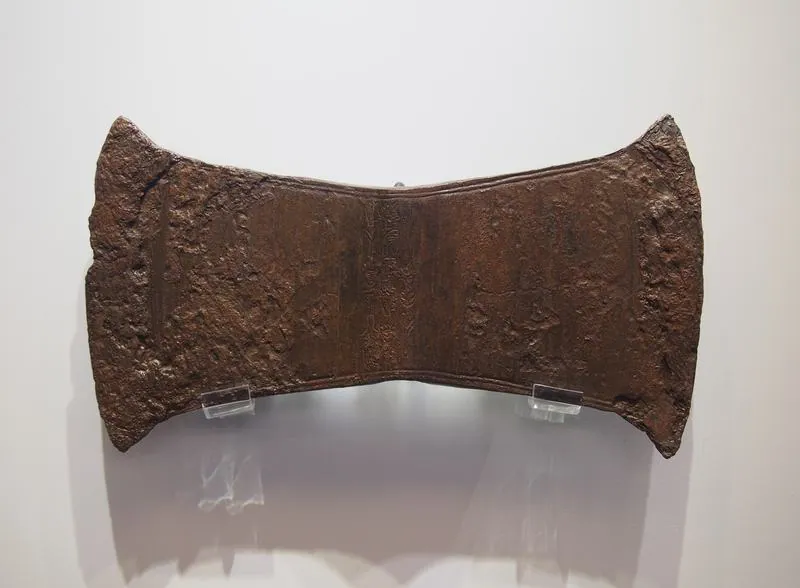
The Phaistos Disc is a flat, roughly circular piece of fired clay about 16 cm across, inscribed on both faces with signs arranged in a spiral running from the rim inward. The signs were not drawn but stamped with individual punches, 45 of them, pressed into the wet clay; short incised lines divide the 242 impressions into 61 groups that are usually taken to be words[1][2]. Many of the signs are pictorial: a plumed head, a walking man, a captive, a fish, a bee, a boat, a shield. It is the only text in this script, and its nearest relatives are a handful of signs on the bronze Arkalochori axe and a few impressed marks on Phaistos pottery[3][2].
Luigi Pernier's Italian mission found the disc on 3 July 1908 in room 101 of the complex north-east of the palace, in a destruction deposit that had been disturbed in Hellenistic times, alongside a Linear A tablet. Pottery from the same fill is now dated to the start of Middle Minoan IIIA, around 1750 BC[2]. Evans published photographs and a sign list in Scripta Minoa in 1909 and the disc has been in the Heraklion museum since[4][1].
Two questions have dominated the century since. The first is what the text says. Proposals have read it as a Luwian letter, as early Greek, as a Minoan hymn pronounced with Linear A values, and as many other things; none reads all 61 groups consistently in a way others can check, and the text is far too short for internal statistics to pick a language[5][3][1][6]. The second, raised sharply by Jerome Eisenberg in 2008, is whether the disc is genuine. The archaeological reply is that signs on the disc match impressed marks and a sealing from Phaistos excavated decades after 1908, which a forger could not have copied; the museum has not permitted a thermoluminescence test[7][8][9][2]. Of the 4 questions on this site, 1 are answered. The most likely answer to “Is the Phaistos Disc a genuine Middle Minoan object?”, not yet confirmed: the disc is a Minoan object of about 1750 BC found where Pernier said he found it.
Key questionsset by the editors
The object
The disc is fired clay, slightly irregular in outline, about 16 cm across and about 1 to 2 cm thick. Each face carries a spiral of stamped signs read, by most scholars, from the rim toward the centre, following the way the sign groups are packed and the direction the figures face[3][4]. Side A has 31 groups and side B 30, together 61; the impressions number 241 or 242 depending on whether an erased and restamped sign is counted[1][2]. The 45 distinct signs were cut once each into hard punches and pressed repeatedly, which makes the disc the earliest known use of movable type; several impressions show the maker correcting a sign by smoothing the clay and restamping[4]. Some groups end with an oblique stroke under the last sign, which has been read as a suffix marker, a punctuation mark or a word-class indicator; no account of it is agreed[3]. The sign set was encoded in Unicode in 2008 as the Phaistos Disc block[10].
The find context is better documented than is often said. Giorgia Baldacci's 2021 review summarises Pernier's notes and Pietro Militello's re-examination of the deposit in 2013 and 2015: the disc lay in a destruction level of room 101, disturbed later, with pottery of the start of Middle Minoan IIIA, so around 1750 BC, with the last Protopalatial phase not excluded[2]. The only close parallels for the signs are the Arkalochori axe, a bronze votive axe from a cave in central Crete bearing a short inscription in similar pictorial signs, and a small number of relief potmarks and a sealing from Phaistos[3][2].
Timeline
What is known
The script is probably syllabic. Forty-five signs is too many for an alphabet and too few for a logographic system, and the word lengths, two to seven signs, fit a syllabary[1][3]. Because the text is short, the true size of the sign inventory is unknown; estimates from the frequency distribution put the full "font" at around 60 signs, so some signs the language needed never appear on the disc[3]. The direction of reading, rim to centre, is accepted by most but not all[3].
The best-supported claim about the language is Brent Davis's 2018 finding that the disc and Linear A treat shared sign shapes in a statistically similar way, which he takes to show that the disc records the Minoan language of Linear A[6]. Yves Duhoux, reviewing the Greek decipherment attempts, reached the same view on different grounds: the find context, the Arkalochori parallel and the sign repertoire all point to Crete and to the Linear A world rather than abroad[3]. If so, the disc is a second script for an undeciphered language, which adds little to the material but rules out readings in languages Linear A cannot be.
What has been tested
Decipherments. Duhoux's 2000 review set out the checks a reading must pass: it must use an accurate text, read in the right direction, choose a plausible script type, and not inflate the sign count to make room for a syllabary the disc does not show. Faucounau's proto-Ionian Greek reading failed these, with an estimated 88 to 95 signs against about 60, a misstated find context and internal inconsistencies[3]. The Luwian reading of Achterberg and colleagues (2004), which makes the disc a letter to a king Nestor, depends on reading the signs as Luwian hieroglyphs of a much later period and has not been taken up by Anatolian specialists[5]. Gareth Owens and John Coleman's reading, announced in 2014 and restated in 2018 as covering 99 per cent of the text, assigns Linear A and Linear B values to look-alike signs and reads the result as a hymn to a mother goddess; it rests on the assumption that the look-alikes share values and has not been published in a form others have confirmed[1].
Authenticity. Eisenberg argued in Minerva in 2008 that the disc is a forgery planted by Pernier, perhaps with the restorer Émile Gilliéron, pointing to its uniqueness, its stamped rather than incised signs, and signs he saw as borrowed from Egyptian, Hittite and Lycian art of other periods; he and others called for a thermoluminescence test, which the Greek authorities have not allowed[7][11]. Hnila's 2009 reply examined Pernier's record, the find circumstances and the signs, and found the evidence favoured authenticity, chiefly because sign 21 recurs on a sealing from Phaistos found in a secure context in 1955[8]. La Rosa, from Pernier's excavation daybooks, argued that the timing and the people involved exclude a plant[9]. Baldacci added that six disc signs have parallels in impressed fine ware from Phaistos excavated between 1950 and 1966[2]. No physical dating of the clay has been done.
The readings
On the language, four positions are live: Minoan, the same language as Linear A, supported by the sign statistics and the context[6][3]; Luwian or another Anatolian language, carried to Crete or written there, supported only by sign-shape comparisons[5]; Greek, in various early forms, supported by selected readings and weighed against by the context[3]; and something else or unknowable from one text. On the object, two: genuine, a Middle Minoan document with no surviving relatives except the Arkalochori axe and a few potmarks[8][2]; or a modern forgery, which now requires that a forger in 1908 anticipated signs excavated at Phaistos between 1950 and 1966[7][2]. The hoax hypothesis has lost ground but has not been closed by a physical test.
Published claims
| Year | Who | Claimed | Status | Reason |
|---|---|---|---|---|
| 1909 | Arthur Evans[4] | The disc is not Minoan work, since its signs, figures and ship differ from every Cretan script and design, and it came from outside Crete. | Disputed | Signs matching the disc's have since been excavated at Phaistos on a sealing and on local pottery, which favour a Cretan origin[2][8] |
| 1999 | Jean Faucounau[12] | The disc is written in a proto-Ionian form of Greek, read from the centre outwards. | Disputed | The reading needs 88 to 95 signs where about 60 are expected, misstates the find context and is internally inconsistent[3] |
| 2000 | Yves Duhoux[3] | No published decipherment of the disc meets the basic checks, and one 241-sign text may be too short to identify its language at all. | Accepted | No reading published since has passed the checks he set out or been accepted by specialists[6] |
| 2004 | Winfried Achterberg, Jan Best and colleagues[5] | The disc is a letter in Luwian addressed to a king Nestor, readable through Luwian hieroglyphs. | Disputed | Its comparisons are with much later Anatolian signs, and neither Anatolian nor Aegean specialists have adopted it[3] |
| 2008 | Jerome Eisenberg[7] | The disc is a forgery made around 1908 and planted at Phaistos by Pernier or with his knowledge. | Disputed | Sign 21 and other signs recur on material excavated at Phaistos after 1950, which no forger of 1908 could have known, though the thermoluminescence test he called for has not been allowed[8][2][11] |
| 2009 | Pavol Hnila[8] | The evidence favours the disc's authenticity, above all because sign 21 recurs on a sealing excavated at Phaistos in 1955. | Accepted | Further sign parallels in Phaistian pottery and the re-examined excavation record point the same way[2] |
| 2009 | Vincenzo La Rosa[9] | Pernier's excavation daybooks and the conduct of the 1908 season rule out a planted forgery. | Accepted | Later re-examination of Pernier's record agrees with it[2] |
| 2014 | Gareth Owens and John Coleman[1] | Read with Linear A and B values for look-alike signs, the disc is a hymn to a Minoan mother goddess, about 99 per cent understood. | Disputed | It has been reported in the press but has no refereed edition that others have checked, and shared sign shapes need not share values[1][6] |
| 2018 | Brent Davis[6] | The disc and Linear A treat their shared sign shapes alike, so both most likely record the same Minoan language. | Still possible | The method is sound, but the disc's 241 impressions make any statistical result fragile[6] |
| 2021 | Giorgia Baldacci[2] | The disc is a genuine Phaistian object of about 1750 BC from a sealed deposit in room 101, with parallels in local potmarks and sealings. | Accepted | The pottery of the deposit dates it, and the sign parallels came from excavations decades after the find[2][8] |
What would settle it
A thermoluminescence date on the fired clay would settle authenticity either way; the museum has declined to allow sampling[11]. A second text in the same script, from a controlled excavation, would both confirm authenticity and double the material. On the language, the only realistic routes are a decipherment of Linear A, if Davis is right that the two share a language, or a longer disc-script text[6]. Any new reading should be judged by Duhoux's checks and should publish its sign values and its treatment of all 61 groups so that others can test it[3].
Questions
1 of 4 questions are answered.
Evidence 19 findings
Artifacts
The films, photos, papers and objects this mystery rests on, each with its own key and its distance from the original.
See also
References
- 1.National Documentation Centre (EKT), G. 2018. The secrets of the Phaistos Disc. ekt.gr news.cited 7 times hereSRC0D1GFZBR32RW
- 2.Baldacci, G. 2021. The Phaistos Disk: An Enigmatic Artifact in its Cultural Context. The Ancient Near East Today (ASOR), vol. 9.11.cited 13 times hereSRC0D1GFZ3Y0Q5E
- 3.Duhoux, Y. 2000. How Not to Decipher the Phaistos Disc: A Review Article. American Journal of Archaeology.doicited 17 times hereSRC0D1GFZKJ0DQG
- 4.Evans, A. 1909. Scripta Minoa: The Written Documents of Minoan Crete, Volume I. Clarendon Press, Oxford.cited 8 times hereSRC0D1GFYW45VW4
- 5.Achterberg, W., Best, J., Enzler, K. et al. 2004. The Phaistos Disc: A Luwian Letter to Nestor. Publications of the Henri Frankfort Foundation 13, Dutch Archaeological and Historical Society, Amsterdam.doicited 4 times hereSRC0D1GG036293G
- 6.Davis, B. 2018. The Phaistos Disk: A New Way of Viewing the Language Behind the Script. Oxford Journal of Archaeology.doicited 14 times hereSRC0CQHJYJE4TNT
- 7.Eisenberg, J. 2008. The Phaistos Disk: A One Hundred-Year-Old Hoax?. Minerva.cited 6 times hereSRC0D1GG0JT7VVV
- 8.Hnila, P. 2009. Notes on the Authenticity of the Phaistos Disk. Anodos. Studies of the Ancient World 9.cited 5 times hereSRC0D1GG12E2VVK
- 9.La Rosa, V. 2009. Il disco di Festòs: un centenario autentico!. Creta Antica.cited 2 times hereSRC0D1GG1A87CD3
- 10.Unicode Consortium n.d.. Phaistos Disc, Range 101D0–101FF (The Unicode Standard code chart). unicode.org.cited 2 times hereSRC0D1GG1J240PF
- 11.Eisenberg, J. 2008. The Phaistos Disk: A 100-Year-Old Hoax? Addenda, Corrigenda, and Comments. Minerva.cited 2 times hereSRC0D1GG0TM3MEE
- 12.Faucounau, J. 1999. Le déchiffrement du disque de Phaistos: preuves et conséquences. L'Harmattan, Paris.cited 3 times hereSRC0D1GFZVC52KE