The Cascajal block and Isthmian writing
In April 1999 the authorities of Jáltipan, Veracruz, asked Mexico's National Institute of Anthropology and History (INAH) to look at objects turned up in a gravel quarry. The quarry was cutting into the mounds of a site since named El Cascajal, within sight of the Olmec centre of San Lorenzo, and among the sherds, figurine pieces and ground stone in the debris was a slab of serpentine with incised signs on one face[1]. Seven scholars published it in Science in 2006 as the oldest writing in the New World: 62 signs, about 28 of them distinct, arranged in sequences that repeat, dated by the associated pottery to the San Lorenzo phase, about 900 BC[2].
The block has stayed contested on three counts. It has no stratigraphic context, so its date depends on which sherds in the debris it belongs with; it is unique, since no other Olmec text of any length exists; and its layout is unlike any later Mesoamerican script. Bruhns and Kelker raised all three in 2007 and suggested a hoax was possible; the authors replied the same year[3]. Since then the work has gone two ways. Englehardt and colleagues examined the stone with imaging, X-ray fluorescence and microscopy and found Olmec material and ancient workmanship[4]. Mora-Marín has re-drawn the text, proposed that it should be turned and read in columns, and argued that its sign co-occurrences look like spelling in a logosyllabic script[5][6].
The nearest readable relative would be the Isthmian or Epi-Olmec script of the same region a millennium later, on La Mojarra Stela 1, the Tuxtla Statuette and a few other objects. Justeson and Kaufman published a decipherment in 1993 as an early Zoquean language; Houston and Coe applied it to a newly known text in 2003 and found it failed. Neither script is agreed to be read[7][8][9]. Of the 6 questions on this site, 0 are answered. The most likely answer to “Has Isthmian (Epi-Olmec) writing been deciphered?”, not yet confirmed: the decipherment is unproven or wrong; the corpus is too small to confirm it.
Key questionsset by the editors
The object
The block is a slab of serpentinite about 36 by 21 by 13 cm, weighing about 11.5 kg. Five sides are slightly convex; the sixth was smoothed flat and carries the signs, cut with a blunt blade for outlines and a sharper one for interior detail[10][1]. The 2006 paper numbered 62 signs and grouped them into about 28 distinct forms, some appearing up to four times; many resemble Olmec motifs (maize, pineapple, insects, a fish, a bundle)[2][1]. Mora-Marín's 2020 drawing, made from Carrasco and Englehardt's documentation, is the current reference copy; Englehardt's group also re-imaged the surface with polynomial texture mapping[6][4].
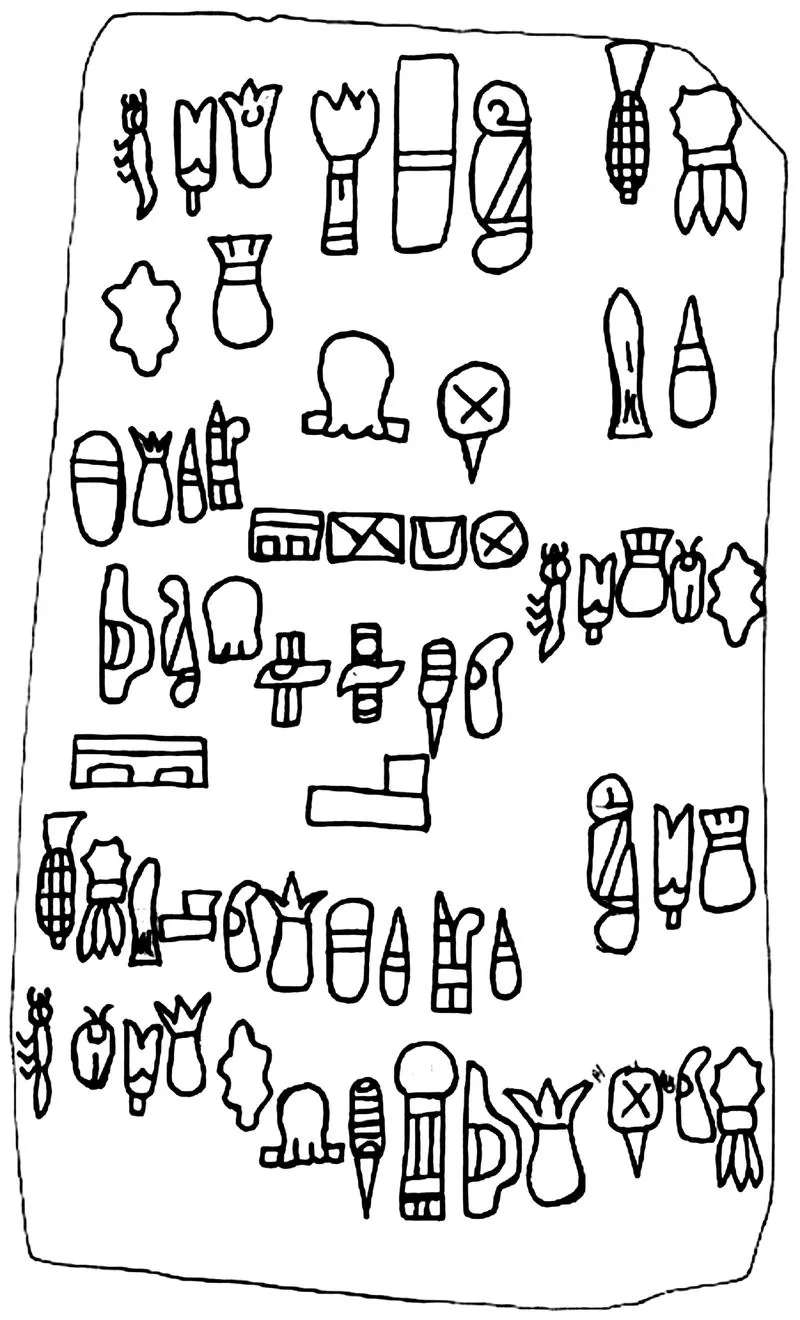
No open dataset exists. The sign numbering and drawings are in the Science paper and its supplement, the 2020 drawing and distributional tables in the Ancient Mesoamerica supplements, and photographs on FAMSI and Mesoweb without stated reuse terms[2][6][11][1]. The custody and display of the block were not established in this research.
Timeline
What is known
The find is documented only as debris. About three quarters of the material collected with the block is Formative, nearly all of the San Lorenzo phase (uncalibrated 1200 to 900 BC) with a few Palangana sherds, and a quarter Terminal Classic; the authors placed the block late in San Lorenzo B, about 900 BC, also on the grounds that its motifs are Olmec and cannot be Classic[1][2].
The stone and its working have been examined. Weathering, pitting over the incisions and mineralisation in the lines were reported in 2006 and confirmed by INAH's geological laboratory[1]. The 2020 study added X-ray fluorescence matching the serpentinite to a source at Tehuitzingo, Puebla, used for Olmec stone, and electron microscopy showing incision with obsidian and abrasion with sandstone[4].
The text's structure is partly described. Signs and short sequences repeat, some in pairs; Carrasco and Englehardt identified paired signs as possible diphrastic kennings of the kind known in later Mesoamerican texts, and Mora-Marín found a further repeated pair (PELT-PAW)[6]. The reading order is disputed: horizontal rows in 2006, columns after a 90-degree turn in 2009[2][5].
What has been tested
Authenticity has been tested more than anything else. Against the 2007 objections, the 2020 imaging and archaeometry found Olmec-source stone and ancient tool marks and patina, which makes a modern forgery on fresh stone unlikely; it does not test whether old stone was incised later[4][3]. The date has not been tested independently, because no organic material is associated with the block and the debris is mixed[1].
Whether the signs are writing has been tested by distribution. The 2006 authors argued from repetition and sequencing; Mora-Marín tested the proposed inventory against co-occurrence and argued that the irregularities others had noticed fit logosyllabic spelling[2][6]. These are analyses of a single text of 62 signs, which limits what any statistic can show.
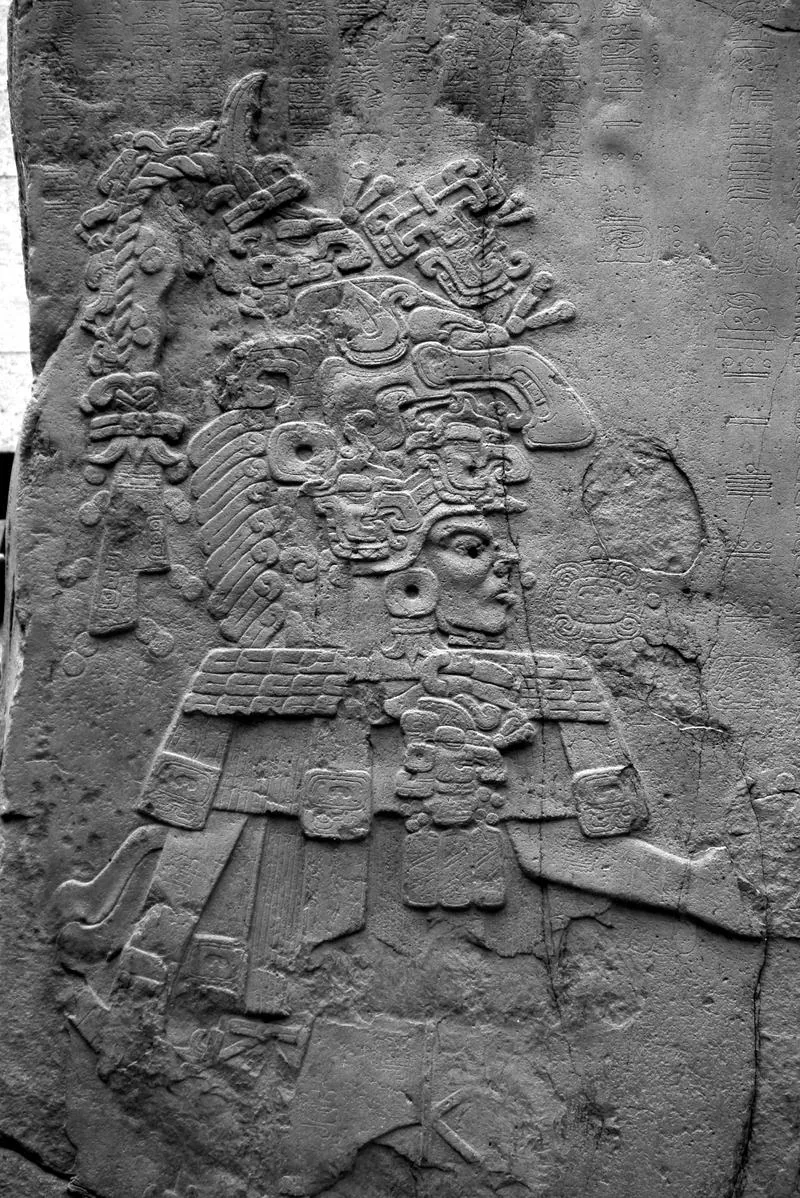
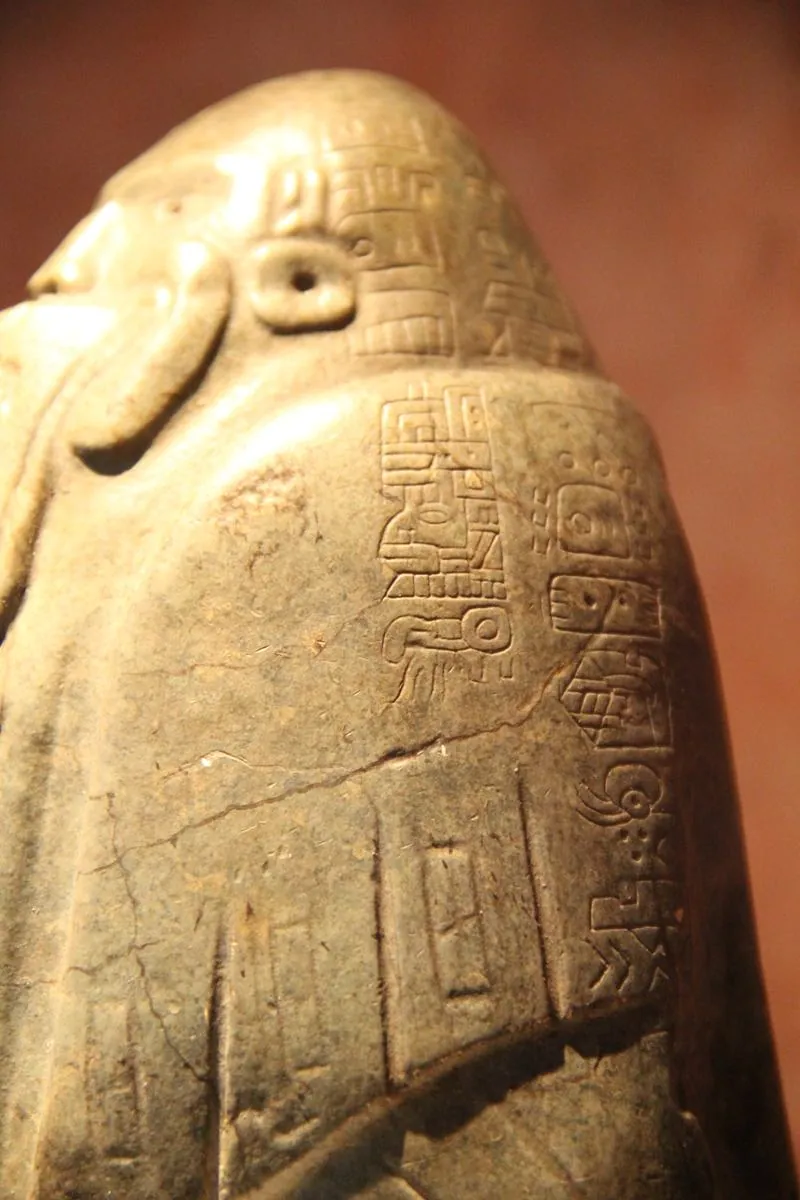
The Isthmian decipherment has had one formal test each way. Justeson and Kaufman reported in 1997 that a column on La Mojarra Stela 1 noticed in 1995, after their decipherment, read readily with their values[12]. Houston and Coe applied the same values to the back of a Teotihuacan-style mask of unknown provenance, with about 101 glyphs, 25 of them new, and could not obtain a reading[8][13].
The readings
Four positions on the Cascajal block are in print. It is writing, the earliest in Mesoamerica, possibly logosyllabic and possibly ancestral to later Isthmian writing[2][6][14]. It is a ritual text whose signs belong to an Olmec vocabulary, an initiation rite on Magni's reading[15]. It is not writing but an arrangement of sacred objects drawn in Olmec iconography[16]. Or it is undatable and possibly a hoax, the view Bruhns and Kelker raised, with doubts also voiced by Grove and Pool[3][10].
On Isthmian, Justeson and Kaufman read La Mojarra Stela 1 as the record of a ruler's accession, wars and rituals in an early Zoquean language; Houston and Coe, and Robinson in a later survey, regard the decipherment as unproven; Vonk has argued that the corpus is too small for any unique decipherment[7][8][9][17].
Published claims
| Year | Who | Claimed | Status | Reason |
|---|---|---|---|---|
| 1993 | John Justeson and Terrence Kaufman[7] | Epi-Olmec writing records an early Zoquean language, and La Mojarra Stela 1 tells of a ruler's accession, wars and rituals. | Disputed | Houston and Coe applied the values to a new text and could not obtain a reading, and the field holds the decipherment unproven[8][9] |
| 1997 | John Justeson and Terrence Kaufman[12] | A column on La Mojarra Stela 1 first noticed in 1995 reads readily with the 1993 values, which confirms the decipherment. | Disputed | The test was run by the decipherers themselves, and the next independent test, on the Teotihuacan-style mask, failed[8] |
| 2003 | Stephen Houston and Michael Coe[8] | Applied to the Teotihuacan-style mask, the Justeson and Kaufman values give no reading, so Isthmian writing has not been deciphered. | Accepted | Later surveys take the same position, that the corpus is too small to confirm the decipherment[9] |
| 2006 | María del Carmen Rodríguez Martínez, Ponciano Ortíz Ceballos and colleagues[2] | The Cascajal block carries writing, with repeated signs and sequences, and is the oldest known in the New World. | Still possible | The sign distribution is suggestive, but with a single text of 62 signs there is nothing to test a script against[6][3] |
| 2006 | María del Carmen Rodríguez Martínez, Ponciano Ortíz Ceballos and colleagues[2] | The block belongs with the San Lorenzo phase sherds in the quarry debris and dates to about 900 BC. | Still possible | The debris was mixed and included later sherds, and the date has not been tested independently[1] |
| 2007 | Karen Bruhns and Nancy Kelker[3] | The block cannot be dated from bulldozer debris, its signs do not behave like a script, and a hoax cannot be excluded. | Disputed | The 2020 study found Olmec-source stone and ancient tool marks under the patina, though it could not test whether old stone was incised later[4] |
| 2008 | Caterina Magni[15] | The block is a religious text, the record of an initiation rite, written in an Olmec glyph vocabulary. | Still possible | No one has tested the reading, and it depends on the block being writing, which is itself unsettled[10] |
| 2009 | David Mora-Marín[5] | The block should be turned 90 degrees and read in columns, not rows. | Still possible | Mora-Marín's later analyses build on the column order, but no one has tested it against the row order with shuffled controls[6] |
| 2010 | David Freidel and F. Kent Reilly[16] | The signs are not a script but a ritual arrangement of sacred objects drawn in Olmec iconography. | Still possible | Many signs do match Olmec motifs, but that fits both readings, and one text cannot decide between them[14] |
| 2020 | Joshua Englehardt and colleagues[4] | The block is serpentinite from Tehuitzingo, a source the Olmec used, incised with obsidian and abraded with sandstone in antiquity. | Accepted | It agrees with INAH's earlier geological report of weathering and mineralisation in the incisions[1] |
| 2020 | David Mora-Marín[6] | The co-occurrence of signs on the block, including its irregularities, fits spelling in a logosyllabic script. | Still possible | The analysis rests on a single short text and has not been run against shuffled or non-linguistic controls[6] |
| 2024 | David Mora-Marín[14] | The Cascajal signs match Olmec motifs and are consistent with the later Epi-Olmec signary. | Still possible | These are research notes, not peer reviewed, and about a thousand years with almost no texts separate the two scripts[9] |
The Isthmian script
Isthmian texts come from southern Veracruz and Chiapas; the oldest is a sherd of 450 to 300 BC and the longest dates to the second century AD. La Mojarra Stela 1, a four-ton limestone stela pulled from the Acula River in 1986 and now in the Museo de Antropología de Xalapa, carries about 535 glyphs and Long Count dates of AD 143 and 156; the Tuxtla Statuette, a nephrite figure found near Tres Zapotes in 1902 and held by the Smithsonian, has a possible date of AD 162[17][18]. The rest of the corpus is short: Tres Zapotes Stela C, a few glyphs at Cerro de las Mesas, the O'Boyle mask, the Teotihuacan-style mask, and a sherd from Chiapa de Corzo of 450 to 300 BC[9]. Kaufman and Justeson's working papers are archived at AILLA, some open and some restricted[19].
What would settle it
For the block, a second inscribed Olmec object from a dated, excavated context would answer the uniqueness objection and anchor the date; residue or microstratigraphic analysis inside the incisions could test whether the cutting is as old as the patina[4][3]. For both scripts, a machine-readable sign-by-sign transcription of every text in one numbering would allow the repeated-pair and co-occurrence claims to be tested against shuffled controls[6]. For Isthmian, a new substantial text read with the 1993 values fixed in advance, by someone other than the decipherers, would decide it[12][8].
Questions
0 of 6 questions are answered.
Evidence 20 findings
Artifacts
The films, photos, papers and objects this mystery rests on, each with its own key and its distance from the original.
See also
References
- 1.Skidmore, J. 2006. The Cascajal Block: The Earliest Precolumbian Writing. Mesoweb Reports, Precolumbia Mesoweb Press.cited 10 times hereSRC0CYBBJDM1BJG
- 2.Rodríguez Martínez, M., Ortíz Ceballos, P., Coe, M. et al. 2006. Oldest Writing in the New World. Science 313(5793), pp. 1610 to 1614.doicited 13 times hereSRC0CYBBJ5T0KBD
- 3.Bruhns, K., Kelker, N. 2007. Did the Olmec Know How to Write?. Science 315(5817), pp. 1365 to 1366 (letter, with the authors' reply).doicited 9 times hereSRC0CYBBJNE430Z
- 4.Englehardt, J., Insaurralde Caballero, M., Melgar Tísoc, E. et al. 2020. Digital Imaging and Archaeometric Analysis of the Cascajal Block: Establishing Context and Authenticity for the Earliest Known Olmec Text. Ancient Mesoamerica 31(2), pp. 189 to 209.doicited 8 times hereSRC0CYBBKCW2VEJ
- 5.Mora-Marín, D. 2009. Early Olmec Writing: Reading Format and Reading Order. Latin American Antiquity 20(3), pp. 395 to 412.doicited 4 times hereSRC0CYBBJX86XAQ
- 6.Mora-Marín, D. 2020. The Cascajal Block: New Line Drawing, Distributional Analysis, and Orthographic Patterns. Ancient Mesoamerica 31(2), pp. 210 to 229.doicited 4 times hereSRC0CYBBK523QRA
- 7.Justeson, J., Kaufman, T. 1993. A Decipherment of Epi-Olmec Hieroglyphic Writing. Science 259(5102), pp. 1703 to 1711.doicited 6 times hereSRC0CYBBMKY1WQF
- 8.Houston, S., Coe, M. 2003. Has Isthmian Writing Been Deciphered?. Mexicon 25(6), pp. 151 to 161.cited 7 times hereSRC0CYBBN3J413Z
- 9.Wikipedia contributors n.d.. Isthmian script. Wikipedia.cited 3 times hereSRC0CYBBNK62YR9
- 10.Wikipedia contributors n.d.. Cascajal Block. Wikipedia.cited 2 times hereSRC0CYBBKWG7GE5
- 11.Foundation for the Advancement of Mesoamerican Studies n.d.. Cascajal Block (FAMSI Maya writing pages). famsi.org.cited 1 time hereSRC0CYBBPJE7WJH
- 12.Justeson, J., Kaufman, T. 1997. A Newly Discovered Column in the Hieroglyphic Text on La Mojarra Stela 1: A Test of the Epi-Olmec Decipherment. Science 277(5323), pp. 207 to 210.doicited 2 times hereSRC0CYBBMVR5839
- 13.Mesoweb 2004. Ancient Mask Adds to Corpus of Isthmian Script. mesoweb.com.cited 3 times hereSRC0CYBBNBC71F2
- 14.Mora-Marín, D. 2024. The Cascajal Block: Iconographic Motivations, Part 3 (Note 36). davidmm.web.unc.edu (research notes).cited 6 times hereSRC0CYBBKMP6M8H
- 15.Magni, C. 2008. Olmec Writing. The Cascajal Block: New Perspectives. Arts and Cultures 9 (Barbier-Mueller Museum), pp. 64 to 81.cited 1 time hereSRC0CYBBM4A6J50
- 16.Freidel, D., Reilly, F. 2010. The Flesh of God. Staller and Carrasco (eds), Pre-Columbian Foodways, Springer, pp. 635 to 680.doicited 3 times hereSRC0CYBBMC43AFC
- 17.Wikipedia contributors n.d.. La Mojarra Stela 1. Wikipedia.cited 4 times hereSRC0CYBBNV00MQ9
- 18.Wikipedia contributors n.d.. Tuxtla Statuette. Wikipedia.cited 3 times hereSRC0CYBBP2T1QP1
- 19.Kaufman, T., Justeson, J. n.d.. Epigraphy Collection of Terrence Kaufman and John Justeson. Archive of the Indigenous Languages of Latin America (AILLA), University of Texas.cited 2 times hereSRC0CYBBPAM0N5Z