The White Shaman Mural
On the back wall of a shallow rock shelter above the Pecos River, a few kilometres upstream of its meeting with the Rio Grande in Val Verde County, Texas, hunter-gatherers painted a mural about 26 feet long and 13 feet high in black, red, yellow and white[1][2]. It belongs to the Pecos River style, the oldest and most elaborate of the Lower Pecos rock art styles, whose tall human-like figures carry headdresses, spear-throwers, darts and "power bundles" among deer, cats, serpents and shapes no one can name[3][4]. The panel takes its name from its pale central figure. The site, 41VV124, has belonged to the Witte Museum of San Antonio since 2017[5][6].
For much of the twentieth century Pecos River figures were read as shamans and the panels as records of trance, possibly with peyote, which grows in the region and was used there early[7][3][8]. Carolyn Boyd, who first saw the shelter in 1989, made a different case. Microscopy of overlapping paint showed that the mural was laid out as one composition and painted in a fixed order of colours, and in a 2016 book she read it figure by figure as a narrative of the birth of the sun and the beginning of time, close in detail to Huichol (Wixárika) and Nahua myth[9][1]. Huichol religious specialists shown the mural gave readings that she and her colleagues take as confirmation[8][10].
Two things are unsettled: the mural's age, and how far the analogy can reach. Four paint dates published in 2004, between about 1,500 and 2,400 radiocarbon years, were later judged unusable by the laboratory that now dates Lower Pecos paint, and the 2025 study that dated twelve other murals, placing the style between about 5,700 and 1,000 years ago, did not sample this one[11][4]. Scholars who find Boyd's reading compelling still ask how myths recorded in historic Mexico can be read into a painting thousands of years older and hundreds of kilometres away, in a style that looks like nothing in Mesoamerica[12][9]. Of the 4 questions on this site, 0 are answered.
Key questionsset by the editors
The object
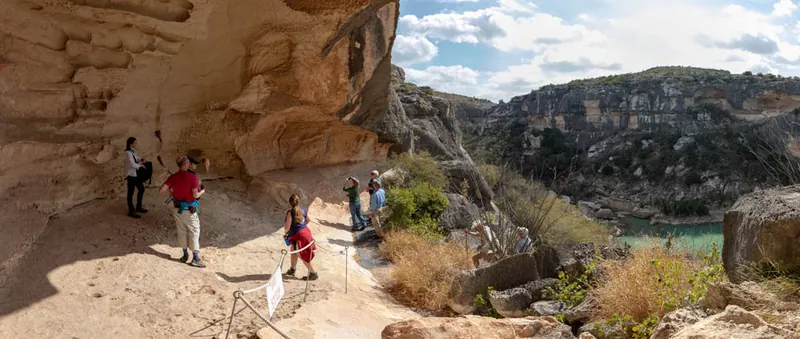
The mural covers about 26 by 13 feet (about 8 by 4 m) of the back wall of a shelter some 65 feet across and 26 feet deep, under an overhang high above the Pecos[1][5][8]. The shelter floor has bedrock mortars and grinding facets, with pigment residue in some of them, but almost no midden, and the walls also carry paintings in the later Red Linear style[8]. The exact position is withheld, as is usual for rock art sites; the museum describes the preserve as lying on the Pecos two miles west of Seminole Canyon State Park[2].
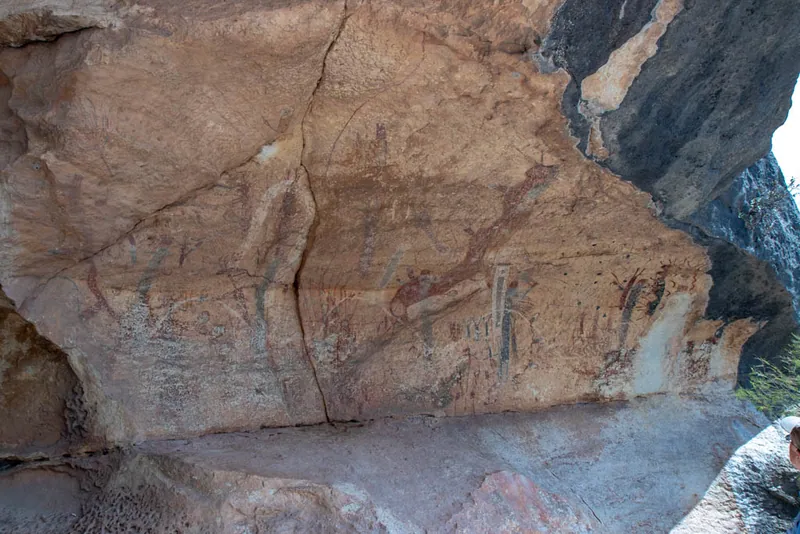
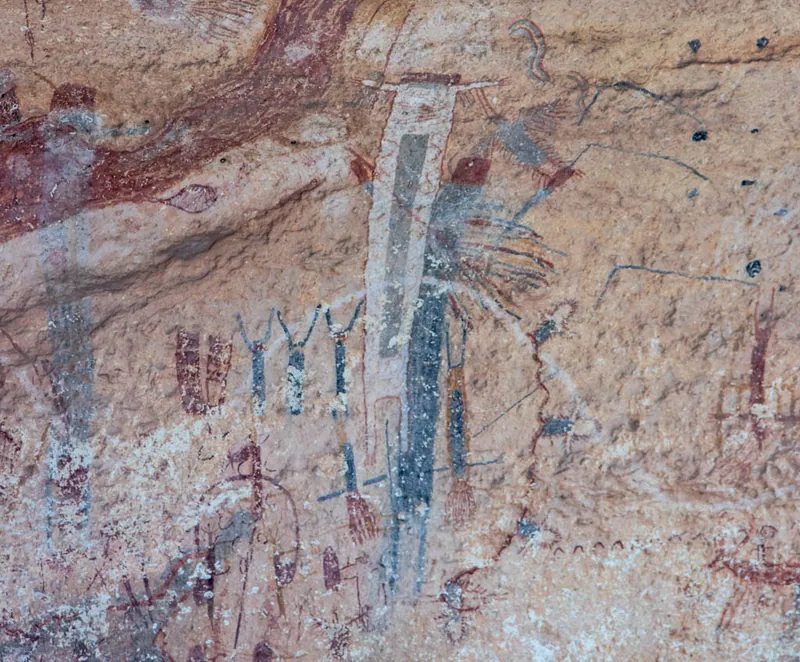
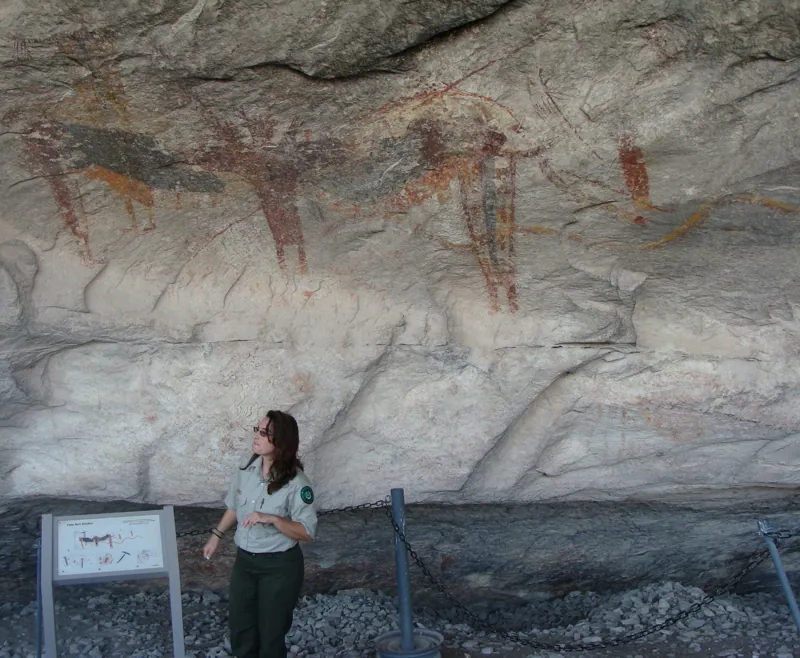
The panel is crowded with figures. Five nearly identical human-like figures, black from the neck down with red heads and holding black objects tipped with red, are spaced across it. Among the others are a pale headless figure, a half-serpent, half-catfish about six feet long, a red antlered deer, a deer beside a water seep, an arch, a red figure in a boat, an upside-down figure, a black and red band with nine bulges, a caterpillar-like figure and a long wavy white line[8][9].
The mural has been recorded at high resolution but not openly published. Bob Mark and Evelyn Billo made a GigaPan panorama of it in 2009, which Boyd used as the base of her digital drawing, and in one day in 2012 her team took 656 microscope images at 42 points and 1,635 close-up photographs[13][5]. Shumla's Alexandria Project recorded 233 sites of the region in 2017 to 2020 with GigaPans, GPS positions and photogrammetry for 3D models[14]. None of that documentation carries a free licence; the photographs on this page were taken by a visitor on a guided tour in 2019 and shared under CC BY.
Timeline
What is known
The painters were foragers. The Lower Pecos Canyonlands, about 8,000 square kilometres of limestone cut by the Pecos, the Devils River and the Rio Grande, hold more than 12,500 years of hunter-gatherer occupation, with diets of baked agave and sotol, prickly pear, small game and fish, and a large industry in plant fibre[4]. Pecos River murals cover the walls of at least 150 shelters north of the Rio Grande; the largest run to 150 m long and 15 m high and needed ladders or scaffolding[4].
The paints are mineral. Studies of Pecos River paint have identified iron minerals (hematite, goethite and others) in the reds, oranges and yellows and manganese minerals in the blacks, with limonite siltstones from canyon floors the likely source; the white has not been characterised[4]. The binder is less certain. An early DNA result pointing to deer or bison could not be repeated, a search for fatty acids found none unique to the paint, and carbon isotope values fit a mix of bone marrow and yucca without proving it[4][15]. Organic carbon is present in the paint and absent from the unpainted rock, which is what makes the paint datable[4].
The mural was painted as one design. Under the microscope black was laid down first, then red, yellow and white, with figures interwoven so that one lies both over and under another[5][1]. The 2025 study found the same order at 525 of 535 points in eight other murals, says its results agree with Boyd and Cox's analysis of this one, and found the dates within each mural statistically indistinguishable, which points to single painting events[4]. The same study models the start of Pecos River painting at 5760 to 5385 cal BP and its probable end at 1370 to 1035 cal BP, about 175 generations of painters[4][16].
What has been tested
The paint sequence is the best-tested claim. It rests on microscope images of the points where figures overlap, and the same rule has since been found across eight other murals[5][4].
The date has been tested and has not held. Marvin Rowe's laboratory at Texas A&M developed a way to burn off only the organic carbon in rock paint with an oxygen plasma, dating a Pecos River painting for the first time in 1990[17]. Rowe published four dates for the White Shaman mural in 2004, from four upside-down figures: 1970, 1460, 1960 and 2420 radiocarbon years BP. He treated them as provisional, and the 2021 Landmark nomination accepted them as Late Archaic[11][8]. The same year Steelman, Boyd and Bates reviewed all 32 of the laboratory's Lower Pecos dates and found every one problematic, for want of documented sampling points, base pretreatment or controls on unpainted rock; they did not calibrate them and advised against drawing conclusions from them[11]. The four White Shaman results also spread over nearly a thousand radiocarbon years for a painting made at one time.
The 2025 campaign used the improved protocol: documented sampling points, base washes, 52 control samples of bare rock with negligible carbon, and dated oxalate crusts above and below the paint that came out in the right order[4]. It dated twelve murals. White Shaman was not among them, so no reliable date for this mural has been published.
Boyd's reading has not been tested in the same way. Its support comes from the fit of figure and myth, and from Huichol religious specialists: a mara'akame who visited in 2010 read the red and black crenellated band as the ocean, which Boyd connects with the Huichol serpent that circles the world and the entrance to the underworld, and shamans later shown printouts named the central figure Kauyumari[8][10]. Those consultations were arranged by the researchers whose reading they support and were not blind.
The readings
The shamanic reading came first. Newcomb sorted the Lower Pecos paintings into four styles, of which the Pecos River style is the oldest and most complex, and many Pecos River paintings came to be seen as expressions of shamanistic ritual[18][3]. Turpin attributed the large figures to shamans and linked the murals to trance with hallucinogens such as peyote; Boyd's early papers read a recurring motif of figures passing through a serpent arch as the shaman's journey to the spirit world and set the art beside hallucinogenic plants found in the shelters[7][19][20].
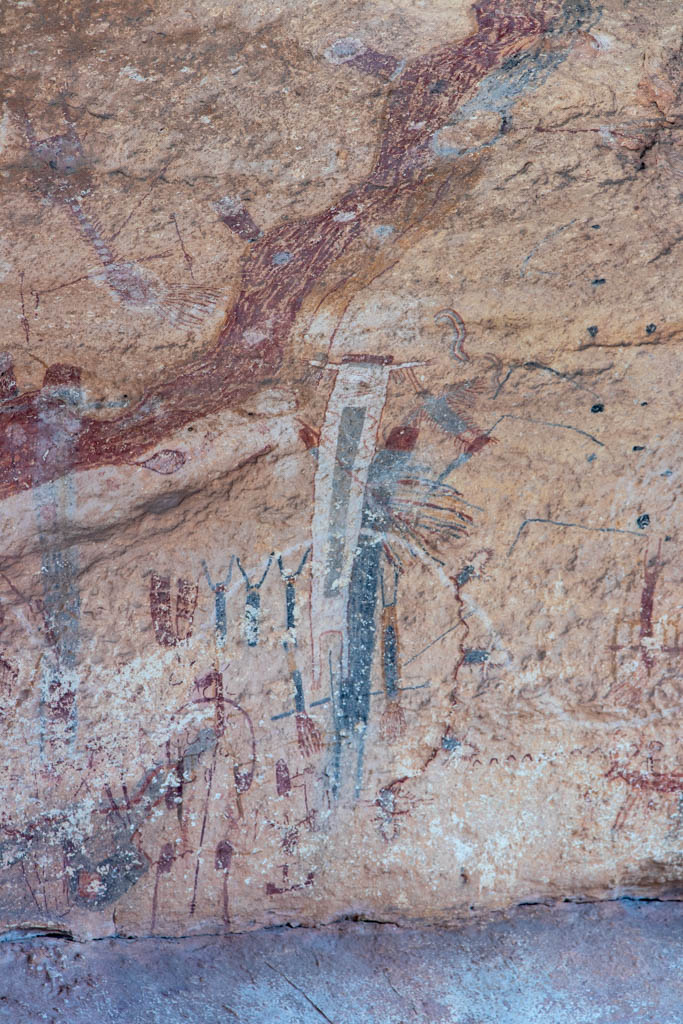
Boyd's 2016 reading keeps the ritual but makes the panel a story. Using Huichol accounts of the peyote pilgrimage and Nahua creation myths, she reads the five black figures as primordial ancestors of the five directions, the headless pale figure as a decapitated moon goddess, the serpent-catfish as an earth goddess, the arch as Dawn Mountain where the sun was born and the wavy white line as the sun's path[1][9][8]. She argues that the panel was meant, like the later Mexican painted books, to pass knowledge to later generations[8].
The wider claim is continuity. Boyd and Cox, and the 2025 dating study, propose that Pecos River murals are the oldest surviving expression of a core of belief that later shaped Aztec and Huichol religion, the hard core López Austin described for Mesoamerica; Tate has suggested that the Aztec sign for Chicomoztoc, their place of origin, drew on a Pecos River place sign[1][4]. In 1974 Kelley explained the parallels the other way, as Pecos River painters copying art from the south, but he thought the style far younger than the dates now show[4].
The doubts are about method rather than detail. Carolyn Tate called the links provocative but not conclusive, and others question reading myths separated from the painting by thousands of years[9]. Farmer finds the reading compelling but notes that the mural looks like no known Mesoamerican style, that virtually no hard evidence of a Mesoamerican presence in the Pecos area has surfaced, and that northern Uto-Aztecan sources such as Hopi ethnography are left aside[12]. The Huichol and Nahua traditions drawn on are living religion as well as evidence; the analogy is the scholars' argument, not something the Huichol consultants were asked to prove.
Published claims
| Year | Who | Claimed | Status | Reason |
|---|---|---|---|---|
| 1967 | Forrest Kirkland and W. W. Newcomb[18] | Lower Pecos rock art falls into four styles: Pecos River, Red Linear, Red Monochrome and Historic. | Accepted | The four styles are still in use, Red Linear paintings lie over Pecos River ones, and direct dating starts Pecos River painting at 5760 to 5385 cal BP[8][21][4] |
| 1974 | J. C. Kelley[4] | Pecos River painters imitated ceremonial art more fully developed in Mesoamerica, which explains the parallels. | Ruled out | Pecos River painting began 5760 to 5385 cal BP, far earlier than Kelley assumed[4] |
| 1982 | Solveig Turpin[8] | The large Pecos River figures are shamans and the murals relate to trance, possibly induced with peyote. | Still possible | Peyote use in the region is early, but the planned compositions are now read by many as narratives, and no test separates the two[7][8] |
| 1990 | Jon Russ, Marian Hyman, Harry Shafer and Marvin Rowe[17] | The organic carbon in Pecos River paint can be extracted with an oxygen plasma and radiocarbon dated. | Accepted | Refined with pretreatment and controls, the method underlies the 2025 chronology, though the early dates themselves are set aside[11][4] |
| 1995 | Wayne Ilger, Marian Hyman, John Southon and Marvin Rowe[21] | Pecos River style paintings date between about 2950 and 4200 radiocarbon years BP. | Disputed | All of Rowe's laboratory's Lower Pecos dates were judged problematic in 2021, and the new chronology runs from about 5,700 to 1,000 years ago[11][4] |
| 1996 | Carolyn Boyd[19] | Figures passing through a serpent arch show the shaman's journey into the spirit world, and Mesoamerican cosmology was established in the Chihuahuan Desert at least 4,000 years ago. | Still possible | The style's antiquity is now confirmed, but the meaning of the motif rests on analogy that has not been tested independently[4][12] |
| 1996 | Carolyn Boyd and Phil Dering[20] | Medicinal and hallucinogenic plants in Lower Pecos deposits and paintings support reading the art as shamanic. | Still possible | Early peyote use in the region is accepted, but the link to the imagery is interpretation[8] |
| 2004 | Marvin Rowe[11] | Four paint samples date the White Shaman mural to between about 1460 and 2420 radiocarbon years BP. | Disputed | The dates lack controls and pretreatment, spread too widely for one painting event, and were set aside in 2021[11] |
| 2016 | Carolyn Boyd and Kim Cox[1] | The White Shaman mural was planned and painted as one composition in a fixed colour order. | Accepted | The 2025 study found the same rule in eight other murals and says its results agree[4] |
| 2016 | Carolyn Boyd[1] | The mural is a narrative of the birth of the sun and the beginning of time that corresponds in detail to Huichol and Nahua myth. | Most likely | Specialists call it compelling, but it has not been tested on material it was not built from and the consultations were not blind[12][9][16] |
| 2021 | Karen Steelman, Carolyn Boyd and Lennon Bates[11] | The 32 early plasma-oxidation dates for Lower Pecos paintings are problematic and should not be used to draw archaeological conclusions. | Accepted | No published challenge; the 2025 chronology was built on new dates under a stricter protocol[4] |
| 2022 | James Farmer[12] | Boyd's reading is persuasive in iconography, but the mural's style does not resemble Mesoamerican art and no hard evidence places Mesoamericans in the Pecos area. | Still possible | No intermediate material linking the Lower Pecos to later Mesoamerica has been published since[4] |
| 2025 | Karen Steelman, Carolyn Boyd and Phil Dering[4] | Pecos River style painting began 5760 to 5385 cal BP and probably ended 1370 to 1035 cal BP, each mural painted in a single event. | Accepted | Controls, oxalate brackets and replicate dates agree; the commentary in the same journal accepts it, though no second laboratory has repeated it[16] |
| 2025 | Karen Steelman, Carolyn Boyd and Phil Dering[4] | Pecos River murals transmitted a metaphysics that later informed the beliefs of Mesoamerican agriculturalists. | Still possible | The dates show the tradition was old and stable enough, but the inheritance rests on analogy that critics find unproven[12][9] |
What would settle it
The date needs new samples. Paint taken from several White Shaman figures under the 2025 protocol, with controls on bare rock and oxalate layers above and below, would either reproduce the legacy values near 2,000 radiocarbon years or replace them, and would test whether the mural was painted in one event[11][4].
The reading needs a test it was not built from. A dictionary of motifs and meanings fixed in advance, applied by others to Pecos River murals Boyd did not use, such as the panels of Seminole Canyon two miles away, and compared with what the same method finds in unrelated hunter-gatherer art, would show whether the correspondences are more specific than chance; consultations run without the researchers' framing would add independent readings[1][12][2].
Questions
0 of 4 questions are answered.
Evidence 21 findings
Artifacts
The films, photos, papers and objects this mystery rests on, each with its own key and its distance from the original.
See also
References
- 1.Boyd, C. E., with contributions by Cox, K. 2016. The White Shaman Mural: An Enduring Creation Narrative in the Rock Art of the Lower Pecos. Austin: University of Texas Press.doicited 11 times hereSRC0DCKGBQZHPQM
- 2.Witte Museum. Witte Museum’s White Shaman Preserve. Web page, consulted October 2026.cited 6 times hereSRC0DCKGQEEFWZV
- 3.Texas Beyond History. 2008. Lower Pecos: Rock Art. Texas Beyond History, University of Texas at Austin.cited 2 times hereSRC0DCKH162N95J
- 4.Steelman, K. L., Boyd, C. E. and Dering, J. P. 2025. Mapping the chronology of an ancient cosmovision: 4000 years of continuity in Pecos River style mural painting and symbolism. Science Advances 11(48), eadx7205.doicited 17 times hereSRC0DCKG27FGC74
- 5.Tyer, B. 2016. If These Walls Could Talk. Texas Observer, December 2016.cited 7 times hereSRC0DCKH06AXB8N
- 6.Witte Museum. 2023. Fact Sheet: White Shaman. San Antonio: Witte Museum.cited 7 times hereSRC0DCKGQVGM1GM
- 7.Shafer, H. J. 2022. Sacred Landscape in the Lower Pecos. Tracks, Witte Museum Members Magazine, Fall 2022.cited 6 times hereSRC0DCKGR8KDJSQ
- 8.National Park Service. 2021. National Historic Landmark Nomination: Lower Pecos Canyonlands Archeological District, Val Verde County, Texas (redacted public version). U.S. Department of the Interior.cited 20 times hereSRC0DCKGC55AJWR
- 9.Powell, E. A. 2017. Reading the White Shaman Mural. Archaeology, November/December 2017.cited 9 times hereSRC0DCKGCG9HV00
- 10.Hillviews. 2024. An Ancient Account. Hillviews (Texas State University), the Water Issue.cited 3 times hereSRC0DCKGZNK0VCZ
- 11.Steelman, K. L., Boyd, C. E. and Bates, L. N. 2021. Implications for rock art dating from the Lower Pecos Canyonlands, TX: A review. Quaternary Geochronology 63, 101167.doicited 14 times hereSRC0DCKGBACYHRR
- 12.Farmer, J. 2022. The Lack of “Creativity” in Pre-Columbian Art: The Impact of Terence Grieder’s Early Scholarship on Recent Rock Art Studies. In J. Farmer and R. Koontz (eds), Making “Meaning”: Precolumbian Archaeology, Art History, and the Legacy of Terence Grieder. Houston: University of Houston Libraries.doicited 5 times hereSRC0DCKGQ0DGQBH
- 13.Shumla Archaeological Research & Education Center. High-Resolution Rock Art Documentation and Digital Preservation. Web page, consulted October 2026.cited 5 times hereSRC0DCKGYH605YG
- 14.Shumla Archaeological Research & Education Center. The Alexandria Project. Web page, consulted October 2026.cited 2 times hereSRC0DCKGZ51CKFE
- 15.Spades, S. and Russ, J. 2005. GC–MS analysis of lipids in prehistoric rock paints and associated oxalate coatings from the Lower Pecos region, Texas. Archaeometry 47(1), pp. 115 to 126.doicited 1 time hereSRC0DCKGPMN9HYE
- 16.Whitley, D. S. 2025. Unlocking the secrets of ancient Texas cave paintings. Science Advances 11(48).doicited 4 times hereSRC0DCKGD6CVA3M
- 17.Russ, J., Hyman, M., Shafer, H. J. and Rowe, M. W. 1990. Radiocarbon dating of prehistoric rock paintings by selective oxidation of organic carbon. Nature 348, pp. 710 to 711.doicited 4 times hereSRC0DCKGNTXWSBY
- 18.Kirkland, F. and Newcomb, W. W. 1967. The Rock Art of Texas Indians. Austin: University of Texas Press.cited 4 times hereSRC0DCKH0PY3B6A
- 19.Boyd, C. E. 1996. Shamanic Journeys into the Otherworld of the Archaic Chichimec. Latin American Antiquity 7(2), pp. 152 to 164.doicited 1 time hereSRC0DCKGDE1A4D1
- 20.Boyd, C. E. and Dering, J. P. 1996. Medicinal and hallucinogenic plants identified in the sediments and pictographs of the Lower Pecos, Texas Archaic. Antiquity 70(268), pp. 256 to 275.doicited 3 times hereSRC0DCKGDSYV4FS
- 21.Ilger, W., Hyman, M., Southon, J. R. and Rowe, M. W. 1995. Dating Pictographs with Radiocarbon. Radiocarbon 37(2).doicited 2 times hereSRC0DCKGP7Q51P0