Homo floresiensis, the origin of the Flores "hobbits"
In September 2003 an Indonesian-Australian team digging in Liang Bua, a limestone cave in western Flores, found the partial skeleton of an adult about a metre tall with a brain the size of a chimpanzee's. Peter Brown, Michael Morwood and colleagues named it Homo floresiensis in 2004[1]. The first dates put it at only 18,000 years old, which would have meant a second human species living alongside modern humans almost to the end of the Ice Age[2]. The find set off a long fight over whether it was a new species at all or a modern human with a disorder[3].
Two decades on, much has been settled. Re-excavation showed the 2004 ages came from younger sediment, and the skeletons are 100,000 to 60,000 years old, with stone tools until about 50,000 years ago[4]. Fossils at Mata Menge in central Flores show that hominins of the same small size lived there 700,000 years ago[5][6], and in 2024 a humerus from the same deposits proved even smaller than LB1's[7]. Tests of the pathology readings have gone against them[8][9].
What is not settled is where the lineage came from. One reading has Homo erectus, known on nearby Java from more than a million years ago, reaching Flores and shrinking under island conditions[7][10]. The other has an earlier, already small hominin, akin to Homo habilis, leaving Africa and reaching Flores, with H. floresiensis its last survivor[11]. The two predict different things in the anatomy and in the age of the first Flores hominins, and both are still argued. Of the 4 questions on this site, 1 are answered. The most likely answer to “From which earlier hominin did Homo floresiensis descend?”, not yet confirmed: an early Asian Homo erectus population reached Flores and evolved small body and brain size by insular….
Key questionsset by the editors
The object
LB1 is the type specimen: a nearly complete cranium and mandible with much of the legs, parts of the arms, hands, feet and pelvis, of an adult probably female[1]. Its endocranial volume, re-measured by micro-CT, is about 426 cc[10]. Remains of perhaps a dozen more individuals were found at Liang Bua, with stone tools and the bones of Stegodon, a dwarf proboscidean, giant rats, Komodo dragons and vultures[12]. The originals are held by the National Research Centre of Archaeology in Jakarta; the Mata Menge fossils are at the Geological Museum, Bandung[7][13].
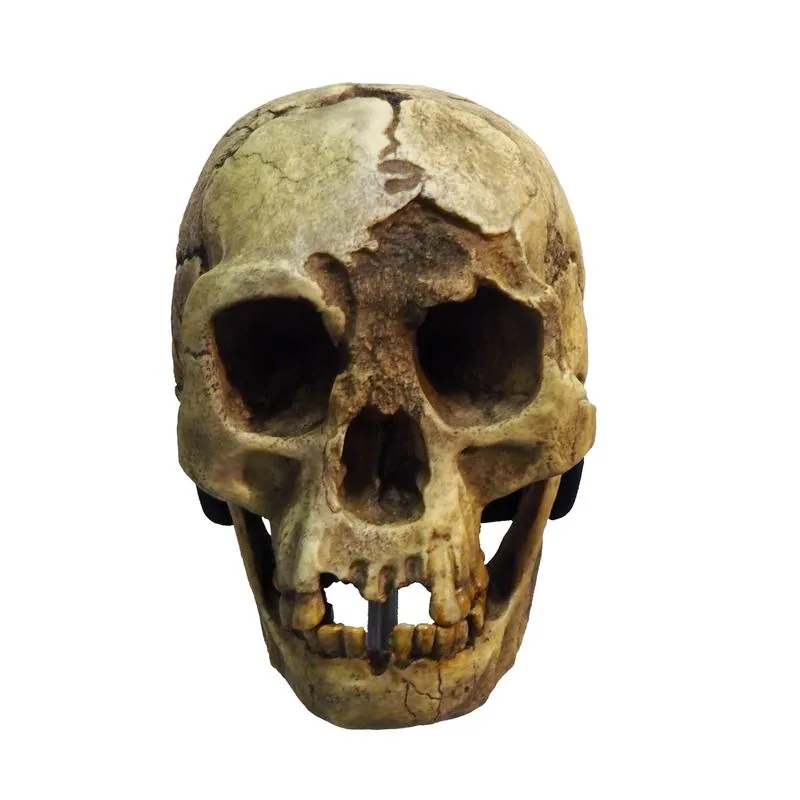
The anatomy is a mosaic. The skull is small with thick bone and a sloping face, and the brain is small, but the teeth are small too; the wrists and shoulders are primitive, the legs short and the feet long[1][11]. Interpretation depends on which of these traits are inherited and which are the result of being small.
Timeline
What is known
The chronology is now firm at both ends. Stone tools on Flores go back about a million years at Wolo Sege[14]. At Mata Menge a fluvial sandstone dated to about 700,000 years by argon and fission-track dates on bracketing ash layers, with uranium-series and ESR dates on teeth, holds a jaw fragment, teeth and now a humerus of very small hominins[6][5][7]. At Liang Bua the skeletal remains date to about 100,000-60,000 years and the tools of the species to about 190,000-50,000 years[4].
The species disappears from Liang Bua before modern humans are recorded there. Rainfall at the cave fell steeply between 76,000 and 61,000 years ago, with a record low of summer rain at 61,000-55,000 years, as Stegodon became rarer[15]. Taphonomy of the Stegodon bones shows Komodo dragons had first access to carcasses and H. floresiensis scavenged what was left, and finds no sign of deliberate fire[16]. The living short-statured people of nearby Rampasasa carry Denisovan and Neanderthal DNA but no trace of another archaic hominin, and their stature evolved independently[17].
What has been tested
The pathology readings have been tested repeatedly. LB1's virtual endocast does not match microcephalic humans[18]. 3D geometric morphometrics of the cranium groups it with fossil Homo rather than with modern humans with microcephaly or other conditions[9]. A trait-by-trait review of the Down syndrome diagnosis found the features absent or not diagnostic[8]. The discovery of equally small hominins at Mata Menge 600,000 years earlier removes the need for a pathology to explain LB1's size[5]. Proponents maintain the asymmetry and other features of LB1 are abnormal[19]; a 2026 study finds a similar cranial deformation in Indonesian H. erectus and reads it as a sign of helpless infancy, not disease[20].
Ancestry has been tested by phylogenetics and by modelling. Parsimony and Bayesian analyses of characters across the skeleton place H. floresiensis as an early Homo lineage, sister to H. habilis or to H. habilis plus later Homo[11]. Micro-CT brain measurement and scaling models show that an erectus-sized brain could shrink to LB1's size under insular dwarfing, beyond the scaling seen in other primates[10]; quantitative-genetic models of the island rule show the change could be fast[21]. The 2024 Mata Menge teeth include one that resembles early Javanese H. erectus[7].
The readings
Dwarfed Homo erectus. An early Asian H. erectus population reached Flores, probably by about a million years ago, and became smaller under island conditions; by 700,000 years it was already tiny[7][10]. For it: Java's H. erectus is the nearest known hominin population, the Mata Menge teeth and the shared cranial deformation link the two, and dwarfing on islands is common in mammals[7][20][21]. Against it: primitive wrist, shoulder, foot and pelvic traits that H. erectus had lost, which a phylogenetic analysis reads as inherited from an earlier ancestor[11].
An early, small Homo lineage. A hominin like H. habilis left Africa early, already small, and its descendants reached Flores[11]. For it: the primitive postcranial traits and the phylogenetic results. Against it: no such hominin is known outside Africa before H. erectus, and the oldest Flores fossils show an erectus-like tooth[7].
Pathological modern humans. LB1 was a modern human with microcephaly, Down syndrome or another disorder, and the Liang Bua remains were a small-bodied modern population[3][19]. This is now rejected by most researchers: the dates put the remains before modern humans on Flores, several individuals share the anatomy, Mata Menge shows the same size 700,000 years ago, and the shape analyses group LB1 with fossil Homo[4][5][9].
Published claims
| Year | Who | Claimed | Status | Reason |
|---|---|---|---|---|
| 2004 | Peter Brown and colleagues[1] | LB1, a metre-tall adult with a brain of about 380 cc, belongs to a new species, Homo floresiensis. | Accepted | Older remains of the same small size at Mata Menge and 3D comparisons with fossil and pathological crania bear it out[5][9] |
| 2004 | Mike Morwood and colleagues[2] | LB1 lived about 18,000 years ago, so the species overlapped with modern humans for tens of thousands of years. | Ruled out | New excavation showed those dates came from younger deposits; the skeletal remains date to about 100,000 to 60,000 years ago[4] |
| 2004 | Mike Morwood and colleagues[2] | The Liang Bua hominins hunted young Stegodon and used fire. | Disputed | Bite marks and bone-part profiles show Komodo dragons had first access, and no deliberate fire was found[16] |
| 2005 | Dean Falk and colleagues[18] | LB1's endocast is unlike those of microcephalic humans and fits an advanced small-brained hominin. | Accepted | Later shape studies of the whole cranium reached the same result[9] |
| 2006 | Teuku Jacob and colleagues[3] | The Liang Bua remains are small-bodied modern humans, and LB1 had a pathological, microcephalic skull. | Ruled out | The remains are 100,000 to 60,000 years old, before modern humans reached Flores, and hominins as small lived there 700,000 years ago[4][5] |
| 2010 | Adam Brumm and colleagues[14] | Stone tools at Wolo Sege show hominins were on Flores by about a million years ago. | Accepted | The dates have stood, and hominin fossils of 700,000 years from the same basin confirm an early arrival[6] |
| 2013 | Daisuke Kubo and colleagues[10] | LB1's brain was about 426 cc, a size reachable from Javanese Homo erectus by island dwarfing. | Most likely | The Mata Menge humerus and tooth point to a small erectus-like ancestor, though phylogenies built on many traits disagree[7][11] |
| 2013 | Karen Baab and colleagues[9] | In 3D shape LB1's cranium groups with fossil Homo, not with microcephalic or other pathological modern humans. | Accepted | No later shape study has overturned it[8] |
| 2014 | Maciej Henneberg and colleagues[19] | LB1 was a modern human with Down syndrome, and Homo floresiensis is not a valid species. | Ruled out | The proposed Down syndrome traits are absent or not diagnostic, and the remains predate modern humans on Flores[8][4] |
| 2016 | Thomas Sutikna and colleagues[4] | The Homo floresiensis remains date to about 100,000 to 60,000 years ago and its stone tools to about 50,000. | Accepted | Several dating methods agree, and the finds were re-plotted against the new stratigraphy in 2018[12] |
| 2016 | Gerrit van den Bergh and colleagues[5] | A jaw fragment and teeth from Mata Menge, about 700,000 years old, come from early relatives of Homo floresiensis, even smaller than LB1. | Accepted | The age rests on tephra dates, and a humerus found later at the site confirms the small size[6][7] |
| 2017 | Debbie Argue and colleagues[11] | Homo floresiensis is the sister of Homo habilis, from an early small-bodied lineage that left Africa before Homo erectus. | Still possible | The phylogenies support it, but no pre-erectus hominin is known outside Africa and the Mata Menge tooth resembles Javanese H. erectus[7] |
| 2018 | Serena Tucci and colleagues[17] | The short-statured people of Rampasasa near Liang Bua carry no Homo floresiensis ancestry; their small size evolved separately. | Accepted | Their genomes show Denisovan and Neanderthal admixture but no trace of another archaic hominin[17] |
| 2022 | Gregory Forth[22] | Lio accounts of an "ape-man" on Flores are best explained by a non-sapiens hominin that survived into recent times. | Disputed | It rests on testimony alone, with no specimen, photograph or DNA, and the bones and tools at Liang Bua end about 50,000 years ago[4] |
| 2024 | Yousuke Kaifu and colleagues[7] | A 700,000-year-old humerus from Mata Menge shows the small body size evolved early, from an Asian Homo erectus ancestor. | Most likely | The humerus is direct evidence for early small size; the erectus ancestry rests on a single tooth and is contested by trait-based phylogenies[11] |
| 2025 | Michael Gagan and colleagues[15] | Summer rainfall fell to a record low between 61,000 and 55,000 years ago, and the drying, with the decline of Stegodon, drove Homo floresiensis from Liang Bua. | Most likely | The timing matches the end of the skeletal record, though it shows what happened at one cave, not across Flores[15][4] |
| 2026 | E. Grace Veatch and colleagues[16] | Homo floresiensis scavenged Stegodon carcasses after Komodo dragons had fed, and did not use fire. | Accepted | It rests on a systematic taphonomic study of the whole proboscidean assemblage[16] |
What would settle it
Fossils between one million and 700,000 years old from the So'a Basin would show the size and anatomy of the first Flores hominins: an erectus-sized founder supports dwarfing, an already small one does not. Ancient proteins from Mata Menge or Liang Bua teeth, if they survive in the tropics, would place the lineage molecularly, as enamel proteomes have placed Homo erectus and Denisovans in China; no such result has been published. A phylogenetic analysis that includes the Mata Menge material and corrects for size, run on shared open character matrices and 3D data, would test whether the primitive traits are inherited or allometric. The 3D data of the original fossils are not openly available; their release would let the shape analyses be repeated by anyone.
Questions
1 of 4 questions are answered.
Evidence 19 findings
Artifacts
The films, photos, papers and objects this mystery rests on, each with its own key and its distance from the original.
See also
References
- 1.Brown, P., Sutikna, T., Morwood, M. et al. 2004. A new small-bodied hominin from the Late Pleistocene of Flores, Indonesia. Nature 431: 1055-1061.doicited 7 times hereSRC0CZNM6KC00PP
- 2.Morwood, M., Soejono, R., Roberts, R. et al. 2004. Archaeology and age of a new hominin from Flores in eastern Indonesia. Nature 431: 1087-1091.doicited 3 times hereSRC0CZNM6V60Q5W
- 3.Jacob, T., Indriati, E., Soejono, R. et al. 2006. Pygmoid Australomelanesian Homo sapiens skeletal remains from Liang Bua, Flores: Population affinities and pathological abnormalities. Proceedings of the National Academy of Sciences 103(36): 13421-13426.doicited 3 times hereSRC0CZNM9RY6QRZ
- 4.Sutikna, T., Tocheri, M., Morwood, M. et al. 2016. Revised stratigraphy and chronology for Homo floresiensis at Liang Bua in Indonesia. Nature 532: 366-369.doicited 11 times hereSRC0CZNM730024W
- 5.van den Bergh, G., Kaifu, Y., Kurniawan, I. et al. 2016. Homo floresiensis-like fossils from the early Middle Pleistocene of Flores. Nature 534: 245-248.doicited 6 times hereSRC0CZNM7TE5DJF
- 6.Brumm, A., van den Bergh, G., Storey, M. et al. 2016. Age and context of the oldest known hominin fossils from Flores. Nature 534: 249-253.doicited 5 times hereSRC0CZNM8285CTK
- 7.Kaifu, Y., Kurniawan, I., Mizushima, S. et al. 2024. Early evolution of small body size in Homo floresiensis. Nature Communications 15: 6381.doicited 12 times hereSRC0CZNM8HW1C2H
- 8.Baab, K., Brown, P., Falk, D. et al. 2016. A Critical Evaluation of the Down Syndrome Diagnosis for LB1, Type Specimen of Homo floresiensis. PLOS ONE 11(6): e0155731.doicited 3 times hereSRC0CZNMA8J5YJT
- 9.Baab, K., McNulty, K., Harvati, K. 2013. Homo floresiensis Contextualized: A Geometric Morphometric Comparative Analysis of Fossil and Pathological Human Samples. PLOS ONE 8(7): e69119.doicited 2 times hereSRC0CZNMAGC2CMR
- 10.Kubo, D., Kono, R., Kaifu, Y. 2013. Brain size of Homo floresiensis and its evolutionary implications. Proceedings of the Royal Society B 280: 20130338.doicited 3 times hereSRC0CZNM91G4N2E
- 11.Argue, D., Groves, C., Lee, M. et al. 2017. The affinities of Homo floresiensis based on phylogenetic analyses of cranial, dental, and postcranial characters. Journal of Human Evolution 107: 107-133.doicited 6 times hereSRC0CZNM8SP60DN
- 12.Sutikna, T., Tocheri, M., Faith, J. et al. 2018. The spatio-temporal distribution of archaeological and faunal finds at Liang Bua (Flores, Indonesia) in light of the revised chronology for Homo floresiensis. Journal of Human Evolution 124: 52-74.doicited 1 time hereSRC0CZNM7AT1SC8
- 13.Smithsonian Institution, N. 2020. Homo floresiensis: cranium (LB1 cast), Smithsonian 3D. Smithsonian 3D Digitization.cited 4 times hereSRC0CZNMBQE0ZJE
- 14.Brumm, A., Jensen, G., van den Bergh, G. et al. 2010. Hominins on Flores, Indonesia, by one million years ago. Nature 464: 748-752.doicited 4 times hereSRC0CZNM8A278W2
- 15.Gagan, M., Ayliffe, L., Puspaningrum, M. et al. 2025. Onset of summer aridification and the decline of Homo floresiensis at Liang Bua 61,000 years ago. Communications Earth & Environment 6: 992.doicited 6 times hereSRC0CZNMB000TDM
- 16.Veatch, E., Alamsyah, N., Pante, M. et al. 2026. Taphonomic analysis at Liang Bua reveals the behavioral and technological capabilities of Homo floresiensis. Science Advances 12(27): eaeb7219.doicited 8 times hereSRC0CZNMB7T7AY4
- 17.Tucci, S., Vohr, S., McCoy, R. et al. 2018. Evolutionary history and adaptation of a human pygmy population of Flores Island, Indonesia. Science 361(6401): 511-516.doicited 2 times hereSRC0CZNMAR60XX1
- 18.Falk, D., Hildebolt, C., Smith, K. et al. 2005. The Brain of LB1, Homo floresiensis. Science 308(5719): 242-245.doicited 2 times hereSRC0CZNM9H472AK
- 19.Henneberg, M., Eckhardt, R., Chavanaves, S. et al. 2014. Evolved developmental homeostasis disturbed in LB1 from Flores, Indonesia, denotes Down syndrome and not diagnostic traits of the invalid species Homo floresiensis. Proceedings of the National Academy of Sciences 111(33): 11967-11972.doicited 3 times hereSRC0CZNMA0R76V6
- 20.Kaifu, Y., Yano, W., Hikosaka, M. et al. 2026. Cranial evidence for human-like helpless infancy in Homo erectus and Homo floresiensis. Proceedings of the Royal Society B 293(2075): 20261055.doicited 2 times hereSRC0CZNMBFM7YX1
- 21.Diniz-Filho, J., Raia, P. 2017. Island Rule, quantitative genetics and brain-body size evolution in Homo floresiensis. Proceedings of the Royal Society B 284(1857): 20171065.doicited 2 times hereSRC0CZNM99A5W16
- 22.Forth, G. 2022. Opinion: Another Species of Hominin May Still Be Alive. The Scientist, April 2022.cited 1 time hereSRC0CZNMCEW4JN7