Who were the Denisovans? The Harbin "Dragon Man" cranium
In 2010 a fragment of a child's finger bone from Denisova Cave in the Altai Mountains yielded a mitochondrial genome unlike that of any human or Neanderthal[1]. Its nuclear genome showed a sister group of Neanderthals, which the authors called Denisovans, and showed that they had interbred with the ancestors of living Melanesians[2]. Denisovan DNA was later traced in Papuans, in East and South Asians, and in the high-altitude variant of EPAS1 carried by Tibetans[3][4][5]. Yet the people themselves were known from a few teeth and scraps of bone. A population that had left its DNA across Asia and Oceania had no face.
Meanwhile East Asia held a set of large, robust crania that fitted no named species well: Dali, Jinniushan, Hualongdong, Xujiayao, and the most complete of all, a cranium reportedly found in 1933 during the building of a bridge in Harbin and first described in 2021[6][7]. Its describers named it Homo longi, the "Dragon Man", and placed it in a lineage they saw as the sister group of Homo sapiens[8]. Several researchers suspected these were the Denisovans, but no DNA or protein linked them.
The link came in 2025. Qiaomei Fu and colleagues recovered 95 proteins from the Harbin cranium's petrous bone, with three amino acid variants found only in Denisovans, and, separately, Denisovan mitochondrial DNA from its dental calculus[9][10]. In September and October 2026 proteins identified five Denisovan specimens at Bianfu Cave in Yunnan and showed that the Xujiayao fossils from northern China were Denisovan too; a comparison of the crania then found a common Denisovan morphology shared by Harbin, Xujiayao, Jinniushan, Dali and Hualongdong[11][12]. The Denisovans have a face, and it was already in the museum drawers. Of the 4 questions on this site, 2 are answered. The most likely answer to “How deep are the roots of the Denisovan lineage, and how many distinct Denisovan populations were there?”, not yet confirmed: the lineage goes back about a million years and comprised several deeply diverged regional populations,….
Key questionsset by the editors
The object
The Harbin cranium is almost complete and undistorted, though it lacks the mandible. It is massive, larger than any other known archaic human cranium, long and low, without the globular braincase of modern humans, with an endocranial capacity of about 1,420 ml, in the range of modern humans and Neanderthals[8]. It is said to have been found in 1933 when the Dongjiang Bridge was built over the Songhua River and kept out of sight for decades; its history is described by its describers as "long, difficult, and confused"[6]. It entered the collection of the Geoscience Museum of Hebei GEO University as HBSM2018-000018(A)[8].
Because the find spot was lost, the age had to be reconstructed. The cranium's trace elements, rare-earth pattern and strontium isotope ratio match sediments from a core drilled near the bridge and place it in the upper Upper Huangshan Formation, dated by luminescence to 138-309 ka; ten uranium-series analyses on the bone give a minimum age of 146 ka[6].
Timeline
What is known
Denisovans were a sister group of Neanderthals who lived across eastern Asia from at least about 200,000 years ago, from the Altai to the Tibetan Plateau, Taiwan and Yunnan[2][4][13][14][11]. Molecularly confirmed fossils now include the Denisova Cave teeth and bones, the Xiahe mandible and a rib from Baishiya Karst Cave, the Penghu 1 mandible, the Harbin cranium, two Xujiayao specimens and five specimens from Bianfu Cave[13][15][14][9][12][11].
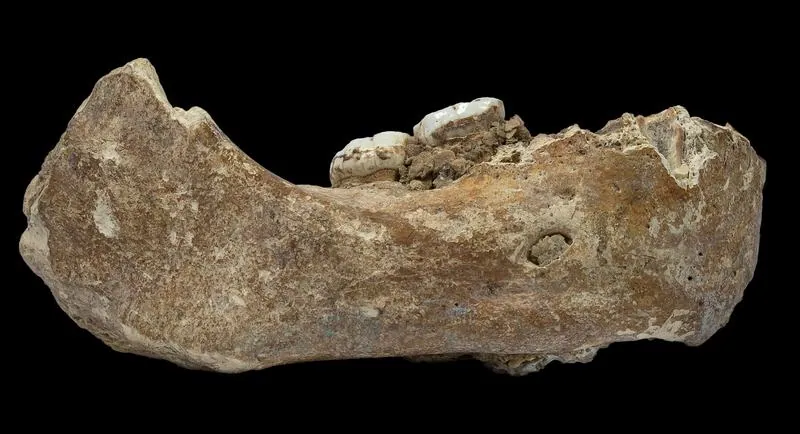
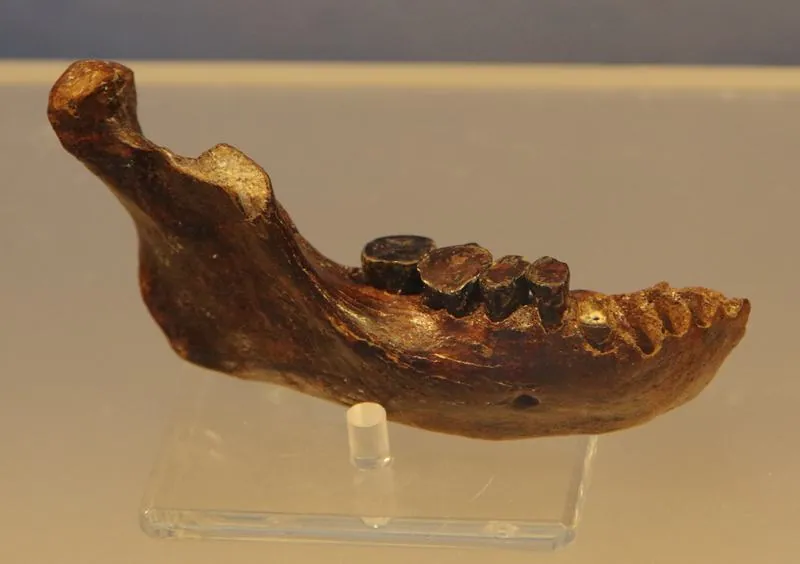
Their anatomy, as the confirmed fossils show it, combines traits reminiscent of Homo erectus, such as a thick cranial vault, with some seen in modern humans, such as a strongly arched temporal squama, and some shared with late Neanderthals, such as the structure of the inner ear and a suprainiac fossa. Distinctive to them are a low cranial profile with near-parallel side walls, a massive brow, a flat cheek region, weak facial projection, large teeth and robust jaws[12][14]. Brains were large; the Harbin endocranial volume is about 1,420 ml[8].
Genetically they were not one population. Living people carry DNA from at least three Denisovan groups, and Oceanians and South Asians share one that diverged deeply from the Altai Denisovans[4][3]. A 200,000-year-old Denisovan from the Altai belonged to a group later replaced by other Denisovans[4].
What has been tested
Two independent molecular tests were run on the Harbin cranium. Palaeoproteomics of two petrous-bone samples recovered 95 endogenous proteins, the best-preserved hominin proteome yet; of 122 single amino acid polymorphisms informative within hominids, three are derived variants known only in Denisovans, and phylogenetic analysis groups the cranium with Denisova 3[9]. No DNA survived in the tooth or the petrous bone, but mitochondrial DNA was captured from dental calculus; it falls within Denisovan variation, on the branch of the early Denisovans at Denisova Cave[10]. Calculus can contain DNA from other sources, so the agreement of the two tests matters: proteins from the bone itself and DNA from the calculus point the same way[9][10].
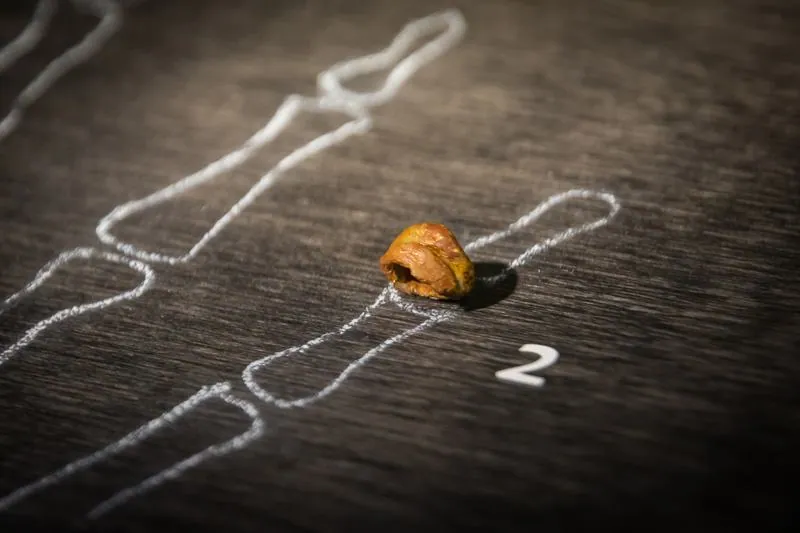
The same test, the Denisovan-specific COL1A2-996K variant, was applied to the Xujiayao bones and found in both specimens; the variant is present in every Denisovan with protein or genome data and absent in Neanderthals and modern humans, who carry arginine at that site[12]. The Bianfu specimens were found by screening 60,000 fragments by peptide mass fingerprinting before sequencing[11]. The extension of the label to Dali, Jinniushan and Hualongdong rests on shared morphology, not on molecules[12].
The readings
Before 2025 there were three main readings of the East Asian crania. One placed Harbin, Dali, Jinniushan and Hualongdong in a new lineage, Homo longi, sister to H. sapiens, and suspected but could not show that the Denisovans belonged to it[7][8]. A second split them: H. longi for Harbin, Dali and Jinniushan, and a separate species, Homo juluensis, for the large-brained Xujiayao and Xuchang crania and the Denisovan-identified Xiahe and Penghu jaws[16]. A third treated them as regional archaic H. sapiens or as variants of H. heidelbergensis, with no special link to the Denisovans[12].
The molecular results decide between these. Harbin is Denisovan[9][10]; Xujiayao, the holotype of H. juluensis, is Denisovan too[12]. The two proposed species are therefore one lineage, and it is the Denisovan one. The Yunxian 2 cranium, about a million years old, has been placed as an early member of the same clade, which would give the lineage roots beyond the Middle Pleistocene[17]. What remains is a question of names and of boundaries: which fossils without molecular data belong, and whether the genetic subgroups correspond to anatomical ones[12][4].
Published claims
| Year | Who | Claimed | Status | Reason |
|---|---|---|---|---|
| 2010 | Johannes Krause and colleagues[1] | The finger bone from Denisova Cave carries the mitochondrial genome of an unknown hominin, whose mtDNA line split from those of modern humans and Neanderthals about a million years ago. | Accepted | The nuclear genome confirmed a new group, though it showed the population to be sister to Neanderthals, so the deep mtDNA line is a discordance rather than the date of the split[2] |
| 2010 | David Reich and colleagues[2] | The Denisovans were a sister group of the Neanderthals who contributed about 4 to 6 per cent of the genomes of present-day Melanesians. | Accepted | The high-coverage genome of 2012 and every later study of living people's ancestry have borne it out[18][3] |
| 2018 | Viviane Slon and colleagues[19] | Denisova 11 was the daughter of a Neanderthal mother and a Denisovan father. | Accepted | The genome shows it directly, and no one has challenged the reading[19] |
| 2019 | Fahu Chen and colleagues[13] | The Xiahe mandible from the Tibetan Plateau is Denisovan and at least 160,000 years old. | Accepted | Denisovan mtDNA in dated sediments from the same cave, and a second Denisovan bone from it, support the attribution[20][15] |
| 2019 | Guy Jacobs and colleagues[3] | Papuans carry two distinct, deeply diverged Denisovan ancestries, so there were several Denisovan populations. | Accepted | The 200,000-year-old genome finds at least three Denisovan groups behind living people's ancestry[4] |
| 2021 | Ni Xijun and colleagues[7] | The Harbin cranium belongs to a lineage, with Dali, Jinniushan and Hualongdong, that is the sister group of Homo sapiens. | Disputed | Harbin is now Denisovan by its proteins and mtDNA, and the genomes place Denisovans beside Neanderthals, though the 2025 Yunxian analysis repeats the morphological result[9][2][17] |
| 2021 | Ji Qiang and colleagues[8] | The Harbin cranium is the holotype of a new species, Homo longi. | Still possible | The name is valid and now attaches to a Denisovan, but whether Denisovans should carry a species name is still argued[12][16] |
| 2022 | Fabrice Demeter and colleagues[21] | A molar from Tam Ngu Hao 2 cave in Laos is Denisovan, so the lineage reached tropical South-east Asia. | Still possible | The attribution rests on the tooth's shape; its proteins confirm only the genus Homo[21] |
| 2024 | Christopher Bae and Wu Xiujie[16] | The Denisovans belong to a new species, Homo juluensis, separate from Homo longi, which keeps Harbin, Dali and Jinniushan. | Disputed | Both Harbin and Xujiayao, which the scheme puts in different species, carry Denisovan protein variants and share a cranial form[12] |
| 2025 | Takumi Tsutaya and colleagues[14] | The Penghu 1 mandible, dredged off Taiwan, is a male Denisovan. | Accepted | Two Denisovan-specific amino-acid variants and a male-specific peptide identify it; its age is less certain[14] |
| 2025 | Qiaomei Fu and colleagues[9] | The Harbin cranium's proteins carry Denisovan variants and cluster it with Denisova 3, so it is Denisovan. | Accepted | The mtDNA from its dental calculus points to the same lineage independently[10] |
| 2025 | Qiaomei Fu and colleagues[10] | Mitochondrial DNA from the Harbin cranium's dental calculus falls within Denisovan variation, on an early branch. | Accepted | No DNA survived in the bone, so the result rests on the calculus alone, but it agrees with the proteome[9] |
| 2025 | Feng Xiaobo and colleagues[17] | The million-year-old Yunxian 2 cranium is an early member of the Homo longi clade, which has roots more than a million years deep. | Still possible | It rests on the morphometrics of a digitally restored, crushed skull, with no molecules to test it[17] |
| 2025 | Stéphane Peyrégne and colleagues[4] | A 200,000-year-old Denisovan genome shows an early group replaced by later Denisovans, and at least three Denisovan groups behind living people's ancestry. | Most likely | It fits the deep structure seen in Papuan genomes but is a preprint not yet through peer review[4][3] |
| 2026 | Xing Song and colleagues[12] | Two Xujiayao bones carry a Denisovan-specific protein variant, and Xujiayao, Harbin, Jinniushan, Dali and Hualongdong share one Denisovan cranial form. | Accepted | The protein result is direct; the shared form extends the attribution to Dali, Jinniushan and Hualongdong on morphology alone[12] |
| 2026 | Rao Huiyun and colleagues[11] | Five hominin specimens from Bianfu Cave in Yunnan, of about 167,000 to 134,000 years ago, are all Denisovan by their proteins. | Accepted | The proteomic identifications are backed by a separate study of the cave's layers and dates[22] |
What would settle it
The identity question is answered. The open edges are narrower. A nuclear genome, or more proteins, from any of Dali, Jinniushan or Hualongdong would test the morphological extension of the label. Proteins or DNA from Yunxian would test whether the clade really reaches back a million years. Genomes from the southern fossils, such as Penghu, Bianfu or Tam Ngu Hao 2, would show whether the deeply diverged Denisovan ancestry in Oceanians and South Asians came from a southern population with its own anatomy. The name is a matter for zoological nomenclature: if the Harbin and Xujiayao fossils are one species, Homo longi, published first in 2021, would normally have priority over H. juluensis, unless the lineage is kept informal.
Questions
2 of 4 questions are answered.
Evidence 16 findings
Artifacts
The films, photos, papers and objects this mystery rests on, each with its own key and its distance from the original.
See also
References
- 1.Krause, J., Fu, Q., Good, J. et al. 2010. The complete mitochondrial DNA genome of an unknown hominin from southern Siberia. Nature 464: 894-897.doicited 4 times hereSRC0CZKYYG46T30
- 2.Reich, D., Green, R., Kircher, M. et al. 2010. Genetic history of an archaic hominin group from Denisova Cave in Siberia. Nature 468: 1053-1060.doicited 5 times hereSRC0CZKYYQY78SZ
- 3.Jacobs, G., Hudjashov, G., Saag, L. et al. 2019. Multiple Deeply Divergent Denisovan Ancestries in Papuans. Cell 177(4): 1010-1021.e32.doicited 3 times hereSRC0CZKZ3CC3N62
- 4.Peyrégne, S., Massilani, D., Swiel, Y. et al. 2025. A high-coverage genome from a 200,000-year-old Denisovan. bioRxiv.doicited 5 times hereSRC0CZKZ34J79GV
- 5.Zhang, X., Witt, K., Bañuelos, M. et al. 2021. The history and evolution of the Denisovan-EPAS1 haplotype in Tibetans. Proceedings of the National Academy of Sciences 118(22): e2020803118.doicited 1 time hereSRC0CZKZ3M65ST0
- 6.Shao, Q., Ge, J., Ji, Q. et al. 2021. Geochemical provenancing and direct dating of the Harbin archaic human cranium. The Innovation 2(3): 100131.doicited 3 times hereSRC0CZKZ1621MQ6
- 7.Ni, X., Ji, Q., Wu, W. et al. 2021. Massive cranium from Harbin in northeastern China establishes a new Middle Pleistocene human lineage. The Innovation 2(3): 100130.doicited 2 times hereSRC0CZKZ0PE0MGB
- 8.Ji, Q., Wu, W., Ji, Y. et al. 2021. Late Middle Pleistocene Harbin cranium represents a new Homo species. The Innovation 2(3): 100132.doicited 7 times hereSRC0CZKZ0Y87W3G
- 9.Fu, Q., Bai, F., Rao, H. et al. 2025. The proteome of the late Middle Pleistocene Harbin individual. Science 389(6761): 704-707.doicited 10 times hereSRC0CZKZ1NP4N96
- 10.Fu, Q., Cao, P., Dai, Q. et al. 2025. Denisovan mitochondrial DNA from dental calculus of the >146,000-year-old Harbin cranium. Cell 188(15): 3919-3926.e9.doicited 7 times hereSRC0CZKZ1DW4XNV
- 11.Rao, H., Xing, S., Ruan, Q. et al. 2026. Ancient proteins identify various Denisovan remains from Southwest China. Nature.doicited 4 times hereSRC0CZKZ2MY62DW
- 12.Xing, S., Wu, Z., Shao, Q. et al. 2026. The proteome of Middle Pleistocene Xujiayao and common Denisovan morphology. Nature.doicited 12 times hereSRC0CZKZ2D45SWC
- 13.Chen, F., Welker, F., Shen, C. et al. 2019. A late Middle Pleistocene Denisovan mandible from the Tibetan Plateau. Nature 569: 409-412.doicited 4 times hereSRC0CZKYZFC0K5C
- 14.Tsutaya, T., Sawafuji, R., Taurozzi, A. et al. 2025. A male Denisovan mandible from Pleistocene Taiwan. Science 388(6743): 176-180.doicited 4 times hereSRC0CZKZ0EM0VFC
- 15.Xia, H., Zhang, D., Wang, J. et al. 2024. Middle and Late Pleistocene Denisovan subsistence at Baishiya Karst Cave. Nature 632: 108-113.doicited 1 time hereSRC0CZKYZZ07D76
- 16.Bae, C., Wu, X. 2024. Making sense of eastern Asian Late Quaternary hominin variability. Nature Communications 15: 9479.doicited 4 times hereSRC0CZKZ1XG39KY
- 17.Feng, X., Yin, Q., Gao, F. et al. 2025. The phylogenetic position of the Yunxian cranium elucidates the origin of Homo longi and the Denisovans. Science 389(6767): 1320-1324.doicited 4 times hereSRC0CZKZ25A7GRA
- 18.Meyer, M., Kircher, M., Gansauge, M. et al. 2012. A High-Coverage Genome Sequence from an Archaic Denisovan Individual. Science 338(6104): 222-226.doicited 1 time hereSRC0CZKYYZR2Y6K
- 19.Slon, V., Mafessoni, F., Vernot, B. et al. 2018. The genome of the offspring of a Neanderthal mother and a Denisovan father. Nature 561: 113-116.doicited 2 times hereSRC0CZKYZ7J1YFC
- 20.Zhang, D., Xia, H., Chen, F. et al. 2020. Denisovan DNA in Late Pleistocene sediments from Baishiya Karst Cave on the Tibetan Plateau. Science 370(6516): 584-587.doicited 1 time hereSRC0CZKYZQ66QJ1
- 21.Demeter, F., Zanolli, C., Westaway, K. et al. 2022. A Middle Pleistocene Denisovan molar from the Annamite Chain of northern Laos. Nature Communications 13: 2557.doicited 1 time hereSRC0CZKZ06T5HBN
- 22.Ruan, Q., Li, H., Xing, S. et al. 2026. Denisovans from southwestern China and their subsistence strategies. Nature.doicited 1 time hereSRC0CZKZ2WR4HXJ