Homo naledi and the Rising Star burial claims
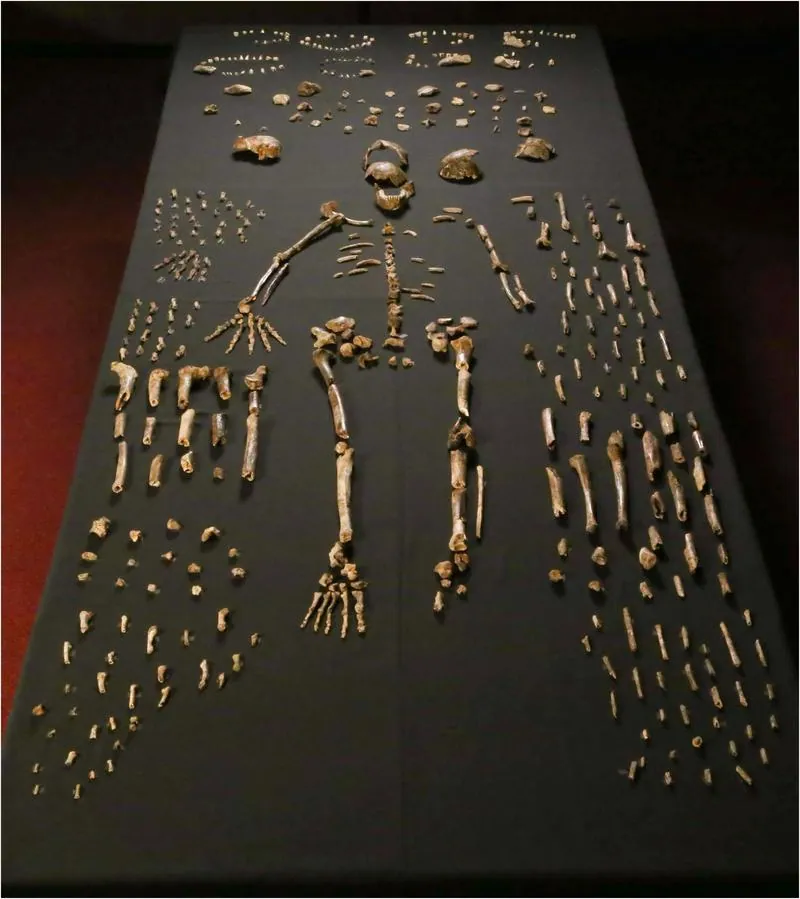
In September 2013 two cavers working with the University of the Witwatersrand squeezed through a fissure about 20 cm wide in the Rising Star cave, 50 km north-west of Johannesburg, and reached a small chamber some 30 m underground whose floor was strewn with hominin bones. Excavations in 2013 and 2014 recovered 1,550 numbered specimens from at least 15 individuals, adults and children, which Lee Berger and colleagues named Homo naledi in 2015[1]. The species combines a brain of chimpanzee size with human-like hands and feet, and it lived between about 236,000 and 335,000 years ago, alongside early Homo sapiens[2]. A second chamber, Lesedi, held at least three more individuals[3].
The chamber holds almost nothing but H. naledi. There are no carnivore tooth marks, no signs of water transport and very few other animals, and the geologists found no passage through which bodies could have washed or fallen in from the surface[4]. From the start the team proposed that the hominins brought their dead there[4]. In 2023 they went further: in preprints and an eLife reviewed preprint they argued that H. naledi dug shallow hollows in the cave floor, placed bodies in them and covered them, which would make these the oldest burials known by more than 100,000 years and the work of a species with a brain a third the size of ours[5]. Companion papers proposed that the same hominins engraved the cave walls[6].
The claim went through eLife's open review twice. In 2023 four reviewers found it unproven, asking above all for a demonstrated pit cut and micromorphology of the disturbed sediment[7]. The revised and final version, published on 1 September 2025, persuaded one reviewer and not another; the editors rated the finding "landmark" if it holds and recorded the split[8]. Specialists outside the team have argued that the evidence does not exclude natural processes[9][10]. The bones are real and their presence is unexplained; whether they were buried is the open question. Of the 5 questions on this site, 0 are answered. The most likely answer to “How did the remains of many Homo naledi individuals come to lie in the dark chambers of the Dinaledi Subsystem?”, not yet confirmed: living H. naledi carried or dragged their dead into the subsystem.
Key questionsset by the editors
The site
Rising Star is a dolomite cave system in the Cradle of Humankind World Heritage Site. The Dinaledi Subsystem is reached from the surface by a crawl, a climb over a jagged ridge called Superman's Crawl and the Dragon's Back, and then a vertical fissure, the Chute, about 12 m long and at its narrowest about 20 cm wide; the Hill Antechamber lies at the foot of the Chute and the Dinaledi Chamber beyond it[4][11]. Remains have since been found in narrow passages well beyond the two main chambers[12]. Whether the hominins used this route or another opening is not settled; a flowstone chronology of the system shows that passages opened and closed over time and that an opening through the Postbox would have shortened the route by about 80 m[13][8].
The sediments matter as much as the route. The fossils lie in Unit 3, an unlithified breccia of mud clasts in an orange-red matrix that formed in place as older laminated mud (Unit 1) cracked, weathered and broke up, a process called autobrecciation; it was not carried in by flowing water[14]. Units 2 and 3 have been churned and reworked within the chamber for a long time, which is the difficulty for any argument that rests on sediment boundaries[4][14].
Timeline
What was found
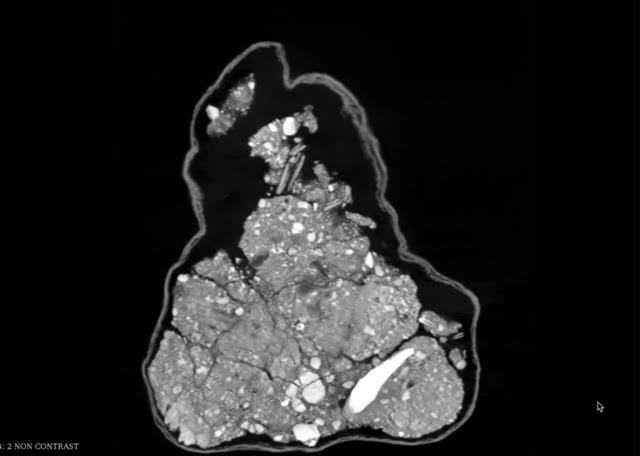
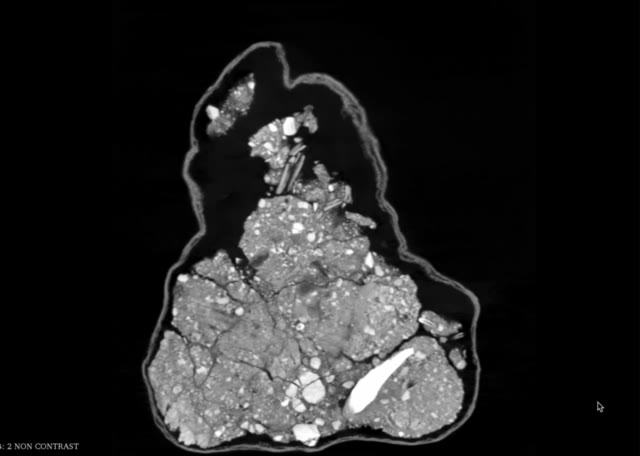
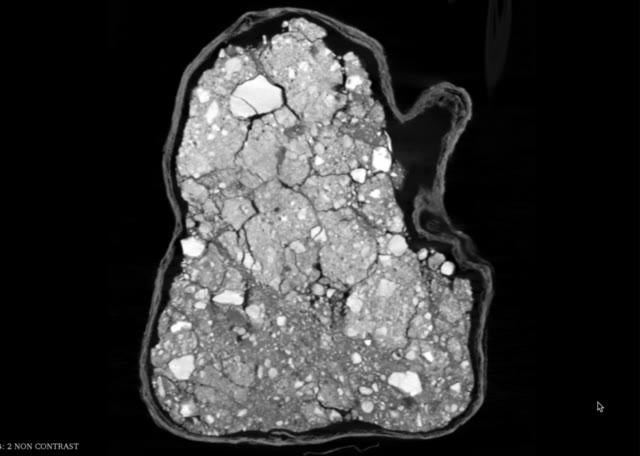
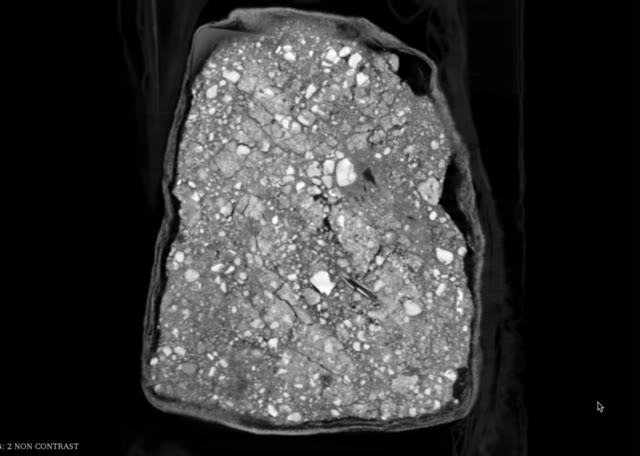
The 2025 paper describes three areas. In the Hill Antechamber, excavated in 2017 and 2018, a cluster of at least 90 skeletal and 51 dental elements included the substantially articulated right foot and hand of one individual, teeth of two more and a stone with a shape the authors compare to a tool, lying near the hand; the cluster was lifted in a plaster block and imaged by CT and synchrotron scanning[5]. In the Dinaledi Chamber, Feature 1 is an oval area of bone concentrated in a hollow, with articulated and near-articulated parts of at least one body; Feature 2, at the edge of the excavation, was recognised and left unexcavated[5]. The authors also re-read the Puzzle Box, the area dug in 2013 and 2014 that yielded at least six individuals, as a burial feature that was later reworked[5].
 0:06
 0:06
 0:12
 0:18
The paper reports the trace and rare-earth element chemistry of sediment within and around Feature 1 and argues that the infill differs from the surrounding floor[5]. It dates nothing new: it relies on the 2017 bracket from teeth and the flowstone that seals bone, a U-Th minimum of 244,000 years[2][5].
What is known
Several things are not in dispute. The remains are numerous, they belong to one species, they span infants to old adults, and they were not brought in by carnivores or water[4][1]. Some skeletal regions are articulated and supported by matrix, so parts of bodies were covered before the soft tissue had fully decayed[5]. The chambers are dark, deep and hard to reach, so any hominin that took bodies there needed a route and probably light[4][15].
What is disputed is the step from "bodies came to rest here and were covered" to "bodies were placed in dug pits and deliberately covered". A burial in archaeology is usually recognised by a cut through existing layers, infill that differs from what it cuts, and a body whose position and articulation show it lay in a protected space, all demonstrated in section and in micromorphology[16][17]. The 2023 reviewers asked for exactly these and found them missing[7]. The final paper changes its framing, treating cultural burial as the starting hypothesis to be tested against the alternatives rather than natural deposition as the null, a choice the editors noted rests heavily on the authors' own earlier papers[5][8].
The explanations
Cultural burial. H. naledi dug hollows in the cave floor, laid bodies in them and covered them; later hominins dug into some of the features and disturbed them[5]. In its favour are the articulated, matrix-supported body parts, the oval bone concentrations, the sediment chemistry of Feature 1 and the stone near the Hill Antechamber hand[5]. One of the final reviewers judged this now convincing[8]. Against it: no pit cut has been shown in section or thin section, the features were not fully excavated, and the sediment is of a kind that reworks itself, so a hollow and a geochemical difference need not mean digging[7][14][9].
Deliberate placement without burial. Bodies were carried or dropped into the chamber and left on the floor or in natural hollows, and covered by sediment that moved or formed around them[4][18]. This keeps the hominin agency that the absence of other agents implies but asks less of the evidence. The 2025 paper argues that floor decomposition is excluded by the articulation and matrix support[5].
Natural accumulation. Bodies arrived through openings now closed, by falls, by individuals entering and dying, or by remains moving down through the system, and were buried by natural sedimentation and slumping[18][13]. A comparison of skeletal-part profiles found the Dinaledi assemblage closest to bodies that decayed in the open or in caves, not to buried ones[10]. Its difficulty is the near-total absence of other animals, which natural traps usually collect[4].
Published claims
| Year | Who | Claimed | Status | Reason |
|---|---|---|---|---|
| 2015 | Lee Berger, John Hawks and colleagues[1] | The Dinaledi fossils, from at least 15 individuals, belong to a new species, Homo naledi. | Accepted | The species is accepted, and a second locality and an age have since been published[3][2] |
| 2015 | Paul Dirks, Lee Berger and colleagues[4] | With no carnivore marks, no water sorting and almost no other fauna, the remains are best explained by H. naledi deliberately placing its dead in the chamber. | Most likely | The pattern it rests on holds, but how bodies or living hominins reached the chamber is still not known, and eLife's reviewers split on it[8] |
| 2016 | Aurore Val[18] | The taphonomic data do not exclude natural accumulation, and deliberate disposal has not been demonstrated. | Still possible | No natural route into the chamber has been shown either; the flowstone chronology leaves a closed opening possible[13] |
| 2016 | Paul Dirks, Lee Berger and colleagues[19] | Natural transport routes into the Dinaledi Chamber can be excluded. | Still possible | Later work found that passages in the system opened and closed over time, so another route cannot be ruled out[13] |
| 2017 | Paul Dirks, Eric Roberts and colleagues[2] | The Dinaledi fossils are between 236,000 and 335,000 years old. | Accepted | It combines U-Th dating of flowstones, palaeomagnetism and direct dating of teeth, and has not been challenged[2] |
| 2017 | John Hawks, Marina Elliott and colleagues[3] | A second chamber of the same cave system, the Lesedi Chamber, holds at least three more H. naledi individuals. | Accepted | Remains have since been mapped in remote passages too, so any explanation has to cover more than one chamber[12] |
| 2018 | Charles Egeland, Manuel Domínguez-Rodrigo and colleagues[10] | The Dinaledi skeletal-part profile matches bodies that decayed in the open or in caves, not buried bodies. | Still possible | The discovery team's later excavations report articulated bodies covered by sediment before decay, a claim that is itself disputed[5][9] |
| 2020 | Jelle Wiersma, Eric Roberts and Paul Dirks[14] | The fossil-bearing sediment formed in place by repeated wetting, drying and mineral growth breaking up older mud, not by water transport. | Accepted | No later study disputes it, and it means that hollows and chemical differences in the sediment need not mean digging[7] |
| 2021 | Jessie Robbins, Paul Dirks and colleagues[13] | Passages in the cave opened and closed over time, and an opening such as the Postbox could have shortened the route into the Dinaledi Subsystem. | Still possible | The flowstone dates allow the route but do not show it was used[13] |
| 2023 | Lee Berger, John Hawks and colleagues[5] | H. naledi dug hollows in the chamber floor, laid bodies in them and covered them with sediment. | Disputed | eLife's reviewers split on the final 2025 version, one finding it convincing and one incomplete, and published critics hold that a dug pit has not been shown[8][9] |
| 2023 | Lee Berger, John Hawks and colleagues[5] | A stone found by the hand of the body in the Hill Antechamber Feature is a shaped tool placed with it. | Still possible | The critics suggest it may be a natural clast, and no study of the stone has been published[9] |
| 2023 | Lee Berger, John Hawks and colleagues[6] | Cross-hatched marks on the Hill Antechamber walls are engravings made by H. naledi. | Disputed | eLife rated the evidence incomplete, since the marks' human origin, age and authorship are not shown[6][9] |
| 2024 | María Martinón-Torres, Diego Garate, Andy Herries and Michael Petraglia[9] | The Rising Star papers do not show dug pits, deliberate covering, a placed tool or hominin engraving. | Most likely | The final eLife assessment records one reviewer finding the burial evidence incomplete, chiefly because the way into the chamber is unknown[8] |
| 2025 | Agustín Fuentes, Marc Kissel, Penny Spikins and colleagues[15] | Burial, engraving and fire use by H. naledi would show that meaning-making did not need a large brain. | Still possible | It is conditional on the burial and engraving papers, both of which are disputed[8] |
What would settle it
A burial is shown in the ground, not argued from the bones. Full excavation of Dinaledi Feature 2 under a published protocol, with micromorphology thin sections across its edge, would show whether there is a cut through older layers and an infill of different origin. Sediment samples from inside and outside the Hill Antechamber block, analysed by an independent laboratory, would test whether the chemistry of the infill differs in the way a dug and refilled hollow predicts. Release of the CT volumes and the 3D positions of every element would let others test the articulation and orientation patterns against natural accumulations. A dated record of when the Chute and other openings were passable would decide which access routes are even possible. Direct dates on the features themselves, rather than on the chamber, would say whether they are one event or many. If the cut is there, the claim stands; if it is not, the case reduces to bodies placed or accumulated in a cave, which is remarkable but not burial.
Questions
0 of 5 questions are answered.
Evidence 25 findings
Artifacts
The films, photos, papers and objects this mystery rests on, each with its own key and its distance from the original.
See also
References
- 1.Berger, L., Hawks, J., de Ruiter, D. et al. 2015. Homo naledi, a new species of the genus Homo from the Dinaledi Chamber, South Africa. eLife 4: e09560.doicited 7 times hereSRC0D38WXDJ0GA9
- 2.Dirks, P., Roberts, E., Hilbert-Wolf, H. et al. 2017. The age of Homo naledi and associated sediments in the Rising Star Cave, South Africa. eLife 6: e24231.doicited 5 times hereSRC0D38WXX63155
- 3.Hawks, J., Elliott, M., Schmid, P. et al. 2017. New fossil remains of Homo naledi from the Lesedi Chamber, South Africa. eLife 6: e24232.doicited 2 times hereSRC0D38WY504PBE
- 4.Dirks, P., Berger, L., Roberts, E. et al. 2015. Geological and taphonomic context for the new hominin species Homo naledi from the Dinaledi Chamber, South Africa. eLife 4: e09561.doicited 8 times hereSRC0D38WXNC3V58
- 5.Berger, L., Makhubela, T., Molopyane, K. et al. 2025. Evidence for deliberate burial of the dead by Homo naledi. eLife 12: RP89106 (version of record, 1 September 2025).doicited 23 times hereSRC0D38WW6G22RF
- 6.Berger, L., Hawks, J., Fuentes, A. et al. 2025. An initial report of circa 241,000- to 335,000-year-old rock engravings and their relation to Homo naledi in the Rising Star cave system, South Africa. eLife 12: RP89102 (version of record, 22 July 2025).doicited 7 times hereSRC0D38WWXY7MGG
- 7.eLife reviewers 2023. Public reviews of the reviewed preprint (version 1): Evidence for deliberate burial of the dead by Homo naledi. eLife.doicited 6 times hereSRC0D38WWP45D1P
- 8.eLife editors and reviewers 2025. eLife Assessment and public reviews (version of record): Evidence for deliberate burial of the dead by Homo naledi. eLife.cited 8 times hereSRC0D38WWEA046H
- 9.Martinón-Torres, M., Garate, D., Herries, A. et al. 2024. No scientific evidence that Homo naledi buried their dead and produced rock art. Journal of Human Evolution 195: 103464.doicited 8 times hereSRC0D38X03G25V3
- 10.Egeland, C., Domínguez-Rodrigo, M., Pickering, T. et al. 2018. Hominin skeletal part abundances and claims of deliberate disposal of corpses in the Middle Pleistocene. Proceedings of the National Academy of Sciences 115(18): 4601-4606.doicited 2 times hereSRC0D38WZKW05TJ
- 11.Kruger, A., Randolph-Quinney, P., Elliott, M. 2016. Multimodal spatial mapping and visualisation of Dinaledi Chamber and Rising Star Cave. South African Journal of Science 112(5/6): 1-11.doicited 1 time hereSRC0D38X0K40ERX
- 12.Elliott, M., Makhubela, T., Brophy, J. 2021. Expanded explorations of the Dinaledi Subsystem, Rising Star Cave System, South Africa. PaleoAnthropology 2021(1).doicited 2 times hereSRC0D38WYWE3QPH
- 13.Robbins, J., Dirks, P., Roberts, E. et al. 2021. Providing context to the Homo naledi fossils: Constraints from flowstones on the age of sediment deposits in Rising Star Cave, South Africa. Chemical Geology 567: 120108.doicited 5 times hereSRC0D38WYCT19WJ
- 14.Wiersma, J., Roberts, E., Dirks, P. 2020. Formation of mud clast breccias and the process of sedimentary autobrecciation in the hominin-bearing (Homo naledi) Rising Star Cave system, South Africa. Sedimentology 67(2): 897-919.doicited 2 times hereSRC0D38WYMM7J84
- 15.Fuentes, A., Kissel, M., Spikins, P. et al. 2025. Meaning-making behavior in a small-brained hominin, Homo naledi, from the late Pleistocene: contexts and evolutionary implications. eLife 12: RP89125.doicited 3 times hereSRC0D38WX5R718G
- 16.Pettitt, P. 2022. Did Homo naledi dispose of their dead in the Rising Star Cave system?. South African Journal of Science 118(11/12).doicited 1 time hereSRC0D38WZVP5611
- 17.Martinón-Torres, M., d'Errico, F., Santos, E. 2021. Earliest known human burial in Africa. Nature 593: 95-100.doicited 2 times hereSRC0D38X0BA1MZR
- 18.Val, A. 2016. Deliberate body disposal by hominins in the Dinaledi Chamber, Cradle of Humankind, South Africa?. Journal of Human Evolution 96: 145-148.doicited 3 times hereSRC0D38WZ48343W
- 19.Dirks, P., Berger, L., Hawks, J. et al. 2016. Comment on "Deliberate body disposal by hominins in the Dinaledi Chamber, Cradle of Humankind, South Africa?". Journal of Human Evolution 96: 149-153.doicited 1 time hereSRC0D38WZC27AAQ