The Great Sphinx of Giza
The Great Sphinx is carved from the living rock of the Giza plateau, in a horseshoe-shaped ditch quarried out around a reserved core that became its body. It sits at the valley end of the causeway of the second pyramid, Khafre's, with two temples at its feet: the Sphinx Temple directly in front of the paws, never finished, and Khafre's Valley Temple to the south-east. In 1980 Tom Aigner and Mark Lehner matched the fossil beds in the Sphinx Temple's core blocks to the strata of the Sphinx ditch, which showed that the temple was built from the rock quarried to free the statue, in one operation[1][2]. This, with the Khafre statuary from the Valley Temple, the shared masonry style and the causeway layout, is the case for dating the Sphinx to Khafre, about 2500 BC. No inscription of the Old Kingdom names it[1].
The dispute is geological. The Sphinx's body and the walls of its ditch are deeply weathered, with a rounded, undulating profile and vertical fissures, while Old Kingdom tombs on the same plateau show the sharper, flaking wear expected from wind and sand. In 1992 Robert Schoch, a Boston University geologist brought to Giza by John Anthony West, argued that the profile is the work of rain and runoff over a long wet period and that the core of the Sphinx must date to 5000 to 7000 BC at least; he and Thomas Dobecki supported this with seismic refraction profiles of the ditch floor[3][4]. Egyptologists and geologists replied within three years: K. Lal Gauri's team at Louisville, who had mapped the Sphinx's limestone beds since 1979, argued that the weathering follows bed properties and salt action under wet sand; James Harrell argued that millennia of burial in damp sand and Nile flooding explain the deep decay; Lehner argued that Schoch was comparing different rock members and that the ditch was quarried late in Khafre's reign[5][6][7].
The question did not close. In 2001 Colin Reader, a British geologist, accepted that runoff shaped the ditch but traced it to Khufu's quarries above, which changed the drainage, and proposed an early-dynastic Sphinx a few centuries before Khafre; his 2026 book extends this to the Second Dynasty and argues the head was recut[8][9]. In 2023 physicists at New York University showed in a water tunnel that clay mounds with a hard inclusion erode into lion-like shapes, which they offered as a reason to take seriously the idea that the builders began from a natural yardang[10]. In October 2025 a poster at the Geological Society of America argued against both camps: that there is very little erosion, that the rough body was pounded back during construction and faced with a limestone veneer, and that the "weathering" is the exposed rough core[11]. The site therefore offers rival explanations with distinct predictions, a mapped stratigraphy, and a record of what each side has measured. Of the 6 questions on this site, 0 are answered. The most likely answer to “What did the Sphinx originally represent?”, not yet confirmed: it was made as the king, with a human head on a lion's body, as part of his pyramid complex; it was….
Key questionsset by the editors
The site
The Sphinx lies on the eastern edge of the Mokattam Formation outcrop that forms the Giza plateau, about 500 metres east-south-east of Khafre's pyramid. Gauri's stratigraphy divides the exposed rock into Member I, a hard reef limestone forming the base and the ditch floor; Member II, seven alternating softer and harder beds from which most of the body is cut; and Member III, harder at the top, from which the neck and head are carved and which was quarried away across the plateau for building stone[12][5]. The ditch floor is at about 20 metres above sea level, near the range of the historical Nile flood[6].
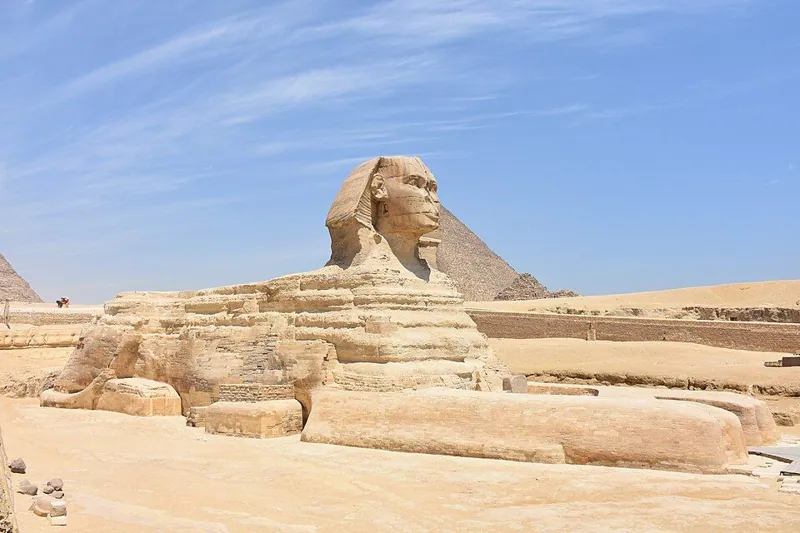
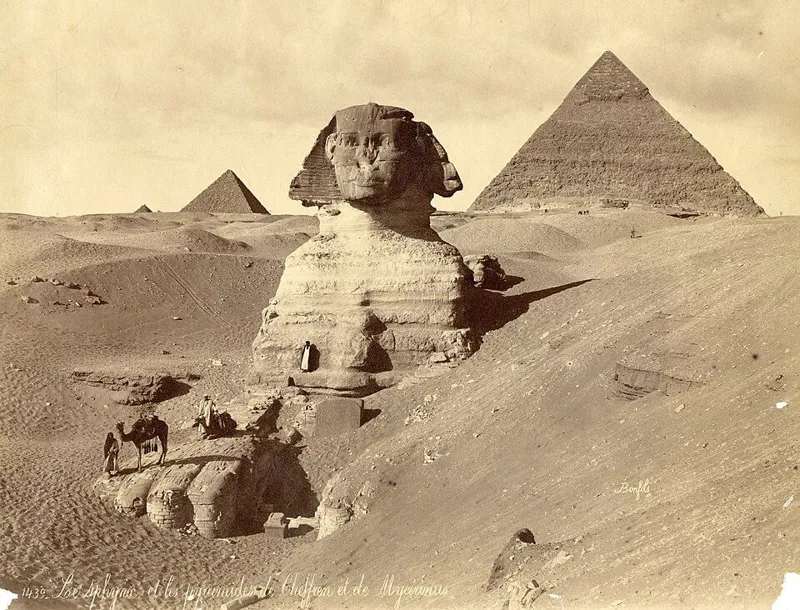
The statue has been buried in sand for most of its history and cleared at least five times: by Thutmose IV about 1400 BC, who set up the granite Dream Stele between the paws and whose name is on mudbrick walls around the enclosure; in the Saite and Roman periods; by Caviglia in 1817 to 1818, who found the stele and the beard fragments; by Mariette and Maspero in the nineteenth century; by Baraize from 1925 to 1936, who exposed the Sphinx Temple and added much of the present masonry; and by Selim Hassan in 1936 to 1938[1][13][2]. The body is clad in limestone blocks of several phases, the oldest of which Lehner attributes to Thutmose IV; the original carved surface survives beneath them[1].
The ARCE Sphinx Project (1979 to 1983, field director Mark Lehner) produced the first complete record: photogrammetric elevations and a plan at 1:50 by Ulrich Kapp, maps of the two temples at 1:100, geological and topographic maps of the enclosure at 1:200, sections of the masonry at 1:10 and 1:20, about 7,700 photographs and a water-table profile for 1981 to 1982. The archive was published through Open Context in 2017 under a CC BY 4.0 licence[14][15]. Lehner's 1991 Yale dissertation is the full written publication of the survey[16]. Hawass's team laser-scanned the statue around 2010 for conservation; those data are not public[17]. The Giza Project at Harvard publishes a 3D model of the Sphinx for its reconstructions, without stated accuracy or download terms[18].
Timeline
What was found
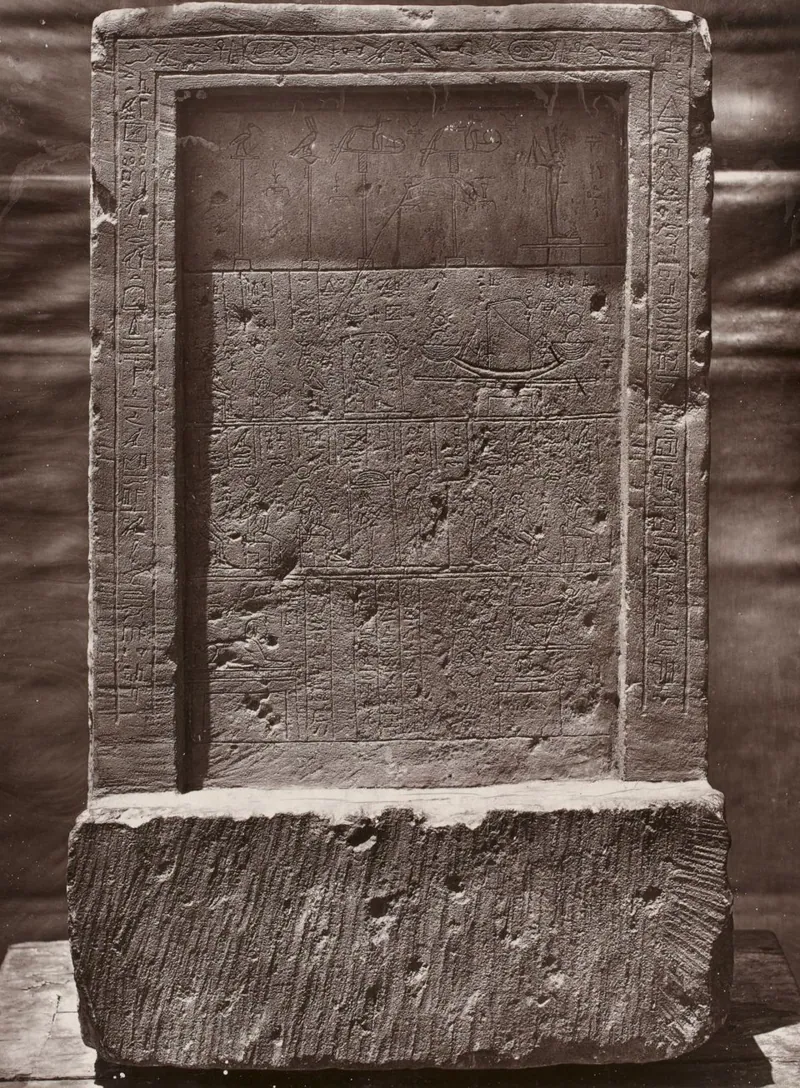
No Old Kingdom text names the Sphinx; texts about it begin in the New Kingdom[1]. The best known is the Dream Stele, a 3.6-metre granite slab reused from a lintel of Khafre's mortuary temple, set up in Thutmose IV's first year (about 1401 BC). It tells how the prince slept in the Sphinx's shadow, was promised the kingship by the god Horemakhet if he cleared the sand, and did so. A damaged line contains the syllable "Khaf", read by some as Khafre's name, but the passage is fragmentary[13]. The Inventory Stela (Cairo JE 2091), found by Mariette in 1858 in the Isis temple beside the Great Pyramid, says Khufu found the temple of Isis already standing beside the "house of Harmakhis", the Sphinx, and rebuilt it. It is a Saite (Twenty-sixth Dynasty) composition, written about two thousand years after Khufu, which names him by his Horus name, gives Isis a title she never held and makes Henutsen a king's daughter; Egyptologists treat it as a claim of antiquity by the Isis temple's priests[19][20].
The beard is the Sphinx's one detached part with a museum history. Caviglia recovered fragments of a plaited limestone beard in 1817 to 1818; one piece (78.7 cm high) is in the British Museum as EA58, and other pieces are in Cairo. The style is New Kingdom, and the pieces are read as an addition of Thutmose IV's restoration rather than part of the original carving, though Digital Giza files the fragments under Dynasty 4[21][22]. Fragments of the Sphinx's uraeus, the royal cobra on the brow, were found with the beard[2]. A life-size statue of Khafre, found by Mariette in the ruins of the Valley Temple, is the basis for reading the Sphinx as part of his statue programme[2][1]. In 1978 Hawass and Lehner found three stone blocks abandoned in a corner of the Sphinx quarry while being dragged to the Sphinx Temple, which they read as a sign that the workers stopped abruptly[2]. A passage under the Sphinx, opened by Baraize and re-examined by Hawass and Lehner in 1980, proved to be a shallow cut with no chamber[23].
What is known
Three lines of evidence tie the Sphinx to Khafre. The Sphinx Temple's core blocks carry the same fossil beds as the Sphinx ditch, so the temple was built from the ditch's quarry[1][2]. The temple's plan, core-and-granite construction and alignment match Khafre's Valley Temple beside it. A drainage channel running along the north side of Khafre's causeway opens into the upper corner of the ditch; Selim Hassan reasoned that the builders would not have let it drain into an existing ditch, so the ditch was quarried after the causeway, late in Khafre's reign. Schoch countered that the rear of the ditch was cut much later than the front and sides, so the channel dates only the west wall; Lehner replies that Schoch then cannot also cite the west wall's weathering as evidence of age[7]. The Sphinx stands at the end of that causeway as the valley element of the pyramid complex, and the Khafre statues from the Valley Temple give the only royal face for comparison[1].
The geology is also well recorded. Gauri's group published the bed-by-bed porosity and durability of the limestone and showed that the softer beds of Member II recede faster whatever the agent; they attributed the modern flaking to salt crystallisation driven by moisture and daily temperature cycles[5][24]. The deep rounding of the ditch walls is agreed by all sides to be real; what is disputed is the agent and the time it took. Harrell measured the enclosure floor against flood levels and the water-holding capacity of the sand that filled it for most of 4,500 years, and argued that wet-sand burial and repeated flooding produce the observed decay without any pre-Old Kingdom time[6].
Schoch's seismic profiles found a weathered low-velocity layer beneath the ditch floor that was deeper on the sides and front than behind the rump, which he read as longer exposure of the sides; Harrell pointed out that the velocities behind the Sphinx were lower than at the sides, the opposite of what that reading needs, and that the layer may be a depositional reef facies[3][6]. Reader's 2001 Archaeometry paper accepted runoff erosion in the ditch and dated it by the quarrying history of the plateau above, which drew a published comment and reply[8][25]. The 2023 NYU experiment is a laboratory analogue only: 10-centimetre clay mounds in a water tunnel, at Reynolds numbers far below natural wind-blown sand, and the authors say their results "hardly resolve" the Sphinx[10].
The explanations
Khafre, about 2500 BC. The Sphinx was designed as part of Khafre's complex and carved with the Sphinx Temple in a single quarrying operation; the head is his portrait; the weathering is the product of soft beds, salt, wet-sand burial and flooding over 4,500 years, and tells nothing about age beyond that[1][5][6]. This reading predicts that no feature of the Sphinx or its enclosure can be shown to pre-date Khufu's quarrying, and that the Sphinx Temple's masonry and the ditch are contemporaneous. Lehner argues both hold; no pre-Khufu material has been published from the enclosure[7].
A much older core, 5000 BC or earlier. Schoch holds that the rounded profile and deep fissures are rain erosion from the wet Sahara of the early Holocene or the end of the last Ice Age, that the seismic weathering depth implies 7,000 to 12,000 years of exposure, that the head was recut in dynastic times (which is why it is small for the body), and that a lion or lioness was the original form[4][3]. It predicts datable pre-dynastic human activity in the enclosure, erosion features in Member I and II that no Old Kingdom process can produce, and a seismic weathering gradient consistent across the ditch. None of these has been shown; the seismic gradient is contested, and no pre-dynastic material has been found in the enclosure[6][7].
Early dynastic, about 2700 to 3000 BC. Reader accepts runoff as the agent but places it in the Early Dynastic Period, when the plateau's drainage ran into the Sphinx area before Khufu's quarries intercepted it; he argues Khafre's Valley Temple is later than the Sphinx Temple, that Second Dynasty masonry skills were sufficient, and in 2026 that the body was carved for the lion goddess Mafdet and the head recut by Khufu[8][9]. It predicts that the ditch's runoff features pre-date Khufu's quarry cuts stratigraphically and that the Sphinx Temple is earlier than the Valley Temple. Egyptologists have not accepted the stratigraphic argument. The book had a favourable notice in Ancient Egypt magazine in April 2026, and Peter Lacovara's review is in press in the American Journal of Archaeology[26][27].
A natural yardang shaped by the builders. The NYU experiment shows that a hard inclusion in an eroding mound yields head, neck, back and paws under a steady flow; the reading is that a wind-carved outcrop suggested the lion and was finished by hand[10]. It predicts a pre-existing landform in the plateau's geomorphology at the Sphinx's position; the quarry evidence is that the body was freed by cutting a ditch into a flat bench, which leaves little room for a free-standing yardang[1].
Little erosion at all. Schneiker's 2025 poster proposes that the rough body was shaped by pounding during construction and faced with a veneer, that sand protected it, and that looting of the veneer exposed the rough core now read as weathering[11]. It predicts that the "weathered" surfaces carry tool marks under the masonry and that the fissures are quarry features. Lehner's record of the core beneath the earliest cladding is the test; no paper behind the poster had appeared by October 2026.
What it represented. The head is small for the body, which every side notes. The usual reading is that the sculptors reserved a block of good Member III stone for the head and carved the body to the rock available, or that the body was lengthened to pass a fissure[1]. Robert Temple argued in 2009 that the original was a jackal, Anubis, with the present head recut under the Middle Kingdom; Schoch and Reader argue for a lion or lioness head recut in the Old Kingdom[28][4][9]. Each predicts a different original neck line and proportions beneath the New Kingdom and later cladding, and none has been tested against the ARCE elevations.
Published claims
| Year | Who | Claimed | Status | Reason |
|---|---|---|---|---|
| 1990 | A. N. Chowdhury, A. R. Punuru and K. Lal Gauri[24] | The Sphinx's limestone beds flake because salts crystallise in their pores as moisture comes and goes, and the softer beds go fastest. | Accepted | Later geological replies built on the measurements and no study has contradicted the mechanism[5][6]. |
| 1992 | Mark Lehner[1] | The Sphinx was carved for Khafre, about 2500 BC, in the same quarrying operation that supplied the Sphinx Temple's blocks. | Accepted | Fossil beds in the temple blocks match the ditch, and no pre-Khufu material has been published from the enclosure[2][7]. |
| 1992 | Robert Schoch[29] | The enclosure walls are eroded by rain, so the core of the Sphinx was carved around 7000 to 5000 BC, long before Khafre. | Disputed | Geologists attribute the weathering to salt, wet sand and flooding within the Old Kingdom date, and no pre-dynastic material has been found in the enclosure[6][7]. |
| 1992 | Thomas Dobecki and Robert Schoch[3] | Seismic profiles show a weathered layer under the ditch floor deep enough to imply thousands of years of exposure before the Old Kingdom. | Disputed | Harrell found the velocities internally inconsistent and the depth differences explained by the rock's own beds[6]. |
| 1994 | James Harrell[6] | Wet sand, clay swelling, salt and Nile flooding of the enclosure floor explain the deep weathering within the Old Kingdom date. | Accepted | It agrees with the Louisville group's bed-by-bed work and has not been answered by new field data[5]. |
| 1994 | Mark Lehner[7] | The ditch was cut late in Khafre's reign, and the weathering forms Schoch reads as rain can arise from other processes. | Accepted | The construction sequence rests on the causeway channel and the temple blocks, and no published survey has overturned it[1]. |
| 1995 | K. Lal Gauri, John Sinai and Jayanta Bandyopadhyay[5] | The weathering profile follows the beds of the rock and was produced by salt and moisture under sand cover within the Old Kingdom date. | Accepted | It is the peer-reviewed geological reply to the redating and has not been refuted[6]. |
| 2000 | Rainer Stadelmann[30] | The Sphinx was made for Khufu, not Khafre, as the style of its headdress and beard show. | Still possible | Lehner's construction sequence ties the ditch to Khafre's causeway, but the stylistic argument has not been settled[7]. |
| 2001 | Colin Reader[8] | Runoff eroded the enclosure before Khufu's quarries cut off its catchment, so the Sphinx dates from the Early Dynastic Period. | Disputed | Egyptologists have not accepted the stratigraphic argument, and the fossil match ties the Sphinx Temple to the ditch in Khafre's programme[25][1]. |
| 2001 | Toby Wilkinson[25] | The archaeology of Giza does not support an Early Dynastic monument on the plateau. | Most likely | The Fourth Dynasty date remains the field's position, though Reader replied in the same issue and restated his case in 2026[9]. |
| 2009 | Robert Temple and Olivia Temple[28] | The Sphinx was first a jackal, Anubis, guarding a moat, and its head was recut as a king's in the Middle Kingdom. | Disputed | Lehner records the headdress and uraeus as part of the original carving, and the book has had no peer review[1]. |
| 2023 | Samuel Boury, Scott Weady and Leif Ristroph[10] | Clay mounds with a hard inclusion erode in flowing water into lion-like forms, so a natural yardang may have suggested the Sphinx. | Still possible | The experiment is a qualitative analogue, and its authors say it does not resolve the question[10]. |
| 2025 | Robert Schneiker[11] | The Sphinx shows little true erosion: its rough core was pounded into shape, faced with a veneer, and exposed when the veneer was looted. | Still possible | It is a conference poster; no paper behind it had appeared by October 2026[11]. |
| 2026 | Colin Reader[9] | The Sphinx was carved in the Second Dynasty as the lion goddess Mafdet, and Khufu had its head recut in his own image. | Still possible | A magazine review was favourable; the first academic review is in press, and the recutting has not been tested against the survey data[26][27]. |
What would settle it
The age question turns on stratigraphy that already exists in map form. The ARCE archive's 1:50 elevations, 1:200 geological maps and masonry sections allow the Member II bed recession to be measured bed by bed around the whole body and ditch and compared with the same beds in Khufu's and Khafre's quarries; if the agent was early Holocene rain, the pattern should not correlate with burial depth and flood level, and if it was wet sand and salt, it should[15][6]. A repeat seismic survey of the ditch floor with modern equipment, published with the raw traces, would settle the weathering-depth argument that has stood unresolved since 1992[3]. Luminescence or cosmogenic-nuclide dating of the quarried ditch faces, where unweathered rock was first exposed, would give an exposure age independent of both camps.
The head question needs the data under the cladding: a published 3D model of the core body from the ARCE photogrammetry or the 2010 laser scans, with the neck and chest profile analysed for recutting. The Khafre attribution would be strengthened by a Fourth Dynasty text naming the statue, which has never been found, and would be overturned only by securely dated pre-Khufu material in the enclosure or under the Sphinx Temple.
Questions
0 of 6 questions are answered.
Evidence 43 findings
Artifacts
The films, photos, papers and objects this mystery rests on, each with its own key and its distance from the original.
See also
References
- 1.Lehner, M. 1992. Reconstructing the Sphinx. Cambridge Archaeological Journal 2(1): 3-26.doicited 20 times hereSRC0CTWRSPG31HX
- 2.Hadingham, E. 2010. Uncovering Secrets of the Sphinx. Smithsonian Magazine, February 2010.cited 9 times hereSRC0CTWRTNR2N3D
- 3.Dobecki, T., Schoch, R. 1992. Seismic investigations in the vicinity of the Great Sphinx of Giza, Egypt. Geoarchaeology 7(6): 527-544.doicited 8 times hereSRC0CTWRWCE2JAW
- 4.Schoch, R. n.d.. The Great Sphinx (Robert Schoch's statement of the redating). robertschoch.com.cited 9 times hereSRC0CTWRWM84SS4
- 5.Gauri, K., Sinai, J., Bandyopadhyay, J. 1995. Geologic weathering and its implications on the age of the Sphinx. Geoarchaeology 10(2): 119-133.doicited 5 times hereSRC0CTWRVN048W5
- 6.Harrell, J. 1994. The Sphinx Controversy: Another Look at the Geological Evidence. KMT 5(2), Summer 1994: 70-74.cited 13 times hereSRC0CTWRW4M7ANG
- 7.Lehner, M. 1994. Notes and Photographs on the West-Schoch Sphinx Hypothesis. KMT 5(3), Fall 1994: 40-48.cited 8 times hereSRC0CTWRT6451X8
- 8.Reader, C. 2001. A Geomorphological Study of the Giza Necropolis, with Implications for the Development of the Site. Archaeometry 43(1): 149-165.doicited 8 times hereSRC0CTWRWW22NE7
- 9.Reader, C. 2026. Rewriting the History of the Great Sphinx. Archaeopress Archaeology, Oxford (332 pp., ISBN 9781805832096).doicited 5 times hereSRC0CTWRXBP1TMP
- 10.Boury, S., Weady, S., Ristroph, L. 2023. Sculpting the Sphinx. Physical Review Fluids 8, 110503 (Gallery of Fluid Motion).doicited 6 times hereSRC0CTWRXVA1BVT
- 11.Schneiker, R. 2025. The Great Sphinx: A New View on the Erosion Enigma. Geological Society of America Abstracts with Programs 57(6), paper 63-6, GSA Connects 2025, San Antonio, 19 October 2025.doicited 6 times hereSRC0CTWRY340M59
- 12.Ancient Egypt Research Associates n.d.. Geology of the Sphinx. aeraweb.org.cited 2 times hereSRC0CTWRTXJ6W11
- 13.Wikipedia contributors n.d.. Dream Stele. Wikipedia.cited 5 times hereSRC0CTWRYJR3Z6A
- 14.Ancient Egypt Research Associates n.d.. ARCE Sphinx Project 1979-1983 Archive. aeraweb.org.cited 5 times hereSRC0CTWRV5C521K
- 15.Lehner, M., Flowers, M., Miracle, R. 2017. ARCE Sphinx Project 1979-1983 Archive (Open Context). Open Context (Alexandria Archive Institute).doicited 4 times hereSRC0CTWRVD671KF
- 16.Lehner, M. 1991. Archaeology of an Image: The Great Sphinx of Giza. Ph.D. dissertation, Yale University (UMI 1994), 534 pp..cited 2 times hereSRC0CTWRSYA5W67
- 17.Maptek 2010. I-Site makes most accurate 3D model of the Sphinx ever. Maptek news, 14 September 2010.cited 3 times hereSRC0CTWRZST5ZVQ
- 18.Giza Project at Harvard University n.d.. 3D model of the Sphinx (primary model), GPH_3D_Sphinx. Digital Giza.cited 2 times hereSRC0CTWS10W2AZE
- 19.Giza Project at Harvard University n.d.. Limestone inventory stela (GEM_3568, Cairo JE 2091). Digital Giza.cited 3 times hereSRC0CTWRZ2C0BQH
- 20.Wikipedia contributors n.d.. Inventory Stela. Wikipedia.cited 4 times hereSRC0CTWRYTJ654Q
- 21.British Museum n.d.. Part of the limestone beard of the Sphinx at Giza (EA58). British Museum collection online.cited 5 times hereSRC0CTWRZJ05YN0
- 22.Giza Project at Harvard University n.d.. Fragments of beard of Great Sphinx (GEM_1089). Digital Giza.cited 3 times hereSRC0CTWRZA64MWP
- 23.Hawass, Z., Lehner, M. 1994. The Passage under the Sphinx. Hommages à Jean Leclant, vol. 1 (Bibliothèque d'Étude 106/1), IFAO, Cairo: 201-216.cited 2 times hereSRC0CTWRTDY44ZH
- 24.Chowdhury, A., Punuru, A., Gauri, K. 1990. Weathering of limestone beds at the Great Sphinx. Environmental Geology and Water Sciences 15: 217-223.doicited 3 times hereSRC0CTWRVWT5BCP
- 25.Wilkinson, T. 2001. Comment on C. D. Reader, 'A Geomorphological Study of the Giza Necropolis'. Archaeometry 43(1): 163-165.doicited 2 times hereSRC0CTWRX3W7VW8
- 26.JPP 2026. Rewriting the History of the Great Sphinx (book review). Ancient Egypt magazine 154, published on The Past, 16 April 2026.cited 3 times hereSRC0CTWS01M05VX
- 27.Lacovara, P. 2026. Rewriting the History of the Great Sphinx (review). American Journal of Archaeology (ahead of print, 2026; issue dated January 2027).doicited 1 time hereSRC0CTWRXKG1NXG
- 28.Temple, R., Temple, O. 2009. The Sphinx Mystery: The Forgotten Origins of the Sanctuary of Anubis. Inner Traditions, Rochester, Vermont (ISBN 9781594772719).cited 7 times hereSRC0CTWRYAY4SX6
- 29.Schoch, R. 1992. Redating the Great Sphinx of Giza. KMT: A Modern Journal of Ancient Egypt 3(2), Summer 1992: 53-59, 66-70.cited 1 time hereSRC0CTWS1GG5GKV
- 30.Stadelmann, R. 2000. The Great Sphinx of Giza. Hawass, Zahi (ed.), Egyptology at the Dawn of the Twenty-first Century: Proceedings of the Eighth International Congress of Egyptologists, Cairo, 2000, vol. 1, American University in Cairo Press: 464-469.cited 2 times hereSRC0CTWS09E6ANS