Puma Punku and Tiwanaku
Tiwanaku lies on the altiplano 15 km from the southern shore of Lake Titicaca. Bayesian reassessment of its radiocarbon dates puts the founding of the settlement around AD 110 rather than the 300 BC long repeated, and its growth into a city of monumental platforms, sunken courts and gateways around AD 500[1][2]. At its height between about AD 500 and 1000 it was the centre of a state whose temples and colonies reached into Peru and Chile; a terraced platform temple 215 km to the south-east was reported in 2025[3].
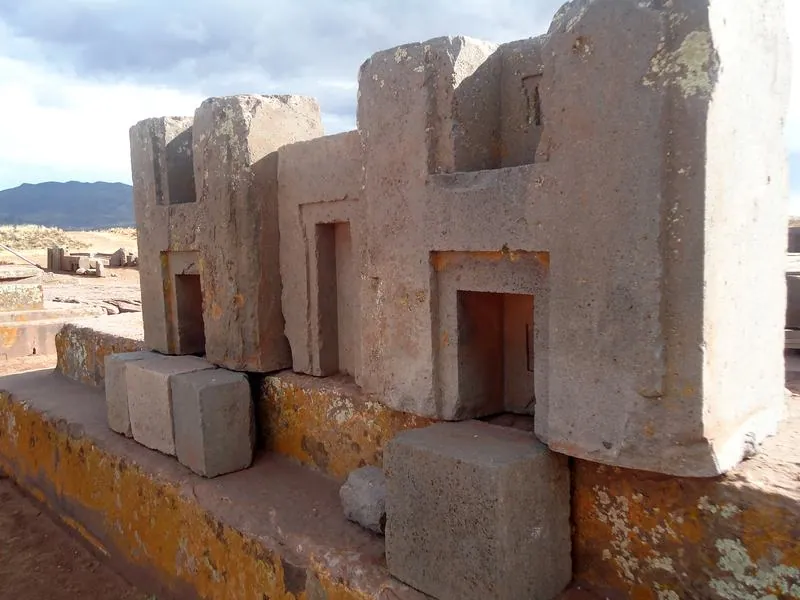
Puma Punku is one of its platforms: a terraced mound faced with red sandstone, with a stair and a paved court on top, built in the sixth century AD and rebuilt more than once[4]. On it stood the buildings that made the site famous: walls, gateways and lintels of grey andesite cut into repeated modules, with flat faces, square sockets, drilled holes and interior angles so regular that the blocks could be swapped for one another, and sandstone slabs weighing more than 100 tonnes forming the platform's floor[5][6]. Spanish writers of the sixteenth century described the building as wonderful and unfinished. Five centuries of looting have left about 150 shattered blocks of the standing architecture, none in its original place[7].
The questions people bring to Puma Punku are how stone could be cut so exactly without iron, how blocks of such weight were moved at 3,850 m, and whether the Tiwanaku could have done it at all. The measurements answer most of them: the stones come from known quarries with unfinished blocks still in them, the cuts carry the marks of stone hammers and abrasives, and the precision is that of templates and modules, not machines[8][6]. What the evidence has not settled is the building's exact form, why it was never finished, and what ended the city[7][9]. Of the 4 questions on this site, 1 are answered. The most likely answer to “What did the andesite buildings on Puma Punku look like, and why were they left unfinished?”, not yet confirmed: a complex of gateways, walls and lintels on the platform's east side, assembled from modular blocks, that….
Key questionsset by the editors
The site
Tiwanaku's monumental core includes the Akapana, a stepped platform mound; the Kalasasaya enclosure with the Gateway of the Sun; the semi-subterranean temple; and Puma Punku, 1 km to the south-west. The platforms are built of earth and rubble faced with cut sandstone, with andesite used for gateways, lintels and the finest walls[2][6]. The gateways and platforms are oriented to the solar horizon and the night sky, and the architecture channelled processions through sequences of courts and doorways[10][4].
Puma Punku's platform is a T-shaped terraced mound about 167 m by 117 m and 5 m high on the published plans, with a monumental stair on the west and a sunken court; the great sandstone slabs of the floor, the largest estimated at over 130 tonnes, lie on its eastern side[4][6]. The andesite blocks that lay on and around it are the H-shaped blocks, the gateway fragments and the lintels with their regular niches[5].
Timeline
What was found
Excavation by Vranich dated the platform's first construction to the sixth century AD from radiocarbon in its lowest fill, and showed repeated episodes of rebuilding and resurfacing, with later additions never completed[4]. The Spanish accounts of an unfinished building agree with the unfinished blocks on the site[7].
Protzen and Nair measured the andesite pieces and showed that the H-blocks, the niche blocks and the lintels were cut to standard modules from templates, so that any block of a type fits any position of that type; they also recorded the tool marks, pecking with stone hammers followed by grinding and polishing with sand and water, and reproduced the cuts with such tools in experiments[5][6]. Many blocks carry T-shaped and I-shaped sockets for metal cramps that joined them, and the cramps' copper-arsenic alloy was poured in place[6].
Janusek and colleagues traced the stone by geochemistry. The red sandstone comes from quarries in the Kimsachata range about 10 km south, where quarry faces, roads and abandoned blocks survive; the andesite comes from the Ccapia volcano on the Peruvian side of the lake and from Copacabana, 90 km away by water, and the authors read the lake crossing as made on reed boats, with sledges and ramps on land[8]. Vranich's project printed the measured blocks at scale and refitted them, producing a reconstruction of the gateway building that differs from the earlier conjectures[7].
What is known
The date of Puma Punku is fixed to the Tiwanaku period, from the sixth century AD, by excavation[4]. The city's chronology is now anchored by a Bayesian model: founded about AD 110, monumental from about AD 500, in decline after about AD 1000[1][2]. The stones' sources are known and the quarries have been visited and sampled[8]. The working method is known from the tool marks, the unfinished pieces and the experiments[6]. The state's reach is known from its temples abroad, most recently Palaspata[3].
What is not known is the full plan and elevation of the andesite buildings, since no block stands where it was set[7], the reason the work stopped, and the cause of the city's decline.
The explanations
On the precision, the archaeological reading is that the Tiwanaku masons achieved it with templates, modules, stone tools and abrasives over long working times, as the measurements, tool marks and experiments show[5][6]. The claim that the blocks are too exact for the culture, often paired with the claim that they are far older than the city, predicts tool marks or tolerances that stone tools cannot produce and dates earlier than the Tiwanaku period; neither is found[6][4].
A 2019 paper argued from electron microscopy that the andesite and sandstone are geopolymers, cast in moulds from crushed rock and organic binder[11]. This predicts a stone with no natural igneous texture and no match to a quarry. The andesite has been matched geochemically to the Ccapia volcano and the sandstone to Kimsachata, where quarry faces and abandoned blocks of the same material remain, and the blocks carry the pecking and grinding marks of carving[8][6]. The geopolymer reading has not been taken up by Andean archaeologists or petrologists.
On the collapse, one reading is a drought from about AD 1100, recorded in lake levels and ice cores, that made the raised fields fail[9]. Janusek and others read the decline as beginning earlier and as political and religious as much as environmental: the monuments were desecrated and the city's ritual order was abandoned[2]. The two are not exclusive.
On the building's purpose, Vranich reads Puma Punku as a processional stage, with its stair, court and gateways framing views and movement, that was continuously rebuilt as part of the ritual itself rather than aimed at completion[4][10].
Published claims
| Year | Who | Claimed | Status | Reason |
|---|---|---|---|---|
| 1553 | Pedro de Cieza de León[12] | The great stone buildings at Tiahuanaco were never finished, were begun before the Incas, and are the oldest ruins in Peru. | Accepted | Excavation dates Puma Punku to the sixth century AD, long before the Incas, and finds later additions left incomplete[4][7]. |
| 1945 | Arthur Posnansky[13] | Tiwanaku was built in the last Ice Age, about 15,000 BC. | Ruled out | Radiocarbon dates put the founding at about AD 110 and Puma Punku's construction in the sixth century AD[1][4]. |
| 1997 | Michael Binford, Alan Kolata and colleagues[9] | A long drought from about AD 1100 made Tiwanaku's raised fields fail and brought down the state. | Still possible | The drought is recorded, but others date the decline earlier and stress political and ritual breakdown; the two readings can be combined[2]. |
| 2000 | Jean-Pierre Protzen and Stella Nair[5] | The H-blocks, niche blocks and lintels were cut to standard modules, so any block of a type fits any position of that type. | Accepted | Confirmed by their full measured study and by the 3D-printed refitting of the blocks[6][7]. |
| 2006 | Alexei Vranich[4] | Puma Punku was first built in the sixth century AD and rebuilt repeatedly as a processional stage, with rebuilding part of the ritual itself. | Most likely | The date is secure from excavation; the reading of continual rebuilding as ritual is an interpretation that fits the unfinished additions[7]. |
| 2012 | John Janusek, Patrick Ryan Williams and colleagues[8] | Tiwanaku's red sandstone came from Kimsachata, about 10 km south, and its andesite from the Ccapia volcano and Copacabana across Lake Titicaca. | Accepted | Geochemical matches to sampled quarries where faces, roads and abandoned blocks of the same stone survive[8]. |
| 2012 | John Janusek, Patrick Ryan Williams and colleagues[8] | The andesite crossed the lake on reed boats and the sandstone was dragged on sledges and ramps. | Most likely | Fits the quarry locations and roads, but no boat or sledge has been found or tested at the weights involved[8]. |
| 2012 | Erik Marsh[1] | Tiwanaku was founded around AD 110, not 300 BC as long stated, and became a complex centre around AD 500. | Accepted | A Bayesian model of the published radiocarbon dates, adopted in later syntheses[2]. |
| 2013 | Jean-Pierre Protzen and Stella Nair[6] | Tiwanaku masons shaped the blocks with stone hammers and sand-and-water abrasion, working from templates, and joined them with copper-arsenic cramps poured in place. | Accepted | Tool marks, unfinished pieces and experiments all agree, and no rival method accounts for the marks[6]. |
| 2015 | John Janusek[2] | Tiwanaku's decline began before the drought and was political and religious as much as environmental, with monuments desecrated and its ritual order abandoned. | Still possible | Fits the desecration evidence, but the timing of the last building and first desecration at each monument is not finely dated[1][9]. |
| 2017 | Alexei Vranich and Scott Smith[10] | Tiwanaku's platforms and gateways were oriented to the solar and stellar horizon and used in night-time ritual. | Most likely | The orientations are measured; their ritual use is inferred from the architecture[10]. |
| 2018 | Alexei Vranich[7] | Refitting 3D-printed copies of the measured blocks gives a gateway complex on the platform's east side that differs from earlier conjectures. | Most likely | The best-documented reconstruction, but no block stands in place and the sockets and cramp holes have not all been tested against it[7]. |
| 2019 | Joseph Davidovits and colleagues[11] | Puma Punku's andesite and sandstone blocks are geopolymers, cast in moulds from crushed rock and an organic binder. | Disputed | The blocks carry carving marks and match quarries where blocks of the same stone were abandoned, and Andean archaeologists and petrologists have not taken the claim up[6][8]. |
| 2025 | José Capriles and colleagues[3] | A Tiwanaku platform temple at Palaspata, 215 km south-east of the city, controlled trade with the Cochabamba valleys. | Most likely | The temple's Tiwanaku form is clear; its role as a trade gateway is the authors' reading[3]. |
What would settle it
The form of the andesite buildings would be settled by matching every surviving block to the refitted reconstruction and testing it against the sockets and cramp holes, and by excavation of the platform surface for foundations[7]. The geopolymer claim would be settled by publishing thin sections and whole-rock and trace-element analyses of the blocks alongside the Ccapia and Kimsachata quarry samples, which already exist[8]. The end of the city would be narrowed by high-resolution dating of the last construction and the first desecration at each monument, set against the lake-level record[1][9].
Questions
1 of 4 questions are answered.
Evidence 16 findings
Artifacts
The films, photos, papers and objects this mystery rests on, each with its own key and its distance from the original.
See also
References
- 1.Marsh, E. 2012. A Bayesian Re-Assessment of the Earliest Radiocarbon Dates from Tiwanaku, Bolivia. Radiocarbon.doicited 5 times hereSRC0D69Y9ZE0N0B
- 2.Janusek, J. 2015. Tiwanaku urban origins: distributed centers and animate landscapes. The Cambridge World History, Volume 3 (Cambridge University Press).doicited 9 times hereSRC0D69Y9QM22TD
- 3.Capriles, J., Calla Maldonado, S., Calero, J. et al. 2025. Gateway to the east: the Palaspata temple and the south-eastern expansion of the Tiwanaku state. Antiquity.doicited 3 times hereSRC0D69YAF2263B
- 4.Vranich, A. 2006. The Construction and Reconstruction of Ritual Space at Tiwanaku, Bolivia (A.D. 500–1000). Journal of Field Archaeology.doicited 7 times hereSRC0D69Y8GJ3RVF
- 5.Protzen, J., Nair, S. 2000. On Reconstructing Tiwanaku Architecture. Journal of the Society of Architectural Historians.doicited 4 times hereSRC0D69Y906129A
- 6.Protzen, J., Nair, S. 2013. The Stones of Tiahuanaco: A Study of Architecture and Construction. Cotsen Institute of Archaeology Press.doicited 12 times hereSRC0D69Y98073FQ
- 7.Vranich, A. 2018. Reconstructing ancient architecture at Tiwanaku, Bolivia: the potential and promise of 3D printing. Heritage Science.doicited 9 times hereSRC0D69Y8RC0P1P
- 8.Janusek, J., Williams, P., Golitko, M. et al. 2012. Building Taypikala: Telluric Transformations in the Lithic Production of Tiwanaku. Mining and Quarrying in the Ancient Andes (Springer, Interdisciplinary Contributions to Archaeology).doicited 9 times hereSRC0D69Y9FT5X34
- 9.Binford, M., Kolata, A., Brenner, M. et al. 1997. Climate Variation and the Rise and Fall of an Andean Civilization. Quaternary Research.doicited 4 times hereSRC0D69YA782SZ9
- 10.Vranich, A., Smith, S. 2017. Nighttime Sky and Early Urbanism in the High Andes: Architecture and Ritual in the Southern Lake Titicaca Basin during the Formative and Tiwanaku Periods. Archaeology of the Night (University Press of Colorado).doicited 1 time hereSRC0D69YAYP3H0F
- 11.Davidovits, J., Huaman, L., Davidovits, R. 2019. Ancient geopolymer in south-American monument. SEM and petrographic evidence. Materials Letters.doicited 4 times hereSRC0D69YAPW0FZK
- 12.Cieza de León, P., Markham, C. 1864. The Travels of Pedro de Cieza de León, A.D. 1532–50, contained in the first part of his Chronicle of Peru. Hakluyt Society, London.cited 1 time hereSRC0D69YBEA35DP
- 13.Posnansky, A. 1945. Tihuanacu, the Cradle of American Man. J. J. Augustin, New York (volumes I–II 1945, III–IV 1957).cited 1 time hereSRC0D69YBP44T9Y