Gunung Padang
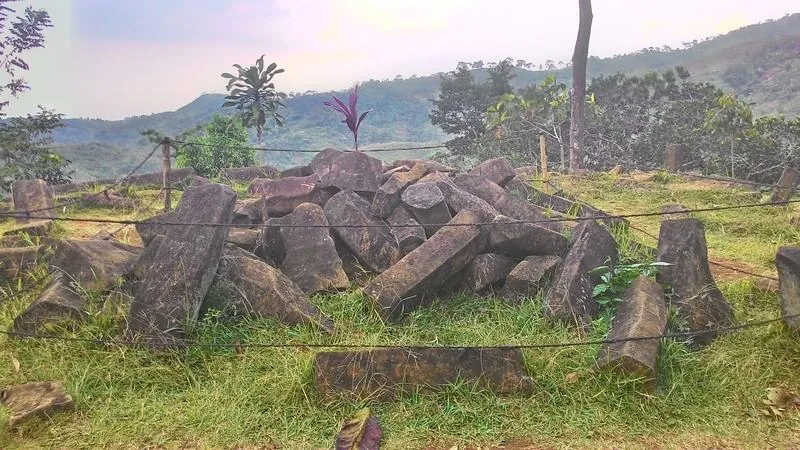
Gunung Padang is a promontory on an extinct volcano in Cianjur, West Java, whose top was cut into five terraces held up by retaining walls and covered with rectangular enclosures made from prismatic blocks of andesite. A stair of about 370 stone steps climbs to it from the valley. The blocks are columnar joints, a shape the rock takes naturally as lava cools, and the builders used them for walls and enclosures[1][2].
Archaeologists who have excavated the terraces since the 1980s date them by charcoal under the walls to the last centuries BC, about 117 BC under terrace 1 and about 50 BC under terraces 2 and 4, and read the site as a punden berundak, a terraced shrine to ancestral spirits that was used for centuries[1][3].
In October 2023 the geologist Danny Hilman Natawidjaja and colleagues published a paper arguing that the hill is a buried pyramid built in stages, the oldest dated to 25,000 to 14,000 BC, with hidden chambers inside[4][5]. In March 2024 the publisher and the editors retracted it: the dates came from soil with no artefacts or features that could be read as human work, so the inference of a pyramid 9,000 or more years old was unsupported. The authors disagree with the retraction[6][7].
In 2025 the Ministry of Culture began a study and restoration programme led by Ali Akbar, a co-author of the retracted paper. The team excavated on all five terraces and began shoring the landslide-prone upper ones[8]. In December 2025 it announced, without publishing data, that carbon from about 4 m under the fifth terrace gives an age of about 6000 BC[9][10]. Of the 5 questions on this site, 1 are answered. The most likely answer to “Is there a human-built structure inside the hill older than the visible terraces?”, not yet confirmed: the core is a volcanic body with natural columnar jointing; the deep layers are weathered and slumped columns….
Key questionsset by the editors
The site
The terraces step up a narrow ridge, the lowest and largest first, the fifth and smallest at the top. Each carries enclosures, paths and standing stones built from andesite columns, and a stone well at the foot of terrace 1 may have supplied water for ceremonies. One block on terrace 1, the batu kecapi, rings when struck[1]. Yondri has studied how the columns were laid and stacked in the walls[2].
The Dutch archaeologist N. J. Krom recorded the site in 1914. It was then ignored for decades until farmers from Karyamukti reported it in 1979, and the national archaeology institute excavated and exposed its layout in the 1980s[1]. Between 2011 and 2015 a team of geologists, with government support, drilled and surveyed the hill in search of a buried structure, a project criticised at the time as driven by national pride[4][11].
Timeline
What was found
Excavation on the terraces has produced charcoal under the retaining walls, pottery and a grinding stone, but no animal bone that would point to feasting. Yondri reads the spread of dates as building by several generations and use over many centuries[1].
The 2023 paper reported four layers from the surface down: Unit 4, the visible megalithic terraces; Unit 3, columnar rock in a matrix of soil; Unit 2, coarse sand and pillar-like rock; and Unit 1, a lava core that it argued had been sculpted. Radiocarbon dates on organic soils from cores gave four phases: 25,000 to 14,000 BC, 7900 to 6100 BC, 6000 to 5500 BC, and 2000 to 1100 BC. Resistivity and seismic tomography showed a high-resistivity, low-velocity zone that the authors read as cavities, and drilling lost water at depth[4][5].
In 2025 the government team reported buried terrace-like structures beside the stair, four upright stones embedded deep in the ground, and a possible source of columns at Pasir Pogor, about 5 km away. In December it announced carbon-bearing material at about 4 m under terrace 5 and a date of about 6000 BC, with no laboratory, sample list or calibrated ranges given[12][10].
What is known
The visible terraces are a human construction. The radiocarbon dates from charcoal under their walls fall in the last centuries BC, and archaeologists place the main megalithic building around 2,000 years ago[1].
The soil dates in the 2023 paper are not in dispute as measurements: critics accept that the samples are as old as reported. What is disputed is what they date. None of the dated soils contained charcoal, bone or artefacts, so they date the formation of the soil, not human work[13]. That is the error the journal named when it retracted the paper[6].
In the region, people lived in caves between about 12,000 and 6,000 years ago, and no stonemasonry of that age is known; Indonesian archaeologists are therefore sceptical of any large construction in the Pleistocene[13][1].
The explanations
The buried-pyramid reading holds that the hill was shaped and built up in four phases over 20,000 years, with chambers inside[4]. It predicts worked stone, tools, hearths or other human traces in the deep layers, dates on material that people made or burned, and voids of regular shape. None of these has been published; the retraction removed the dating basis[6].
The natural-hill reading holds that the core is a volcanic body whose rock broke into columns as it cooled, and that the deeper "layers" are weathered and slumped columns and soil. Dibble notes that blocks moving downslope tend to align, which can mimic order[13]. It predicts columns in their cooling orientation at depth and soils without anthropogenic inclusions.
The archaeological reading holds that people in the last centuries BC terraced the top of a natural hill and built a shrine from the columns lying on it, which they used for centuries[1][3][14]. It predicts that every secure date for construction falls in the late first millennium BC or later.
The 2025 government team's position sits between: an earlier human construction phase in the early Holocene, about 6000 BC, below the visible terraces[10]. It cannot be judged until the samples, their contexts and the laboratory results are published.
Published claims
| Year | Who | Claimed | Status | Reason |
|---|---|---|---|---|
| 2014 | Lutfi Yondri[3] | The terraces are a punden berundak, a terraced shrine to ancestral spirits laid out to suit the hill and its surroundings. | Accepted | The standard archaeological reading, consistent with the finds and with the other terraced shrines of Indonesia[1][14]. |
| 2016 | Lutfi Yondri[2] | The builders laid and stacked the natural andesite columns in regular patterns to make the walls and enclosures. | Accepted | The visible walls are accepted as human work by all parties, including the authors of the pyramid claim[4]. |
| 2018 | Danny Hilman Natawidjaja and colleagues[16] | A large pyramid-like structure inside the hill predates 10,000 years before present. | Disputed | The fuller 2023 version was retracted because its dated soils show no human activity[6]. |
| 2022 | Graham Hancock[17] | Gunung Padang is an Ice Age pyramid with hidden chambers, built by a lost advanced civilisation. | Disputed | It rests on the soil dates the journal later found do not date human work, and no Ice Age stonework is known in the region[6][13]. |
| 2023 | Danny Hilman Natawidjaja and colleagues[4] | The hill is a pyramid built in four phases, the oldest between 25,000 and 14,000 BC, around a sculpted lava core. | Disputed | Retracted in 2024 because the dated soils contain no artefacts or features that could be read as human work; the authors dispute the retraction[6][7]. |
| 2023 | Danny Hilman Natawidjaja and colleagues[4] | The visible megalithic terraces were built between 2000 and 1100 BC. | Disputed | Charcoal sealed under three terrace walls dates to the last centuries BC, though those results are reported only in the press[1]. |
| 2023 | Danny Hilman Natawidjaja and colleagues[4] | A zone of high resistivity and low seismic velocity inside the hill marks built chambers. | Still possible | No borehole or camera has reached the anomaly, which could equally be fractured or loose rock[13]. |
| 2023 | Lutfi Yondri, Flint Dibble and Bill Farley[13] | The dated soils contain no charcoal, bone or artefacts, so they date the formation of the soil, not any building. | Accepted | The journal retracted the paper on the same ground in March 2024[6]. |
| 2023 | Flint Dibble[13] | Columns sliding downslope tend to line up, so the apparent order in the buried layers could be natural. | Still possible | A plausible geological mechanism that no fieldwork on the hill has yet tested[15]. |
| 2024 | Archaeological Prospection and Wiley[6] | The 2023 paper's radiocarbon dates come from soil with no sign of human activity, so they cannot support a pyramid 9,000 or more years old. | Accepted | No data published since show human-made material in the dated layers[1]. |
| 2024 | Lutfi Yondri[1] | Charcoal under the terrace walls dates to about 117 BC on terrace 1 and about 50 BC on terraces 2 and 4. | Accepted | No secure construction date older than these has been published, though the laboratory details are not in print[1]. |
| 2024 | Harry Sofian[14] | Gunung Padang is a terraced shrine of the punden berundak type, not a pyramid. | Accepted | Matches the excavated finds and the dates under the terrace walls[1]. |
| 2025 | Ali Akbar's government study team[12] | Terrace-like structures lie buried beside the stair beyond the five visible terraces, with upright stones set deep in the ground. | Still possible | Announced to the press with no plans, sections or contexts published[12]. |
| 2025 | Ali Akbar's government study team[10] | Carbon from about 4 m under the fifth terrace dates a building phase to about 6000 BC. | Still possible | No laboratory, sample list or calibrated ranges have been released, and the 2023 paper's dates of this kind were found unsound[6]. |
What would settle it
Dated material that only people produce, such as charcoal from a hearth sealed under a built wall, or seeds and bone from an occupation floor, taken from the deep layers in a published excavation, would test any pre-Holocene or early Holocene phase. The 2025 samples need a published list with depths, contexts, materials and laboratory numbers.
The magnetic-susceptibility and orientation work begun by Universitas Indonesia in late 2025 can show whether the buried columns lie in the orientation they had when the lava cooled, which would mean natural, or were moved[15]. An independent re-processing of the 2023 resistivity and seismic profiles, with drill cores logged by a second team, would test the cavities.
Questions
1 of 5 questions are answered.
Evidence 20 findings
Artifacts
The films, photos, papers and objects this mystery rests on, each with its own key and its distance from the original.
See also
References
- 1.Powell, E. 2024. Java's Megalithic Mountain. Archaeology (July/August 2024).cited 18 times hereSRC0D32C8DG685C
- 2.Yondri, L. 2016. Konstruksi dan pola susun balok batu punden berundak Gunung Padang, Cianjur. Purbawidya: Jurnal Penelitian dan Pengembangan Arkeologi 2(2), 163–.doicited 1 time hereSRC0D32C9CR622V
- 3.Yondri, L. 2014. Punden Berundak Gunung Padang: Refleksi Adaptasi Lingkungan dari Masyarakat Megalitik. Jurnal Sosioteknologi 13(1), 1–14.doicited 3 times hereSRC0D32C94Y0EXV
- 4.Natawidjaja, D., Bachtiar, A., Nurhandoko, B. et al. 2023. RETRACTED: Geo-archaeological prospecting of Gunung Padang buried prehistoric pyramid in West Java, Indonesia. Archaeological Prospection 31.doicited 20 times hereSRC0D32C7E83H62
- 5.Cassella, C. 2023. Giant Pyramid Buried in Indonesia Could Be The Oldest in The World. ScienceAlert.cited 2 times hereSRC0D32C8NA7WA1
- 6.Archaeological Prospection 2024. Retraction: Geo-Archaeological prospecting of Gunung Padang buried prehistoric pyramid in West Java, Indonesia. Archaeological Prospection 31(2), 199.doicited 9 times hereSRC0D32C7P200ZQ
- 7.Retraction Watch 2024. Controversial pyramid paper retracted when authors turn out to have radiocarbon-dated nearby dirt. Retraction Watch.cited 1 time hereSRC0D32C7XW6RRQ
- 8.Metro TV News 2025. Fakta Baru di Situs Gunung Padang, Usia Asli Segera Terungkap. Metro TV News.cited 1 time hereSRC0D32CAC044NM
- 9.Khairurizqi, R. 2025. Hadiri Doa Bersama, Menbud Tegaskan Komitmen Pemugaran Situs Gunung Padang. detikNews.cited 4 times hereSRC0D32CA461674
- 10.CNN Indonesia 2025. Gunung Padang Dibangun 6.000 SM, Lebih Tua dari Piramida Mesir. CNN Indonesia.cited 7 times hereSRC0D32CAKT7M87
- 11.Rochmyaningsih, D. 2015. Don't distort policy in the name of national pride. Nature 523, 257.doicited 1 time hereSRC0D32C9WC22JH
- 12.Primayanti 2025. Researchers discover clues to ancient structures at Gunung Padang. ANTARA News Mataram.cited 1 time hereSRC0D32CAVM7M1W
- 13.Lewis, D. 2023. Experts Doubt Claims that World's Oldest Pyramid Was Discovered in Indonesia. Scientific American (reprinted from Nature News).cited 10 times hereSRC0D32C85P3MSD
- 14.Sofian, H. 2024. Teka-teki situs Gunung Padang: Bukan piramida, tapi punden berundak. The Conversation Indonesia.doicited 3 times hereSRC0D32C9MJ78HP
- 15.Universitas Indonesia, D. 2026. Gunung Padang: Re-reading an Ancient Site Between Science and Earth's Magnetic Traces. Universitas Indonesia.cited 2 times hereSRC0D32CB3E7VPD
- 16.Natawidjaja, D., Bachtiar, A., Endar, B. et al. 2018. Evidences of Large pyramid-like structure predating 10,000 Year BP at Mount Padang, West Java, Indonesia: Applications of geological-geophysical methods to explore buried large archeological site. ESS Open Archive (AGU Fall Meeting 2018 poster).doicited 2 times hereSRC0D32C8X44CEN
- 17.Hancock, G. 2022. Ancient Apocalypse, episode 1: Once There Was a Flood. Netflix.cited 1 time hereSRC0D32CBB83AED