The Tarim Basin mummies (Xiaohe)
Since the 1990s the Tarim Basin in western China has yielded hundreds of naturally dried bodies dating from about 2000 BC to AD 200, preserved by the desert's salt and aridity. The earliest come from the lowest layers of cemeteries at Gumugou, Xiaohe and Beifang[1]. They were dressed in felted and woven wool, buried in boat-shaped coffins under posts and oars of wood, and given cattle hides, wheat, millet, Ephedra and lumps of cheese[2][3]. Their light hair and what observers called Western features, and their herding and farming economy in the middle of Asia, made them the centre of a long argument about the eastward spread of Indo-European speakers and the origins of the Tocharian languages written in the basin two thousand years later[4].
Three migration stories competed: herders from the Afanasievo culture of the Altai, descended from the Yamnaya of the Pontic steppe; farmers from the oasis towns of Bactria and Margiana; or agropastoralists moving down the mountains of Inner Asia[1]. Early mitochondrial and Y-chromosome studies found a mixture of West and East Eurasian lineages, which seemed to fit migrants meeting locals[5][6].
In 2021 Fan Zhang, Chao Ning, Yinqiu Cui, Choongwon Jeong and colleagues published genome-wide data for 13 of the earliest Tarim individuals and 5 contemporaries from the Dzungarian Basin to the north[1]. The Dzungarian people were mostly Afanasievo in ancestry. The Tarim people were not: they descended from an old, isolated local population whose ancestry was mainly Ancient North Eurasian, a Pleistocene Siberian lineage, with no detectable admixture from any of the proposed migrant groups. Milk proteins in their dental calculus showed they consumed dairy from the cemetery's founding[1]. The people came from where they were found; the way of life came from somewhere else. Of the 4 questions on this site, 1 are answered. The most likely answer to “How did a genetically isolated people come to herd cattle and sheep, make cheese, weave wool and grow wheat and millet?”, not yet confirmed: neighbouring groups passed on the practices and the animals and crops through trade and contact, with little….
Key questionsset by the editors
The object
The Xiaohe cemetery is a sand mound in the dunes near Lop Nur, set with standing wooden posts and fencing, with burials stacked in successive layers[2][1]. It was explored by the Swedish archaeologist Folke Bergman in 1934 and excavated by the Xinjiang Institute of Cultural Relics and Archaeology from 2002 to 2005[7][2]. The dead lie in boat-shaped wooden coffins covered with hides, and the dry, salty sand preserved the bodies[2]. An oar-shaped plank stands in front of male burials and a wooden pole in front of female ones[1].
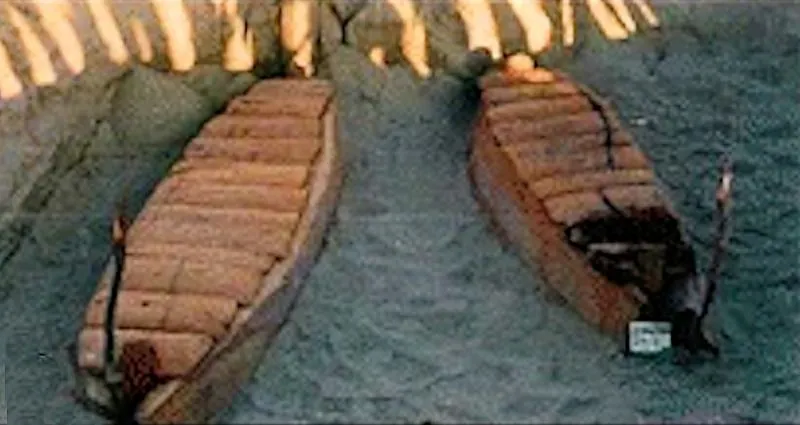
The bodies are accompanied by felt hats, woollen cloaks and waistcloths, baskets, wooden figures, bundles of Ephedra twigs and, around the neck and chest, yellowish lumps that proteomics identified as kefir cheese[3][8]. Cattle and sheep or goats were kept, and wheat and broomcorn millet were placed in the graves[1][9].
Timeline
What is known
The earliest individuals date to about 2135-1939 BC at Gumugou, 1884-1736 BC in the lowest layer of Xiaohe and 1785-1664 BC at Beifang[1]. Genome-wide data place all 13 Tarim individuals in one genetic cluster, which qpAdm modelling explains as about 72% Ancient North Eurasian ancestry (best represented by the Siberian individual AG3) and 28% ancestry related to Early Bronze Age people of the Baikal region, with no contribution from steppe, BMAC or Inner Asian Mountain Corridor groups; the Tarim lineage is estimated to have separated from its relatives about 9,000 years ago[1]. By contrast the Early Bronze Age Dzungarian individuals, a few hundred kilometres north, were 50-70% Afanasievo[1].
The Xiaohe people consumed dairy from the start: seven of them carry ruminant milk peptides in dental calculus, from cattle and sheep or goats, though none carried the lactase persistence allele[1]. Their cheese was a kefir made with a mixed culture, and its bacteria belong to the lineage now found in Tibet, not to the North Caucasian lineage from which kefir was thought to have spread[3][10]. Isotopes show a diet dominated by animal products, with millet and wheat minor and perhaps ritual[9]. Later in the Bronze and Iron Ages the isolated Tarim ancestry mixed with steppe, Central Asian and East Asian ancestry that entered Xinjiang[11].
What has been tested
Ancestry has been tested three times, with improving resolution. Uniparental markers from the lowest Xiaohe layer found West Eurasian mitochondrial lineages and the Y haplogroup R1a1a alongside East Eurasian lineages[5]. A wider mtDNA survey found lineages that the authors traced to Europe, Siberia and southern and western Asia[6]. These single-locus results were read as admixture between incoming and local groups. The genome-wide analysis of 2021 used f-statistics, qpAdm models with rotating sources and admixture dating, and found that a single local source fits and the migrant sources fail[1]. The two are reconcilable because Ancient North Eurasian ancestry is itself ancestral to both later West and East Eurasians, so its lineages can look Western on a single marker[1].
Diet and economy have been tested by palaeoproteomics of calculus and of the cheese, ancient DNA of the cheese microbes, and carbon and nitrogen isotopes[1][3][10][9]. The animal fibres of textiles and hair objects have been identified by DNA barcoding[12], and the Ephedra by pharmacognostic analysis[8].
The readings
Steppe migrants. The Tarim people descended from Afanasievo herders and spoke an early form of Tocharian[4]. The 2021 genomes contradict this for the Tarim Basin: no Afanasievo ancestry was found there, though it was found in the Dzungarian Basin to the north[1]. Afanasievo migrants may still have carried Tocharian into Xinjiang by the northern route[1].
Bactrian farmers. The Tarim was colonised by farmers of the Bactria-Margiana Archaeological Complex, on the evidence of similar desert agriculture and ritual Ephedra[1]. No BMAC-related ancestry was detected[1]. Mountain corridor agropastoralists are excluded in the same way[1].
A local population that adopted a foreign way of life. The founders were descendants of Pleistocene Ancient North Eurasians who had stayed isolated in the region and took up herding, dairying, wool and crops from neighbours through contact rather than intermarriage[1]. This fits the genomes, the dairy evidence and the Tibetan affinity of the cheese bacteria[10]. What it leaves open is the mechanism: who taught them, along which routes, and how practices passed with almost no exchange of partners[1].
Published claims
| Year | Who | Claimed | Status | Reason |
|---|---|---|---|---|
| 2000 | J. P. Mallory and Victor Mair[13] | The Bronze Age Tarim people descended from Indo-European-speaking herders who came east from the steppe. | Ruled out | Genome-wide data from 13 of the earliest individuals in three cemeteries show no steppe ancestry, though it was present just to the north in Dzungaria[1][11]. |
| 2000 | J. P. Mallory and Victor Mair[13] | The Tarim mummies' people were ancestors of the Tocharian speakers recorded in the basin in the first millennium AD. | Still possible | Genes do not fix language; Tocharian may have come in with the steppe migrants who reached Dzungaria by the northern route[1]. |
| 2010 | Chunxiang Li and colleagues[5] | The lowest layer at Xiaohe holds an admixed population carrying both West and East Eurasian lineages, with the Y haplogroup R1a1a in the men. | Disputed | Genome-wide data explain the same people as one local population whose Ancient North Eurasian ancestry looks Western on single markers[1]. |
| 2014 | Yimin Yang and colleagues[3] | The yellowish lumps on the Xiaohe dead are kefir cheese made with a mixed culture of bacteria and yeast. | Accepted | Ancient DNA from the cheese later recovered kefir bacteria genomes[10]. |
| 2015 | Chunxiang Li and colleagues[6] | Xiaohe maternal lineages came from Europe, Siberia and southern and western Asia, showing a diverse founding population. | Disputed | Read against genome-wide data, the lineages fit a single isolated population rather than incomers from several regions[1]. |
| 2018 | Yating Qu and colleagues[9] | Early Xiaohe diets were based on animal products, with millet and wheat minor, and diets diversified later. | Accepted | Fits the milk proteins in dental calculus and the cheese in the graves[1][3]. |
| 2021 | Fan Zhang, Chao Ning, Choongwon Jeong, Yinqiu Cui and colleagues[1] | The earliest Tarim people descended from an old, isolated local population of mainly Ancient North Eurasian ancestry, with no admixture from the proposed migrant groups. | Accepted | Consistent with the later Xinjiang genomes, in which this Tarim ancestry appears as a distinct component that mixes only later[11]. |
| 2021 | Fan Zhang, Chao Ning, Choongwon Jeong, Yinqiu Cui and colleagues[1] | The Xiaohe people drank milk from the cemetery's founding and took up herding, dairying and crops from neighbours through contact rather than intermarriage. | Most likely | The dairy evidence is direct, but who passed on the practices and by what route is not known[1]. |
| 2022 | Vikas Kumar, Qiaomei Fu and colleagues[11] | Later Bronze and Iron Age people in Xinjiang mixed the isolated Tarim ancestry with steppe, Central Asian and East Asian ancestry. | Accepted | Based on 201 genomes from 39 sites, and consistent with the earlier Tarim and Dzungarian results[1]. |
| 2024 | Yichen Liu, Qiaomei Fu and colleagues[10] | The Xiaohe kefir bacteria belong to the lineage now found in Tibet, so kefir reached East Asia by a route through Xinjiang, not only from the North Caucasus. | Most likely | A single ancient strain; more ancient dairy samples along both routes would test it[10]. |
| 2026 | Jingxian Feng and colleagues[8] | The Ephedra twigs placed in Xiaohe burials are Ephedra intermedia. | Accepted | A pharmacognostic identification not challenged since publication[8]. |
What would settle it
The origin question is close to settled for the earliest layers; it would be reopened only by genomes from Xiaohe-horizon individuals that carry migrant ancestry, or by earlier Tarim individuals that show a different source. The transmission question needs material the genomes cannot give: genomes of the cattle, sheep and goats and of the wheat, to show where the domesticates came from; a dated compilation of radiocarbon dates for every Xiaohe-horizon site, which does not yet exist in one table; and genomes of Bronze Age people from the mountain valleys around the basin, where contact would have happened. The language question can be answered only by writing or by a much denser ancient-DNA map that ties genetic groups to later Tocharian speakers, and may not be answerable at all.
Questions
1 of 4 questions are answered.
Evidence 17 findings
Artifacts
The films, photos, papers and objects this mystery rests on, each with its own key and its distance from the original.
See also
References
- 1.Zhang, F., Ning, C., Scott, A. et al. 2021. The genomic origins of the Bronze Age Tarim Basin mummies. Nature 599: 256-261.doicited 32 times hereSRC0D90DSHP05J1
- 2.Xinjiang Institute of Cultural Relics and Archaeology 2008. The Xiaohe Graveyard in Luobupo, Xinjiang. Chinese Archaeology 8(1).doicited 4 times hereSRC0D90DVR001PZ
- 3.Yang, Y., Shevchenko, A., Knaust, A. et al. 2014. Proteomics evidence for kefir dairy in Early Bronze Age China. Journal of Archaeological Science 45: 178-186.doicited 5 times hereSRC0D90DT1A3X7V
- 4.Di Cosmo, N. 2002. Review of The Tarim Mummies: Ancient China and the Mystery of the Earliest Peoples from the West, by J. P. Mallory and Victor H. Mair. Journal of Anthropological Research 58(2): 279-281.doicited 4 times hereSRC0D90DW7M0BWK
- 5.Li, C., Li, H., Cui, Y. et al. 2010. Evidence that a West-East admixed population lived in the Tarim Basin as early as the early Bronze Age. BMC Biology 8: 15.doicited 4 times hereSRC0D90DT942E3R
- 6.Li, C., Ning, C., Hagelberg, E. et al. 2015. Analysis of ancient human mitochondrial DNA from the Xiaohe cemetery: insights into prehistoric population movements in the Tarim Basin, China. BMC Genetics 16: 78.doicited 2 times hereSRC0D90DTGY1NAH
- 7.Abuduresule, Y., Li, W., Hu, X. 2019. The Xiaohe (Small River) Cemetery and the Xiaohe Culture. The Cultures of Ancient Xinjiang, Western China: Crossroads of the Silk Roads (Archaeopress), pp. 19-51.doicited 4 times hereSRC0D90DVZT3Y7T
- 8.Feng, J., Hu, X., Zhang, T. et al. 2026. A pharmacognostic approach to identifying Ephedra intermedia Schrenk ex Mey. in burials at the Xiaohe Cemetery, Lop Nor, Xinjiang. Journal of Archaeological Science: Reports 70: 105612.doicited 1 time hereSRC0D90DV8C40KQ
- 9.Qu, Y., Hu, Y., Rao, H. et al. 2018. Diverse lifestyles and populations in the Xiaohe culture of the Lop Nur region, Xinjiang, China. Archaeological and Anthropological Sciences 10(8): 2005-2014.doicited 1 time hereSRC0D90DV0J2DAK
- 10.Liu, Y., Miao, B., Li, W. et al. 2024. Bronze Age cheese reveals human-Lactobacillus interactions over evolutionary history. Cell 187(21): 5891-5900.e8.doicited 12 times hereSRC0D90DSSG5QQR
- 11.Kumar, V., Wang, W., Zhang, J. et al. 2022. Bronze and Iron Age population movements underlie Xinjiang population history. Science 376(6588): 62-69.doicited 2 times hereSRC0D90DTRR2D1F
- 12.Zhang, X., Wu, X., Yang, H. et al. 2025. Successful species identification of textile and hair cultural relics from Xiaohe cemetery by DNA barcoding. Journal of Cultural Heritage 72: 141-149.doicited 2 times hereSRC0D90DVG6071C
- 13.Mallory, J., Mair, V. 2000. The Tarim Mummies: Ancient China and the Mystery of the Earliest Peoples from the West. Thames & Hudson, London.cited 1 time hereSRC0D90DX6W1D16