The Gallo-Roman dodecahedra
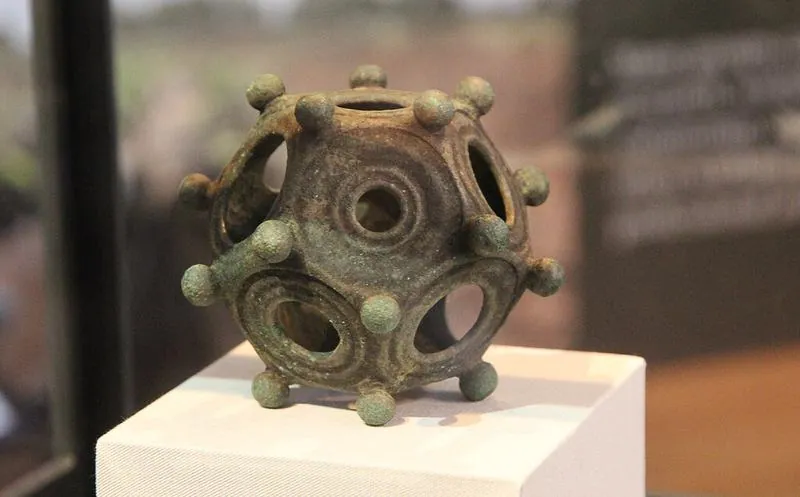
A Gallo-Roman dodecahedron is a hollow bronze object with twelve pentagonal faces, each pierced by a round hole, and a small knob at each of its twenty corners. The holes on one object differ in diameter. Examples measure 4 to 10 cm and weigh 30 to 580 g; they date from the late 2nd to the late 4th century AD and come from the north-western provinces, from Britain to Hungary, but never from Italy[1].
About 130 are known[2]. They come from graves, coin hoards and refuse; none carries an inscription and no Roman writer describes them[1][3]. Proposed uses include surveying and range-finding, calendars, gauges, knitting gloves, moulding wax, fortune-telling, proof of a smith's skill and cosmic symbols[4][5][6][7].
The latest finds keep the question alive. In June 2023 the Norton Disney History and Archaeology Group dug up an undamaged example in Lincolnshire, the 33rd from England[2]. Fragments from Kortessem in Belgium and from two sites in Slovakia beyond the Roman frontier show that some were deliberately broken[6][8]. In 2025 Michael Guggenberger and Stephen Leach tied the objects to Pythagorean and Platonic texts[3]. Of the 3 questions on this site, 0 are answered. The most likely answer to “What were the Gallo-Roman dodecahedra for?”, not yet confirmed: they were religious or magical objects, used for divination or as symbols of the cosmos, perhaps mounted on….
Key questionsset by the editors
The object
The dodecahedra were cast in copper alloy. The Norton Disney example, about 8 cm across and 245 g, has round holes framed by knobs and shows no wear; X-ray fluorescence gave roughly 75% copper, 7% tin and 18% lead[2]. Holes range from about 0.6 to 4 cm across over the corpus, and some carry incised concentric circles[8].
Paul-Marie Duval proposed in 1981 a standard description of each example (face and hole measurements, knobs, decoration) so that they could be compared; such a scheme is the basis for any quantitative study[9]. Christopher Hill reported on progress towards a corpus in 1994[10]. The fullest catalogue known is Guggenberger's 1999 Innsbruck thesis, which is not published online[7][11].
Timeline
What is known
The distribution is regional: Gaul, Britain, the Rhineland and the Danube provinces, but not the Mediterranean heartland, which suggests a practice of the north-western provinces rather than an imperial standard[1][6].
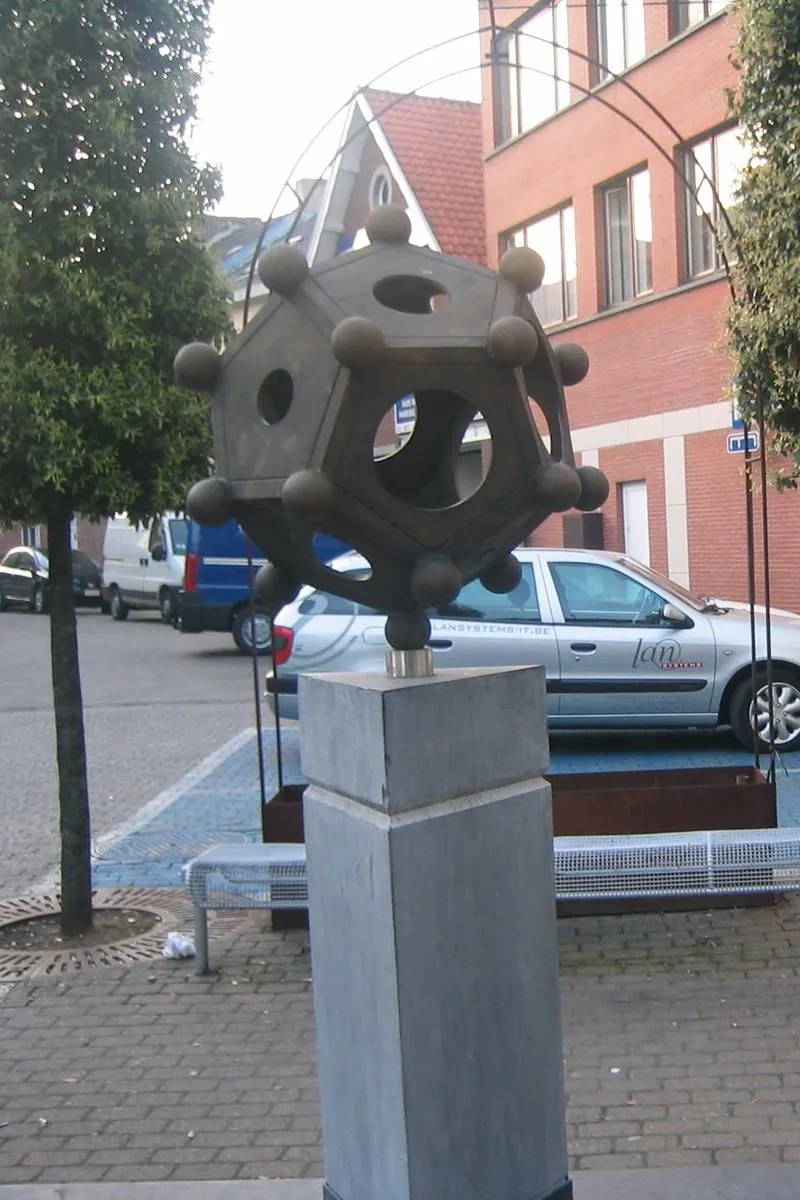
Find contexts are mixed. The Gellep dodecahedron came from a woman's grave in 1966, next to a bone rod that may have been a handle, which suggests it could have been mounted on a staff[1]. A complete example found outside the walls of Tongeren in 1939 is in the Gallo-Roman Museum there; a corner fragment from Kortessem joined it in 2023[6][12]. The Slovak fragments, from Hurbanovo and Chotín, appear to have been cut up for scrap bronze, perhaps after reaching Germanic communities through raids[8].
What has been tested
Very little has been tested on the objects themselves. Sparavigna worked out the geometry of a coincidence rangefinder from published dimensions and argued the objects would work as one[4]. Lamb made a 3D-printed replica and showed it can form wax tokens around a cord, with the knobs acting as stops, but did not use measurements of real examples[5]. A snake-trap reconstruction and a craft-token argument appeared as preprints in 2026[13][14].
Composition has been measured on single examples such as Norton Disney[2]. No study has yet compared alloys or lead isotopes across the corpus to identify workshops, and no published statistical test compares the sets of hole diameters on different objects.
The readings
Measuring instruments. Readings as rangefinders, surveying aids or calendars for timing the sowing of winter grain by the sun's angle predict standard dimensions and consistent ratios between hole sizes[4][12]. The variation in size, weight and hole sizes between examples counts against them[1].
Tools. Knitting gloves on the knobs or forming wax predict wear on the knobs or hole rims and fit with workshop or domestic contexts[1][5]. The Norton Disney example shows no wear[2].
Religious or magical objects. Guido Creemers of the Tongeren museum suggests unofficial practices such as fortune-telling, which would explain the silence of texts[6]. Guggenberger reads them as a symbol of the universe, the dodecahedron being Plato's figure for the cosmos, and with Leach links them to the Druids' reputed Pythagoreanism[7][3]. These readings predict ritual contexts and deliberate deposition, which some finds show.
Craft masterpieces. The objects may have shown a bronze-caster's skill, which would explain their complexity and lack of a standard[2][14].
Published claims
| Year | Who | Claimed | Status | Reason |
|---|---|---|---|---|
| 2012 | Amelia Carolina Sparavigna[4] | The dodecahedron was a dioptron, a coincidence rangefinder, whose paired holes of different sizes let a user judge distance. | Disputed | The objects vary several-fold in size, weight and hole size, which no standard measuring instrument would allow[1] |
| 2013 | Michael Guggenberger[7] | The dodecahedron served as a symbol of the universe rather than as a practical tool. | Most likely | No practical use fits the whole corpus, but no inscription or text ties the objects to a cult[1] |
| 2025 | Petra Dragonidesová[8] | Fragments from Hurbanovo and Chotín, beyond the Roman frontier in Slovakia, come from dodecahedra broken up as scrap bronze. | Most likely | The breaks and the surface-survey context fit scrap, though the fragments are few[8] |
| 2025 | Michael Guggenberger and Stephen Leach[3] | The dodecahedra embodied the Pythagorean figure of the cosmos, which Iamblichus describes and which Druids in Gaul and Britain may have taken up. | Most likely | It fits the texts and the north-western spread of finds, but no object carries an inscription that would confirm it[1][6] |
| 2026 | Greg Lamb[5] | Dodecahedra were tools for forming standard wax tokens, with the knobs acting as depth stops and the holes letting the wax out. | Still possible | One 3D-printed replica works, but no real dodecahedron has been tested for wax residue, and the Norton Disney example shows no wear[5][2] |
| 2026 | Marshall[14] | Dodecahedra were masterpieces and portable tokens proving a metalworker's skill. | Still possible | The castings are complex and no two are alike, but the idea is in an unrefereed preprint and has not been tested[14][2] |
| 2026 | Vashakidze[13] | Dodecahedra were parts of passive traps for catching snakes, which is why they are found in wet regions. | Still possible | A reconstruction works mechanically, but the case is an unrefereed preprint and the habitat correlation is untested[13] |
What would settle it
A structured, open catalogue of every known example, following Duval's scheme, with hole diameters per face, knob form, mass, alloy, findspot coordinates and context[9]. With it, three tests become possible: whether hole sets share ratios across objects, as any measuring use requires; whether alloys and lead isotopes cluster into workshops; and whether findspots associate with military, funerary or religious sites more than chance. Use-wear microscopy of knobs and rims on well-preserved examples such as Norton Disney would separate tools from display objects[2].
Questions
0 of 3 questions are answered.
Evidence 11 findings
Artifacts
The films, photos, papers and objects this mystery rests on, each with its own key and its distance from the original.
See also
References
- 1.Killgrove, K. 2025. Roman dodecahedron: A mysterious 12-sided object that has baffled archaeologists for centuries. Live Science.cited 10 times hereSRC0D5Y5KS24XXW
- 2.Tipper, S. 2024. Beautifully crafted Roman dodecahedron discovered in Lincoln – but what were they for?. The Conversation.doicited 10 times hereSRC0D5Y5KH8522R
- 3.Guggenberger, M., Leach, S. 2025. The Gallo-Roman Dodecahedron and the Receptacle of All Becoming. The Antiquaries Journal 105, 31–54.doicited 4 times hereSRC0D5Y5JA63M6Y
- 4.Sparavigna, A. 2012. Roman Dodecahedron as dioptron: analysis of freely available data. arXiv 1206.0946.cited 5 times hereSRC0D5Y5MRA6QF4
- 5.Lamb, G. 2026. A Functional Reassessment of Roman Dodecahedra as Tools for Forming Standardised Wax Objects. EXARC Journal 2026/2.cited 4 times hereSRC0D5Y5N041W0C
- 6.Metcalfe, T. 2023. [Report on a Roman dodecahedron fragment from Kortessem, Belgium]. Live Science.cited 6 times hereSRC0D5Y5M0W1FXP
- 7.Guggenberger, M. 2013. The Gallo-Roman Dodecahedron. The Mathematical Intelligencer 35(4), 56–60.doicited 2 times hereSRC0D5Y5JJ01QQT
- 8.Dragonidesová, P. 2025. Mysterium Insolutum. Fragments of Roman Dodecahedrons from Hurbanovo and Chotín. Študijné zvesti Archeologického ústavu SAV, Supplementum 3, 29–36.doicited 3 times hereSRC0D5Y5MGG2DC1
- 9.Duval, P. 1981. Comment décrire les dodécaèdres gallo-romains, en vue d'une étude comparée. Gallia 39(2), 195–200.doicited 4 times hereSRC0D5Y5K9E5V0A
- 10.Hill, C. 1994. Gallo-Roman Dodecahedra: A Progress Report. The Antiquaries Journal 74, 289–292.doicited 1 time hereSRC0D5Y5K1M1R7K
- 11.Guggenberger, M. 1999. [Thesis on the Gallo-Roman dodecahedra]. University of Innsbruck.cited 2 times hereSRC0D5Y5JST58ZT
- 12.VRT NWS 2023. Second mysterious dodecahedron found in Flanders. VRT NWS.cited 3 times hereSRC0D5Y5M8P5A4T
- 13.Vashakidze 2026. Reinterpreting the Gallo-Roman Dodecahedron: Experimental Reconstruction and Environmental Evidence for its use as a Snake Trap. SSRN.doicited 3 times hereSRC0D5Y5NFR2Q8B
- 14.Marshall 2026. Roman Dodecahedra as Craft Skill Tokens: A Functional Hypothesis. SSRN.doicited 3 times hereSRC0D5Y5N7Y3ZKW