The Antikythera Mechanism
In 1900 sponge divers found a shipwreck off the island of Antikythera, between Crete and the Peloponnese, and in 1900 and 1901 raised bronze and marble statues, glass, pottery and coins for the Greek state. In May 1902 Valerios Stais, a former minister, was credited with noticing that a lump of corroded bronze among the finds carried gear wheels and inscriptions, although the fragments had probably been noticed earlier[1]. Four fragments were described in 1903; later recognitions and splits brought the inventory to 82 pieces, lettered A to G for the larger ones and numbered 1 to 75 for the rest, all in the National Archaeological Museum in Athens[1][2].
Derek de Solla Price's 1974 monograph established from radiographs that the device was a geared calendrical and astronomical calculator and reconstructed its main train[3]. The decisive step came in 2005, when the Antikythera Mechanism Research Project, with X-Tek Systems and Hewlett-Packard, made high-resolution X-ray computed tomography scans and reflectance images of every fragment in the museum[4][2]. The 2006 paper in Nature read the gear train and inscriptions in the CT data and showed a pin-and-slot device that modelled the moon's varying speed, the 19-year Metonic cycle, the 223-month Saros eclipse cycle and a lower back dial for eclipse prediction[4]. The 2008 paper read the month names of the Metonic dial, which belong to the Corinthian family of calendars, and found a dial for the four-year cycle of the Panhellenic games[5]. A 2021 paper proposed a full reconstruction of the lost front display with the five planets[6].
The open questions are narrower than they were but real. The front calendar ring, long taken to have 365 divisions for the Egyptian civil year, was argued in 2020 to have 354, a lunar year, from the spacing of surviving holes; two independent 2024 analyses supported a count near 354, and a 2025 reconstruction insisted on 365[7][8][9][10]. A 2025 simulation argued that, with the tooth errors measured in the fragments, the gear train would have jammed within months, so either it never ran or the measurements overstate the errors[11]. The date of manufacture is bracketed between an eclipse-table epoch of 205 BC and the wreck of about the mid first century BC, and the maker's city is argued between Rhodes, Syracuse and the Corinthian north-west[12][13][14][5]. Of the 5 questions on this site, 0 are answered. The most likely answer to “Did the mechanism function as built?”, not yet confirmed: the mechanism ran as designed, with tooth errors smaller than those measured in the corroded fragments.
Key questionsset by the editors
The object
The fragments are bronze, heavily corroded to copper salts, with the gears, plates and inscribed surfaces preserved as mineralised shapes inside the mass. Fragment A, the largest, holds the main train with 27 gears; Fragment B the Metonic spiral; Fragment C the front dial with its zodiac and calendar rings; Fragment D a single gear; E, F and G and the small pieces carry further gears and text[4][1]. The inscriptions, in a Greek script dated by letter forms to roughly the late third to the mid first century BC, include a front parapegma of star risings and settings, a back-cover "user's guide" describing the dials and the planetary display, and the month names and eclipse glyphs on the back dials[1][4].
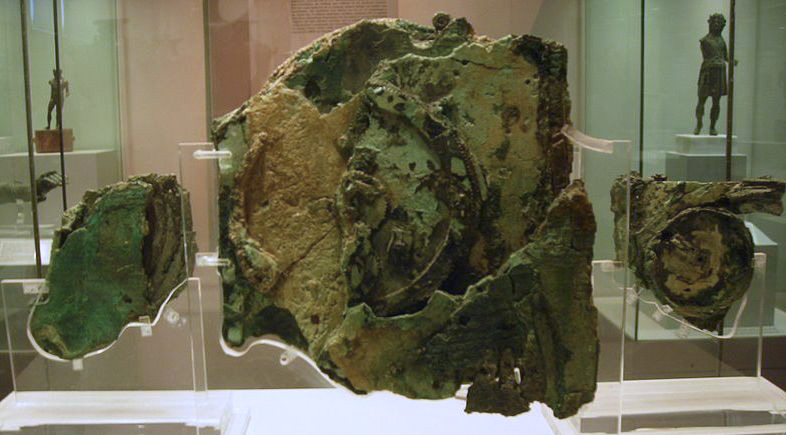
The primary data are the 2005 X-ray CT scans and polynomial texture maps. The PTM images of all known surfaces are published by the Institute for the Study of the Ancient World at NYU under the Open Database Licence[2]. A reprocessed CT volume of Fragment A, with missing projections corrected, is on the Harvard Dataverse with the 2018 paper that produced it[15].
Timeline
What is known
The gearing is understood in its main lines. An input turned a crown wheel that drove the main train; the front dial showed the sun and moon in the zodiac and the moon's phase on a rotating ball; a pin-and-slot coupling on epicyclic gears varied the moon's speed according to Hipparchus's lunar theory, the earliest known mechanical model of an astronomical anomaly[4]. The back had two spiral dials: an upper one of 235 months for the Metonic cycle, with a subsidiary games dial and a Callippic dial, and a lower one of 223 months for the Saros cycle, with glyphs predicting lunar and solar eclipses and their times, and a subsidiary exeligmos dial[4][5]. The Metonic month names belong to the Corinthian family of calendars, which pointed the 2008 authors toward Corinth's colonies and Iversen's 2017 study toward Epirus[5][14]. The back-cover inscription names the planets and their displays, which the 2021 reconstruction used to propose a front display of all five with their synodic cycles, a reconstruction that is mechanically plausible but not attested by surviving gears[6].
On dating, Carman and Evans showed in 2014 that the eclipse table's starting point is best explained by a full-moon epoch in 205 BC, which puts the astronomical scheme earlier than the 150 to 100 BC range assumed in 2006; Jones's 2020 study confirms the eclipse-sequence dating, reaffirms the calendrical epoch and argues that the design decisions could still have been made by a maker working as late as the shipwreck[12][13]. The wreck itself is placed in the first century BC by its cargo[1].
What has been tested
The calendar ring. The front dial's outer ring carried the 12 Egyptian months and could be rotated to compensate for the Egyptian year's drift against the seasons; it was fixed by pins in a ring of holes beneath. The 2006 and later reconstructions assumed 365 holes. In 2020 Budiselic, Thoeni, Dubno and Ramsey measured the 81 surviving holes in the CT data and, from their spacing, estimated a full count near 354, a lunar year[7]. In 2024 Woan and Bayley applied Bayesian techniques from gravitational-wave astronomy to the same coordinates and found 354 or 355 holes, with 360 strongly disfavoured and 365 not plausible under their model[8]. Dickens and Malin, re-analysing the same data with least squares and criticising the 2020 statistics, found 352.3 plus or minus 1.5 and put the chance of 365 below one in ten thousand[9]. Specialists objected that the mechanism already had a lunar calendar on the Metonic dial, which would make a second, cruder one redundant[16]. In 2025 Voulgaris, Mouratidis and Vossinakis published a reconstruction of the front dial that keeps 365 holes and argues that any other count would make the Egyptian ring malfunction[10]. The dispute turns on the statistics of 81 hole positions in corroded metal and has not been resolved.
Whether it worked. Szigety and Arenas built a computational model of the gear train with triangular teeth and the manufacturing errors measured by Edmunds in 2011, and found that the train jammed in 90 per cent of simulations, typically before the solar pointer completed a third of a turn; they conclude that either the device never functioned or the true errors were smaller than measured, and note that corrosion has deformed the gears the measurements rest on[11][17]. The 2018 reprocessing of the Fragment A scan tested and rejected an earlier suggestion that the fragment had moved during scanning[15].
The readings
On function, the consensus is a display calculator for astronomical and calendrical cycles, built to show rather than to compute anything new, and the live disagreements are about the planets on the front, the calendar ring and the mechanical tolerances[6][8][11]. On origin, three candidates are argued. Rhodes, because the lunar theory is Hipparchus's and Cicero places a planetary device with Posidonius there[4]. Syracuse or another Corinthian colony, because the calendar is Corinthian and Cicero describes Archimedes' planetarium taken from Syracuse[5]. Epirus or north-west Greece, because the month names fit that branch of the Corinthian family best[14]. On date, the eclipse epoch of 205 BC marks the astronomical scheme; the physical object may be later, with the shipwreck as the lower bound[12][13].
Published claims
| Year | Who | Claimed | Status | Reason |
|---|---|---|---|---|
| 1959 | Derek de Solla Price[18] | The fragments are the remains of a geared computer that showed the calendar and the movements of the sun and moon. | Accepted | X-ray tomography recovered the gear trains and the astronomical cycles they modelled[4]. |
| 1974 | Derek de Solla Price[3] | The main train included a differential gear that subtracted the sun's motion from the moon's to show the lunar phase. | Ruled out | The CT data showed no differential: the gears Price read that way carry the pin-and-slot lunar anomaly device[4]. |
| 2006 | Tony Freeth and colleagues[4] | A pin-and-slot coupling modelled the moon's varying speed, and spiral back dials showed the 19-year Metonic and 223-month Saros cycles with eclipse predictions. | Accepted | The reading rests on the CT scans of every fragment and has been confirmed by the full edition of the inscriptions[1]. |
| 2008 | Tony Freeth and colleagues[5] | The Metonic dial's month names are Corinthian and a subsidiary dial showed the Panhellenic games, which points to a Corinthian colony such as Syracuse. | Still possible | The Corinthian calendar is accepted, but Iversen finds the month names fit north-west Greece better than Syracuse[14]. |
| 2012 | Tony Freeth and Alexander Jones[19] | The back-cover inscription describes a front display of the stars, sun, moon and all five planets, driven by planetary gearing like the lunar device. | Most likely | The planets are named on the cover inscription, but no planetary gear survives, so the gearing is conjecture[6]. |
| 2013 | Michael Wright[20] | The planets were shown on the front dial by compound gear trains. | Still possible | No planetary gearing survives, so rival trains for the planets cannot be tested against the parts[6]. |
| 2014 | Christián Carman and James Evans[12] | The eclipse predictor starts from a full moon in 205 BC, earlier than the construction date assumed in 2006. | Accepted | Jones's 2020 study confirmed the eclipse-sequence epoch independently[13]. |
| 2017 | Paul Iversen[14] | The month names fit the calendar of Epirus or north-west Greece best within the Corinthian family. | Still possible | It rests on comparison with incompletely known calendars and no inscription on the mechanism names a city[1]. |
| 2020 | Alexander Jones[13] | The 205 BC epochs follow from calendar practice, so the object itself could have been made as late as the shipwreck. | Most likely | It fits the Hipparchan lunar theory in the gearing and the first-century BC wreck, but no physical evidence dates the making[4]. |
| 2020 | Chris Budiselic and colleagues[7] | The spacing of the 81 surviving holes under the calendar ring implies about 354, a lunar year, not 365. | Most likely | Two independent re-analyses of the hole positions agree on a count near 354, though a 2025 reconstruction holds to 365[8][10]. |
| 2021 | Tony Freeth and colleagues[6] | The lost front display can be reconstructed with gearing for all five planets that fits the inscriptions and surviving parts. | Still possible | The cycles come from the inscription, but the planetary gearing itself has no surviving parts to test against[6]. |
| 2024 | Graham Woan and Joseph Bayley[8] | A Bayesian fit to the hole positions gives 354 or 355 holes, with 360 strongly disfavoured and 365 not plausible. | Most likely | It agrees with a separate least-squares analysis of the same data, but specialists object that a second lunar calendar would be redundant[9][16]. |
| 2024 | R. J. Dickens and Stuart Malin[9] | Least squares on the hole positions give 352.3 plus or minus 1.5 holes, putting the chance of 365 below one in ten thousand. | Most likely | It agrees with the Bayesian analysis, though all three analyses share one set of 81 holes in corroded metal[8]. |
| 2025 | Aristeidis Voulgaris and colleagues[10] | The front dial needs 365 holes for the Egyptian calendar ring to work, and any other count would make it malfunction. | Disputed | Three statistical analyses of the surviving holes disfavour 365, though none models corrosion and fracture fully[8][9]. |
| 2025 | Esteban Szigety and Gustavo Arenas[11] | With the tooth errors measured in the fragments, the gear train would have jammed within a few months of use. | Still possible | The errors were measured on corroded gears and the authors call the result speculative[17]. |
What would settle it
The calendar ring question needs either more of the ring, which would require new finds from the wreck, or an agreed statistical treatment of the 81 holes with the uncertainties of corrosion built in; the three 2024 analyses already share one dataset[7][9]. The functioning question needs tooth measurements that account for corrosion, which the reprocessed CT data make possible[11][15]. The origin question would be settled by a maker's name or a city in the unread parts of the inscriptions, or by a second mechanism; the inscriptions are now largely read and name neither[1]. The wreck has been re-excavated since 2012 and further fragments are possible[1].
Questions
0 of 5 questions are answered.
Evidence 25 findings
Artifacts
The films, photos, papers and objects this mystery rests on, each with its own key and its distance from the original.
See also
References
- 1.Jones, A. 2016. The Inscriptions of the Antikythera Mechanism. 2. Historical Background and General Observations. Almagest.doicited 9 times hereSRC0D3FPXZJ76EP
- 2.Antikythera Mechanism Research Project 2019. Antikythera Mechanism PTMs (collection, Texts and Artifacts of Ancient Astronomy). NYU Faculty Digital Archive, Institute for the Study of the Ancient World.cited 8 times hereSRC0D3FPXFY6C4S
- 3.Price, D. 1974. Gears from the Greeks: The Antikythera Mechanism, a Calendar Computer from ca. 80 B.C.. Transactions of the American Philosophical Society.doicited 5 times hereSRC0D3FPXQR0MBB
- 4.Freeth, T., Bitsakis, Y., Moussas, X. et al. 2006. Decoding the ancient Greek astronomical calculator known as the Antikythera Mechanism. Nature.doicited 11 times hereSRC0D8MQY5J38KW
- 5.Freeth, T., Jones, A., Steele, J. et al. 2008. Calendars with Olympiad display and eclipse prediction on the Antikythera Mechanism. Nature.doicited 6 times hereSRC0D3FPWRG12B3
- 6.Freeth, T., Higgon, D., Dacanalis, A. et al. 2021. A Model of the Cosmos in the ancient Greek Antikythera Mechanism. Scientific Reports.doicited 7 times hereSRC0D8MQYDC4S7K
- 7.Budiselic, C., Thoeni, A., Dubno, M. et al. 2020. The Antikythera Mechanism: Evidence of a Lunar Calendar. Horological Journal (British Horological Institute).cited 7 times hereSRC0D3FPYYT2M16
- 8.Woan, G., Bayley, J. 2024. An improved calendar ring hole-count for the Antikythera mechanism: A fresh analysis. Horological Journal.cited 5 times hereSRC0D3FPZ6M1YM8
- 9.Dickens, R., Malin, S. 2024. How Many Days in an Egyptian Year? Evidence from the Antikythera Mechanism. Horological Journal, April 2024, 140–145.cited 5 times hereSRC0D3FPZEE2K1W
- 10.Voulgaris, A., Mouratidis, C., Vossinakis, A. 2025. Reconstructing the Antikythera Mechanism's Central Front Dial Parts: Division and Placement of the Zodiac Dial Ring. Journal of Astronomical History and Heritage.doicited 3 times hereSRC0D3FPZP80P76
- 11.Szigety, E., Arenas, G. 2025. The Impact of Triangular-Toothed Gears on the Functionality of the Antikythera Mechanism. arXiv.doicited 7 times hereSRC0D3FPZY24AA3
- 12.Carman, C., Evans, J. 2014. On the epoch of the Antikythera mechanism and its eclipse predictor. Archive for History of Exact Sciences.doicited 6 times hereSRC0D3FPYF66JCC
- 13.Jones, A. 2020. The Epoch Dates of the Antikythera Mechanism (With an Appendix on its Authenticity). ISAW Papers 17.cited 5 times hereSRC0D3FPY7C1DJK
- 14.Iversen, P. 2017. The Calendar on the Antikythera Mechanism and the Corinthian Family of Calendars. Hesperia.cited 6 times hereSRC0D3FPYQ07QNB
- 15.Pakzad, A., Iacoviello, F., Ramsey, A. et al. 2018. Improved X-ray computed tomography reconstruction of the largest fragment of the Antikythera Mechanism, an ancient Greek astronomical calculator. PLoS ONE.doicited 3 times hereSRC0D3FPX84498P
- 16.Whiddington, R. 2024. A New Study Shakes Up Our Understanding of the World's First Analog Computer. Artnet News.cited 2 times hereSRC0D3FQ05W0F1F
- 17.Whiddington, R. 2025. Did the Antikythera Mechanism Actually Work? A New Study Says It May Have Jammed. Artnet News.cited 2 times hereSRC0D3FQ0DP4TCA
- 18.Price, D. 1959. An Ancient Greek Computer. Scientific American.doicited 1 time hereSRC0D3FQ15425V9
- 19.Freeth, T., Jones, A. 2012. The Cosmos in the Antikythera Mechanism. ISAW Papers 4.cited 1 time hereSRC0D3FQ1CY6NK6
- 20.Wright, M. 2013. The Antikythera Mechanism: Compound Gear-Trains for Planetary Indications. Almagest.doicited 1 time hereSRC0D3FQ1MR1G8F