The Nebra Sky Disc
The Nebra Sky Disc is a bronze disc just over 320 mm across with gold inlays: a large circle, a crescent, small stars including a tight group of seven, two arcs on the rim (one now missing), and a curved band at the bottom[1][2]. Two looters with a metal detector dug it up on the Mittelberg hill near Nebra on 4 July 1999, together with two swords, two flanged axes, a chisel and two spiral arm rings. They sold the find within days; the disc was seized by Basel police in February 2002 and the rest of the hoard was traced by the police investigation[2].
The swords and other objects date the deposit to the end of the central European Early Bronze Age, about 1600 BC, and the disc is thought to have been made 100 to 200 years earlier and altered several times before it was buried[3]. Its copper comes from the Mitterberg in the Salzburg Alps; its gold and tin match sources in Cornwall[2][4][5].
The usual reading is that the disc shows the night sky, with the seven-star group as the Pleiades, the rim arcs as horizon arcs tied to the solstices, and the whole as a memory aid and leap rule for keeping lunar and solar years in step[2]. In 2020 Rupert Gebhard and Rüdiger Krause argued that the disc may not belong with the hoard and could be Iron Age[6]; the excavators and analysts replied point by point[2]. A 2024 metallographic study settled how it was made[3]. Of the 4 questions on this site, 2 are answered. The most likely answer to “What does the image on the disc represent?”, not yet confirmed: the disc shows the night sky with the Pleiades and served as a memory aid and leap rule for reconciling lunar….
Key questionsset by the editors
The object
The disc is a sheet of low-tin bronze, thicker at the centre (4.6 mm) than the rim (1.5 to 1.8 mm), with gold foil set into grooves. Its alloy is copper with 2.6% tin and small amounts of nickel, arsenic and zinc[3]. The image was changed over time: horizon arcs were added on the rim, then the curved band often read as a boat, and finally a ring of holes was punched around the edge; one arc is now missing. The excavators count five phases[3][2].
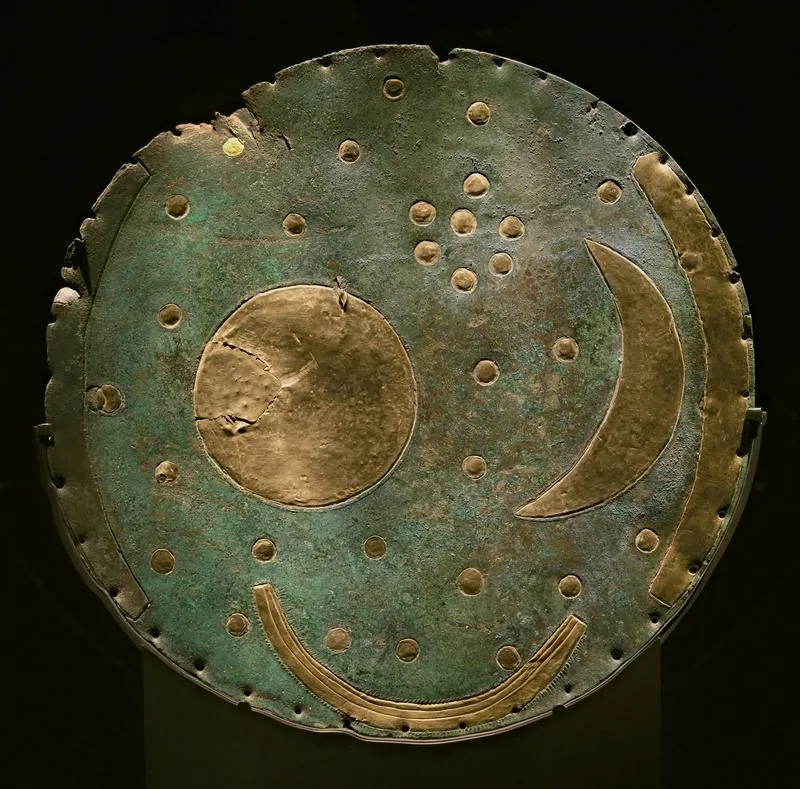
Corrosion is uneven, with pitting on one half only, which the analysts read as the disc having stood upright in the ground. The rim carries fresh damage from the looters' pickaxe[2]. The disc and hoard are in the Landesmuseum für Vorgeschichte in Halle, which publishes a 3D model of the objects[7].
Timeline
What is known
The find story rests on a criminal case. The looters were convicted, then testified against the two dealers who last held the hoard. The Regional Court of Halle concluded in 2005, with what it called a probability close to certainty, that the disc was found with the hoard on the Mittelberg; the Higher Regional Court in Naumburg upheld the verdict[2].
The State Office excavated the spot the looters showed in 2002. It found their pit, the shards of a West German mineral-water bottle they said they had smashed there, marks of their fire-brigade pickaxe in the section, and an enrichment of copper (up to 138 µg/g) and gold (19 ng/g) in the undisturbed soil under the pit, consistent with metal corroding there for a long time[2].
The copper's trace elements and lead isotope ratios match the Mitterberg ores, which were mined mainly in the Bronze Age. The gold's trace elements match natural gold from the Carnon River in Cornwall, and the disc's tin isotope ratio fits Cornish tin ores[2][4][5].
What has been tested
Authenticity. An early allegation that the disc was a modern fake was answered by the analyses of patina, metal, isotopes and lead-210, and is not repeated by the 2020 critics[2].
Association with the hoard. A forensic soil analyst compared soil adhering to the disc and to one sword with a sample taken at 30 to 40 cm depth at the findspot and with soils from geologically similar places. The disc and sword samples matched the Mittelberg sample almost completely; a third sample on an axe matched less well. The authors call the common origin highly probable but note that one reference sample cannot give certainty[2].
Manufacture. A 2024 study sectioned a sample from the rim and forged a replica of the same alloy. The disc has medium grains with annealing twins and elongated sulphide inclusions; it cannot have been cast to shape. It was cast as a thick preform and forged in about ten cycles of heating to nearly 700 °C and hammering, then heat treated[3].
Lead isotopes. Measurements in Freiberg (2003) and Mannheim (2007) of the disc, swords and chisel are published in a table; the disc's ratios vary between drill holes, which the analysts attribute to the variable lead of the Mitterberg ores and to mixed metal[2].
The readings
The calendar reading holds that the disc is an image of the night sky. The seven-star group is the Pleiades, and the horizon arcs relate to the summer solstice; from the Mittelberg the sun sets behind the Brocken on 21 June. The image is read as a memory aid and leap rule for reconciling the lunar and solar years[2]. Meller and Kai Michel argue that this knowledge came from Mesopotamia[8].
The symbolic reading accepts that the disc shows sun or moon and stars but denies that it maps a real sky or encodes a calendar; Pásztor and Roslund read it as the cosmological device of a local warrior society[1].
The sky-event reading treats the seven stars as a planetary conjunction with Castor and Pollux in 2210 BC and the large disc as a supernova[9]. It has not been taken up by archaeologists.
The Iron Age reading holds that the disc was not found with the hoard, possibly not on the Mittelberg, and that its style fits the first millennium BC better than the Bronze Age[6]. The challenge drew some 70 press reports in 2020 and an immediate statement from the State Office[10]. The analysts answer that the court, the excavation of the looters' pit, the soil chemistry and soil matching, the metal and isotope data and the boat motif all point to the Early Bronze Age, and that a text of the La Tène period, Aratus, says only six Pleiades could be seen[2].
Published claims
| Year | Who | Claimed | Status | Reason |
|---|---|---|---|---|
| 2005 | Peter Schauer[11] | The disc is an amateurish modern forgery: its green patina was made in a workshop and its marks were made by machine. | Ruled out | Analyses of the patina, the metal, its isotopes and lead-210 showed the disc is ancient, and even the 2020 critics do not repeat the charge[2]. |
| 2007 | Emília Pásztor and Curt Roslund[1] | The disc is a cosmological, shamanistic image of a local warrior society, not a precise map of the sky or a calendar. | Still possible | The image fits both this and the calendar reading, and no test has been proposed that could separate them[2]. |
| 2010 | M. Haustein, C. Gillis and Ernst Pernicka[5] | The disc's tin isotope ratio fits the tin ores of Cornwall, not those of the nearer Erzgebirge. | Accepted | The gold inlays were matched independently to Cornish river gold[4]. |
| 2011 | Anja Ehser, Gregor Borg and Ernst Pernicka[4] | The trace elements of the disc's gold match natural gold from the Carnon River in Cornwall. | Accepted | It agrees with the Cornish tin and the Alpine copper traced by other methods[5][2]. |
| 2018 | Harald Meller and Kai Michel[12] | The disc was a tool for bringing the lunar and solar years into step, made in an Early Bronze Age realm whose rulers lay in great burial mounds. | Most likely | The calendar reading is the usual one, but a symbolic reading fits the same image and neither can be tested against the other[2][1]. |
| 2020 | Rupert Gebhard and Rüdiger Krause[6] | The disc may not belong to the hoard or even to the Mittelberg, and its style fits the Iron Age better than the Bronze Age. | Disputed | The court finding, the excavated looters' pit, the soil chemistry and soil matching and the metal data all point to the Early Bronze Age hoard[2]. |
| 2020 | Ernst Pernicka and colleagues[2] | The disc was found with the hoard on the Mittelberg and dates to the Early Bronze Age, as the court, the soil, the metal and the motifs all show. | Accepted | No new evidence has been published against it, and the 2024 study of how the disc was made fits a Bronze Age forging[3]. |
| 2024 | Nikolaus Vogt and Juan Crocco[9] | The seven-star group shows the five planets with Castor and Pollux in 2210 BC, and the large disc a supernova. | Disputed | Archaeologists have not taken it up, and it sets aside the Pleiades reading on which the other interpretations agree[2]. |
| 2024 | Sebastian Dieck and colleagues[3] | The disc was cast as a thick preform and hot-forged in about ten cycles of heating and hammering, not cast to shape. | Accepted | The rim sample's grains, twins and stretched inclusions rule out casting to shape, and a forged replica of the same alloy reproduced them[3]. |
What would settle it
No method dates a copper alloy directly, so the date will continue to rest on the association with the hoard. A larger set of reference soils from the Mittelberg and the region, analysed blind against the adhesions on all hoard objects, would turn the soil match from highly probable into a measured likelihood ratio.
The calendar reading would be tested by a pre-registered analysis of the star positions against random placements, with the arcs measured on the 3D model rather than photographs. The forthcoming full physical atlas of the disc announced by the State Office would give the data needed to do this[3].
Questions
2 of 4 questions are answered.
Evidence 19 findings
Artifacts
The films, photos, papers and objects this mystery rests on, each with its own key and its distance from the original.
See also
References
- 1.Pásztor, E., Roslund, C. 2007. An interpretation of the Nebra disc. Antiquity 81, 267–278.doicited 4 times hereSRC0D2SB19E27SK
- 2.Pernicka, E., Adam, J., Borg, G. et al. 2020. Why the Nebra Sky Disc Dates to the Early Bronze Age. An Overview of the Interdisciplinary Results. Archaeologia Austriaca 104, 89–122.doicited 36 times hereSRC0D2SB0A67Q0N
- 3.Dieck, S., Michael, O., Wilke, M. et al. 2024. Archaeometallurgical investigation of the Nebra Sky Disc. Scientific Reports 14, 28868.doicited 11 times hereSRC0D2SB02C59G6
- 4.Ehser, A., Borg, G., Pernicka, E. 2011. Provenance of the gold of the Early Bronze Age Nebra Sky Disk, central Germany: geochemical characterization of natural gold from Cornwall. European Journal of Mineralogy 23, 895–910.doicited 2 times hereSRC0D2SB0ST7HP1
- 5.Haustein, M., Gillis, C., Pernicka, E. 2010. Tin isotopy: a new method for solving old questions. Archaeometry 52, 816–832.doicited 2 times hereSRC0D2SB11M1W4D
- 6.Gebhard, R., Krause, R. 2020. Critical comments on the find complex of the so-called Nebra Sky Disk. Archäologische Informationen 43, 325–346.cited 10 times hereSRC0D2SB0J06GQQ
- 7.Landesmuseum für Vorgeschichte Halle 2026. eMuseum Himmelswege: Finds of the Nebra hoard. eMuseum Himmelswege.cited 4 times hereSRC0D2SB20W40BW
- 8.Freudiger, N. 2021. Himmelsscheibe von Nebra: Neue irdische Erkenntnisse dank dieser Himmelsscheibe. SRF Kultur.cited 1 time hereSRC0D2SB1S24052
- 9.Vogt, N., Crocco, J. 2024. Does the Nebra Sky Disk encode an early Bronze Age report of a galactic supernova?. Astronomische Nachrichten 345.doicited 3 times hereSRC0D2SB1H84H8W
- 10.Deutsche Gesellschaft für Ur- und Frühgeschichte 2021. Nebra Sky Disk: the debate (dossier). DGUF.cited 1 time hereSRC0D2SB28P1FB6
- 11.The Guardian 2005. Germany's 'Sky Disk' a fake, archaeologist says. Taipei Times (reprinted from The Guardian), 3 March 2005.cited 1 time hereSRC0D2SB2RA6QCC
- 12.Meller, H., Michel, K. 2018. Die Himmelsscheibe von Nebra: Der Schlüssel zu einer untergegangenen Kultur im Herzen Europas. Propyläen, Berlin.cited 1 time hereSRC0D2SB3042G8N