The Amber Room
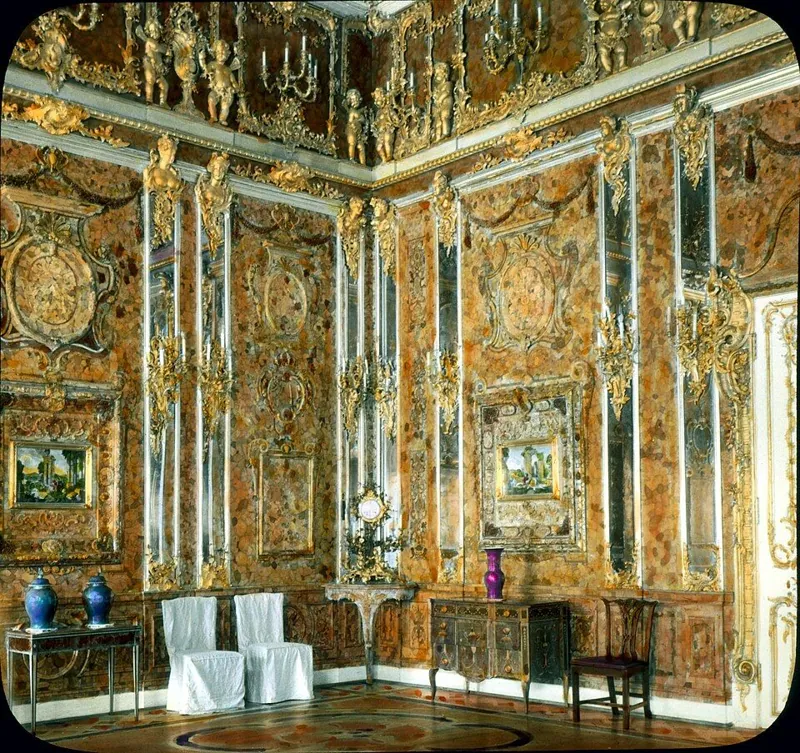
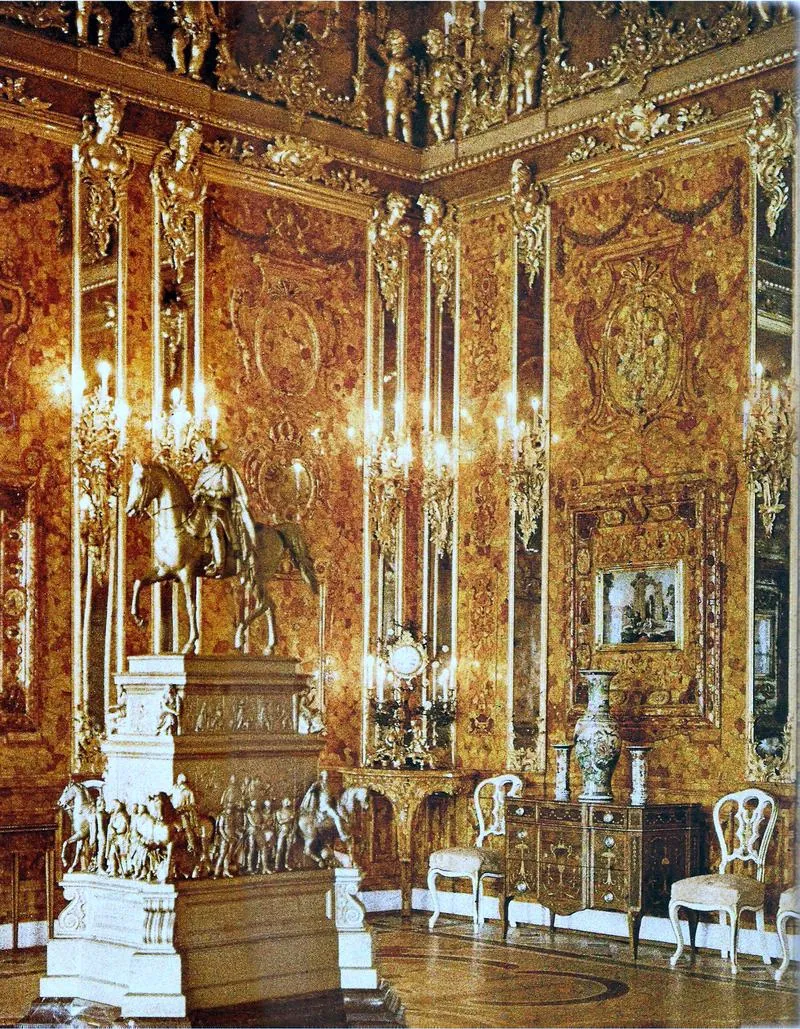
The Amber Room was made in Berlin from 1701 for the Prussian court, designed by Andreas Schlüter and worked by the Danish amber master Gottfried Wolfram and the Danzig masters Turau and Schacht; in 1716 Frederick William I gave it to Peter the Great. Installed in the Catherine Palace at Tsarskoye Selo and enlarged by Rastrelli with mirrors and gilding to fill a far larger hall, it came to cover more than 55 square metres with about six tonnes of amber, and carried four Florentine stone mosaics of the senses given by Maria Theresa[1][2].
When Germany invaded in June 1941 the curator Anatoly Kuchumov tried to take a panel down and it shattered, so he papered the room over. German troops entered the palace on 17 September 1941, found it within hours, took it down in about 36 hours and sent it to Königsberg Castle, where the museum director Alfred Rohde rebuilt and displayed it[2][1][3]. The Royal Air Force burned the city in August 1944; the room was crated and stored in the castle; a letter of 12 January 1945 spoke of evacuating it to Saxony, but by 22 January the last train had gone, and the Red Army took the city on 9 April 1945 after a siege that left the castle a shell[2][1].
Soviet investigators who reached the ruin in 1945 and 1946 found hinges, fragments and, under three layers of ash in the Knights' Hall, three of the four mosaics, "totally burned and discoloured"; Alexander Brusov's report concluded the room was destroyed between 9 and 11 April 1945[2][1]. The Soviet state nevertheless searched, in secret from 1949 and in public from 1958, and the hunt has continued ever since in mines, bunkers, lagoons and wrecks[2][1]. The one thing found is the fourth mosaic, with a chest of drawers from the room, in the hands of a German soldier's family in 1997; both went back to Russia in 2000[4]. Of the 3 questions on this site, 1 are answered. The most likely answer to “What happened to the Amber Room after January 1945?”, not yet confirmed: the crated room burned in Königsberg Castle between 9 and 11 April 1945.
Key questionsset by the editors
The object
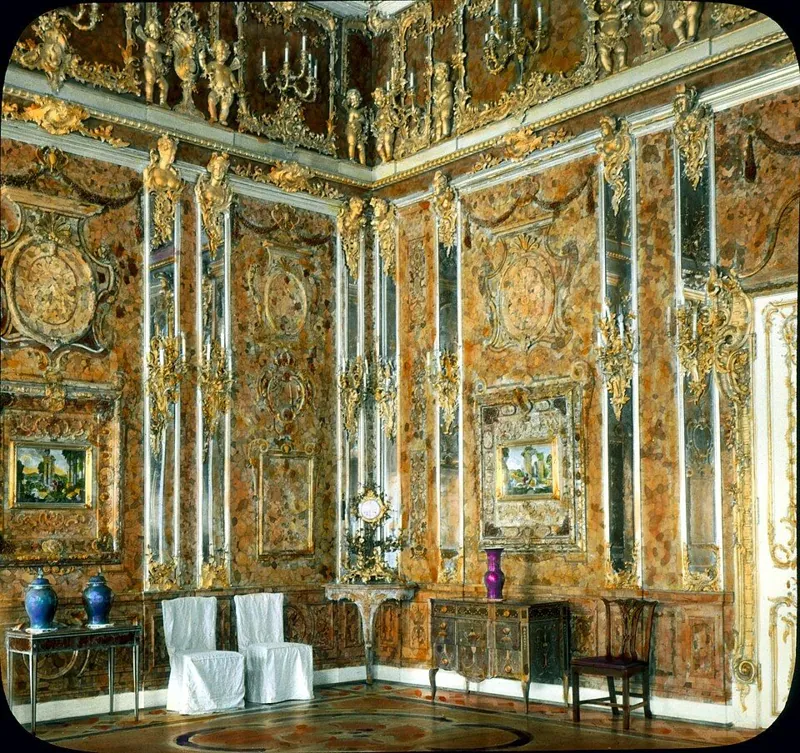
The room was a set of amber panels backed with gold leaf, carved frames, mirrored pilasters and gilded wood, made to fit a Berlin chamber and refitted twice: in the Winter Palace and then, under Empress Elizabeth, in the Catherine Palace, where Rastrelli added mirrors and gilded elements and Frederick II sent further amber. Four Florentine mosaics in coloured stones, allegories of the senses, hung on the panels[1][2]. The amber, by 1941, had dried and become brittle, which is why the Soviet curators could not remove it and why any surviving panels would be fragile[2][3].
What survives today is the reconstruction, begun in 1979 and completed for the city's tercentenary on 31 May 2003 with German corporate funding, using drawings and a 1931 hand-coloured photograph; the recovered fourth mosaic was used in it[1][4]. Russia's 1998 law made displaced wartime cultural property federal property, which frames any future find[4].
Timeline
What is known
The removal and display are documented on the German side (Rohde exhibited the room and wrote about it) and the arrival at the castle by a Nazi ledger found by a Red Army colonel in 1945[2][1]. The last documents are German: the room was taken down and crated in the castle in 1944 or January 1945; a letter of 12 January 1945 planned its evacuation to a castle in western Saxony; a restaurant manager, Paul Feyerabend, later confirmed that crates were still in the Knights' Hall at the surrender[2][3]. Kuchumov, working from maps, concluded that after 22 January the crates could have gone no farther than somewhere in East Prussia by road[2].
The Soviet record is the key. Brusov's 1945 team found copper hinges and other remains; Kuchumov in March 1946 found the three mosaics burned in the Knights' Hall; Brusov's report dated the destruction to 9 to 11 April 1945, the days of the city's fall and the fires that followed[3][2][1]. Brusov later said the opposite in public, which Scott-Clark and Levy attribute to pressure from a state that did not want the Red Army blamed, and Kuchumov led secret digs in Kaliningrad from 1949, a public appeal in 1958 and a search team from 1967 to 1984 while maintaining that the room survived[5][2][3]. In 1968 Brezhnev had the castle ruin demolished, ending any archaeology of the site[1].
The 1997 recovery is the only hard evidence since 1946. The fourth mosaic, "Sense of Smell and Touch", was offered for auction in Bremen on behalf of Hans Achtermann, whose father had been a soldier on the Eastern Front; it and a chest of drawers from the room were confiscated, and after negotiations Bremen handed them to Russia on 29 April 2000 in exchange for 101 drawings taken from the Kunsthalle Bremen in 1945[4][1]. A soldier pocketing a small mosaic during the 1941 packing is consistent with the rest of the room going to Königsberg and no further.
What has been tested
The destruction reading has been tested against the archives: Scott-Clark and Levy read Kuchumov's private papers, Brusov's report, Stasi files on the East German leads and interviewed veterans, and found no document placing the crates anywhere but the castle in April 1945[5][2]. The survival readings have been tested by digging. German and Lithuanian teams announced finds in 1998 (a silver mine; a lagoon), a historian claimed a bunker at Mamerki in Poland in 2016, and in 2020 Polish divers found the steamer Karlsruhe, sunk after leaving Königsberg in April 1945 with crates aboard; none produced amber, and the Karlsruhe's crates proved to hold military equipment and personal effects[1][6]. The Wilhelm Gustloff, sunk 30 January 1945, has been dived repeatedly on the strength of eyewitness claims that the room was loaded aboard, without result[1][2]. Russian officials have rejected the destruction finding on the ground that the Red Army would not have been so careless, which is an argument, not evidence[1].
The readings
That the room burned in Königsberg Castle between 9 and 11 April 1945 is the reading of the Soviet investigators' own 1945 report and of the only archival study since[1][5]. It predicts exactly what was found: burned mosaics and fittings in the Knights' Hall, no document of evacuation after 22 January, and no amber anywhere else in eighty years. It predicts that any future excavation of the castle site (now under a public square and the unfinished House of Soviets) would find amber residue in the fire layer[1].
That the room was evacuated and hidden, in a Saxon castle, a Thuringian or Czech mine, a Polish bunker or a Baltic wreck, rests on the January 1945 letter of intent and on post-war witness claims, mostly collected after the 1958 public appeal[2][1]. It predicts crates of amber panels in some sealed place and a paper or oral trail; every announced location has failed when dug[1][6].
That the Red Army found the room intact and hid it, or that it survives in a Kaliningrad store, is told in Kaliningrad and rests on no document; it predicts that the Russian state holds the panels, which seventy years of Soviet and Russian searching and the 2003 reconstruction make hard to credit[1][3].
Published claims
| Year | Who | Claimed | Status | Reason |
|---|---|---|---|---|
| 1945 | Alexander Brusov (Soviet investigation)[5] | The room was destroyed in the fire at Königsberg Castle between 9 and 11 April 1945. | Accepted | Kuchumov's own find of three burned mosaics in the Knights' Hall in 1946 bears it out, though the castle cellars were never excavated[2][5] |
| 1958 | Anatoly Kuchumov and the Kaliningrad search[2] | The Germans hid the crated room somewhere outside the castle before the city fell, so it could still be found. | Disputed | Decades of Soviet digging found nothing, and the missing fourth mosaic that kept the hope alive turned out to have left in 1941[2][4] |
| 2004 | Catherine Scott-Clark and Adrian Levy[5] | The room burned in the castle in April 1945, and the Soviet state kept up the search to avoid blame and for propaganda. | Still possible | The burning is well supported, but the political motive rests on their reading of files that have not been published in full[5][1] |
| 2008 | Heinz-Peter Haustein[7] | A man-made cavern at Deutschneudorf in the Ore Mountains, found from a Luftwaffe radio operator's notes, holds crates from the room. | Disputed | No amber was produced, and the claim rested on a soil reading and a dead man's notes[7] |
| 2016 | Bartłomiej Plebańczyk[9] | A sealed room beside a German army bunker at Mamerki, found by ground-penetrating radar, holds the Amber Room. | Disputed | Drilling in July 2016 could not reach the space and the radar readings proved unreliable[8] |
| 2019 | Brian Dunning[3] | The documentary record shows the room burned in Königsberg Castle in 1945 and the survival stories have no basis. | Accepted | It summarises the Soviet investigators' finds, which no later search has contradicted[3][2] |
| 2020 | Baltictech divers[6] | The crates in the hold of the steamer Karlsruhe, sunk after leaving Königsberg in April 1945, may hold the Amber Room. | Ruled out | The divers went back in 2021 and found the crates held military equipment and passengers' belongings[10] |
| 2025 | Jan Delingowski[11] | The room may lie in a bunker on a former SS training ground near Dziemiany in Kashubia, where radar found a large anomaly. | Still possible | Drilling was permitted in August 2025 but no result has been published, and the surveying geophysicist doubted the anomaly was a bunker[11] |
What would settle it
Two things. A controlled excavation of the Königsberg Castle site in Kaliningrad, with sampling of the April 1945 fire layer for amber residue and the metal fittings of the panels, would test the destruction reading directly; the ruin was demolished in 1968 but the cellars remain under the square[1]. And full publication of the Soviet files, Brusov's 1945 report and Kuchumov's Königsberg papers, which have been read by two journalists but never published in full, would let others check the dating[2][5]. Any claimed find is settled quickly by the amber itself: brittle, eighteenth-century Baltic amber with gold-leaf backing and carved frames matching the 1931 photographs[1].
Questions
1 of 3 questions are answered.
Evidence 18 findings
Artifacts
The films, photos, papers and objects this mystery rests on, each with its own key and its distance from the original.
See also
References
- 1.Wikipedia contributors n.d.. Amber Room. Wikipedia.cited 20 times hereSRC0D4N2KER6EXB
- 2.Levy, A., Scott-Clark, C. 2004. The amber facade. The Guardian, 22 May 2004.cited 22 times hereSRC0D4N2JFG45ND
- 3.Dunning, B. 2019. Skeptoid #680: The True Fate of the Amber Room. Skeptoid Podcast, 18 June 2019.cited 3 times hereSRC0D4N2K6Y67J7
- 4.Art-Law Centre, U. n.d.. Sammlung 101 – City of Bremen, Kunsthalle Bremen and Russia (ArThemis case note). ArThemis, Art-Law Centre, University of Geneva.cited 11 times hereSRC0D4N2JQA1AXE
- 5.Scott-Clark, C., Levy, A. 2004. The Amber Room: The Untold Story of the Greatest Hoax of the Twentieth Century. Atlantic Books, London (US edition Walker, "The Fate of the World's Greatest Lost Treasure").cited 4 times hereSRC0D4N2J7P3HQZ
- 6.Reuters 2020. Nazi shipwreck found off Poland may solve Amber Room mystery. The Guardian, 1 October 2020.cited 2 times hereSRC0D4N2JZ465QN
- 7.Associated Press 2008. Is latest Amber Room 'discovery' real?. NBC News, February 2008.cited 1 time hereSRC0D4N2MNT5ZFH
- 8.TASS 2016. Another attempt to find Amber Room fails in Poland. TASS, 12 July 2016.cited 1 time hereSRC0D4N2N5E0S46
- 9.Scislowska, M. 2016. Polish historian hopes crumbling bunker hides Amber Room. The Times of Israel (Associated Press), 23 April 2016.cited 1 time hereSRC0D4N2MXM3SKE
- 10.Divernet 2021. Amber Room still missing, say divers. Divernet, 10 September 2021.cited 1 time hereSRC0D4N2ND82DVW
- 11.Tilles, D. 2025. Polish researchers obtain permission to search potential site of Amber Room missing since WWII. Notes from Poland, 14 August 2025.cited 1 time hereSRC0D4N2NN22VRS