The Stradivari "secret"
Antonio Stradivari worked in Cremona from the late 17th century until his death in 1737, and his violins, with those of Giuseppe Guarneri del Gesù, have become the benchmark against which others are judged[1][2]. Generations of makers and scientists have looked for what made them special: the spruce and maple, a secret varnish, chemical treatment of the wood, or the shape of the plates.
Two kinds of question have become separate. The first is whether these violins sound or play better at all. In three double-blind studies, experienced violinists and then hall audiences preferred new violins on average and could not tell new from old better than chance[3][4][5].
The second is whether the instruments differ physically. Here the answer is yes in several respects. The maple and spruce show mineral treatments and chemical changes not found in modern tonewood[6][7][8]; the contrast in density between early and late growth rings is smaller than in modern wood[2]; and the varnish is a two-layer oil and resin system made with pigments common at the time[9]. None of these differences has yet been tied to how the instruments sound. Of the 4 questions on this site, 2 are answered. The most likely answer to “Is there anything physically distinct about the wood and finish of Stradivari's instruments?”, not yet confirmed: stradivari and Guarneri treated their wood with mineral solutions (borax, sulphates, salt, alum, alkali),….
Key questionsset by the editors
The object
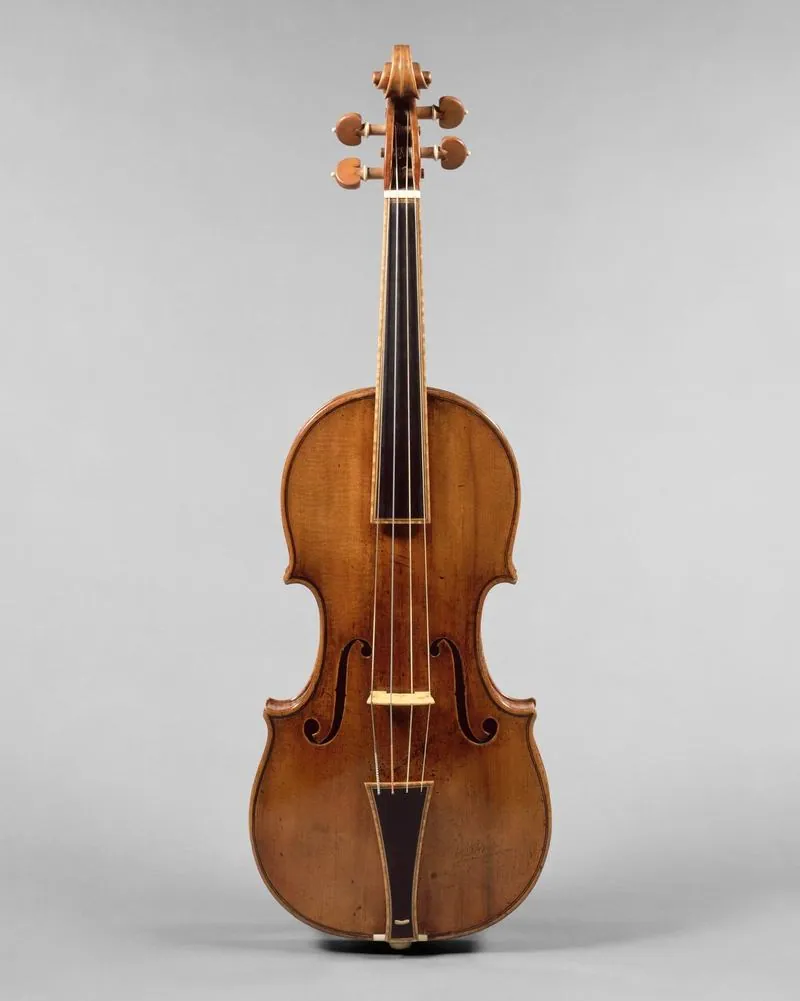
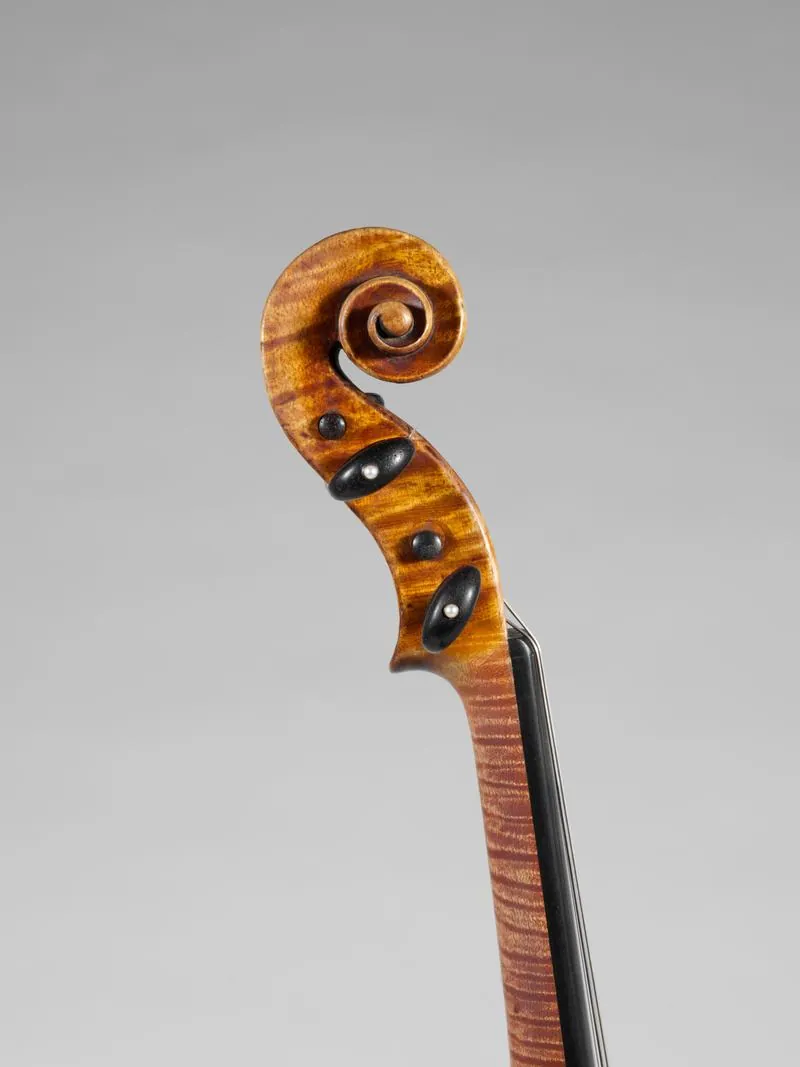
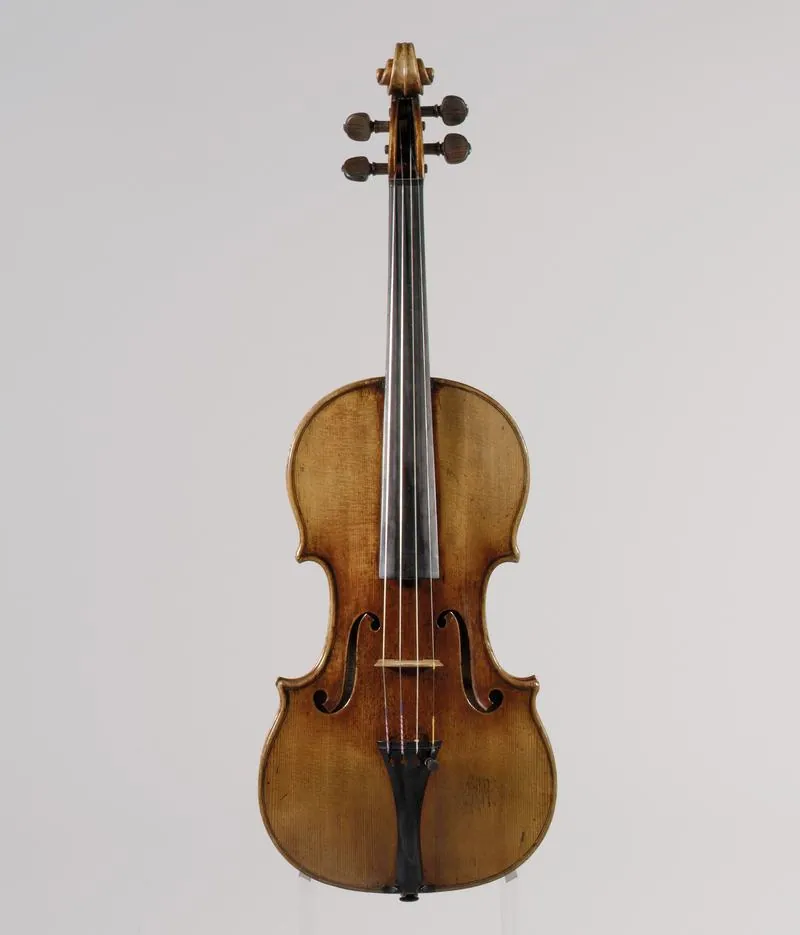
A violin has a carved spruce top and maple back and ribs, finished with a varnish over a ground layer. Three of his violins, the Gould (1693), the Francesca (1694) and the Antonius (1711), are in the Metropolitan Museum of Art, with public-domain images[1]. The Messiah of 1716, at the Ashmolean Museum in Oxford, was the subject of a long dispute over whether it is his[10][11].
Timeline
What is known
Under blind conditions, 21 violinists in 2012 picked a new violin as most preferred and a Stradivari as least preferred; in 2014, six of ten leading soloists chose a new violin for a hypothetical tour; in 2017, listeners in halls in two experiments judged new violins to project better than Stradivaris, with and without orchestra, and preferred them on average[3][4][5].
Chemically, Stradivari's maple has lost about a third of its hemicellulose and shows signs of lignin oxidation, and its elements suggest treatment with complex mineral preservatives[6]. Spruce tops by Stradivari and Guarneri carry elemental compositions and oxidation patterns pointing to borax and metal sulphates against fungi, salt for moisture control, alum for crosslinking and potash or quicklime[7]. Earlier work found barium sulphate, calcium fluoride, borate and zirconium silicate in wood ash from four Cremonese instruments[8][12].
The finish has a drying-oil layer that soaks up to a tenth of a millimetre into the wood and an upper layer of oil, pine resin and pigments such as vermilion, a probable cochineal red and iron-oxide red, all materials painters of the time used[9][13]. Infrared nanospectroscopy has since detected a thin protein layer between wood and varnish on two Stradivari violins[14].
What has been tested
Wood density. CT scans of five Cremonese and eight modern violins found no difference in median density but a smaller density contrast between early and late wood in the Cremonese tops (183 against 274 g/l) and backs (115 against 128 g/l)[2]. A wider study of 30 instruments found no difference in median density between Cremonese, other classical and modern violins[15].
Climate. Burckle and Grissino-Mayer proposed that the cold of the Maunder Minimum slowed Alpine spruce growth and gave unusually even wood[16]. The density contrast result fits this, but no study has separated climate from treatment.
Dating and attribution. Two independent dendrochronological studies placed the outer rings of the Messiah's top in the 1680s, consistent with its 1716 label, and a later claim of an 1844 outer ring could not be verified on the same data[10][17][18]. The ring-width series is public[11].
Sound. Formant analysis of Amati and Stradivari violins found Stradivari's tone resonances placed higher, like a tenor or alto voice rather than a bass[19]. This describes a difference; it does not show a preference.
The readings
No secret, only reputation. The blind tests suggest that the perceived superiority of Old Italian violins comes largely from knowing what one is playing or hearing, and that differences between individual instruments matter more than old versus new[3][5].
Chemical treatment. Stradivari and his contemporaries treated their wood with minerals, for preservation or tone, and the treated wood, aged for three centuries, is a material modern makers cannot buy[6][7]. The evidence for treatment is good; the evidence that it changes the sound is absent.
Wood quality. The Cremonese makers had access to unusually even spruce, whether from climate or selection[16][2]. The 2012 density study argues against uniquely dense wood[15].
Varnish. A special varnish was long the favourite explanation. The analysed finishes are ordinary oil and resin with common pigments, so the varnish is not a secret material, though its layering and the protein ground may still matter to the plates' vibration[9][14].
Design and craft. The violins' geometry and plate tuning, rather than any material, carry the difference, as the formant shift between Amati and Stradivari suggests[19].
Published claims
| Year | Who | Claimed | Status | Reason |
|---|---|---|---|---|
| 2000 | John Topham and Derek McCormick[10] | Tree rings date the spruce tops of Cremonese instruments, and the Messiah's outer rings fall in the 1680s, consistent with its 1716 label. | Accepted | An independent study reached the same dates, and a later re-dating to 1844 could not be verified on the same data[17][18]. |
| 2003 | Lloyd Burckle and Henri Grissino-Mayer[16] | The cold of the Maunder Minimum slowed Alpine spruce growth and gave the Cremonese makers unusually even wood. | Disputed | Cremonese tops show a smaller density contrast between growth rings, but a wider study found no difference in density and no study has separated climate from treatment[2][15]. |
| 2004 | Henri Grissino-Mayer, Paul Sheppard and Malcolm Cleaveland[17] | An independent tree-ring study places the Messiah's outer rings in the 1680s, so it can be a Stradivari of about 1716. | Accepted | It agrees with Topham and McCormick, and both teams found the proposed 1844 re-dating could not be reproduced[10][18]. |
| 2006 | Joseph Nagyvary, Joseph DiVerdi and Noel Owen[12] | The maple of Stradivari and Guarneri instruments is chemically degraded beyond natural ageing, a sign of deliberate treatment. | Most likely | Later studies of maple and spruce also found signs of mineral treatment, though part of the change is put down to ageing[6][7]. |
| 2008 | Berend Stoel and Terry Borman[2] | Cremonese violins are no denser than modern ones, but the contrast in density between early and late growth rings is smaller. | Most likely | It rests on five Cremonese instruments, and the wider 2012 study confirmed only that median density does not differ[15]. |
| 2009 | Joseph Nagyvary, Renald Guillemette and Clifford Spiegelman[8] | Wood ash from two Stradivari and two Guarneri instruments contains compounds absent from natural wood, such as borate, barium sulphate and calcium fluoride. | Most likely | The 2021 study of spruce tops found a similar pattern of mineral treatment by other methods[7]. |
| 2010 | Jean-Philippe Echard and colleagues[9] | Stradivari's finish is a drying-oil base and a layer of oil, pine resin and common red pigments, with no special ingredient. | Accepted | Later work added a thin protein layer under the varnish but found no secret material in the varnish itself[14]. |
| 2012 | Claudia Fritz and colleagues[3] | Under double-blind conditions, 21 violinists preferred a new violin most and a Stradivari least, and could not tell old from new. | Accepted | Tests with leading soloists and with hall audiences gave the same result[4][5]. |
| 2014 | Claudia Fritz and colleagues[4] | Six of ten leading soloists chose a new violin over Old Italian ones for a hypothetical tour, and could not tell them apart better than chance. | Accepted | It agrees with the player and listener tests of 2012 and 2017[3][5]. |
| 2017 | Claudia Fritz and colleagues[5] | Listeners in concert halls judged new violins to project better than Stradivaris and preferred them on average. | Accepted | It repeats in two halls, with and without orchestra, the pattern found with players[3]. |
| 2017 | Hwan-Ching Tai and colleagues[6] | Stradivari's maple has lost about a third of its hemicellulose and carries signs of treatment with mineral preservatives. | Most likely | Spruce from the same workshops shows similar treatment, but no study has shown the treatment changes the sound[7][5]. |
| 2018 | Hwan-Ching Tai and colleagues[19] | Stradivari's violins have higher formants than Amati's, so their tone resembles a tenor or alto voice rather than a bass. | Still possible | It measures a difference in tone between makers, which the blind tests suggest listeners do not turn into a preference[5]. |
| 2021 | Cheng-Kuan Su and colleagues[7] | Stradivari and Guarneri treated their spruce with borax, metal sulphates, salt, alum and potash or quicklime. | Most likely | It agrees with earlier evidence of mineral treatment, but how much is treatment and how much ageing is still argued[8][6]. |
| 2022 | Chiaramaria Stani and colleagues[14] | A thin protein-based layer lies between the wood and the varnish on two Stradivari violins. | Most likely | It is one method on two instruments and has not been challenged, but its effect on the sound is unknown[9]. |
What would settle it
A test linking cause and effect: matched modern violins made from treated and untreated wood of the same logs, measured acoustically and judged blind by players and listeners, would show whether the Cremonese treatments matter. Public release of CT volumes and acoustic measurements of the instruments already studied would let others model plate stiffness from geometry and density. More blind tests with more instruments, pre-registered, would fix how large any old-versus-new difference is.
Questions
2 of 4 questions are answered.
Evidence 20 findings
Artifacts
The films, photos, papers and objects this mystery rests on, each with its own key and its distance from the original.
See also
References
- 1.The Metropolitan Museum of Art 2026. "Gould" Violin, Antonio Stradivari, 1693 (55.86a–c). The Met Collection.cited 7 times hereSRC0CQAGH6W3TWJ
- 2.Stoel, B., Borman, T. 2008. A Comparison of Wood Density between Classical Cremonese and Modern Violins. PLoS ONE 3, e2554.doicited 7 times hereSRC0CQAGF8C7G8P
- 3.Fritz, C., Curtin, J., Poitevineau, J. et al. 2012. Player preferences among new and old violins. Proceedings of the National Academy of Sciences 109, 760–763.doicited 7 times hereSRC0CQAGCT832ZH
- 4.Fritz, C., Curtin, J., Poitevineau, J. et al. 2014. Soloist evaluations of six Old Italian and six new violins. Proceedings of the National Academy of Sciences 111, 7224–7229.doicited 4 times hereSRC0CQAGD222YYZ
- 5.Fritz, C., Curtin, J., Poitevineau, J. et al. 2017. Listener evaluations of new and Old Italian violins. Proceedings of the National Academy of Sciences 114, 5395–5400.doicited 8 times hereSRC0CQAGD9W2GEZ
- 6.Tai, H., Li, G., Huang, S. et al. 2017. Chemical distinctions between Stradivari's maple and modern tonewood. Proceedings of the National Academy of Sciences 114, 27–32.doicited 8 times hereSRC0CQAGDHP4RVE
- 7.Su, C., Chen, S., Chung, J. et al. 2021. Materials Engineering of Violin Soundboards by Stradivari and Guarneri. Angewandte Chemie International Edition 60, 19144–19154.doicited 10 times hereSRC0CQAGDSG1YB4
- 8.Nagyvary, J., Guillemette, R., Spiegelman, C. 2009. Mineral Preservatives in the Wood of Stradivari and Guarneri. PLoS ONE 4, e4245.doicited 3 times hereSRC0CQAGE945BGR
- 9.Echard, J., Bertrand, L., von Bohlen, A. et al. 2010. The Nature of the Extraordinary Finish of Stradivari's Instruments. Angewandte Chemie International Edition 49, 197–201.doicited 5 times hereSRC0CQAGEGY6T92
- 10.Topham, J., McCormick, D. 2000. A Dendrochronological Investigation of Stringed Instruments of the Cremonese School (1666–1757) including 'The Messiah' violin attributed to Antonio Stradivari. Journal of Archaeological Science 27, 183–192.doicited 3 times hereSRC0CQAGFZT51FK
- 11.Grissino-Mayer, H., Sheppard, P., Cleaveland, M. 2005. Grissino-Mayer - Messiah Violin - PCAB - ITRDB BRIT050. NOAA NCEI World Data Service for Paleoclimatology (International Tree-Ring Data Bank).doicited 4 times hereSRC0CQAGGZ27WWP
- 12.Nagyvary, J., DiVerdi, J., Owen, N. et al. 2006. Wood used by Stradivari and Guarneri. Nature 444, 565.doicited 2 times hereSRC0CQAGE1A7FJJ
- 13.CORDIS (European Commission) 2009. Study reveals secret of Stradivari's varnishes. CORDIS News.cited 1 time hereSRC0CQAGERR3366
- 14.Stani, C., Invernizzi, C., Birarda, G. et al. 2022. A Nanofocused Light on Stradivari Violins: Infrared s-SNOM Reveals New Clues Behind Craftsmanship Mastery. Analytical Chemistry 94, 14815–14819.doicited 2 times hereSRC0CQAGF0J5KQD
- 15.Stoel, B., Borman, T., de Jongh, R. 2012. Wood Densitometry in 17th and 18th Century Dutch, German, Austrian and French Violins, Compared to Classical Cremonese and Modern Violins. PLoS ONE 7, e46629.doicited 2 times hereSRC0CQAGFG61SKN
- 16.Burckle, L., Grissino-Mayer, H. 2003. Stradivari, violins, tree rings, and the Maunder Minimum: a hypothesis. Dendrochronologia 21, 41–45.doicited 2 times hereSRC0CQAGFR01KM3
- 17.Grissino-Mayer, H., Sheppard, P., Cleaveland, M. 2004. A dendroarchaeological re-examination of the 'Messiah' violin and other instruments attributed to Antonio Stradivari. Journal of Archaeological Science 31, 167–174.doicited 4 times hereSRC0CQAGG7M04YP
- 18.Grissino-Mayer, H., Sheppard, P., Cleaveland, M. et al. 2010. Adverse implications of misdating in dendrochronology: Addressing the re-dating of the 'Messiah' violin. Dendrochronologia 28, 149–159.doicited 6 times hereSRC0CQAGGFE1C45
- 19.Tai, H., Shen, Y., Lin, J. et al. 2018. Acoustic evolution of old Italian violins from Amati to Stradivari. Proceedings of the National Academy of Sciences 115, 5926–5931.doicited 2 times hereSRC0CQAGGQ87K8D