The Shroud of Turin
The Shroud of Turin is a single piece of herringbone linen about 4.3 m long and 1.1 m wide that carries, side by side, a faint straw-coloured image of the front and back of a man who appears to have been scourged and crucified, with red-brown stains at the wounds[1][2]. Some Christians venerate it as the burial cloth of Jesus. It appears in the historical record in the fourteenth century in Champagne, and a churchman of that century already treated a cloth claimed as the burial shroud there as a fraud[3]. It has been in Turin since the sixteenth century and is kept by the Archdiocese[4].
Science has examined it twice at length. In 1978 the Shroud of Turin Research Project spent five days measuring it with photography, spectroscopy, X-rays and microscopy, and found that the image lies only in the topmost fibrils, is not a layer of paint, and encodes the distance between cloth and body[2][5]. In 1988 three accelerator laboratories dated subsamples from one corner, with control textiles, and reported AD 1260-1390[6].
The date has been contested ever since: that the corner was a medieval repair, that the laboratories' data are statistically inconsistent, that the linen's crystal structure says it is far older[7][8][9]. Tests of the dated threads have so far found them to be the same cloth as the rest[10][1]. The image remains the harder problem: a 2025 digital study found its geometry fits a low relief better than a body, a claim promptly disputed[11][12]. Of the 4 questions on this site, 1 are answered.
Key questionsset by the editors
The object
The cloth measures 4.30 m by 1.08 m, with a sewn-on strip 3.80 m long along one side[1]. It is woven in a three-to-one herringbone twill, and it carries burn marks and patches from a sixteenth-century fire, and water stains[2]. The image is a negative: light and dark are reversed, so that the photographic negative shows a recognisable face, a fact noticed when the cloth was first photographed in 1898[2]. The colour lies in the topmost one or two fibres of the threads and does not penetrate the cloth; there is no image under the bloodstains[2][13]. Image intensity varies with what would be the distance from cloth to body, which is why the image can be rendered in three dimensions[5].
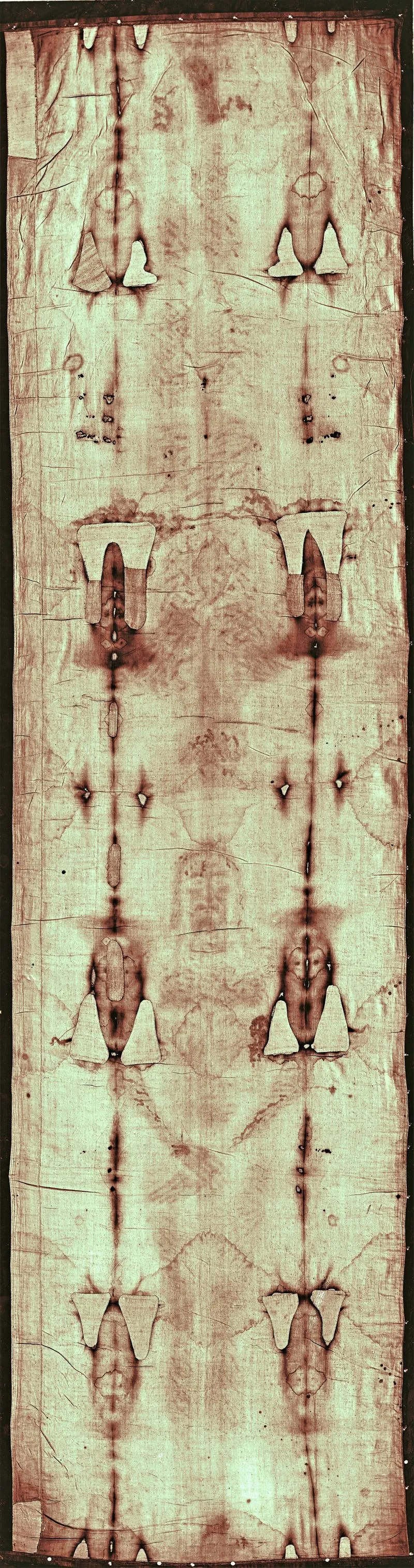
The cloth belongs to the Holy See and is kept by the Archdiocese of Turin, which decides on access and sampling[4].
Timeline
What is known
The radiocarbon result is the anchor. On 21 April 1988 a strip was cut from one corner, near the side strip, and subsamples went to Arizona, Oxford and Zurich with three control cloths of known age; the combined result was a calibrated range of AD 1260-1390 at 95% confidence[1][6]. This matches the historical record, in which the cloth appears in fourteenth-century France and its authenticity is disputed by churchmen of the time[3].
The 1978 study established the physical character of the image: a dehydration and oxidation of the cellulose of the outermost fibrils, with no binder, no brush marks and no capillary flow, and no single mechanism identified[2]. Whether the stains are blood is disputed between two analyses of the same STURP tape samples: blood components in one, red ochre and vermilion in a binder in the other[13][14]. DNA from dust on the cloth comes from many plant and human sources across Europe, the Near East, Asia and the Americas, as centuries of exposure and handling would leave[15].
What has been tested
The date has been tested from three directions. Statistics: when the raw measurements were released by the British Museum in 2017, reanalyses found that the Shroud subsamples are heterogeneous while the controls are not, with an apparent trend in age across the sampled strip[8][16][17]. The authors read this as unremoved contamination or a sampling problem. None of them proposes an alternative date; they call for experiments or re-dating[16][17].
The sample: Raymond Rogers argued from threads said to come from the corner that it contained cotton and a dye and was a repair[7]. Photomicrography of a piece of the Arizona sample found no dye, coating or evidence that it was not part of the main cloth, and a 2026 analysis of two more Arizona fragments found flax consistent with the main body, no cotton and no contamination[10][1].
Other dating methods: wide-angle X-ray scattering of a thread near the sampling area gave a cellulose degradation profile matching a first-century linen from Masada, but only on the assumption of a particular temperature and humidity history for thirteen undocumented centuries[9]. No independent laboratory has reproduced the method on the Shroud.
The image and the blood: bloodstain pattern analysis with a volunteer found that the arm stains require two different arm positions and that the back stains are unrealistic for a body lying down[18]. A digital simulation of a cloth draped over a body and over a low relief found the relief reproduces the image's proportions and the body does not[11]; a published commentary rejects the method[12].
The readings
A medieval artefact. The cloth was made in the fourteenth century, and the image was produced by an artistic technique, perhaps rubbing or contact with a heated or treated low relief, or painting. For it: the radiocarbon date, the fourteenth-century documentary record, the pigment findings, the blood-pattern inconsistencies and the relief geometry[6][3][14][18][11]. Against it: no reproduction yet matches all of the 1978 properties, including the superficiality of the colour and the absence of image under the blood[2].
An older cloth misdated. The linen is ancient and the 1988 date is wrong because of a repair, contamination or a flawed statistical treatment[7][17][9]. For it: the heterogeneity of the raw data and the WAXS result. Against it: the dated threads are the main cloth on textile examinations, the statistical critiques propose no alternative date, and the WAXS result depends on an assumed storage history[10][1][9].
An authentic burial cloth with an unexplained image. The cloth wrapped a crucified man in antiquity, which the WAXS authors find compatible with their result, and the image formed by a process not yet identified[9]. Its proponents point to the 3D encoding and the superficial colour that no artistic method has matched[5][2]. It requires the radiocarbon date to be wrong and offers no tested mechanism.
Published claims
| Year | Who | Claimed | Status | Reason |
|---|---|---|---|---|
| 1981 | John Heller and Alan Adler[13] | Chemical tests on STURP tape samples find blood components in the red-brown stains. | Most likely | McCrone read the same tapes as red ochre and vermilion, so the identification is still contested[14]. |
| 1982 | Larry Schwalbe and Raymond Rogers (STURP)[2] | The body image is a superficial yellowing of the topmost linen fibrils, not a layer of pigment, and no single mechanism explains it. | Accepted | Later image studies take this description as their starting point, and no experiment has yet reproduced every property it lists[19][20]. |
| 1984 | John Jackson, Eric Jumper and William Ercoline[5] | The image's intensity follows the distance between cloth and a body, so the image encodes the three-dimensional shape of a human body. | Still possible | The correlation is accepted, but replicas made from a low relief also carry three-dimensional information[19][11]. |
| 1989 | Paul Damon and colleagues (Arizona, Oxford and Zurich laboratories)[6] | Radiocarbon dating by three laboratories gives the linen a date of AD 1260 to 1390, conclusive evidence that it is medieval. | Accepted | It is the scientific consensus, matches the cloth's first appearance in the fourteenth century, and textile studies of 2010 and 2026 found the dated sample representative[1][3]. |
| 1990 | Walter McCrone[14] | The image and the bloodstains were painted with red ochre and vermilion in a collagen binder. | Disputed | STURP found the image is not a pigment layer, and Heller and Adler identified blood in the stains[2][13]. |
| 2005 | Raymond N. Rogers[7] | The radiocarbon corner contains cotton and a dye not found in the main cloth, so it is a later repair, and the cloth itself is much older. | Disputed | Two examinations of the Arizona sample found flax consistent with the main body of the cloth, no cotton and no coating[10][1]. |
| 2010 | Luigi Garlaschelli[19] | A medieval artist could have made the image by simple means, and a full-size replica made that way has all its main features. | Disputed | Di Lazzaro and colleagues, in the same issue, held that no laboratory method yet reproduces every property of the image, and no independent study has compared the replica with the cloth in full[20]. |
| 2010 | Paolo Di Lazzaro and colleagues[20] | Ultraviolet laser pulses colour linen in a sub-micrometre outer layer of the fibres, much as the Shroud image is coloured. | Still possible | The coloration is shown on small samples; no one has shown how such radiation could form a whole image[20]. |
| 2010 | Rachel Freer-Waters and Timothy Jull[10] | A piece of the 1988 Arizona sample shows no sign of coming from a repair, no coatings or dyes, and only minor contaminants. | Accepted | A second examination of further fragments in 2026 found the same[1]. |
| 2015 | Gianni Barcaccia and colleagues[15] | DNA in dust from the cloth comes from plants and people of many regions, compatible with a medieval European origin or with the cloth's traditional journey from the Near East. | Still possible | The cloth has been handled for centuries, so the DNA cannot tell the two histories apart[15]. |
| 2019 | Tristan Casabianca and colleagues[8] | The laboratories' raw data released in 2017 are not homogeneous, so the 1988 dating should be reconsidered. | Disputed | The heterogeneity is confirmed, but none of the reanalyses proposes another date, and it may come from ordinary laboratory differences[16][17]. |
| 2019 | Matteo Borrini and Luigi Garlaschelli[18] | The bloodstain patterns need different arm positions on the hand and forearm, and the stains on the back are unrealistic for a body lying down. | Disputed | It rests on tests with one living volunteer and has not been repeated[18]. |
| 2020 | Bryan Walsh and Larry Schwalbe[16] | The Shroud dates are heterogeneous where the controls are not, either because the dates depend on position in the sample or because the laboratories cleaned it differently. | Still possible | The two causes have not been told apart by the experiments the authors propose[16]. |
| 2020 | Paolo Di Lazzaro and colleagues[17] | A spatial trend in the subsample ages points to contaminants unevenly removed by cleaning, so the 1988 dating does not meet current standards of accuracy. | Disputed | No new dating has been made, and textile studies of the Arizona sample found no evidence of contamination[1]. |
| 2022 | Liberato De Caro and colleagues[9] | X-ray scattering shows the cellulose of a thread is as degraded as a linen of AD 55 to 74, so the cloth is much older than seven centuries. | Disputed | The result holds only if the cloth was kept at an assumed temperature and humidity for thirteen unknown centuries, and the radiocarbon date stands[6][1]. |
| 2025 | Cicero Moraes[11] | A cloth draped over a body gives a widened, distorted image, while one laid over a low relief gives the Shroud's proportions, so the image was taken from a bas-relief. | Disputed | A published commentary argues the simulation's aims are ambiguous and that it leaves out features of the cloth[12]. |
| 2025 | Nicolas Sarzeaud[3] | A passage by Nicole Oresme, who died in 1382, on fraudulent relics refers critically to the cloth shown at Lirey in Champagne. | Most likely | It fits the radiocarbon date and the cloth's first appearance, but the link to Lirey is the author's reading of the passage[3][6]. |
| 2026 | Rachel Freer-Waters and Timothy Jull[1] | Two further fragments of the Arizona sample are flax consistent with the main body of the cloth, with no cotton and no sign of contamination. | Accepted | It repeats the 2010 finding on new fragments, though both studies come from the same laboratory[10]. |
What would settle it
A new radiocarbon programme would settle the date: several samples from documented points across the cloth, including away from the 1988 corner, divided blind between laboratories with matched pretreatment and published raw data, as the statistical critics themselves propose. Independent replication of the WAXS method on linens of known age and storage history would show whether it can date textiles at all. For the image, a reproduction by a medieval technique that matches every measured property, superficiality, the 3D encoding, the fluorescence and the absence of image under the stains, would make the medieval reading complete; none has been published. Any new sampling depends on the custodian[4].
Questions
1 of 4 questions are answered.
Evidence 22 findings
Artifacts
The films, photos, papers and objects this mystery rests on, each with its own key and its distance from the original.
See also
References
- 1.Freer-Waters, R., Jull, A. 2026. Analysis of textile fragments from the 1988 radiocarbon samples of the Turin Shroud. npj Heritage Science 14: 263.doicited 9 times hereSRC0CWY27105PBE
- 2.Schwalbe, L., Rogers, R. 1982. Physics and chemistry of the shroud of turin. Analytica Chimica Acta 135(1): 3-49.doicited 8 times hereSRC0CWY28083MT6
- 3.Sarzeaud, N. 2025. A New Document on the Appearance of the Shroud of Turin from Nicole Oresme: Fighting False Relics and False Rumours in the Fourteenth Century. Journal of Medieval History 51(5): 604-621.doicited 5 times hereSRC0CWY29F47XR7
- 4.Archdiocese of Turin 2026. Sindone.org: official site of the Pontifical Custodian of the Shroud, Archdiocese of Turin. Archdiocese of Turin.cited 3 times hereSRC0CWY2A6J1WRD
- 5.Jackson, J., Jumper, E., Ercoline, W. 1984. Correlation of image intensity on the Turin Shroud with the 3-D structure of a human body shape. Applied Optics 23(14): 2244.doicited 4 times hereSRC0CWY28822G10
- 6.Damon, P., Donahue, D., Gore, B. et al. 1989. Radiocarbon dating of the Shroud of Turin. Nature 337: 611-615.doicited 10 times hereSRC0CWY25J434GF
- 7.Rogers, R. 2005. Studies on the radiocarbon sample from the shroud of turin. Thermochimica Acta 425(1-2): 189-194.doicited 5 times hereSRC0CWY26HC0DT4
- 8.Casabianca, T., Marinelli, E., Pernagallo, G. et al. 2019. Radiocarbon Dating of the Turin Shroud: New Evidence from Raw Data. Archaeometry 61(5): 1223-1231.doicited 4 times hereSRC0CWY25SY26XP
- 9.De Caro, L., Sibillano, T., Lassandro, R. et al. 2022. X-ray Dating of a Turin Shroud's Linen Sample. Heritage 5(2): 860-870.doicited 7 times hereSRC0CWY278T1R0G
- 10.Freer-Waters, R., Jull, A. 2010. Investigating a Dated Piece of the Shroud of Turin. Radiocarbon 52(4): 1521-1527.doicited 3 times hereSRC0CWY26S67G5H
- 11.Moraes, C. 2025. Image Formation on the Holy Shroud—A Digital 3D Approach. Archaeometry 68(1): 84-93.doicited 4 times hereSRC0CWY27GM6M5Q
- 12.Casabianca, T., Marinelli, E., Piana, A. 2026. Commentary on the Article "Image Formation on the Holy Shroud—A Digital 3D Approach" by Cicero Moraes. Archaeometry 68(4): 861-863.doicited 2 times hereSRC0CWY27RE4WPB
- 13.Heller, J., Adler, A. 1981. A Chemical Investigation of the Shroud of Turin. Canadian Society of Forensic Science Journal 14(3): 81-103.doicited 5 times hereSRC0CWY28FW5NHE
- 14.McCrone, W. 1990. The Shroud of Turin: blood or artist's pigment?. Accounts of Chemical Research 23(3): 77-83.doicited 6 times hereSRC0CWY28QP77XH
- 15.Barcaccia, G., Galla, G., Achilli, A. et al. 2015. Uncovering the sources of DNA found on the Turin Shroud. Scientific Reports 5: 14484.doicited 3 times hereSRC0CWY297A6S1B
- 16.Walsh, B., Schwalbe, L. 2020. An instructive inter-laboratory comparison: The 1988 radiocarbon dating of the Shroud of Turin. Journal of Archaeological Science: Reports 29: 102015.doicited 4 times hereSRC0CWY261R3EGA
- 17.Di Lazzaro, P., Atkinson, A., Iacomussi, P. et al. 2020. Statistical and Proactive Analysis of an Inter-Laboratory Comparison: The Radiocarbon Dating of the Shroud of Turin. Entropy 22(9): 926.doicited 6 times hereSRC0CWY269J3DDN
- 18.Borrini, M., Garlaschelli, L. 2019. A BPA Approach to the Shroud of Turin. Journal of Forensic Sciences 64(1): 137-143.doicited 2 times hereSRC0CWY28ZG13HA
- 19.Garlaschelli, L. 2010. Life-size Reproduction of the Shroud of Turin and its Image. Journal of Imaging Science and Technology 54(4): 040301.doicited 1 time hereSRC0CWY2AP639N7
- 20.Di Lazzaro, P., Murra, D., Santoni, A. et al. 2010. Deep Ultraviolet Radiation Simulates the Turin Shroud Image. Journal of Imaging Science and Technology 54(4): 040302.doicited 1 time hereSRC0CWY2AY078CM