Linear A
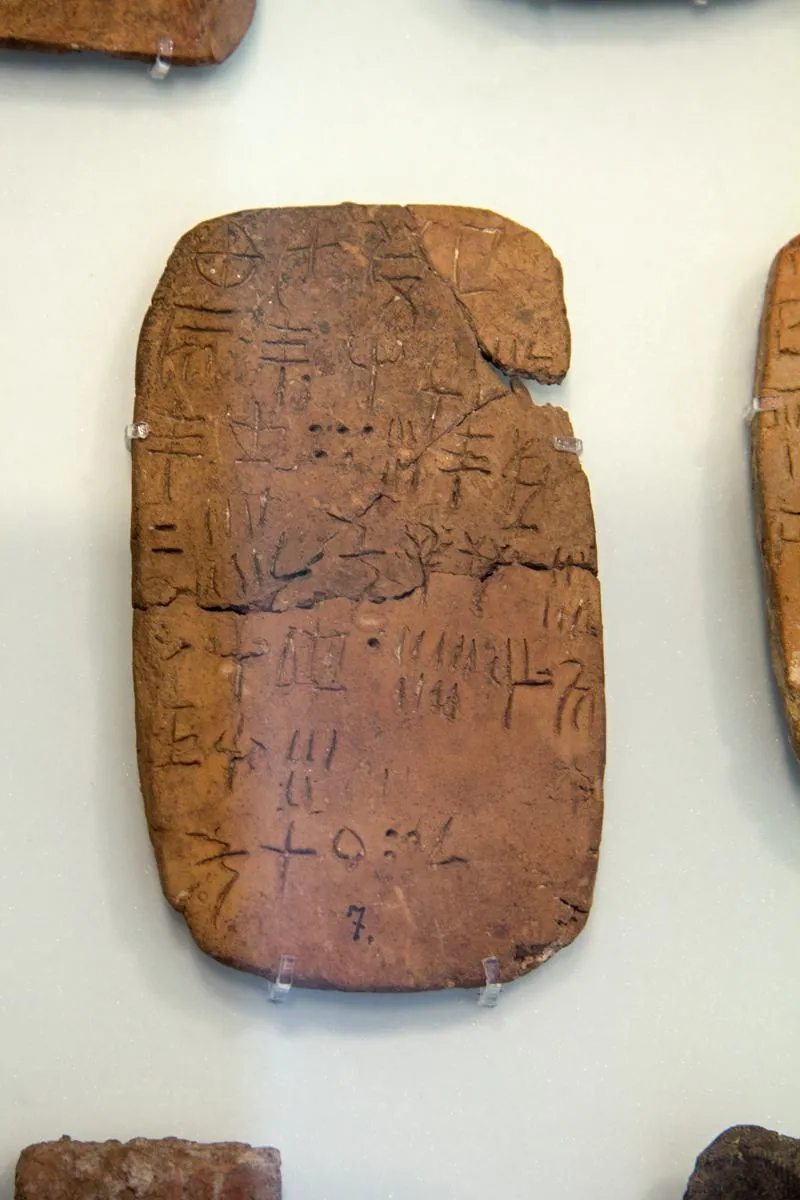
Linear A is the writing system of the Minoan palaces of Crete. Arthur Evans named it in 1909 to distinguish it from the later Linear B, which Michael Ventris showed in 1952 to be Greek. Linear A is older, runs from about 1800 to 1450 BC, and was used mainly for accounts: clay tablets listing people, livestock, grain, oil, wine and figs with numerals, plus sealings and small clay roundels that moved with goods[1][2]. A smaller set of inscriptions, on stone libation tables, ladles and bowls from peak sanctuaries and shrines, carries repeated formulaic phrases that are the best evidence for the grammar of the language[3].
The script is read, in a limited sense. About two thirds of its signs have shapes that continue into Linear B, and scholars conventionally give those signs the Linear B sound values, so that Linear A words can be pronounced[1]. The numerals are decimal and understood; the fraction signs were largely resolved in 2021 by a combined palaeographic and computational study[4]. The commodity logograms are mostly recognisable from their Linear B counterparts. What is not understood is the language. The transliterated words do not match any known language in a way that survives scrutiny, and proposals for Luwian, Semitic, Greek and Uralic have each been put and each been rejected or left unconfirmed[5][6][7][8][9].
The whole corpus is about 1,400 documents and 7,400 signs, most of them numerals or single-word entries[2]. It is published in the five volumes of GORILA (1976 to 1985) and, since 2020, in the open palaeographic database SigLA, which gives every sign a drawing and position so that statistical work can be done on the signs themselves rather than on transliterations[10][11]. The small size of the corpus, the lack of a bilingual text and the uncertainty about whether Linear B values apply are the three constraints that every attempt has to work within. Of the 5 questions on this site, 0 are answered. The most likely answer to “Do the Linear B sound values apply to the Linear A signs that share their shapes?”, not yet confirmed: the shared signs kept their values when Linear B was adapted from Linear A, so Linear A can be pronounced….
Key questionsset by the editors
The object
Linear A documents come from about thirty sites on Crete and a handful off it. The largest archive is Haghia Triada in the Mesara plain, about 147 tablets of Late Minoan IB (c. 1450 BC); the next are Khania, Zakros, Phaistos and Knossos[2]. The documents are of several kinds: page-shaped clay tablets with lists of entries and totals; roundels, flat clay discs stamped with seals on the edge and inscribed with a word on the face; nodules and sealings; and inscribed objects, chiefly stone libation tables and vessels but also a gold pin, a silver pin and pottery[1][3]. The corpus edition is Godart and Olivier's Recueil des inscriptions en linéaire A (GORILA), five volumes with photographs, drawings and normalised transcriptions[10]. John Younger's web edition gives transcriptions and running commentary for the whole corpus and is the usual working text[2]. SigLA, built by Ester Salgarella and Simon Castellan, redraws the signs of every inscription in GORILA and later additions, with sign-by-sign metadata, under a CC BY-NC-SA licence[11][12].
Timeline
What is known
Linear A is a syllabary with logograms. The syllabic signs number about ninety; most stand for an open syllable (a consonant plus a vowel) or a bare vowel[11]. Signs that have the same shape in Linear B are conventionally given the Linear B values, a step defended by Salgarella's 2020 study of how Linear B was adapted from Linear A, which argues for close continuity in the shared signs[1]. The numeral system is decimal: units are vertical strokes, tens horizontal strokes, hundreds circles, thousands circles with rays[10]. The fraction signs, long partly obscure, were given a consistent set of values in 2021 by Corazza, Ferrara, Montecchi, Tamburini and Valério, who combined palaeography with a computational search for value assignments that make the totals on the tablets add up[4]. Commodity logograms for grain, wine, oil, figs, people and animals are recognised from their Linear B descendants and from context[2].
Something is known about the language from the texts themselves. The libation formula, a sequence of up to eight words repeated with variations on stone vessels from Mount Iouktas, Petsophas, Kato Syme and elsewhere, shows a fixed word order and inflected endings. Brent Davis's analysis of the formula argues that the language is likely to place the verb early in the sentence and to mark grammatical relations by suffixes[13][3]. Word-initial and word-final sign frequencies differ from Linear B Greek, which is the main reason most scholars doubt that Linear A is Greek[3]. Davis's 2018 comparison of how Linear A and the Phaistos Disc treat their shared sign shapes found statistically similar behaviour and concluded the two most likely record the same language[14].
What has been tested
Every decipherment proposal has been tested against the same checks: does it read the whole corpus, not just a few words; does it respect the Linear B values or justify departing from them; does it give the libation formula a grammatical reading; and does it make the account totals work. Palmer's Luwian reading of 1958 rested on a small number of word matches and did not generalise[5]. Gordon's Semitic reading of 1966 found Semitic-looking words in the vocabulary, most famously ku-ro for "total" compared with Semitic kull "all", but the grammatical endings do not behave as Semitic morphology requires[6][1]. Greek readings have been proposed since Nagy in 1963 and continue, but the sign statistics of Linear A differ from those of Linear B Greek[7][3]. Finkelberg argued in 1990 for an Anatolian language close to Lycian, on the basis of inflectional endings in the libation formula; the argument is taken seriously but has not been confirmed[15].
Computational work in the 2020s has been modest and mostly negative. Corazza and colleagues' fraction study is the clearest success, because it solved a bounded problem with a check (the totals)[4]. Nepal and Perono Cacciafoco in 2024 combined a sign-shape similarity measure with a consonant-skeleton dictionary search across Egyptian, Luwian, Hittite, Proto-Celtic and Uralic and found only scattered matches, which they themselves judged inconclusive and partly coincidental[9]. Revesz's 2017 claim that Linear A writes a Uralic ("West-Ugric") language related to Hungarian has not been accepted by Aegean epigraphers and rests on sign comparisons and selective readings[8][9]. The SigLA database was built to make these tests reproducible at the level of sign variants rather than transliterations[11].
The readings
Five positions are live. The first is that Linear A writes an Anatolian language of the Luwian or Lycian branch, which would fit the geography and the suffixing grammar of the libation formula[5][15]. The second is that it writes a Semitic language, which rests on vocabulary matches such as ku-ro and on Bronze Age trade contact[6]. The third is that it writes an early form of Greek or another Indo-European language, which would make Linear B a continuation rather than an adaptation; the sign statistics weigh against this[7][3]. The fourth is the Uralic claim, which has no following among specialists[8]. The fifth, and the default among epigraphers, is that Minoan is an isolate or belongs to a family with no other written record, in which case no dictionary search can succeed and progress must come from internal analysis and new texts[1][3]. All five share the problem that the corpus is dominated by names and commodity entries, which carry little grammar.
Published claims
| Year | Who | Claimed | Status | Reason |
|---|---|---|---|---|
| 1909 | Arthur Evans[17] | Linear A and Linear B are two stages of the Minoans' own script, and both write the same non-Greek language. | Ruled out | Linear B was shown in 1952 to write Greek, so the two scripts do not share a language[16] |
| 1953 | Michael Ventris and John Chadwick[16] | Linear B writes an early form of Greek, with sign values that can be stated. | Accepted | The decipherment has been confirmed by thousands of later readings and is the basis for sounding Linear A[1] |
| 1958 | Leonard Palmer[5] | Linear A writes Luwian, an Anatolian language, on the evidence of word matches and endings. | Disputed | The matches did not extend to the corpus, and a 2024 dictionary search found only scattered Luwian matches[9] |
| 1963 | Gregory Nagy[7] | Some Linear A words and endings look Greek when read with Linear B values. | Disputed | Linear A's signs behave differently from Linear B Greek at the starts and ends of words[3] |
| 1966 | Cyrus Gordon[6] | Linear A writes a Northwest Semitic language, as words such as ku-ro, "total", show. | Disputed | The vocabulary matches stand alone, and the suffixing grammar of the libation formula does not fit Semitic morphology[13] |
| 1990 | Margalit Finkelberg[15] | The endings in the libation formula show Linear A writes an Anatolian language close to Lycian. | Still possible | It is taken seriously but has not been confirmed, and dictionary searches have not borne it out[9] |
| 2013 | Brent Davis[13] | The variants of the libation formula show a language that puts the verb early and marks relations with suffixes. | Still possible | It is the most detailed grammatical analysis, but it rests on one formula whose words may be largely names[3] |
| 2014 | Brent Davis[3] | Linear A's signs behave differently from Linear B Greek at word boundaries, so its language is not Greek. | Most likely | No Greek reading has answered the statistical comparison, and most epigraphers accept it[1] |
| 2017 | Peter Revesz[8] | Linear A writes a Uralic language of a "West-Ugric" family that includes Hungarian. | Disputed | Aegean epigraphers have not accepted it, and a search of Uralic dictionaries found only matches that also occur in unrelated languages[9] |
| 2018 | Brent Davis[14] | The Phaistos Disc and Linear A treat their shared sign shapes alike and so most likely write the same language. | Still possible | The Disc's 45 signs and 241 impressions are too few for the result to be firm[14] |
| 2020 | Ester Salgarella[1] | The signs Linear B took over from Linear A kept their shapes and uses, so Linear B sound values can be carried back to Linear A. | Accepted | Cretan place names such as pa-i-to, Phaistos, read alike in both scripts[2] |
| 2021 | Michele Corazza and colleagues[4] | A computational search finds one consistent set of values for the Linear A fraction signs that makes the tablet totals add up. | Most likely | It solved a bounded problem against a check, the totals, but a few values remain less certain than others[4] |
| 2024 | Aaradh Nepal and Francesco Perono Cacciafoco[9] | A search of Linear A words against Egyptian, Luwian, Hittite, Proto-Celtic and Uralic dictionaries finds only scattered matches that decide nothing. | Accepted | The null result agrees with six decades of failed comparisons[1] |
What would settle it
A bilingual, even a short one, would settle the sound values and give a foothold for the language; none has been found on Crete or abroad[1]. Short of that, a longer continuous text would help. Linear A currently has no document longer than a few lines, and the libation formula is the only connected prose. New archives are possible: Linear A sites are still being excavated and the Khania and Zakros deposits were found in the twentieth century[2]. Internally, two tests can be run now. One is whether a proposed reading survives the SigLA sign-variant data, which can show whether two signs treated as the same by a decipherer are in fact distinct[11]. The other is whether a reading of the libation formula is grammatical in the proposed language in all its attested variants, not only in the one the decipherer chose[13].
Questions
0 of 5 questions are answered.
Evidence 20 findings
Artifacts
The films, photos, papers and objects this mystery rests on, each with its own key and its distance from the original.
See also
References
- 1.Salgarella, E. 2020. Aegean Linear Script(s): Rethinking the Relationship between Linear A and Linear B. Cambridge University Press.doicited 11 times hereSRC0CQHJXK61P6J
- 2.Younger, J. n.d.. Linear A Texts & Inscriptions in phonetic transcription & Commentary. University of Kansas.cited 9 times hereSRC0CQHJXBC4BY8
- 3.Davis, B. 2014. Minoan Stone Vessels with Linear A Inscriptions. Aegaeum 36, Peeters, Leuven.cited 7 times hereSRC0CQHJYAM7T2R
- 4.Corazza, M., Ferrara, S., Montecchi, B. et al. 2021. The mathematical values of fraction signs in the Linear A script: A computational, statistical and typological approach. Journal of Archaeological Science.doicited 7 times hereSRC0CQHJXV05G9B
- 5.Palmer, L. 1958. Luvian and Linear A. Transactions of the Philological Society.doicited 3 times hereSRC0CQHJZ227QPH
- 6.Gordon, C. 1966. Evidence for the Minoan Language. Ventnor Publishers, Ventnor, NJ.doicited 3 times hereSRC0CQHJZ9W0AHG
- 7.Nagy, G. 1963. Greek-like Elements in Linear A. Greek, Roman and Byzantine Studies.cited 3 times hereSRC0CQHJZHP071A
- 8.Revesz, P. 2017. Establishing the West-Ugric Language Family with Minoan, Hattic and Hungarian by a Decipherment of Linear A. WSEAS Transactions on Information Science and Applications.cited 3 times hereSRC0CQHK01A7HPE
- 9.Nepal, A., Perono Cacciafoco, F. 2024. Minoan Cryptanalysis: Computational Approaches to Deciphering Linear A and Assessing Its Connections with Language Families from the Mediterranean and the Black Sea Areas. Information.doicited 5 times hereSRC0CQHJYT8078Q
- 10.Godart, L., Olivier, J. 1976. Recueil des inscriptions en linéaire A (GORILA), 5 volumes. Études crétoises 21, École française d'Athènes / Geuthner, Paris.cited 5 times hereSRC0CQHJWKY50VM
- 11.Salgarella, E., Castellan, S. 2021. SigLA: The Signs of Linear A. A Palaeographical Database. Grapholinguistics in the 21st Century, Part II (Grapholinguistics and Its Applications), Fluxus Editions.doicited 3 times hereSRC0CQHJWVR35AJ
- 12.Salgarella, E., Castellan, S. 2020. SigLA: The Signs of Linear A (database). sigla.phis.me.cited 5 times hereSRC0CQHJX3J4FWB
- 13.Davis, B. 2013. Syntax in Linear A: The word-order of the 'Libation Formula'. Kadmos.doicited 6 times hereSRC0CQHJY2T4CP9
- 14.Davis, B. 2018. The Phaistos Disk: A New Way of Viewing the Language Behind the Script. Oxford Journal of Archaeology.doicited 14 times hereSRC0CQHJYJE4TNT
- 15.Finkelberg, M. 1990. Minoan Inscriptions on Libation Vessels. Minos.cited 2 times hereSRC0CQHJZSG67DN
- 16.Ventris, M., Chadwick, J. 1953. Evidence for Greek Dialect in the Mycenaean Archives. The Journal of Hellenic Studies.doicited 3 times hereSRC0D8MTDGM65BD
- 17.Evans, A. 1909. Scripta Minoa: The Written Documents of Minoan Crete, Volume I. Clarendon Press, Oxford.cited 8 times hereSRC0D1GFYW45VW4