Meroitic
Meroitic was the language of the kingdom of Kush in the Nile valley of Sudan, the state that ruled Egypt as its 25th Dynasty and later had its capital at Meroe. From about the 3rd century BC the Kushites wrote their own language in two scripts derived from Egyptian: a hieroglyphic form for monuments and a cursive for everything else, which makes up about 90 per cent of the texts[1][2]. About 2,000 inscriptions survive, on stelae, offering tables, temple walls, ostraca and a few papyri; the last dated text is from the 5th century AD[3][2].
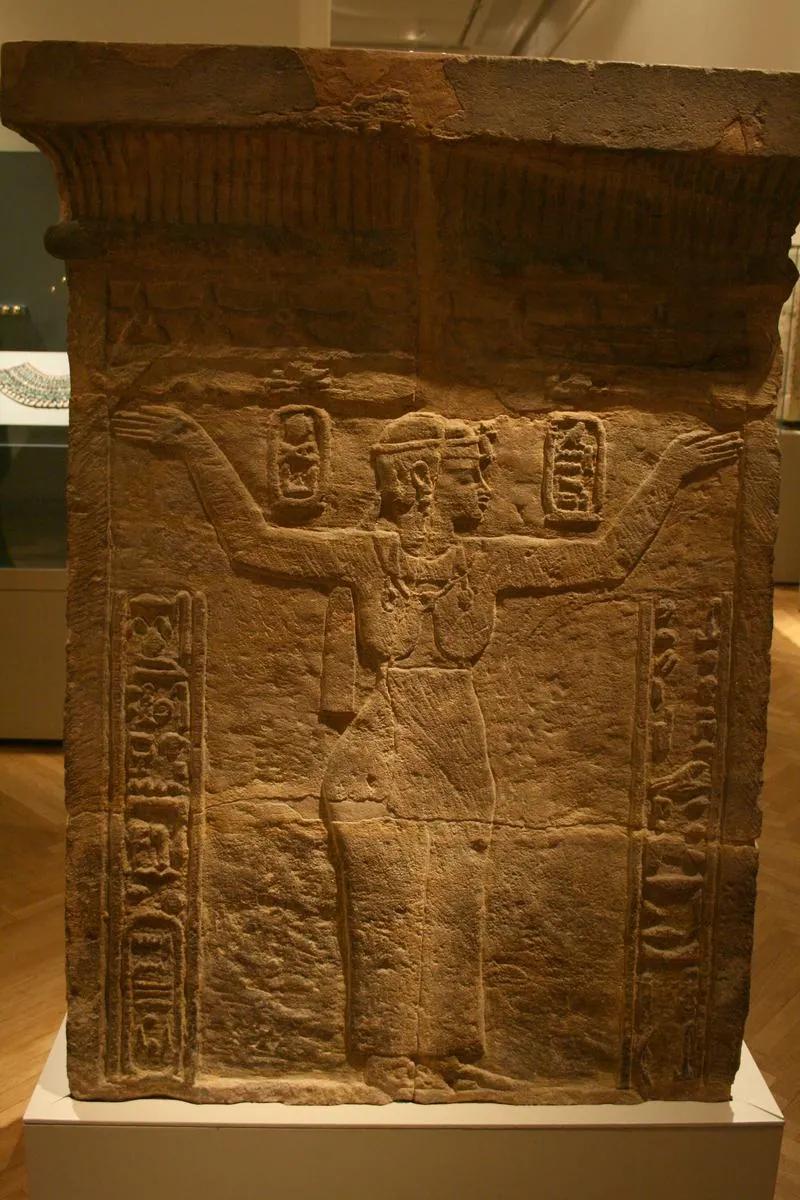
The script was deciphered a century ago. Lepsius had brought to Berlin a bark stand from the temple at Wad ban Naga on which a king and queen wrote their names in Egyptian and in Meroitic hieroglyphs; Griffith used it in 1909, worked out that the Meroitic hieroglyphs face the opposite way to Egyptian ones, matched them to the cursive, and in 1911 published over a hundred funerary texts from Karanog and Shablul with the sign values that are still used[4][5][1]. Every Meroitic text can therefore be transliterated.
What cannot be done is to translate most of it. Griffith could understand only names of people and gods, titles and places, and progress since has been slow: the epitaphs, which are formulaic, are now understood in structure, and a few dozen words and grammatical elements are known, but the long royal inscriptions remain mostly opaque[1][6]. The question has become linguistic, not epigraphic. Rilly's identification of Meroitic as a member of the Northern East Sudanic family, alongside Nubian, Nara, Taman and Nyima, offers a way to recover vocabulary and grammar by comparison[7][8][3]. Of the 4 questions on this site, 2 are answered. The most likely answer to “What language family does Meroitic belong to?”, not yet confirmed: meroitic is a Northern East Sudanic language (Nilo-Saharan), related to Nubian, Nara, Taman and Nyima.
Key questionsset by the editors
The object
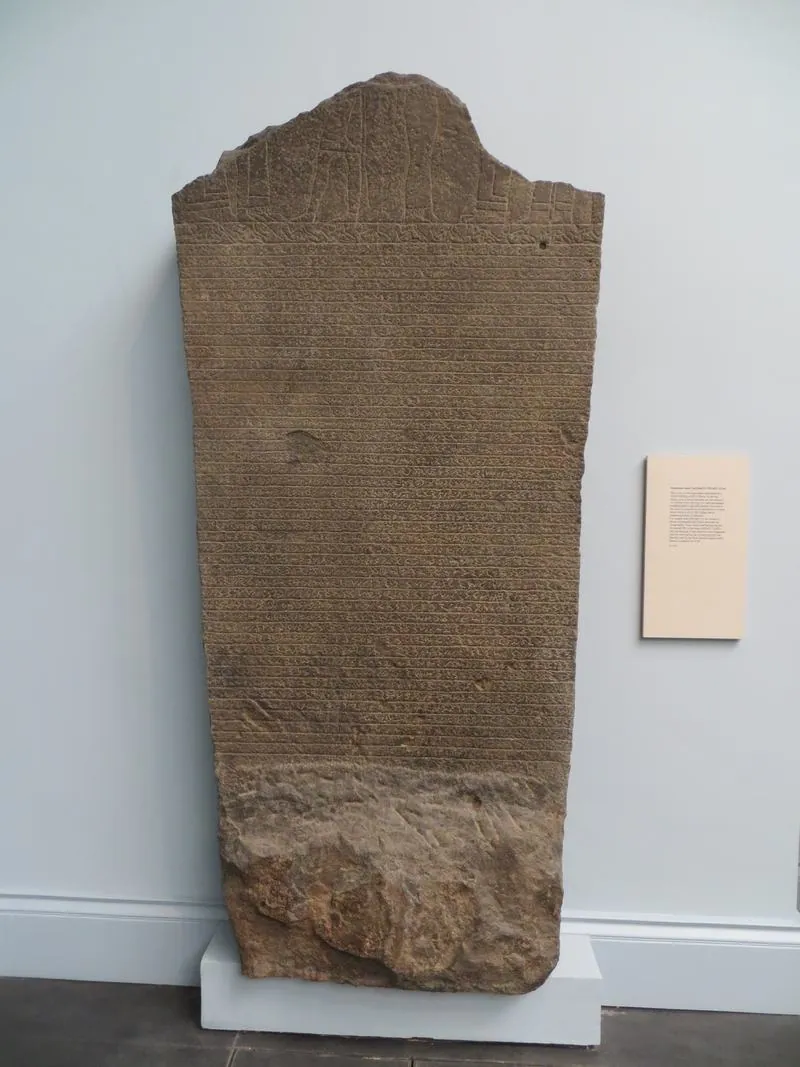
The corpus is about 2,000 inscriptions from the 3rd century BC to the 5th century AD, from Meroe and the other royal sites of the Middle Nile to the cemeteries of Lower Nubia[3]. Most are funerary: stelae and offering tables naming the dead, their parents and their offices. The longest are royal texts on stelae, such as the Hamadab stela of Queen Amanirenas and Prince Akinidad, now in the British Museum, and the stela of King Tanyidamani in Boston[9][10][2].
The standard corpus is the Répertoire d'épigraphie méroïtique (REM), three volumes published by the Académie des Inscriptions in 2000 under Jean Leclant, numbering the texts REM 0001 to REM 1278; it is digitised on Persée as page images[11]. Later finds were reported in the Meroitic Newsletter, whose 30 issues are free online[12]. A DFG project of 2017 to 2022 compiled an analytic dictionary of about 23,000 entries from about 2,000 documents, including unpublished ones; it is announced as a book and is not public[13]. The only machine-readable corpus is the one released with Otten and Anastasopoulos's 2025 paper: 871 transcribed texts and phrases drawn from published vocabularies and grammars, plus three long royal texts, on GitHub with no stated licence[14][15].
Both scripts have been in Unicode since version 6.1 in 2012: Meroitic Hieroglyphs at U+10980 to U+1099F and Meroitic Cursive at U+109A0 to U+109FF[2][16].
Timeline
What is known
The writing system is understood. It has 23 signs plus a divider of two or three dots: four vowel signs, fifteen consonants that carry an inherent a, and four syllabic signs, ne, se, te and to; the sign e may mark a schwa or no vowel[2][1]. Phonology has been reconstructed from Egyptian and Greek spellings of Meroitic words and the reverse[3].
The language is partly understood. Nominal and non-verbal syntax are well described, and the funerary formulae can be parsed into invocation, names, filiation, titles and benediction[3][1][17][18]. A short list of words is secure, among them qore "king", k(a)(n)di "woman", ato "water", at(a) "bread", mak(a) "god" and mas(a) "sun"; verb morphology is still at an early stage[6][3]. No bilingual long enough to serve as a key exists[14].
What has been tested
Griffith's sign values have been tested by a century of use. They give consistent spellings of the same names across hieroglyphic and cursive texts and match Egyptian and Greek renderings of Kushite royal names, and they have not been revised beyond refinements such as the syllabic reading of ne, se, te and to[5][1][2].
The language identification has been tested by comparison. Rilly reconstructed Proto-Northern East Sudanic from its living descendants and argued that Meroitic matches it in basic vocabulary, word order (verb-final, postpositions, genitive before noun) and morphology[8][6]. Rowan argued that the sound system and syllable structure look Afroasiatic instead, and Lipiński has supported an Afroasiatic link on vocabulary[19][6].
Computational work is recent and small. Smith used information-theoretic word similarity in 2008 to extend partial meanings, and Otten and Anastasopoulos in 2025 trained word embeddings on their corpus and attempted alignment with Late Egyptian; the embeddings captured some semantic structure, but the alignment could not induce a lexicon it had not seen, which the authors put down to the lack of machine-readable data[20][14].
The readings
No one disputes how the signs are read. The positions concern the language. The working consensus is Rilly's: Meroitic is a Northern East Sudanic language of the Nilo-Saharan phylum, and its vocabulary and grammar can be recovered by comparison with Nubian and its relatives[7][8][1]. The minority view places it in Afroasiatic on phonological grounds[19]. A third view, older, holds the language to be an isolate whose affiliation cannot be shown from the material available[6].
Published claims
| Year | Who | Claimed | Status | Reason |
|---|---|---|---|---|
| 1909 | Francis Llewellyn Griffith[4] | The sound values of the Meroitic signs can be read off royal names written in both Egyptian and Meroitic hieroglyphs, as on the Wad ban Naga bark stand. | Accepted | His values have been used for a century, refined only for the syllabic signs and the e sign[2][1]. |
| 1911 | Francis Llewellyn Griffith[5] | Meroitic funerary inscriptions follow a fixed formula: an invocation, the names of the dead and their parents, their titles and a set of benedictions. | Accepted | The formula is the best-understood part of the language and the base of all later work[1]. |
| 1966 | Bruce G. Trigger[21] | Meroitic may belong to the Eastern Sudanic group, and was replaced on the middle Nile by Nubian between about AD 200 and 500. | Accepted | Rilly's comparative work placed Meroitic in Northern East Sudanic, with Nubian, and that is now the working consensus[8][3]. |
| 2006 | Kirsty Rowan[19] | Meroitic's sound inventory and phonotactics resemble Afroasiatic languages more than Nilo-Saharan ones, so it may be Afroasiatic. | Disputed | The grammar (verb-final order, postpositions, genitive before noun) matches Northern East Sudanic, and the field follows Rilly's classification[6][3]. |
| 2007 | Claude Rilly[7] | Meroitic is a Northern East Sudanic language of the Nilo-Saharan phylum, related to Nubian, Nara, Taman and Nyima. | Accepted | Backed by comparison with a reconstructed Proto-Northern East Sudanic[8] and used as the basis for current work on the syntax[3]. |
| 2008 | Reginald D. Smith[20] | Statistical measures of word similarity can pair related Meroitic words and extend known meanings to unknown ones. | Still possible | Proposed as an aid, not tested against new bilingual evidence; later computational work found only partial structure[14]. |
| 2012 | Claude Rilly and Alex de Voogt[1] | Funerary formulae, names, titles, places and a few dozen words can be translated; the long royal and narrative texts cannot. | Accepted | Still the state of the field in 2024, when nominal syntax was well understood and verbal morphology in its infancy[3]. |
| 2025 | Joshua Otten and Antonios Anastasopoulos[14] | Word embeddings trained on a machine-readable Meroitic corpus capture some semantic structure, but aligning the lexicon with Late Egyptian does not work. | Still possible | A first baseline on 871 texts; the full REM corpus is not yet machine-readable[14]. |
What would settle it
A substantial bilingual, Meroitic with Egyptian or Greek, would allow translation directly. Short of that, progress depends on data: a machine-readable REM with every text transliterated, joined to the analytic dictionary, would let cognate-matching against reconstructed Northern East Sudanic and Old Nubian be run systematically and tested against Afroasiatic and random-language controls[11][13][14]. A correct identification should predict the meaning of words in the royal texts that are later confirmed by context[1].
Questions
2 of 4 questions are answered.
Evidence 10 findings
Artifacts
The films, photos, papers and objects this mystery rests on, each with its own key and its distance from the original.
See also
References
- 1.Rilly, C., de Voogt, A. 2012. The Meroitic Language and Writing System. Cambridge University Press.doicited 6 times hereSRC0CVTZPKW7BQ6
- 2.Wikipedia contributors n.d.. Meroitic script. Wikipedia.cited 5 times hereSRC0CVTZT184JZZ
- 3.University of Chicago, L. 2024. Claude Rilly: Meroitic Phonology, Syntax, and Linguistic Family. voices.uchicago.edu.cited 5 times hereSRC0CVTZQTY2XRD
- 4.Griffith, F. 1909. Meroitic Inscriptions (Chapter IX of Randall-MacIver and Woolley, Areika). D. Randall-MacIver and C. L. Woolley, Areika. Eckley B. Coxe Junior Expedition to Nubia, vol. 1. Oxford.cited 6 times hereSRC0CVTZP4821DT
- 5.Griffith, F. 1911. Karanòg: The Meroitic Inscriptions of Shablûl and Karanòg. Eckley B. Coxe Junior Expedition to Nubia, vol. 6. University Museum, Philadelphia.cited 7 times hereSRC0CVTZPC27N4F
- 6.Wikipedia contributors n.d.. Meroitic language. Wikipedia.cited 4 times hereSRC0CVTZT9272TR
- 7.Rilly, C. 2007. La langue du royaume de Méroé: un panorama de la plus ancienne culture écrite d'Afrique subsaharienne. Bibliothèque de l'École des Hautes Études, Sciences historiques et philologiques. Honoré Champion, Paris.cited 3 times hereSRC0CVTZPVP3K14
- 8.Rilly, C. 2010. Le méroïtique et sa famille linguistique. Afrique et Langage 14. Peeters, Louvain.cited 2 times hereSRC0CVTZQ3G78Y5
- 9.British Museum n.d.. Stela EA1650 (the Hamadab stela). britishmuseum.org collection online.cited 6 times hereSRC0CVTZTGW6BKE
- 10.Museum of Fine Arts, B. n.d.. Stele of King Tanyidamani. collections.mfa.org.cited 3 times hereSRC0CVTZTRP1Z7S
- 11.Leclant, J. 2000. Répertoire d'épigraphie méroïtique (REM), Tomes I to III. Académie des Inscriptions et Belles-Lettres, Paris; digitised on Persée.cited 5 times hereSRC0CVTZRAJ6Q3N
- 12.Smith, R. n.d.. Meroitic Newsletter / Bulletin d'informations méroïtiques (digital edition). meroiticnewsletter.org.cited 2 times hereSRC0CVTZRJC7KJB
- 13.Deutsche Forschungsgemeinschaft 2017. Meroitic Analytic Dictionary (DFG project 392412163). GEPRIS.cited 1 time hereSRC0CVTZSHM7XC4
- 14.Otten, J., Anastasopoulos, A. 2025. Towards Ancient Meroitic Decipherment: A Computational Approach. Proceedings of the Second Workshop on Ancient Language Processing (ALP 2025), ACL, pp. 87 to 98.doicited 5 times hereSRC0CVTZRT66TY9
- 15.Otten, J. 2025. Meroitic-Corpus (GitHub repository). GitHub.cited 2 times hereSRC0CVTZS206H7K
- 16.Everson, M. 2009. Proposal for encoding the Meroitic script in the SMP of the UCS (L2/09-188R2, WG2 N3646R2). Unicode Technical Committee document register.cited 2 times hereSRC0CVTZSSE79Z0
- 17.Rilly, C. 2016. Meroitic. UCLA Encyclopedia of Egyptology.cited 1 time hereSRC0CVTZQBA5EE7
- 18.Rilly, C. 2020. Meroitic Language and Script. Wiley's Encyclopedia of Ancient History: Asia and Africa.doicited 1 time hereSRC0CVTZQK414HA
- 19.Rowan, K. 2006. Meroitic: an Afroasiatic language?. SOAS Working Papers in Linguistics 14, pp. 169 to 206.cited 4 times hereSRC0CVTZR2R5B1K
- 20.Smith, R. 2008. Constructing word similarities in Meroitic as an aid to decipherment. arXiv 0808.3616 (cs.CL).cited 2 times hereSRC0CVTZS9T0CS5
- 21.Trigger, B. 1966. The Languages of the Northern Sudan: an Historical Perspective. The Journal of African History 7 (1), 19-25.doicited 1 time hereSRC0CVTZV0G3DJD