Proto-Elamite and Linear Elamite
Susa, in the lowlands of south-western Iran, produced two writing systems in the third millennium BC that are not cuneiform. The earlier, Proto-Elamite, is a system of accounts: about 1,600 clay tablets, most of them from the French excavations at Susa between 1897 and the 1930s and now in the Louvre, with smaller groups from Tepe Yahya, Tal-i Malyan, Tepe Sialk, Tepe Ozbaki and Shahr-i Sokhta. They date to about 3100 to 2900 BC, a little after the first proto-cuneiform tablets of Uruk, and share with them the tablet shapes, the numeral systems and the practice of totalling on the reverse[1][2]. The numerals are read, and so the content of many tablets, which count animals, workers and rations, is understood in outline; the several hundred non-numerical signs are not, and no one knows what language, if any, they record[3][1].
The later script, Linear Elamite, is a different problem. It is a set of about fifty inscriptions from the late third and early second millennium BC: monumental stone and clay texts of the Susian king Puzur-Inshushinak (c. 2150 to 2100 BC), several of them with parallel Akkadian cuneiform, a silver cup from Marvdasht, and a group of silver vessels that surfaced in a private collection from 2004 and reportedly come from the Kam-Firuz area near Anshan[4][5][6]. From the bilinguals, Bork and Frank read about a dozen signs in 1905 to 1912; Hinz and Meriggi extended this to perhaps fifteen agreed values by 1971 and the language was assumed, not shown, to be Elamite[4]. In 2022 Desset, Tabibzadeh, Kervran, Basello and Marchesi published what they called a decipherment: Linear Elamite as a purely phonographic system of some 72 signs for vowels, consonants and CV syllables, read through the royal and divine names on the silver vessels and the bilinguals[7]. Several senior Assyriologists found the case largely convincing; others asked for the full translations, and the Bern team that maintains the independent OCLEI corpus has since announced confirmations of the proposed values[8][9]. The first volume of the decipherers' full edition, covering the Susa texts, appeared in 2026[10].
The two scripts are linked by a claim and a dispute. Desset and colleagues argue that Linear Elamite is the direct descendant of Proto-Elamite, the same system at a later stage, and that both grew from a common stock of simple signs; Dahl and Kelley reply that Proto-Elamite was probably a mixed logographic and syllabic system, that 800 years separate the two corpora, and that the resemblances look like deliberate archaising by later scribes[7][8][11]. The two scripts are distinct: Proto-Elamite is the older accounting system and is unread; Linear Elamite is the later script whose reading is claimed. Whether that claim holds is the key question here. Of the 5 questions on this site, 0 are answered. The most likely answer to “Does Proto-Elamite record a language?”, not yet confirmed: proto-Elamite is an administrative notation recording quantities, commodities, persons and institutions….
Key questionsset by the editors
The object
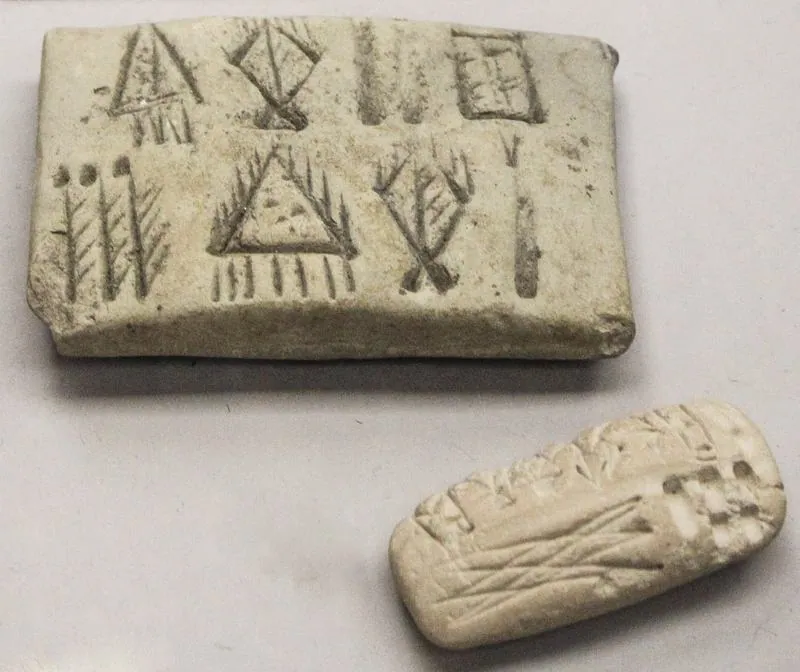
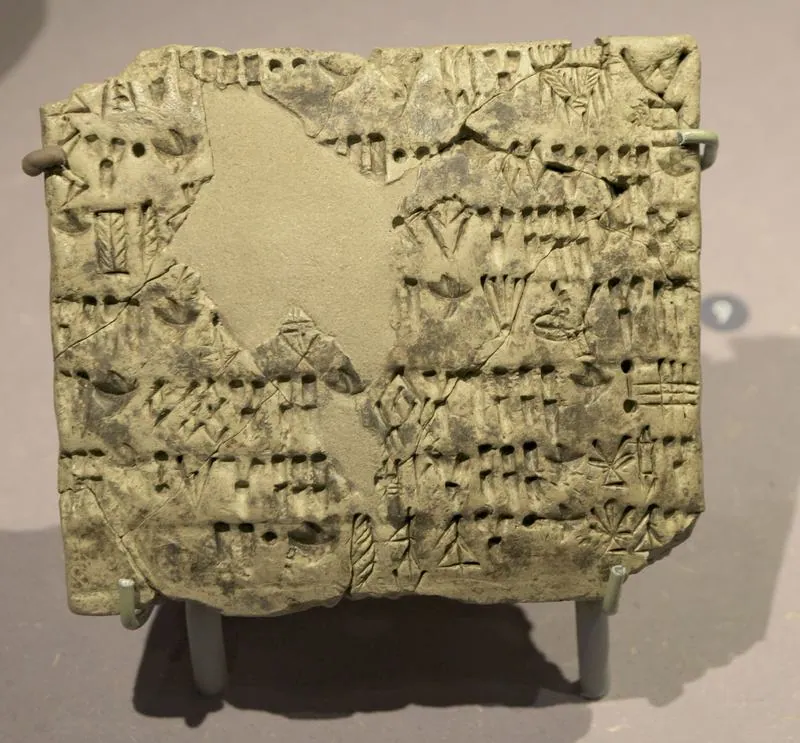
Proto-Elamite tablets are small, mostly rectangular pieces of unfired clay, inscribed left to right with numerical notations and non-numerical signs and often totalled on the reverse[1]. The Louvre holds the largest collection, from Jacques de Morgan's and later excavations at Susa; its online catalogue gives each tablet an image and a record, and the 2019 volume TCL 32 published 121 pieces that had remained unedited[12][13]. Kelley's 2026 survey puts the corpus at about 1,700 tablets dated about 3300 to 2900 BC[14]. The whole corpus is on the Cuneiform Digital Library Initiative with transliterations in ATF, photographs and line art; Jacob Dahl's Oxford project put the images online from 2012 with the stated aim of letting anyone attempt the signs[3][1]. The texts are freely reusable with attribution; the photographs remain the museums'[15]. The sign list is not fixed: Dahl's working list has 1,434 signs, while CDLI's image set used for the 2023 Unicode proposal has 1,636, of which 58 are numerical[16].
Linear Elamite survives on three kinds of object. The western group is 18 texts on stone and clay from the Susa acropolis, now mostly in the Louvre, including the "Table au Lion" (Sb 17) with its Akkadian parallel. The central group is about 24 inscriptions on silver vessels, some 1,100 signs, in a private collection in London; ten more were presented in 2016. The eastern group is eight short inscriptions from the Elamo-Bactrian area, and a silver cup from Marvdasht is in Tehran[5][17][4]. Two digital corpora exist: OCLEI at Bern, with 56 sources in a private encoding and the Elamicon font, and the Hatamti database at Liège, which publishes Desset's team's readings document by document[18][19][20]. Neither script is in Unicode; a preliminary Linear Elamite proposal of 2021 lists 358 characters[19].
Timeline
What is known
For Proto-Elamite, the numerical systems are understood: decimal, sexagesimal, bisexagesimal and capacity systems, each with its own sign values, worked out by Damerow and Englund by comparison with proto-cuneiform and by checking totals[2][1]. Because the same numeral sign can belong to up to four systems, reading a tablet means first deciding which system is in use; Born and colleagues automated that choice in 2023 and found correlations between tablet content and the size of the numbers[21]. Several hundred non-numerical signs exist; a minority are pictographic enough to be read as animals or containers, and one Susa tablet records 47 nanny goats, 8 billy goats, sheep, kids and lambs[1]. The sign list has been the bottleneck. Dahl's list on CDLI is the working standard; computational work since 2019 has clustered signs and extracted "topics" that match the manual groupings and has found that transliteration conventions themselves shape what the algorithms learn, which is why the Simon Fraser group moved to models that read sign images[22][23].
For Linear Elamite, what was known before 2018 was modest: 22 documents, a dozen sign values from the royal name Inshushinak and the title "king" in the bilinguals, Meriggi's 62 numbered signs, and the working assumption that the language was Elamite, known otherwise from cuneiform[4]. What the 2022 paper adds is a full inventory (348 glyph forms reduced to 80 to 110 graphemes, 72 of them phonographic) and readings of the silver vessels as dedications naming the Sukkalmah rulers Shilhaha and Ebarat and the god Napirisha, which fixes the vessels typologically at about 2050 to 1850 BC[7][5][6]. The Bern corpus independently counts 51 texts and 1,731 readable signs[24].
What has been tested
The 2022 decipherment has been tested so far by reception rather than by formal replication. Matthew Stolper, Piotr Steinkeller and Manfred Krebernik judged it coherent and plausible, Krebernik with the proviso that it be right in every detail; Massimo Vidale called it a major discovery[8]. The Bern group, whose OCLEI corpus and earlier syllabary work were independent of Desset, lists a forthcoming paper offering "external and semi-external sound value confirmations" of the 2022 values, which is the nearest thing to an independent check[9]. The obvious weaknesses are also on record: the texts are short and formulaic, so the readings rest heavily on names; the silver vessels have no excavation record and only a reported origin; and the authors themselves say that Elamite is imperfectly understood, so translation stays difficult even where the signs are read[6][8]. Metallurgical analysis is reported to have found the vessels ancient rather than modern[8]. Dahl's objection has hardened: in 2025 he called the 2022 paper "so full of errors" that it should not have been published, and some scholars object to building a decipherment on objects from irregular excavations[25].
The continuity claim has been tested against the corpora. Dahl argued in 2009 that Linear Elamite's signs are unstandardised and sometimes pseudo-glyphs, and that its Proto-Elamite look-alikes are borrowed, not inherited; Dahl and Kelley repeated the 800-year gap objection in 2022[11][8]. Mäder's 2020 comparison found 50.5 per cent of sign forms identical between the two scripts and a further 16.8 per cent similar, and picked out seven inscriptions that share features of both; the Bern group also reports a new inscription from Shahr-e Sokhte dated about 2600 BC that would narrow the gap[26][9]. Neither the comparison method nor the Shahr-e Sokhte text has been tested by others in print.
Proto-Elamite has been the subject of a run of machine-learning papers from 2019: sign clustering and topic models reproduced known groupings and proposed new ones; later work on compositional graphemes, numeral disambiguation and image-aware language models aimed at revising the sign list rather than at reading[22][23][1].
The readings
On Linear Elamite, three positions. The first is that Desset and colleagues have read it: a purely phonographic script writing Elamite, with 72 sign values that hold across the corpus and give sensible dedications and royal names[7]. The second is that the core is right but the system is mixed: Mäder's statistical analyses suggest only about 70 per cent of signs are phonographic and the rest logograms, which would change some readings[5]. The third is that the values are not yet established, because the texts are short and formulaic and the decisive new material is unprovenanced, so the readings should be held until a longer text or an excavated bilingual confirms them[6][8].
On Proto-Elamite, the live question is whether it encodes language. One view is that it writes an early form of Elamite with a mix of logograms and syllabic signs, which Desset's continuity argument requires and which the recurrence of sign sequences in personal-name positions would support[7][8]. Another is that it is an accounting notation that recorded quantities, commodities and perhaps names without encoding speech, so that its "decipherment" would be the recovery of the bookkeeping system rather than of a language; the absence of any positive evidence for Elamite and the purely ideographic earliest tablets support this[1][3]. A third holds the language question open and treats the sign list as the only tractable target[23].
Published claims
| Year | Who | Claimed | Status | Reason |
|---|---|---|---|---|
| 1989 | Peter Damerow and Robert Englund[2] | Proto-Elamite tablets use several numerical systems (decimal, sexagesimal, bisexagesimal and capacity), which can be told apart and read. | Accepted | The analysis underlies all later work, including the computational disambiguation of numeral sequences[21]. |
| 2002 | Jacob Dahl[28] | Proto-Elamite has about 1,900 non-numerical sign forms, most of them rare, and the most frequent stand for grain products, containers and people. | Accepted | The count stands, though it depends on how variants are merged, and later lists give 1,400 to 1,600 signs[16]. |
| 2009 | Jacob Dahl[11] | Linear Elamite had few scribes and no standard sign forms, and its likeness to Proto-Elamite is deliberate archaising, not descent. | Disputed | Mäder found half the sign forms identical and argued for a transitional phase, and Dahl still calls the links superficial[26][25]. |
| 2018 | François Desset[29] | Nine inscribed silver vessels in a private collection name the kings Shilhaha and Ebarat and the god Napirisha in Linear Elamite. | Most likely | The readings became the base of the 2022 decipherment and are broadly accepted, but the vessels have no excavated provenance[8]. |
| 2020 | Michael Mäder[26] | Half the Linear Elamite sign forms are identical to Proto-Elamite ones and a further sixth similar, and seven inscriptions mark a transitional phase. | Most likely | It is the only quantitative comparison, but Dahl and Kelley dispute that the overlap shows descent[8]. |
| 2022 | François Desset and colleagues[7] | Linear Elamite is a phonographic script writing Elamite, with 72 sign values that hold across the corpus. | Most likely | Several uninvolved specialists were broadly convinced, but detailed translations were still awaited and some signs may be logograms[8][6]. |
| 2022 | Kathryn Kelley and colleagues[23] | Transliteration conventions bias what algorithms learn about Proto-Elamite signs, so models should learn from the sign images themselves. | Still possible | It proposes a method for revising the sign list; no revised list based on it has yet been published[23]. |
| 2023 | François Desset[30] | The key royal inscription is on a silver vessel found in the Kam-Firuz region in the 1920s. | Still possible | The find-spot rests on dealers' and collectors' reports, and no excavated vessel confirms it[8]. |
| 2026 | Kathryn Kelley[14] | Proto-Elamite records commodities, people and institutions, and is only partly deciphered: its numbers and accounts are understood, its other signs are not. | Accepted | It summarises the field's position, which no published reading of Proto-Elamite language has changed[14]. |
What would settle it
For Linear Elamite, an excavated text long enough to contain grammar, or a new bilingual from a documented context, would test the 2022 values outside the material they were built on; so would independent readings of the same vessels by scholars working from the OCLEI corpus with the values fixed in advance[24][9]. The full edition with translations has begun: volume I (the Susa texts) appeared in 2026, and volume II, with the silver vessels on which most readings rest, is the one to check[10][20]. For Proto-Elamite, a stable sign list published with the CDLI corpus, whose bulk export already makes every transliteration downloadable[27], followed by positional statistics of the non-numerical signs against the expectations for a syllabary, a logography and a non-linguistic notation, would show which it is; the image-aware models are a step towards that list[23][22]. The continuity question turns on dated intermediate inscriptions, such as the reported Shahr-e Sokhte text[9].
Questions
0 of 5 questions are answered.
Evidence 20 findings
Artifacts
The films, photos, papers and objects this mystery rests on, each with its own key and its distance from the original.
See also
References
- 1.Wikipedia contributors n.d.. Proto-Elamite script. Wikipedia.cited 4 times hereSRC0D1P8SNJ39HC
- 2.Damerow, P., Englund, R. 1989. The Proto-Elamite Texts from Tepe Yahya. American School of Prehistoric Research Bulletin 39. Peabody Museum, Harvard.cited 3 times hereSRC0D1P8SXC5Q5F
- 3.Cuneiform Digital Library Initiative n.d.. Cuneiform Digital Library Initiative: Proto-Elamite texts. cdli.earth.cited 6 times hereSRC0D1P8PG04Q9J
- 4.Salvini, M. 1998. ELAM iv. Linear Elamite. Encyclopaedia Iranica VIII/3.cited 7 times hereSRC0D1P8NRJ75WK
- 5.Wikipedia contributors n.d.. Linear Elamite. Wikipedia.cited 5 times hereSRC0D1P8SDR2EY4
- 6.Mair, V. 2022. Decipherment of Linear Elamite. Language Log.cited 2 times hereSRC0D1P8NGR3812
- 7.Desset, F., Tabibzadeh, K., Kervran, M. et al. 2022. The Decipherment of Linear Elamite Writing. Zeitschrift für Assyriologie und Vorderasiatische Archäologie 112(1).doicited 10 times hereSRC0D1P8MSA3TW6
- 8.Lawler, A. 2022. Have Scholars Finally Deciphered a Mysterious Ancient Script?. Smithsonian Magazine.cited 7 times hereSRC0D1P8N8Y0ZBR
- 9.Mäder, M. n.d.. List of publications: Michael Mäder. center-for-decipherment.ch.cited 3 times hereSRC0D1P8RY40YQ5
- 10.Desset, F., Tabibzadeh, K., Basello, G. et al. 2026. Linear Elamite Inscriptions and Related Cuneiform Texts I: Linear Elamite Texts from Susa. OrientLab Series Maior 10. Ante Quem, Bologna.cited 2 times hereSRC0D1P8TWM5422
- 11.Dahl, J. 2009. Early Writing in Iran, a Reappraisal. Iran 47.doicited 3 times hereSRC0D1P8P0C7MZ0
- 12.Musée du Louvre n.d.. Tablette ; 3 (AS 7060, TCL 32, 28). collections.louvre.fr.cited 5 times hereSRC0D1P8S5Y0PJ9
- 13.Dahl, J. 2019. Tablettes et fragments proto-élamites / Proto-Elamite Tablets and Fragments (TCL 32). Textes cunéiformes du Louvre 32. Éditions Khéops / Louvre éditions, Paris.cited 2 times hereSRC0D1P8P86287G
- 14.Kelley, K. 2026. Proto-Elamite: Proto-Elamite Writing and Society in Early Iran. Elements in Writing in the Ancient World. Cambridge University Press.doicited 3 times hereSRC0D1P8TMT13PK
- 15.Cuneiform Digital Library Initiative n.d.. CDLI Terms of Use. cdli.earth.cited 1 time hereSRC0D1P8PQT7ZC2
- 16.Pandey, A. 2023. Proposal to encode Proto-Elamite in Unicode (L2/23-196). Unicode Technical Committee document register.cited 3 times hereSRC0D1P8TD07P9D
- 17.Mäder, M. 2016. Some new Linear Elamite inscriptions. BAF-Online: Proceedings of the Berner Altorientalisches Forum 1.doicited 2 times hereSRC0D1P8QQ23HR2
- 18.Mäder, M., Plachtzik, S. n.d.. OCLEI: Online Corpus of Linear Elamite Inscriptions (elamicon.org). Universität Bern / Center for Decipherment.cited 2 times hereSRC0D1P8R6P0ZK7
- 19.Pandey, A. 2021. Preliminary proposal to encode Linear Elamite in Unicode (L2/21-233). Unicode Technical Committee document register.cited 2 times hereSRC0D1P8REG4HW4
- 20.Université de Liège n.d.. Hatamti-Linear Elamite Database. hatamti-elam.uliege.be.cited 4 times hereSRC0D1P8RPA2H7B
- 21.Born, L., Monroe, M., Kelley, K. et al. 2023. Disambiguating Numeral Sequences to Decipher Ancient Accounting Corpora. Proceedings of the Workshop on Computation and Written Language (CAWL 2023), ACL.doicited 2 times hereSRC0D1P8VC87RN1
- 22.Born, L., Kelley, K., Kambhatla, N. et al. 2019. Sign Clustering and Topic Extraction in Proto-Elamite. Proceedings of the 3rd Joint SIGHUM Workshop on Computational Linguistics for Cultural Heritage, Social Sciences, Humanities and Literature.doicited 5 times hereSRC0D8MQ7YM27YR
- 23.Kelley, K., Born, L., Monroe, M. et al. 2022. Image-aware language modeling for Proto-Elamite. Lingue e linguaggio 21(2).doicited 2 times hereSRC0D1P8QF86WH3
- 24.Balmer, S., Mäder, M. 2020. Corpus Statistics and Concordance List for Linear Elamite. Supplement to the OCLEI. GEAS Begleitpapiere zum Entzifferungstool 2020/1.cited 4 times hereSRC0D1P8QYW2YQ4
- 25.Stevenson, T. 2025. Beyond Mesopotamia. London Review of Books 47(4), 6 March 2025.cited 3 times hereSRC0D1P8T5604T9
- 26.Mäder, M. 2020. Proto- und Linear-Elamisch: Formaler Vergleich, Berechnung des Jaccard-Index und Identifikation einer Übergangsphase. Begleitpapiere zum Entzifferungstool, Alice Kober Gesellschaft für die Entzifferung antiker Schriftsysteme (GEAS) 2020/7.cited 2 times hereSRC0D1P8V4E2JJD
- 27.Cuneiform Digital Library Initiative n.d.. CDLI bulk data (daily dump of catalogue and transliterations). GitHub cdli-gh/data.cited 1 time hereSRC0D1P8PZM6DZE
- 28.Dahl, J. 2002. Proto-Elamite Sign Frequencies. Cuneiform Digital Library Bulletin 2002:1.cited 5 times hereSRC0D1P8VM24MNV
- 29.Desset, F. 2018. Nine Linear Elamite Texts Inscribed on Silver 'Gunagi' Vessels (X, Y, Z, F', H', I', J', K' and L'): New Data on Linear Elamite Writing and the History of the Sukkalmaḫ Dynasty. Iranica Antiqua 53.doicited 4 times hereSRC0D1P8N143HH6
- 30.Desset, F. 2023. L'Iran dévoilé : le déchiffrement de l'élamite linéaire. La Recherche 572, pp. 108 to 119.cited 2 times hereSRC0D1P8VVW1Z40