The Dhofari script
Across the monsoon hills of Dhofar in southern Oman, and into al-Mahra in Yemen and on Socotra, caves and rock shelters carry short painted texts in an alphabet that matches none of the known scripts of Arabia[1][2]. Travellers reported them from 1900, Bertram Thomas noted inscribed stones in 1932, and the first systematic record was the Dhofar Epigraphic Project of ʿAlī al-Shaḥrī and Geraldine King in 1991 and 1992, which sorted them into a vertical Script 1 and a horizontal Script 2[1][3]. Michael Macdonald wrote in 2000 that they had defied decipherment and might not be very informative; a 2001 decipherment by Nayeem found no support[4][1].
In July 2025 Ahmad Al-Jallad published a decipherment of Script 1[5]. Three inscriptions, too long and too varied to be words, each contained more than 20 distinct letters without repeats; he read them as abecedaries and matched them to halḥam, the letter order of the South Semitic scripts. Comparing letter shapes with the other pre-Islamic Arabian scripts gave candidate values, and the order fixed the rest[5][6]. On his analysis the letter shapes descend mainly from North Arabian scripts, especially Thamudic B, not from South Arabian, and the language merged interdental and sibilant consonants, which ties it to the eastern side of Arabia and rules out direct ancestry of Mehri and Jibbali, though it is related to them[5][7].
The claim is recent and its testing has barely begun. Giuliano Castagna, who had surveyed and dated the inscriptions, called it the first reliable study in Science's report, and the Biblical Archaeology Society carried the story in 2025 and 2026[8][7][6][9]. The paper is on Zenodo under CC BY with its files restricted, and its texts are being entered in the OCIANA corpus, edited by Al-Jallad[5][10]. Of the 4 questions on this site, 0 are answered. The most likely answer to “Has the Dhofari script been deciphered?”, not yet confirmed: the letter order and most values are right, but readings of texts are too uncertain to call the corpus read.
Key questionsset by the editors
The object
The corpus is a body of mostly painted inscriptions in caves and rock shelters, with some carved on wadi beds and loose stones, from the Dhofar hills (the Qara range and its neighbours) west into al-Mahra and on Socotra, with related texts as far as north-eastern Oman[2][1][11]. Al-Shaḥrī and King's survey recorded the bulk of the known texts in 1991 and 1992 in an unpublished report; Castagna's fieldwork found more that they had missed, and no total count has been published[3][1].
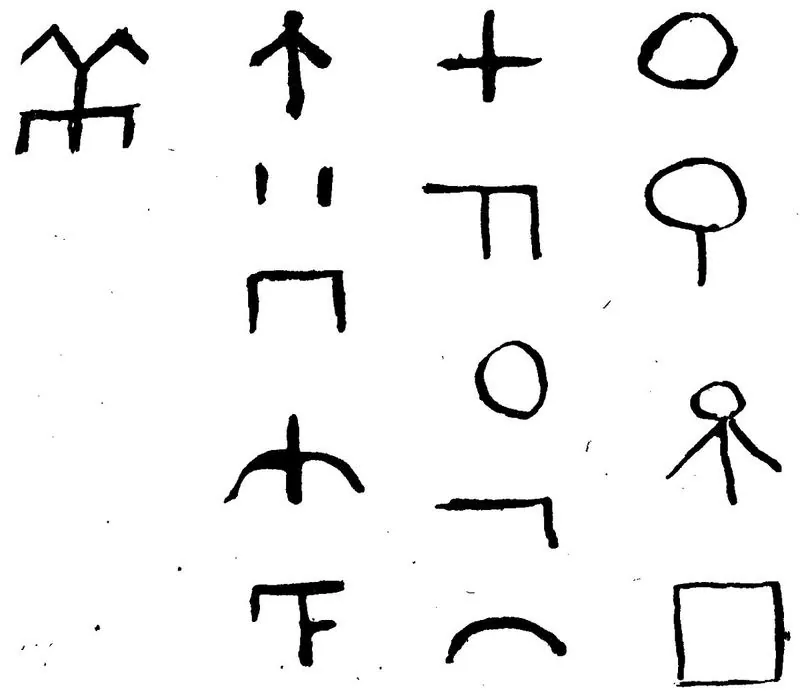
Two script types are recognised. Script 1 is written in vertical columns and is the commoner, with fewer than 40 sign forms as recorded; Script 2 runs in horizontal lines[1][2]. Al-Jallad distinguishes variants 1a and 1b within Script 1 and counts 26 letters in 1a[5][2].
The data are scattered. The decipherment paper is a CC BY Zenodo record whose files require a log-in[5]. OCIANA, the Ohio State successor to the Oxford corpus of Ancient North Arabian, has a Dhofari script category with records such as the abecedary KMD 28-31, each with photograph, tracing, DStretch image and transliteration, images marked CC BY[12][10]. The Ancient South Arabian comparanda are in DASI, whose record data have been CC BY 4.0 since 2026[13]. The script is not in Unicode.
Timeline
What is known
The inscriptions are alphabetic: the sign count is too small for a syllabary, and three texts list more than 20 distinct letters each without repetition[1][6]. Their order matches halḥam, the letter order of the South Semitic family, closely though not perfectly[5][6].
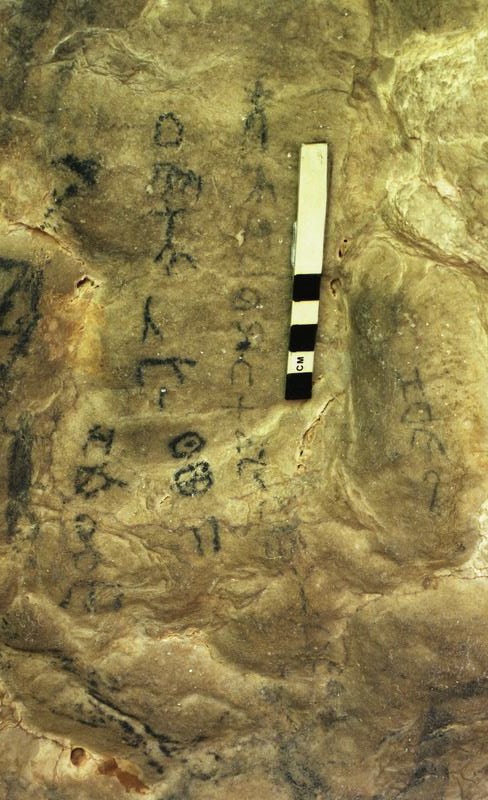
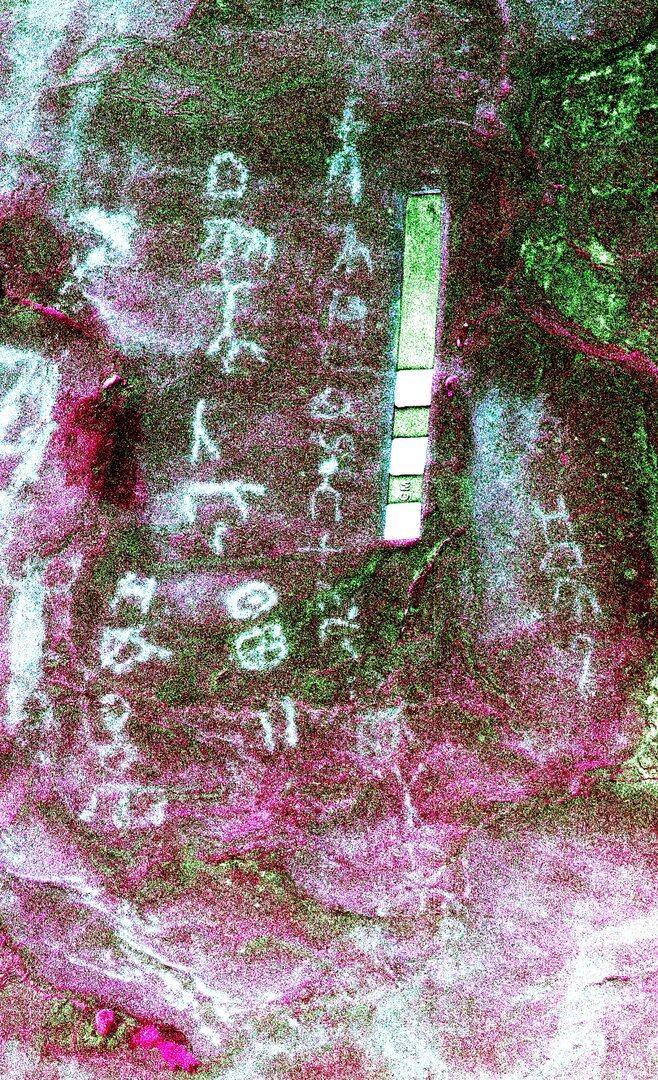
The date is provisional. Castagna sampled three inscriptions for radiocarbon in 2019, analysed in Vilnius in 2020, which gave a terminus post quem in the 4th century BC; popular accounts place both scripts around the end of the first millennium BC and their disuse before the 7th century AD[1][6].
Content, on the new readings, is short: prayers that may have been protective, names and graffiti[6]. Script 1a shows a preposition k- and a plural verb ending -m; Script 2 shows mimation on personal names[2].
What has been tested
The decipherment has an internal test built in: the values come from the order of three abecedaries and from shape comparison, and they must then give sensible words when applied to the other texts. Al-Jallad reports first readings that do so, with forms paralleled in Modern South Arabian[5]. Script 2 values have been proposed largely from those of Script 1a[2].
Outside testing has not yet been published. The one recorded outside judgement is Castagna's, who called it the first reliable study[7]. No published reanalysis of the abecedaries or independent reading of a text with the values fixed in advance has been found. Earlier claims were tested and failed: Castagna rejected Nayeem's 2001 readings for double values and unexplained transliterations[1][14].
The readings
On the script, the decipherment holds that Dhofari is a South Semitic alphabet in the halḥam order whose letter forms derive from a North Arabian archetype close to Thamudic B, not from Ancient South Arabian[5]. The earlier working assumption, reflected in the label "Dhofar inscriptions" and in comparisons with South Arabian, was a local or South Arabian development[1].
On the language, Al-Jallad reads an extinct Semitic language related to the Modern South Arabian languages but not their ancestor, because it had lost the interdental consonants that Mehri and Jibbali keep[5]. The alternative, that the texts are early Modern South Arabian, would require the interdentals to have been restored, which is not expected[5]. Older attributions to the people of ʿĀd mentioned in the Quran are not scholarly readings[7].
Published claims
| Year | Who | Claimed | Status | Reason |
|---|---|---|---|---|
| 1993 | ʿAlī al-Shaḥrī and Geraldine King[3] | The Dhofar inscriptions are written in two related scripts, a vertical Script 1 and a horizontal Script 2. | Accepted | Later surveys and the 2025 decipherment keep the division, adding variants within Script 1[1][5] |
| 2001 | Muhammad Abdul Nayeem[14] | Some of the Dhofar inscriptions can be read, in scripts he named Sa'kalhanic A and B. | Disputed | Castagna rejected the readings because they give some signs two values and leave others unexplained, and no one has taken them up[1] |
| 2024 | Giuliano Castagna[1] | Radiocarbon samples from three inscriptions give a terminus post quem in the 4th century BC. | Most likely | No result contradicts it, but it rests on three samples, and the other inscriptions are undated[1] |
| 2025 | Ahmad Al-Jallad[5] | Three inscriptions are abecedaries in the South Semitic halḥam order, and they give the sound values of Script 1a. | Most likely | The only decipherment, called the first reliable study by an uninvolved specialist, but no detailed critique or independent reading has been published[7][8] |
| 2025 | Ahmad Al-Jallad[5] | The letter shapes derive mainly from a North Arabian script close to Thamudic B, not from Ancient South Arabian. | Most likely | It follows from his shape comparisons, which no one else has yet checked; the earlier assumption of South Arabian origin was never argued in detail[1] |
| 2025 | Ahmad Al-Jallad[5] | The language is an extinct Semitic language related to Mehri and Jibbali but not their ancestor, because it had lost the interdental consonants. | Most likely | It follows from the 26-letter inventory if the decipherment holds; the first readings are short and few[2][6] |
What would settle it
Independent readings by other epigraphers of texts not used in the paper, with the values fixed in advance, would test the decipherment; so would a fourth abecedary found later that fits the same order and values[5]. A published, complete corpus of the inscriptions with images and site data, which OCIANA is beginning to provide, is the precondition for both, and more radiocarbon dates on the pigments would fix the chronology[12][1].
Questions
0 of 4 questions are answered.
Evidence 10 findings
Artifacts
The films, photos, papers and objects this mystery rests on, each with its own key and its distance from the original.
See also
References
- 1.Castagna, G. 2024. South-east Arabian inscriptions: The current state of research. Kervan: International Journal of Afro-Asiatic Studies 28(2), pp. 83 to 108.cited 12 times hereSRC0D7QB9B0417F
- 2.Wikipedia contributors n.d.. Dhofari script. Wikipedia.cited 3 times hereSRC0D7QBASW23FR
- 3.Al-Shaḥrī, ʿ., King, G. 1993. The Dhofar Epigraphic Project: A Description of the Inscriptions recorded in 1991 and 1992. Unpublished report; listed in OCIANA's references.cited 7 times hereSRC0D7QB9TM5TMF
- 4.Macdonald, M. 2000. Reflections on the linguistic map of pre-Islamic Arabia. Arabian Archaeology and Epigraphy 11(1), pp. 28 to 79.doicited 4 times hereSRC0D7QB9JT65D3
- 5.Al-Jallad, A. 2025. The Decipherment of the Dhofari Script: Three halḥam abecedaries and the first glimpses into the corpus. Jaarbericht van het Vooraziatisch-Egyptisch Genootschap Ex Oriente Lux (JEOL) 49.doicited 15 times hereSRC0D7QB83Y6EZ6
- 6.Steinmeyer, N. 2025. Pre-Islamic Arabian Script Deciphered. Bible History Daily, Biblical Archaeology Society.cited 3 times hereSRC0D7QB8BR0ZDP
- 7.Ohio State University, D. 2025. Ahmad Al-Jallad's Research Featured in Science Article. nesa.osu.edu.cited 4 times hereSRC0D7QB8VC76MV
- 8.Sagar, S. 2025. Mysterious pre-Islamic script in Oman finally deciphered. Science (news).cited 1 time hereSRC0D7QB93665B2
- 9.Biblical Archaeology Review 2026. Mysterious Arabian Script Deciphered. Biblical Archaeology Review, Spring 2026 (department).cited 1 time hereSRC0D7QB8KJ1PQQ
- 10.Al-Jallad, A. 2026. KMD 28-31 (OCIANA record 46218): Dhofari 1a abecedary. OCIANA.cited 5 times hereSRC0D7QBAA869DT
- 11.Al-Jahwari, N. 2018. Rock Inscription from the Area of Ja'alan Bani Bu Hasan, Sultanate of Oman. Journal of Arts and Social Sciences (Sultan Qaboos University) 9(2), pp. 97 to 109.doicited 1 time hereSRC0D7QBB1P4CJ3
- 12.Al-Jallad, A., Macdonald, M. 2024. OCIANA: Online Corpus of the Inscriptions of Ancient North Arabia. Ohio State University (DLATO); first version Khalili Research Centre, Oxford, 2013 to 2017.cited 3 times hereSRC0D7QBA2E2323
- 13.University of Pisa and CNR n.d.. DASI: Digital Archive for the Study of pre-Islamic Arabian Inscriptions. dasi.cnr.it.cited 3 times hereSRC0D7QBAJ26TG9
- 14.Nayeem, M. 2001. Origin of Ancient Writing in Arabia and New Scripts from Oman. Book (publisher not confirmed in this session).cited 1 time hereSRC0D7QBB9G27M6