Incident 88: the Hackensack disc, 3 August 1947
Incident 88 is a small case that became a puzzle because of its paperwork. On the evening of Sunday 3 August 1947, at the height of the first American flying-saucer summer, Charles Casella, Jr., of Hackensack and Private William Truex of Fort Dix were looking at a ham-radio aerial on Simons Avenue when they saw a round object moving north across the sky about 200 yards up; Truex's girlfriend came out in time to see it before it vanished over the horizon[1]. Casella telephoned the Hackensack police, the FBI's Newark office sent Washington an urgent teletype the next afternoon, and on 13 August Newark reported separate interviews with all three witnesses and a neighbour who had seen nothing[2][1].
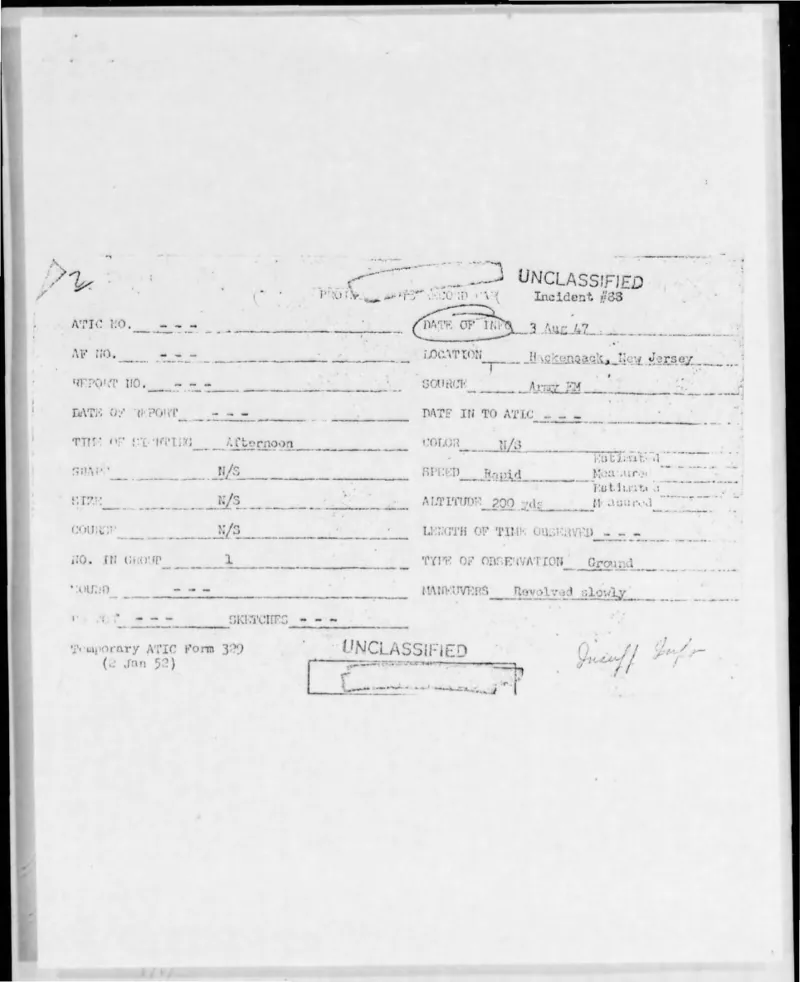
The Air Force's Project Sign gave the report incident number 88, but its check-list holds only the teletype's two lines; every descriptive field is marked "not stated"[3][4]. Hynek, reviewing it for the Grudge report, wrote that no astronomical explanation fitted and that the information was "so meager that little else can be said", and filed it under "lack of evidence precludes explanation"[4][5].
When the Blue Book files were microfilmed, the folder labelled 88 turned out to hold nineteen pages, of which five concern Hackensack. Ten are letters to and from a woman in Wildwood, at the southern tip of New Jersey, who reported saucers over the sea in 1948, and four are an Air Materiel Command letter of 25 August 1947 with a photograph of hoax "flying saucer" parts from Danforth, Illinois, notable for stating that they had no connection with the "Mogul" project[4]. Jazz Shaw's 2022 article in The Debrief drew attention to the mix, identified the Wildwood correspondent as the knitting author Ethel Rodman, writing as "Ethel Evans", and asked whether the Air Force had ever really investigated her[6]. The answer is in a different folder: her reports are Project Sign Incident 50, investigated in person in February 1948 and through the Coast Guard in April 1948, then closed[7]. Of the 5 questions on this site, 0 are answered.
Research sessions1 so far · last 3 Nov
S-001Incident 88 opened: the three files untangled and the balloon tested
What happened
On Sunday 3 August 1947 Charles Casella, Jr., of Euclid Avenue, Hackensack, and William Truex, a private in the 47th Infantry at Fort Dix whose sister was engaged to Casella, were waiting outside the house of Truex's girlfriend on Simons Avenue and looking at a ham-radio rig on a nearby roof[1]. Truex remarked that a child had lost its balloon. Casella looked up and saw, a block or half a block away and east of them, a round object moving from south to north about 200 yards above the hill at Summit and Simons Avenues, steadily, too fast for an ordinary balloon, so that they had to keep turning their heads to follow it[1]. They called the girlfriend out; she saw it shortly before it disappeared over the horizon[1]. Casella later projected its course as a line from the Bendix area, by Teterboro airport to the south, to a point west of Westwood to the north[1].
Casella reported it to Sergeant James Perone of the Hackensack police, who took no further action and had no other reports[1]. The FBI's Newark office sent an urgent teletype to the Director at 5:36 pm on 4 August, describing an object 'two hundred yds in air, revolving slowly, moving rapidly, and neither a kite nor a balloon'[2]. The Bureau was then helping the Army Air Forces collect saucer reports, and Special Agents Arthur F. Williams and T. Howard Waldron interviewed the three witnesses and a neighbour; Newark reported the results on 13 August[1].
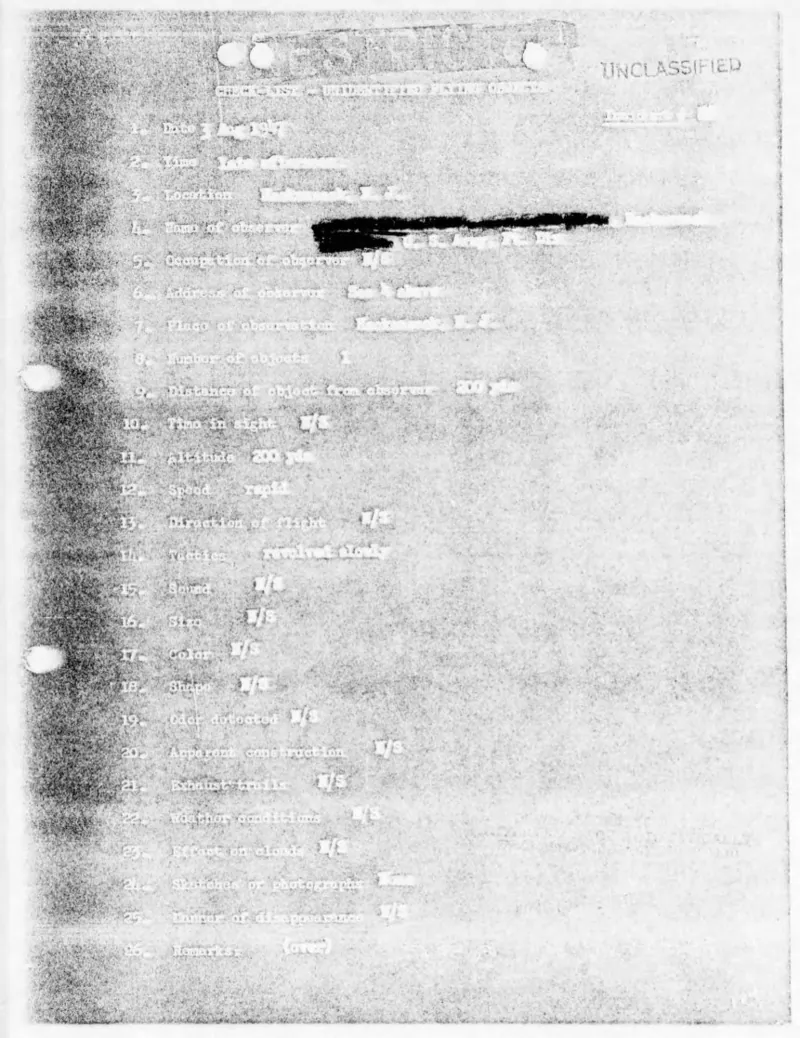
Project Sign, set up at Wright Field in early 1948 to collect and evaluate the reports, gave the sighting incident number 88[8]. Its check-list names Casella and Truex, gives the time as 'late afternoon', the distance and altitude as 200 yards, the speed as 'rapid' and the tactics as 'revolved slowly', marks every other field N/S, and copies the teletype's sentence as its remark[3].
Timeline
The accounts
The only accounts are the three FBI interviews, made eight to ten days after the event, and they disagree on almost every detail[1]. Casella put the time at about 7:45 pm and described a round, black object thirty to forty inches across, which he could not say was a globe or a disc. Truex's girlfriend put it at about 7:30 and called it round, silver-blue and apparently revolving, in view for about a minute; from where she stood, she said, it could not have looked more than six inches across. Truex put it at 8:00 pm and gave two to three feet across, 15 to 20 seconds in sight, no colour, and a shape 'more like a large, flat child's cup than anything else', oval on top and pointed below; he said he first took it for a child's balloon but saw no wind and no string[1].
Two of Casella's details were not borne out. He said Truex's girlfriend had remarked that it looked like a bird on the horizon; she did not recall saying so. He said a man on a porch across the street had seen it and pointed it out; the girlfriend saw no one pointing, and the neighbour on that porch said she and her mother had seen nothing and that no man had been there[1]. Truex was seventeen, born in April 1930, and had enlisted in May 1947; the teletype gives one witness's age as twenty, and the Air Force card records the source as 'Army EM', an enlisted man[1][2][4].
What all three agree on is a single small, round object, moving steadily and fairly fast in a straight line toward the north, silent and with no exhaust, seen against a clear evening sky for between a quarter of a minute and a minute[1].
What was recorded
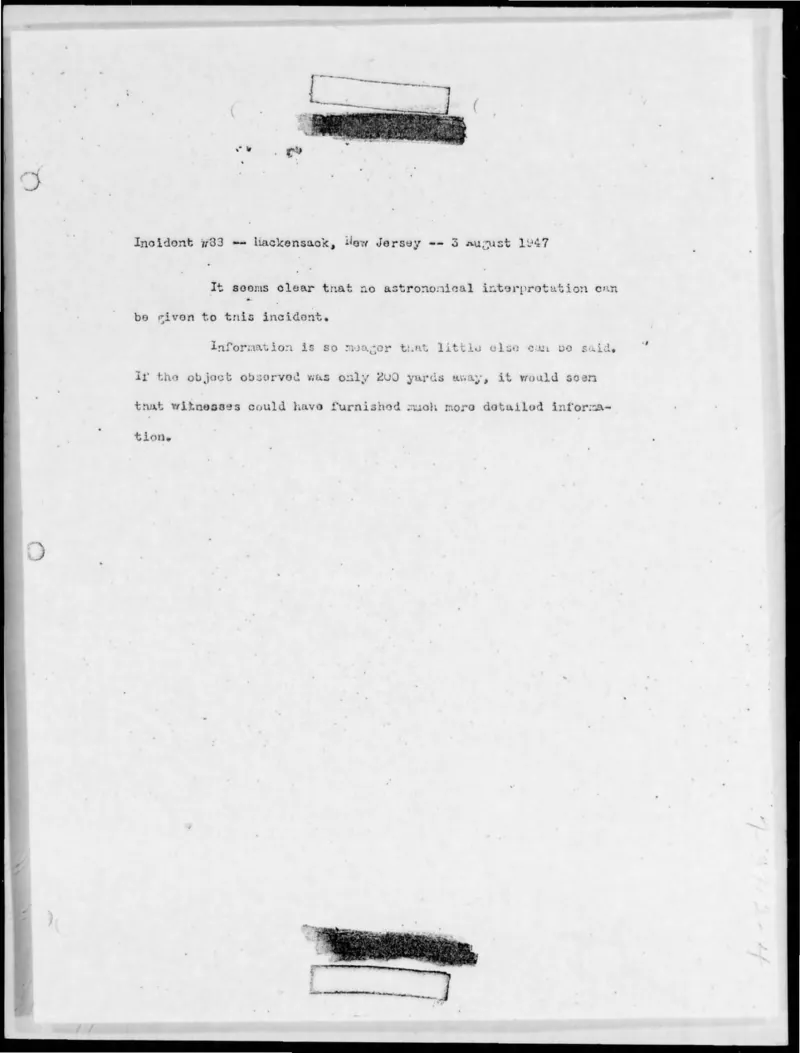
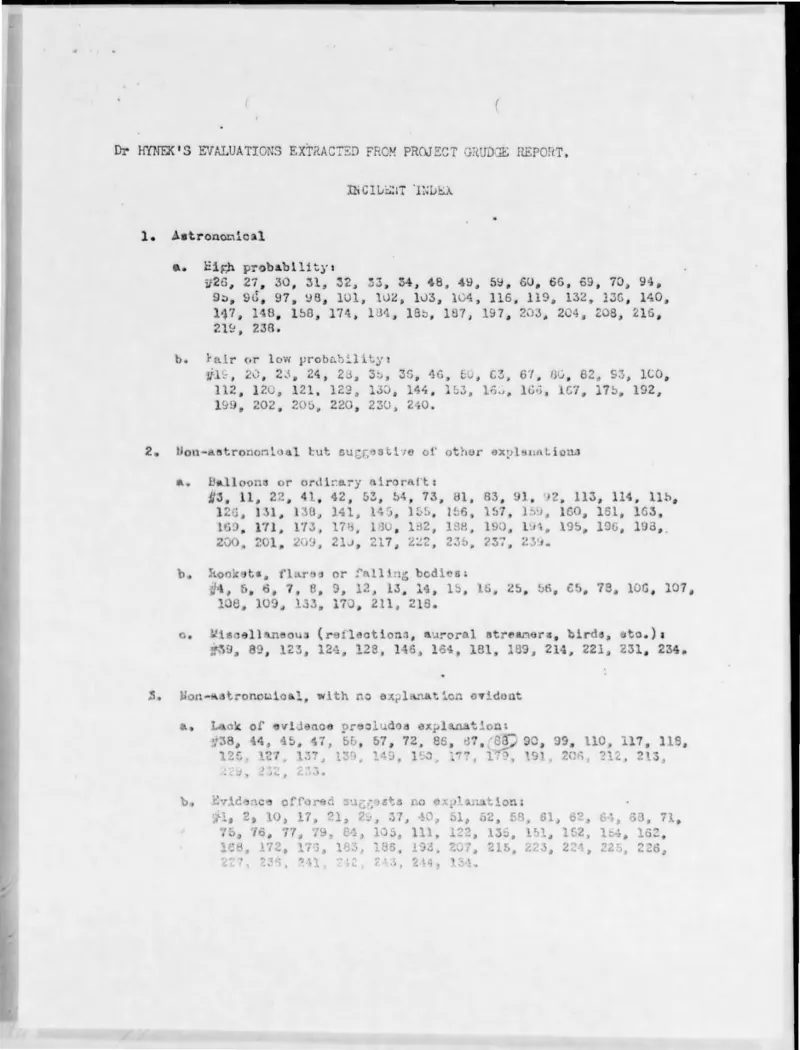
The Air Force record is the folder for Incident 88 in the Blue Book microfilm, nineteen sanitized pages[4]. Five concern Hackensack: an index card on Temporary ATIC Form 329, a form dated 2 January 1952, made when the early files were catalogued; the two-page check-list; Hynek's one-paragraph note; and an extract of his evaluations from the Grudge report's incident index[4]. Hynek's note reads, in full: 'It seems clear that no astronomical interpretation can be given to this incident. Information is so meager that little else can be said. If the object observed was only 200 yards away, it would seem that witnesses could have furnished much more detailed information'[4]. The index places 88 under 'Non-astronomical, with no explanation evident: a. Lack of evidence precludes explanation'[5].
The FBI record is fuller than the Air Force's. The Newark teletype of 4 August, recorded as serial 62-83894-49, and the Newark letter of 13 August with the four interviews are in the Bureau's flying-disc file, released through the National Archives and again in PURSUE Release 01[2][1]. The Air Force check-list repeats the teletype almost word for word and contains nothing from the interviews: no direction, duration, size, colour or shape, all of which the interviews give[3][1]. Nothing in the Blue Book folder shows that the Air Force received the 13 August letter.
The weather is on record. Teterboro airport, three kilometres south, reported a clear sky with no ceiling, visibility of 14 km, and a light wind from the south-west, 225 degrees at 2.6 m/s, at 7 pm and 8 pm that evening; the Sun set at 8:15 pm[9].
The other fourteen pages of the folder belong to two other cases, described below. Unredacted copies of the check-lists, naming the witnesses, were published by the Department of War on 8 May 2026[3].
The pages that belong elsewhere
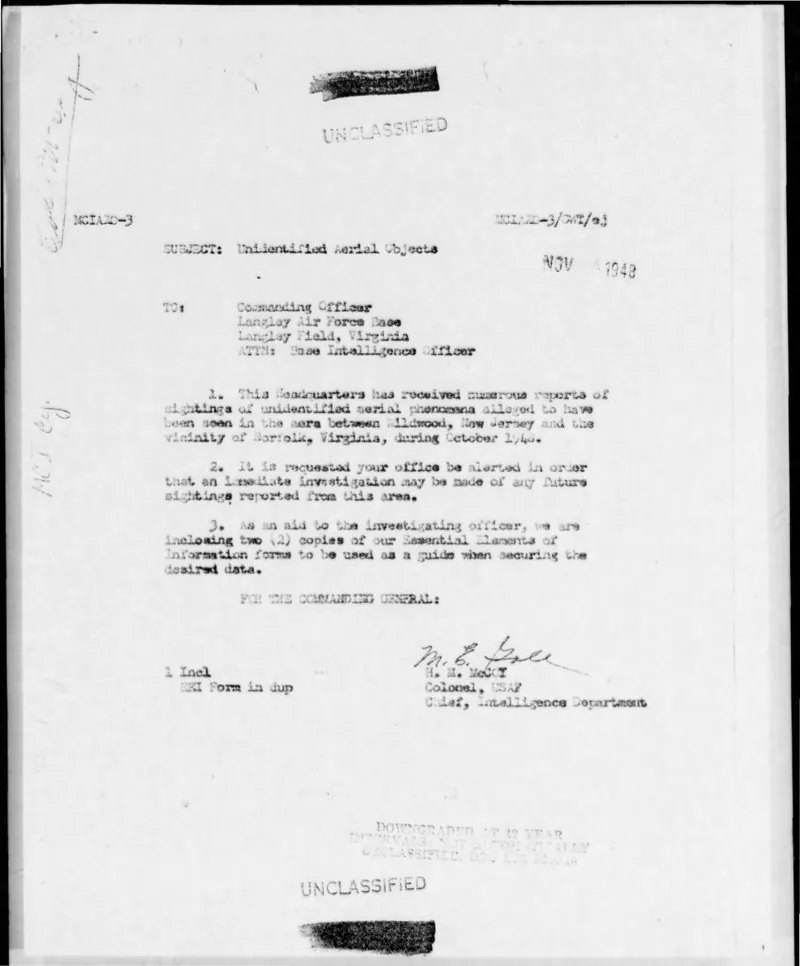
Ten pages are correspondence with a woman in Wildwood, Cape May County, redacted except once as 'Mrs. Evans': two handwritten letters, one of 9 April 1948, describing objects over the sea, among them on 2 April a bright metal 'pilot-less plane' that followed the coast north and a second that fell into the water shedding what looked like sheets of metal; and Air Force replies and acknowledgments from 6 April to 29 October 1948, including a covering note of July 1948 in which she reported the saucers back since 1 July and enclosed a Life magazine picture of Mars[4]. In November 1948 Air Materiel Command asked the intelligence officer at Langley AFB to investigate at once any future reports from 'the area between Wildwood, New Jersey and the vicinity of Norfolk, Virginia', where numerous sightings were said to have been made in October[4].
This correspondence is the tail of Project Sign Incident 50, which has its own 74-page folder[7]. The Sign check-lists for Incidents 50 and 50a name the observer as 'Mrs. Ethel Evans', 'authority on knitting', of the Bellvue Apartments, and record that on 10 January 1948 she and a neighbour saw a lamp-sized orange light descend slowly, split in two and fall into the sea[3]. Ethel Evans was the name on Macmillan's This Is Knitting of 1948; Shaw, working from unredacted copies, identifies her as Ethel Mary Goetz Rodman, who died in Atlantic City in 1950[10][6]. The Incident 50 folder shows that Project Sign took her seriously at first: on 9 February 1948 it requested military air travel for Maj. M. W. Faulk and the engineer A. C. Loedding to interview her at Wildwood, which they did in mid-February, and it processed her film, which showed nothing[7]. In March AMC asked the Coast Guard to investigate; its Intelligence and Law Enforcement Division reported on 7 April 1948 that the tower lookouts of the stations from Wildwood to Atlantic City, the Wildwood police with four patrol cars and a boardwalk watchman, and local American Legion members had seen nothing, and recommended closing the inquiry; AMC wrote that it would abide by the recommendations[7]. Hynek judged the one corroborated sighting, of 10 January, most probably a slow-moving fireball[7]. The polite letters filed under 88, written after April 1948, are acknowledgments of a closed case[4].
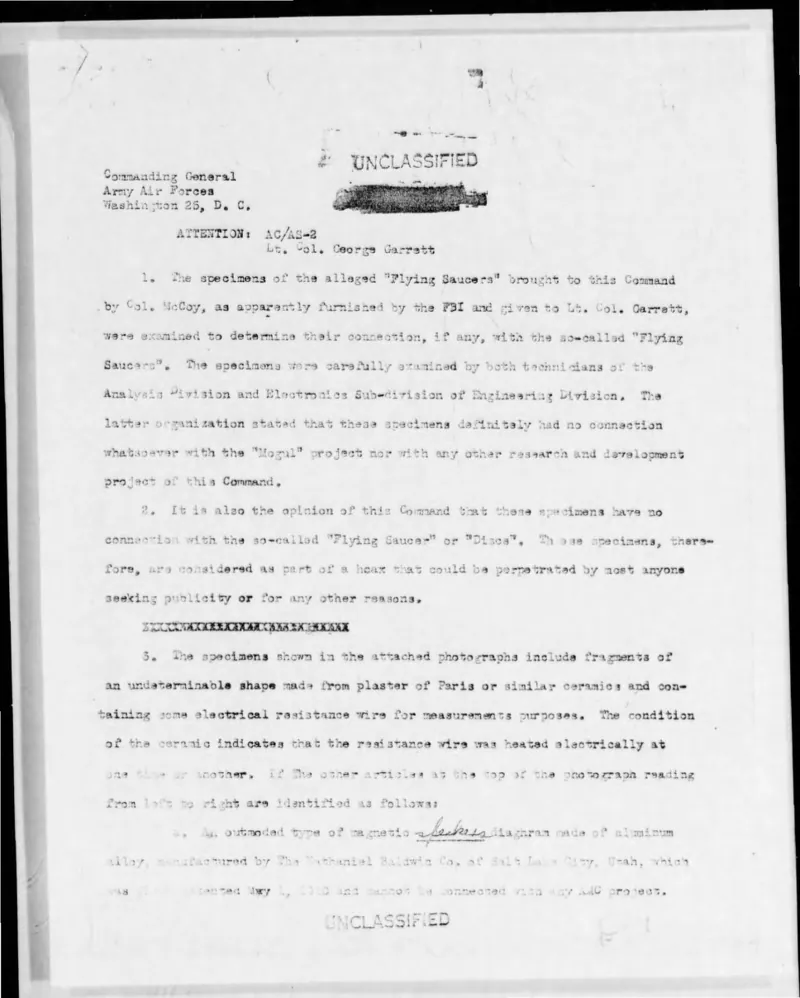
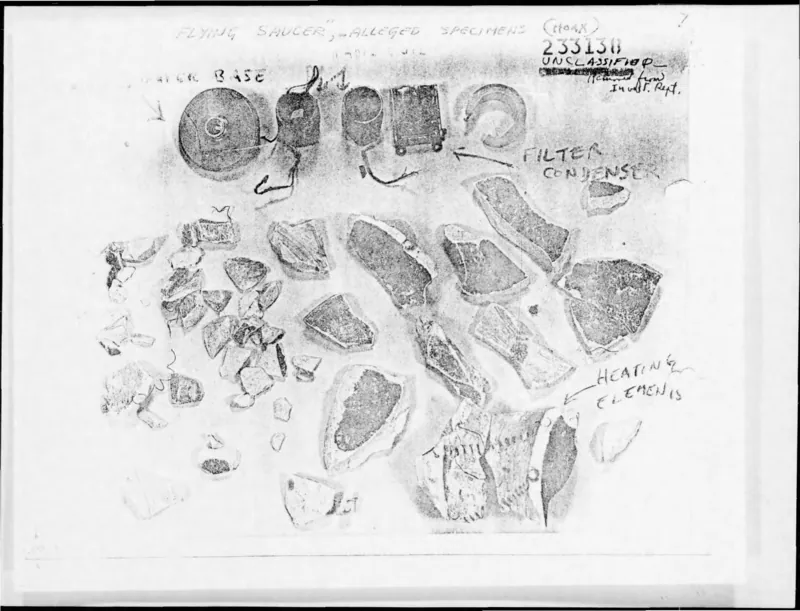
Four pages are the Air Materiel Command letter of 25 August 1947, signed for the commanding general by Col. H. M. McCoy, with its photograph[4]. It reports on an 'instrument' that a farmer near Danforth, Illinois, said had fallen on his land and burned the weeds around it, sent to Wright Field through the FBI: a plaster-of-paris body with heating wire, an old speaker diaphragm patented in 1910, rewound coil forms and a radio filter condenser. AMC found that the parts had 'no connection whatsoever with the "Mogul" project nor with any other research and development project' and called them a hoax[11]. The Danforth case has its own folder, with the original of the same letter and a record card concluding 'Hoax'[11].
The explanations
For the object, three readings have been offered or are open.
A small balloon is the reading Truex himself reached first and then rejected because he felt no wind and saw no string[1]. The weather record allows it: at 7 and 8 pm Teterboro had a light, steady south-westerly, and an object carried on it would cross the sky at a steady rate in a straight line, silently and with no exhaust, as all three witnesses described[9][1]. The witnesses' estimates of size and distance cannot both be checked; an object of 0.8 m at 200 yards and a toy balloon of 0.3 m at 60 m look the same size, about a quarter of a degree, and the nearer balloon, drifting with the wind, would cross the sky three times faster, enough to make people turn their heads. A balloon lit by a sun only a few degrees above the west-north-west horizon could look silver from one side and dark from another, and turning on its string or neck could look like revolving. Against it, the reported course runs almost due north, 41 degrees left of the downwind direction, and two witnesses, who had first thought of a balloon, judged it too fast for one; neither objection is strong, since the course was reconstructed from street landmarks days later and the wind at 200 yards can differ from the wind at the airport. Session 1 sets out the calculation.
A bird, catching the low sun, is the reading Casella attributed to Truex's girlfriend, who did not recall saying it[1]. A bird usually shows wingbeats and changes of course, which no witness described.
An unidentified craft is the reading the 1947 teletype implies and the one Hynek left open: on the Air Force's information there was nothing to explain it with[2][5]. No physical trace, photograph or second sighting exists, and the police received no other report[1].
For the folder, the evidence points to misfiling rather than a hidden link. Each of the intruding cases has its own folder with the originals; the Wildwood letters in 88 run from April to November 1948, after her own case was closed, and the Danforth letter is a copy of one in the Danforth folder[7][11][4]. Nothing in any of the three files mentions the others. Shaw's suggestion that they were filed together because two are from New Jersey is possible; so is a simple clerical slip when Project Sign's papers were sorted into numbered incidents, or when the files were re-carded in 1952[6][4].
Published claims
| Year | Who | Claimed | Status | Reason |
|---|---|---|---|---|
| 1949 | J. Allen Hynek[5] | No astronomical explanation fits Incident 88, and the information is too meagre to say more. | Accepted | The meagreness was the Air Force file's: the FBI's interviews of 13 August give direction, duration, size and shape, none of which reached the check-list[1][3] |
| 1947 | Air Materiel Command (Col. H. M. McCoy)[11] | The Danforth 'flying saucer' specimens have no connection with the Mogul project or any AMC project and are part of a hoax. | Accepted | The parts are identifiable commercial radio and electrical components, and the case's own record card concludes 'Hoax'[11] |
| 1948 | U.S. Coast Guard Intelligence and Law Enforcement Division[7] | No one but the correspondent and one neighbour saw the Wildwood objects, and the inquiry should be closed. | Accepted | Coast Guard lookouts, police patrols and local inquiries found nothing, and Shaw's newspaper search found no Wildwood reports either[7][6] |
| 1948 | J. Allen Hynek[7] | The orange light seen falling into the sea at Wildwood on 10 January 1948 was most probably a slow-moving fireball. | Most likely | Its colour, splitting and slow fall fit a fireball, but no other observer of a fireball that night has been found[7] |
| 2022 | Jazz Shaw[6] | The Incident 88 folder mixes three unconnected cases, and its Wildwood correspondent, 'Mrs. Evans', was the knitting author Ethel Rodman. | Accepted | The unredacted Sign check-list names her as Ethel Evans, an authority on knitting, and her case and the Danforth case have their own folders[3][10][7][11] |
| 2022 | Jazz Shaw[6] | It is unclear whether the Air Force really investigated the Wildwood reports or merely humoured the correspondent. | Disputed | The Incident 50 folder records an interview at Wildwood by Faulk and Loedding and a Coast Guard investigation before the case was closed[7] |
| 2023 | Ryan Sprague and Jazz Shaw[12] | One of the Hackensack witnesses, elusive to trace, may hold the key to the case. | Still possible | The FBI interviewed all three witnesses within ten days; their accounts are on file and disagree on size, colour and duration[1] |
Existing inquiry
The literature on Incident 88 is thin. Hynek's 1949 evaluation is the only official judgement of the sighting[5]. The case is not on Blue Book's list of unidentified cases and is not among the 1947 reports usually discussed. Jazz Shaw's article of May 2022 in The Debrief is the only study of the folder: it describes the three groups of papers, identifies the Wildwood correspondent from unredacted copies obtained through the Center for UFO Studies, reports that newspapers of southern New Jersey and Philadelphia carry no Wildwood saucer reports for 1947 and 1948, and records FOIA requests to the Air Force and the FBI that had produced nothing[6]. Shaw discussed the case on the Somewhere in the Skies podcast in February 2023, including his search for one of the witnesses; the episode was re-released in November 2026[12]. Neither the article nor the podcast uses the FBI's 13 August interviews or the Incident 50 folder, which answer two of the questions they raise[1][7].
What would settle it
For the sighting: an upper-air wind observation for the New York area on the evening of 3 August 1947 (a pilot-balloon run from Newark or LaGuardia at about 0000 UTC on 4 August) would show which way a balloon at 200 yards would have drifted, and so whether the 41-degree gap between the reported course and the surface wind is real. The Hackensack newspaper, The Bergen Evening Record, for 4 and 5 August 1947 may carry the police report and any other calls. Short of a photograph that does not exist, nothing will identify the object beyond 'probably a small balloon' or 'unknown'.
For the file: the Air Force's own copy of the FBI's 13 August letter, if one exists in the Project Sign records at the National Archives, would show whether the interviews ever reached Wright Field. The outcome of Shaw's FOIA requests, and the unsanitized originals of the Incident 50 folder, would complete the Wildwood story.
Questions
0 of 5 questions are answered.
Evidence 11 findings
Artifacts
The films, photos, papers and objects this mystery rests on, each with its own key and its distance from the original.
See also
References
- 1.Federal Bureau of Investigation, Newark Division 1947. SAC Newark to Director, FBI: Flying disc reported at Hackensack, New Jersey, August 3, 1947 – Miscellaneous (FBI file 62-HQ-83894, Section 2).cited 16 times hereSRC0DFY3NXV9HJ2
- 2.Federal Bureau of Investigation, Newark Division 1947. Teletype, SAC Newark to Director: Flying disc reported at Hackensack, NJ, August three, 1947.cited 5 times hereSRC0DFY3NNGPV7K
- 3.Air Materiel Command, Project Sign 1948. Check-List – Unidentified Flying Objects, Incidents 1–100 (38_143685, box 7), PURSUE Release 01.cited 9 times hereSRC0DFY3NCT8C5M
- 4.U.S. Air Force, Project Blue Book 1947. Location: Hackensack, New Jersey – Date: August 1947 – Incident Number: 88 (Project Blue Book case file).cited 17 times hereSRC0DFY3MDQGA59
- 5.Air Materiel Command, U.S. Air Force 1949. Unidentified Flying Objects: Project "Grudge" (Technical Report No. 102-AC-49/15-100).cited 4 times hereSRC0DFY3W8N6XV5
- 6.Jazz Shaw 2022. The Curious Case of Project Blue Book Incident 88.cited 4 times hereSRC0DFY3WTTD70Y
- 7.U.S. Air Force, Project Blue Book 1948. Wildwood, N.J. – January 1948 – Incident 50 (Project Blue Book case file).cited 11 times hereSRC0DFY3MPBT6DN
- 8.U.S. Air Force, Project Blue Book. Project Blue Book (history of the Air Force UFO projects).cited 3 times hereSRC0DFY3WKAF2FV
- 9.NOAA National Centers for Environmental Information 1947. Global Hourly – Integrated Surface Database: Teterboro Airport, NJ (station 99999994741), 1947.cited 4 times hereSRC0DFY3XPMYC8H
- 10.Ethel Evans 1948. This Is Knitting.cited 1 time hereSRC0DFY3XFP96A7
- 11.U.S. Air Force, Project Blue Book 1947. Danforth, Illinois – August 1947 (Project Blue Book case file).cited 8 times hereSRC0DFY3MX2ZGRA
- 12.Ryan Sprague, Jazz Shaw 2023. The Curious Case of Project Blue Book "Incident 88" (Somewhere in the Skies, episode 303).cited 2 times hereSRC0DFY3X6B8TSA