Roswell, 1947
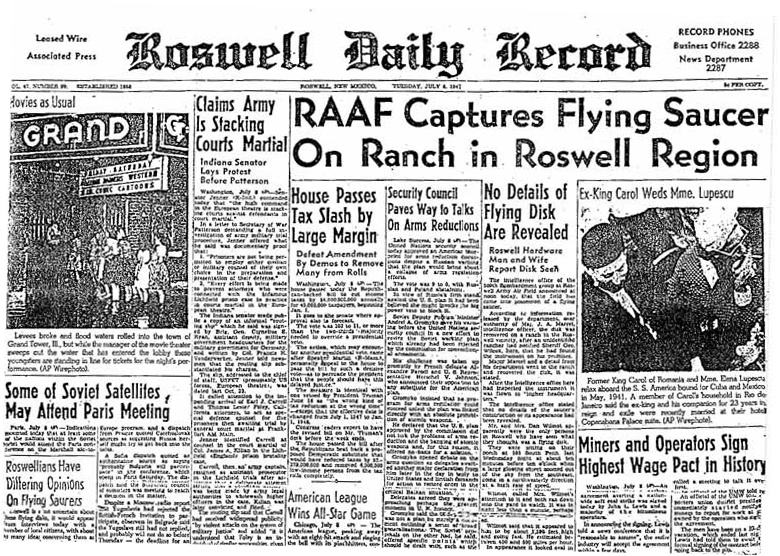
The Roswell story has two parts separated by thirty years. The first is a documented news event of July 1947. On 14 June the rancher W. W. "Mac" Brazel found scattered debris on the Foster ranch near Corona; on 4 July he gathered some of it and on 7 July took it to Sheriff George Wilcox in Roswell, who called the Roswell Army Air Field[1]. The base intelligence officer, Major Jesse Marcel, collected the material, and on 8 July the base's public information officer issued a release saying the field had "come into the possession of a flying saucer", which the Roswell Daily Record printed that afternoon under the headline "RAAF Captures Flying Saucer on Ranch in Roswell Region"[1][2]. The debris was flown to Eighth Air Force headquarters at Fort Worth, where Brigadier General Roger Ramey and his staff identified it as a weather balloon and a radar reflector, were photographed with it, and said so to the press; an FBI teletype of the same evening records the same identification[3][4]. On 9 July the Roswell Daily Record printed Brazel's own account of foil, tape, sticks and rubber strips, in which he said he was sure it was not any weather balloon he had found before[2]. The story ended there.
The second part begins in 1978, when the researcher Stanton Friedman interviewed Marcel, by then retired, who said the balloon explanation had been a cover story and the material had been like nothing on earth[2]. Charles Berlitz and William Moore's 1980 book The Roswell Incident built on Marcel's account and added recovered alien bodies[2]. Through the 1980s and 1990s new witnesses appeared with stories of bodies, a second crash site, a nurse at the base hospital and military threats, and the MJ-12 documents, later judged forgeries, arrived anonymously[2][5].
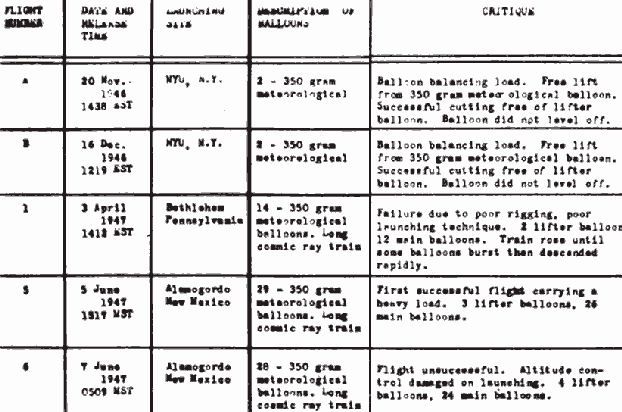
In 1993 Representative Steven Schiff asked the General Accounting Office to find the records. The Air Force's own search, published in September 1994 and in book form in 1995, concluded that the debris was most likely from flight 4 of Project Mogul, a classified New York University balloon programme launched from Alamogordo on 4 June 1947 to carry acoustic sensors for detecting Soviet nuclear tests, whose trains of neoprene balloons, balsa and foil radar reflectors and tape printed with flower patterns match what the witnesses described[6]. The GAO reported in July 1995 that only two 1947 records bearing on the event survive and that the base's outgoing messages for 1946 to 1949 had been destroyed without a recorded authority[3]. The Air Force's 1997 report, The Roswell Report: Case Closed, matched the body stories to anthropomorphic dummies dropped by balloon in 1954 to 1959, a 1956 KC-97 crash that killed eleven airmen, and a 1959 balloon accident that injured two pilots, and concluded that the witnesses had compressed events from different decades into 1947[5]. Of the 3 questions on this site, 3 are answered.
Key questionsset by the editors
What happened
The 1947 record is thin but consistent. Brazel's interview of 9 July describes a debris field of rubber strips, tinfoil, tough paper, tape and sticks, which he and his family gathered into a bundle; he estimated the rubber at 200 yards in diameter and the whole at perhaps five pounds, and said he had found weather balloons on the ranch twice before[2][1]. The 8 July press release, written by Lieutenant Walter Haut on the base commander's instruction, said the "disc" had been recovered and flown to higher headquarters[2]. Ramey's identification followed within hours, and the photographs taken by J. Bond Johnson of the Fort Worth Star-Telegram that evening show Ramey, Colonel Thomas DuBose and Marcel with foil, sticks and the remains of a radar reflector on the office floor[4]. The 509th Bomb Group's history for July 1947 describes the "flying disc" as a radar-tracking balloon[3]. On 10 July officers at Alamogordo demonstrated balloon-borne radar targets for the press, a step the Air Force later called an attempt to draw attention away from Mogul[2].
Project Mogul's flight 4 was launched from Alamogordo on 4 June 1947 and lost to tracking within about 17 miles of the Foster ranch[2][6]. The programme's purpose was secret; its hardware was ordinary. Charles Moore, the NYU project engineer, identified the flower-patterned tape used to reinforce the reflectors from the witnesses' descriptions[6].
Timeline
The accounts
The witness record divides sharply by date. The 1947 accounts are Brazel's interview, Marcel's remarks to the Fort Worth Star-Telegram that the wreckage was parts of a weather device, Ramey's and DuBose's identification, and the official histories[2][3]. None mentions bodies, a craft or a second site.
Marcel's 1978 interview with Friedman is the first account of anything else: he described material that could not be burned, dented or bent, and said the balloon shown in Fort Worth was a substitute[2]. Marcel's son, a child in 1947, has described handling similar material[2]. From 1980 the accounts multiply. Glenn Dennis, a Roswell mortician, said in 1989 that the base had asked him about preserving bodies and that a nurse had described alien corpses; he later admitted inventing the nurse's name, and no such nurse existed[2][5]. Gerald Anderson described bodies at a site 175 miles north-west of Roswell and said "I thought they were plastic dolls" and that the beings lacked a little finger; Jim Ragsdale described a crash site north of Roswell and said "they were using dummies in those damned things"; Frank Kaufmann described an intact craft and bodies and recalled talk of "an experimental plane with dummies in it"[5]. Kaufmann's documents were later shown to be forged, and the investigators Karl Pflock and Kevin Randle, who had promoted the case, concluded that no bodies were recovered[2].
The 1995 "alien autopsy" film was admitted by its promoter in 2006 to have been staged[2]. The MJ-12 papers, which purport to document a 1947 recovery, arrived on film in 1984 and were judged forgeries; Moore admitted in 1989 to having fed fabricated material to researchers[2].
The pattern is one of growth by accretion. Each decade's accounts are more elaborate than the last and are made by people further from the 1947 events, and the physical details that were once specific (foil, sticks, tape) give way to details that cannot be checked (bodies, threats, cover-ups).
What was recorded
Surviving primary records: the Roswell Daily Record of 8 and 9 July 1947 and other newspapers of those days; the Fort Worth Star-Telegram photographs, now in the University of Texas at Arlington Libraries' special collections[4]; the FBI Dallas teletype of 8 July 1947; the 509th Bomb Group history for July 1947; and the Project Mogul records assembled by the Air Force in 1994, including the NYU flight summaries and Moore's identification of the materials[3][6]. One sheet of paper in Ramey's hand in the Johnson photographs, the "Ramey memo", has been enlarged and read many ways; no reading is agreed and the original has not been found[2]. The Air Force's reports are published in full: Fact versus Fiction (1995, with the 1994 report and its 33 attachments) and Case Closed (1997)[6][5]. The GAO's report lists what was searched and what was destroyed[3].
The explanations
The Mogul explanation accounts for the 1947 record in full: the debris field's contents, its size, the Army's initial puzzlement and quick identification, the secrecy about the project's purpose, and the public demonstration of ordinary balloons two days later[6]. Its one gap is documentary: the NYU records do not record where flight 4 came down, so the identification is by match of materials and track rather than by recovery record[2]. The weather-balloon explanation of 1947 was true in its description of the hardware and false only in omitting the project.
The crashed-craft explanation rests on accounts first recorded 31 years or more after the event, several from people who later admitted or were shown to have invented parts of them[2][5]. Its predictions, a second site with bodies, a hospital episode, a craft, have been tested against the Air Force's and the GAO's record searches and against the witnesses' own retractions, and have failed. The 1997 report's matching of body accounts to the dummy drops of 1954 to 1959 is itself a reconstruction, and sceptics such as the Air Force's critics note that the dummies were dropped years after 1947; the report's answer is that this is the point, that the witnesses misdated what they saw[5]. The destroyed RAAF messages are the one loose end the sceptics and believers both cite; the GAO could not say why they were destroyed[3].
Among historians the question has shifted from what fell to how the story grew, and the answers offered are the UFO literature of the 1950s, the films of the late 1970s, the economics of the Roswell tourist industry, and the way second-hand accounts harden with retelling[1][2].
Published claims
| Year | Who | Claimed | Status | Reason |
|---|---|---|---|---|
| 1947 | Eighth Air Force, Fort Worth (reported by the FBI)[7] | The object found near Roswell resembles a high-altitude weather balloon with a radar reflector. | Most likely | The hardware was a balloon train with radar targets, but from the classified Project Mogul, which the Army did not mention[6]. |
| 1980 | Charles Berlitz and William Moore[8] | An alien craft crashed in New Mexico in 1947, its debris was swapped for balloon wreckage for the press, and the witnesses were silenced. | Ruled out | Brazel's own 1947 account and the Fort Worth photographs show foil, sticks, tape and rubber that match Mogul flight 4, and Marcel's account contained provably false claims[6][2]. |
| 1991 | Kevin Randle and Donald Schmitt[9] | An alien spacecraft crashed near Roswell about 3 July 1947, and the government suppressed the story and bought or forced the witnesses' silence. | Disputed | Its craft and witnesses rest on accounts first recorded decades later, some since shown to be invented, and the official record searches found nothing to support them[5][3]. |
| 1994 | Richard Weaver for the US Air Force[6] | The debris was most likely from flight 4 of Project Mogul, a classified balloon train launched from Alamogordo on 4 June 1947. | Accepted | The materials and timing match and no record contradicts it, though no record shows where flight 4 came down[2]. |
| 1995 | US General Accounting Office[3] | Only two 1947 records bearing on the event survive, and the base's outgoing messages for 1946 to 1949 were destroyed without recorded authority. | Accepted | It is the record of the search itself and has not been contradicted; why the messages were destroyed is still unknown[3]. |
| 1995 | Ray Santilli[11] | Black-and-white film shows the autopsy of an alien recovered after the Roswell crash. | Ruled out | In 2006 Santilli and his co-producer admitted they had staged the footage with a built set and actors[10]. |
| 1997 | James McAndrew for the US Air Force[5] | The alien-body stories describe dummies dropped by balloon in 1954 to 1959 and casualties of 1956 and 1959 accidents, misdated by witnesses to 1947. | Most likely | It explains several accounts, but the dummy drops came years after 1947 and the misdating is an inference[2]. |
What would settle it
For the debris, it is settled: the materials match Mogul's, and no 1947 record describes anything else. A recovered NYU field note placing flight 4 on the Foster ranch would close the last gap. For the bodies, the burden sits with the claim: a 1947 or 1948 document, a named hospital record, or a physical object. None has appeared in 45 years of searching, including the Air Force's and the GAO's. The remaining research value of Roswell is as the type case of a story that grew, and for that the dated sequence of accounts, from Brazel's interview to the last retraction, is the dataset.
Questions
3 of 3 questions are answered.
Evidence 16 findings
Artifacts
The films, photos, papers and objects this mystery rests on, each with its own key and its distance from the original.
See also
References
- 1.Smithsonian Magazine 2017. In 1947, A High-Altitude Balloon Crash Landed in Roswell. The Aliens Never Left. Smithsonian Magazine.cited 6 times hereSRC0CS50SJ63DCE
- 2.Wikipedia contributors 2026. Roswell incident. Wikipedia.cited 29 times hereSRC0CS50ST02AK4
- 3.United States General Accounting Office 1995. Government Records: Results of a Search for Records Concerning the 1947 Crash Near Roswell, New Mexico (GAO/NSIAD-95-187). GAO.cited 14 times hereSRC0CS50SAC3E6V
- 4.University of Texas at Arlington Libraries, S. 1947. Roswell UFO Incident (Fort Worth Star-Telegram photographs, 8 July 1947). UTA Libraries.cited 10 times hereSRC0CS50T1T4RFE
- 5.McAndrew, J. 1997. The Roswell Report: Case Closed. Headquarters United States Air Force; U.S. Government Printing Office.doicited 10 times hereSRC0CS50S2J5PEN
- 6.Weaver, R., McAndrew, J. 1995. The Roswell Report: Fact versus Fiction in the New Mexico Desert. Headquarters United States Air Force; U.S. Government Printing Office.doicited 13 times hereSRC0CS50RTR298M
- 7.Federal Bureau of Investigation, D. 1947. Roswell UFO Part 01 (Final): FBI Dallas teletype of 8 July 1947. FBI Records: The Vault.cited 2 times hereSRC0CS50THE6VMG
- 8.Berlitz, C., Moore, W. 1980. The Roswell Incident. Grosset & Dunlap, New York.cited 1 time hereSRC0CS50TS852AQ
- 9.Randle, K., Schmitt, D. 1991. UFO Crash at Roswell. Avon Books, New York.cited 1 time hereSRC0CS50V123S1B
- 10.Lagerfeld, N. 2016. How an Alien Autopsy Hoax Captured the World's Imagination for a Decade. Time.cited 1 time hereSRC0CS50VGP2GW3
- 11.Santilli, R. 1995. Alien Autopsy: Fact or Fiction?. Fox, broadcast 28 August 1995.cited 1 time hereSRC0CS50V8W0XX1