The hijacking of Northwest 305 (D. B. Cooper)
On the afternoon of 24 November 1971 a man who had bought a one-way cash ticket under the name Dan Cooper boarded Northwest Orient Flight 305 in Portland, Oregon. After take-off he handed a flight attendant a note saying he had a bomb, showed her a briefcase with cylinders and wires, and demanded 200,000 dollars in twenty-dollar bills and four parachutes. The aircraft circled for two hours while the money and parachutes were gathered, landed at Seattle, and exchanged its 36 passengers for the ransom. Cooper kept the crew, ordered the aircraft flown toward Mexico City at low altitude and speed with the landing gear down and the cabin unpressurised, and somewhere over south-west Washington a little after 8 pm he lowered the rear airstair and jumped into rain and darkness with the money strapped to him[1][2]. He has never been found, alive or dead.
The FBI investigation, code-named NORJAK, ran for 45 years. It considered more than 800 people by 1976 and hundreds more later, and eliminated almost all of them; in July 2016 the Bureau said it had "redirected resources" away from the case and would act only on new physical evidence, "specifically the parachutes or the ransom money"[1][3]. The case file, 66 volumes, is being released in parts through the FBI's online Vault, with new batches posted as late as 2025[4][5][6].
Three kinds of physical evidence exist. The first is what Cooper left on the aircraft: a black clip-on tie, a tie clip, eight cigarette butts (since lost), latent fingerprints, and two of the four parachutes. The second is 290 of the ransom bills, found decaying on a Columbia River beach called Tena Bar in February 1980, 30 kilometres from where the FBI thinks he jumped and upstream of the mouth of the Lewis River, which drains that zone, so it cannot have floated there from the zone by any simple route[2][7]. The third is a parachute rig kept on a North Carolina property that belonged to Richard Floyd McCoy Jr., who hijacked a United 727 in April 1972 by the same method, and which McCoy's children say was their father's Cooper parachute. The YouTuber Dan Gryder made it public in 2024; the FBI took it, held it until December 2025, and returned it with word that it could offer no specific conclusion and was neither crediting nor discrediting it[8][9][10]. Of the 6 questions on this site, 0 are answered. The most likely answer to “Did he survive the jump?”, not yet confirmed: he died in or soon after the jump, at night in rain over forest with a dummy reserve.
Key questionsset by the editors
What happened
Flight 305 left Portland at 2:50 pm. Cooper, seated in 18C in the last row, passed the note to flight attendant Florence Schaffner shortly after take-off; Tina Mucklow sat beside him for most of the flight and relayed his demands to the cockpit. He asked for the money in "negotiable American currency", four parachutes (two main, two reserve), and a fuel truck waiting at Seattle. Seattle First National Bank supplied 10,000 unmarked twenties, most with serial numbers beginning L (San Francisco Federal Reserve), all of which had been microfilmed[2][1]. The parachutes came from two sources: two main back chutes from a local pilot, Norman Hayden, and two reserves from a skydiving school; the rigger Earl Cossey had packed them. One reserve was a sewn-shut training dummy, which Cooper took with him[2][1].
The aircraft landed at Sea-Tac at 5:39 pm, the passengers left, and it took off again about 7:40 pm with Cooper's instructions: 10,000 feet, about 100 knots, flaps 15, gear down, cabin unpressurised, airstair down, heading for Mexico City with a fuel stop at Reno. The crew flew the airway Victor 23 south. At about 8:00 pm a cockpit light showed the airstair deployed; at about 8:13 pm the tail pitched up, which the crew took to be the jump. The aircraft landed at Reno at 11:02 pm with the stair still down and no one in the cabin[2][11]. Left on board were the tie and clip at seat 18E, the second main chute (an NB-6 military bail-out rig), the opened reserve with three shroud lines cut, cigarette butts, and 66 latent prints[2].
Timeline
The accounts
The witnesses are the two flight attendants and the cockpit crew, the passengers who saw a man in a dark suit, white shirt and sunglasses, the ticket agent at Portland and the people who handled the parachutes and money. Their descriptions produced the FBI's composite sketches: a white man in his mid-forties, about 5 feet 10 to 6 feet, 170 to 180 pounds, with dark hair and a calm manner, who smoked Raleigh cigarettes and drank bourbon[2][1]. Mucklow later told agents that he had unpacked one of the parachutes on board and, when asked whether he had taken it apart, said yes[6]. None of the witnesses was able to identify any later suspect with confidence; several picked out different men from photographs[8].
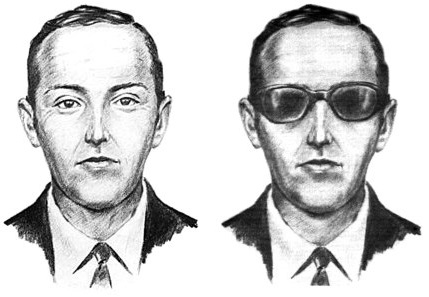
The hijacker's own words are few: the note, which he took back, and what he said to Mucklow. He knew the aircraft well enough to specify the configuration that let a 727 fly with its stair down, which Boeing had tested in 1964, and he knew the local terrain enough to remark on Tacoma and McChord Air Force Base[6][2]. The name "D. B. Cooper" is a press error from the first days, when a Portland man of that name was briefly checked and cleared[3].
What was recorded
The flight was tracked by air traffic control and military radar, and the FBI drew a flight-path map from that data. The radar record itself has not been preserved, but the FBI's transcripts give two DME position fixes and name the towns the aircraft passed; the air traffic controller interviewed by the Citizen Sleuths team said the aircraft never left Victor 23 while on his screen[11]. From the 8:13 pm pressure bump the FBI placed the jump near Ariel, Washington, over the Lake Merwin area south of Mount St. Helens, and searched there on the ground and from the air in 1971 and 1972 without result. A later re-reading of wind data by a Continental pilot led agent Ralph Himmelsbach to favour the Washougal River watershed to the south-east[2][12].
Two things later surfaced. In 1978 a deer hunter found a 727 airstair instruction placard about 13 miles east of Castle Rock, roughly 20 miles north of the Ariel zone, consistent with the stair having been lowered over that stretch[2][11]. On 10 February 1980 eight-year-old Brian Ingram, digging a fire pit on Tena Bar on the Washington bank of the Columbia north-west of Vancouver, found three bundles of twenties, 290 bills in packets of 100, 100 and 90, still in their rubber bands, whose serial numbers matched the ransom. The FBI excavated the beach and found only fragments. The bills were decayed at the edges and some were blackened; Portland State geologist Leonard Palmer examined the site and argued the money lay above a sand layer dumped by dredging in 1974, which would put its arrival after that date[2][7].
The tie is the most-studied object. In 2001 the FBI obtained a partial DNA profile from it, which it has said cannot be tied to the hijacker. From 2009 the Citizen Sleuths team led by Tom Kaye, working with FBI access granted by agent Larry Carr in 2007, lifted particles from the tie and examined them by scanning electron microscopy with energy-dispersive X-ray spectroscopy. They found unalloyed titanium, 400-series stainless steel smeared into a titanium particle, spiral aluminium machining chips, bismuth and other metals, and a majority of particles matching book-match residue[13][14]. A 2016 to 2017 automated scan by McCrone Associates of more than 100,000 particles on 20 stubs added pure cerium, cerium-lanthanum, yttrium, strontium sulfide and other rare-earth and phosphor compounds, with the raw element tables published as spreadsheets[15]. Kaye and Mark Meltzer later showed that diatoms adhering to the Tena Bar bills were a spring-blooming species, which argues the money entered the river months after a November jump[16].
The FBI's own record is the Vault release: the NORJAK investigative files from 1971 to 1992, posted in numbered parts. A March 2025 batch of 472 pages covered the elimination of hundreds of named suspects, and an October 2025 batch, Part 110 of 668 pages, included Special Agent Charles Farrell's 336-page report of 16 February 1972 recording 325 suspects under investigation and 220 eliminated by 4 February 1972[4][5][6]. The complete text has been extracted into a public dataset of 44,000 passages[17].
The explanations
Who he was. The FBI named no one. The suspect discussed longest is Richard Floyd McCoy Jr., a Vietnam veteran and skydiver who on 7 April 1972 hijacked United 855 with a demand for 500,000 dollars and four parachutes, jumped over Utah, and was arrested two days later; he escaped from Lewisburg penitentiary in August 1974 and was killed by FBI agents in Virginia Beach on 9 November 1974[10]. A former FBI agent and a parole officer argued in a 1991 book that he was Cooper. The Bureau ruled him out in August 1974, partly on an exchange student's statement that she ate Thanksgiving dinner at the McCoy home in Provo; his widow later said the couple were in Las Vegas that weekend, and his daughter disputes the alibi[1][8][18]. McCoy's children, Chanté McCoy and Richard McCoy III, say they believe their father was Cooper and kept silent until their mother died in 2020; they showed a modified military bail-out rig and a skydiving logbook from the family property in Cove City, North Carolina, to Dan Gryder, whose videos made the claim public in 2024. The FBI took the rig, searched the property, tested the pack and canopy for DNA and soil, and returned the rig in December 2025. An agent told McCoy III that the Bureau could offer no specific conclusion, that it was neither crediting nor discrediting the material, and that the DNA sample it was working from was degraded, with about seven of the 23 markers needed for a match. The Seattle field office refers reporters to its 2016 statement[8][9][19]. Other named candidates include Robert Rackstraw, Kenneth Christiansen, Sheridan Peterson, Walter Reca, Duane Weber, Lynn Doyle Cooper, William J. Smith and Vince Petersen; each rests on a resemblance, a deathbed remark or a family story, and none has a fingerprint, DNA or documentary match[2]. The Citizen Sleuths reading is occupational rather than personal: the titanium and machining particles point to someone who worked in or around a metal fabrication or titanium plant, and the match residue to a heavy smoker[14].
Where he landed and whether he lived. The FBI's own view, stated by Carr in 2007 and on its case page, is that an inexperienced jumper in a business suit, at night, in rain and a 170-knot slipstream, with a dummy reserve, probably did not survive[1][2]. Against that: no body, parachute or money bag has ever been found, no missing-person report matched, and none of the 9,710 unrecovered bills has surfaced in circulation in 55 years[14]. The landing zone follows from the flight path: if the FBI map is right, he came down near Ariel; if the aircraft was further east than the map shows, the Washougal basin is possible[11][12].
How the money reached Tena Bar. Three readings compete. The "Washougal washdown" has the bundles washed down the Washougal into the Columbia and deposited on the bar; it requires the money to survive years in water and to pass the 1974 dredging if Palmer's stratigraphy is right. Kaye's team tested rubber bands and bundles in river water and sand and found bands failing within months and bundles not travelling far intact, and could find no part of the Washougal basin within 20 miles of the Ariel zone[12][20]. The dredging reading has the money moved with the dredge spoil in 1974; the team's survey of the beach argued the find lay outside the spoil area[7]. The diatom result constrains all of them: the bills were in the river in spring or summer, not in the weeks after the jump, and then buried[16]. The remaining reading is that a person placed or lost the money there; Kaye says this is the one his data do not exclude[14].
Published claims
| Year | Who | Claimed | Status | Reason |
|---|---|---|---|---|
| 1986 | Ralph P. Himmelsbach[22] | Cooper came down further east than the FBI first thought, in the Washougal River watershed, once corrected wind data were applied. | Disputed | The DME fixes in the FBI transcripts leave the aircraft no time to have flown over the Washougal basin[12]. |
| 1991 | Bernie Rhodes and Russell P. Calame[18] | Richard McCoy, who hijacked United 855 over Utah in April 1972 by the same method, was D. B. Cooper. | Disputed | The FBI ruled McCoy out in 1974 on description and alibi, his family disputes the alibi, and the FBI's 2025 examination of a rig from his property reached no conclusion[1][8]. |
| 2007 | FBI (Special Agent Larry Carr)[23] | Cooper was not an experienced skydiver and probably never got his parachute open. | Still possible | The jump conditions favour it, but no body, parachute or money bag has been found[2], and the diatom dating of the Tena Bar money fits a person moving it months later[16]. |
| 2009 | Tom Kaye and the Citizen Sleuths[7] | The Tena Bar money did not arrive with the 1974 dredge spoil: the find lay where the spoil could not have reached. | Most likely | The survey relocated the find from the FBI's excavation photographs[7]; no one has published a survey that places it inside the spoil. |
| 2016 | Thomas J. Colbert[24] | Robert Rackstraw, a former Army helicopter pilot, was D. B. Cooper. | Disputed | No fingerprint, DNA or document ties Rackstraw to the hijacking, and the FBI said it would act only on physical evidence[2][3]. |
| 2016 | FBI Seattle field office[3] | No lead in 45 years has identified the hijacker, and the FBI will now act only on new physical evidence, specifically the parachutes or the ransom money. | Accepted | Still the Bureau's position: more than 1,000 suspects have been considered without a match to the evidence, and it refers reporters to the 2016 statement[1][8]. |
| 2017 | Tom Kaye and the Citizen Sleuths[15] | Particles on Cooper's tie, including pure titanium, rare earths and machining chips, point to a man who worked in or around a titanium or metal fabrication plant. | Still possible | The particles are measured[13], but reading them as his workplace assumes the tie was his and that decades of handling did not add them[2][15]. |
| 2020 | Thomas G. Kaye and Mark Meltzer[16] | Diatoms on the Tena Bar bills show they entered the river in spring or summer, not in the weeks after the November hijacking, and were buried soon after. | Most likely | Published and unchallenged, but not repeated by another laboratory[16]; it weighs against both the washdown and a body in the river[14]. |
| 2024 | Dan Gryder, with Chanté and Richard McCoy III[9] | A modified military bail-out rig found on the McCoy family property is one of the parachutes Cooper took from Flight 305. | Still possible | The FBI took and tested the rig and returned it in December 2025 with no conclusion, and it has not been compared in public with the 1971 parachute records[8]. |
What would settle it
Identity would be settled by a match: a fingerprint from the aircraft or a DNA profile from the tie, the cigarette butts or the parachutes against a named person or his relatives. The FBI's 2001 profile is partial; the tie clip's spindle has not been swabbed, and a federal court held in December 2023 that FOIA does not compel the Bureau to hand over the tie for private testing[21]. The McCoy rig would be settled by showing it is or is not one of the four 1971 chutes, which have known makers, serial numbers and a rigger's history; the FBI has published nothing from its testing[8]. Exhumation of McCoy for DNA, which his son has offered, would answer whether any profile from the evidence is his[9].
The landing zone would move with a recovery: a chute, a harness, the attache case or a skeleton in the Lake Merwin or Washougal drainages, or a re-analysis of surviving radar or weather records. The money question would move with a stratigraphic record of the Tena Bar find that no one made in 1980, or with any of the remaining 9,710 bills appearing anywhere with a provenance. Publication of the FBI's complete Vault file, now past Part 110, is the one thing that is steadily happening[4][6].
Questions
0 of 6 questions are answered.
Evidence 38 findings
Artifacts
The films, photos, papers and objects this mystery rests on, each with its own key and its distance from the original.
See also
References
- 1.Federal Bureau of Investigation n.d.. D.B. Cooper Hijacking. FBI History, Famous Cases and Criminals.cited 16 times hereSRC0D6SWQQ43WDE
- 2.Wikipedia contributors n.d.. D. B. Cooper. Wikipedia.cited 20 times hereSRC0D6SWREJ65CS
- 3.NPR (The Two-Way) 2016. FBI Is Giving Up On Solving The Mystery Of D.B. Cooper. NPR, 13 July 2016.cited 3 times hereSRC0D6SWR6R7DP1
- 4.Federal Bureau of Investigation n.d.. D.B. Cooper (NORJAK investigative files, November 1971 to May 1992). FBI Records: The Vault.cited 5 times hereSRC0D6SWQYY47AJ
- 5.Newcomb, T. 2025. The FBI Has Released 472 New Pages in D.B. Cooper's File, With Riveting Clues About Suspects. Popular Mechanics, 6 March 2025 (republished by Yahoo News).cited 1 time hereSRC0D6SWVVY0R4V
- 6.Natale, M. 2025. The FBI Quietly Released 668 Pages of D.B. Cooper Files. Biography.com, 7 October 2025.cited 4 times hereSRC0D6SWW3R319H
- 7.Kaye, T., Cooper Research Team n.d.. Tena Bar Money Find. citizensleuths.com.cited 11 times hereSRC0D6SWSXE4XQJ
- 8.Kocher, J. 2026. Part 4: Who Is D.B. Cooper? FBI's 'One-In-A-Billion' Parachute Returns. Cowboy State Daily, 22 February 2026.cited 16 times hereSRC0D6SWTWP2FDY
- 9.Paul, A. 2024. The FBI may be on the verge of reopening the D.B. Cooper case. Popular Science, 26 November 2024.cited 3 times hereSRC0D6SWV4G5RYP
- 10.Wikipedia contributors n.d.. Richard McCoy Jr.. Wikipedia.cited 1 time hereSRC0D6SWXJM3C1X
- 11.Kaye, T., Nicholson, R., Cooper Research Team n.d.. Flight Path Analysis. citizensleuths.com.cited 6 times hereSRC0D6SWSNM0Z6T
- 12.Kaye, T., Cooper Research Team n.d.. Washougal Washdown Theory. citizensleuths.com.cited 5 times hereSRC0D6SWTD27KK7
- 13.Kaye, T., Cooper Research Team n.d.. Titanium Particles from Cooper's Tie. citizensleuths.com.cited 6 times hereSRC0D6SWS605K49
- 14.Kaye, T., Cooper Research Team n.d.. Research Conclusions. citizensleuths.com.cited 12 times hereSRC0D6SWTMW0HX5
- 15.Kaye, T., Cooper Research Team 2017. McCrone Labs Analysis 2017. citizensleuths.com.cited 9 times hereSRC0D6SWSDT2B8S
- 16.Kaye, T., Meltzer, M. 2020. Diatoms constrain forensic burial timelines: case study with DB Cooper money. Scientific Reports 10, 13036.doicited 8 times hereSRC0D6SWRPC3N96
- 17.mysocratesnote, noops888 (db-cooper-files-text project) n.d.. db-cooper-text (text extracted from the FBI Vault NORJAK files). Hugging Face Datasets.cited 3 times hereSRC0D6SWWV60HQ6
- 18.Calame, R., Rhodes, B. 1991. D.B. Cooper: The Real McCoy. University of Utah Press.cited 2 times hereSRC0D6SWXAT2NBC
- 19.Casiano, L. 2024. North Carolina siblings say late father is D.B. Cooper after finding alleged parachute in home: report. Fox News, syndicated by KTVU, 28 November 2024.cited 1 time hereSRC0D6SWVCA4Y1P
- 20.Kaye, T., Cooper Research Team n.d.. Money Analysis. citizensleuths.com.cited 3 times hereSRC0D6SWT584PNM
- 21.United States Department of Justice, O. 2023. Ulis v. FBI, No. 23-636, 2023 WL 8620632 (D.D.C. Dec. 13, 2023) (Cobb, J.). DOJ OIP court decision summaries.cited 3 times hereSRC0D6SWWBJ0P0A
- 22.Himmelsbach, R., Worcester, T. 1986. NORJAK: The Investigation of D.B. Cooper. Norjak Project, West Linn, Oregon.cited 4 times hereSRC0D6SWX30563T
- 23.Federal Bureau of Investigation 2007. D.B. Cooper Redux. FBI News Stories, 31 December 2007.cited 1 time hereSRC0D6SWY28132T
- 24.Colbert, T., Szollosi, T. 2016. The Last Master Outlaw: How He Outfoxed the FBI Six Times, but Not a Cold Case Team. Jacaranda Roots Publishing.cited 1 time hereSRC0D6SWYA25PMH