Loch Ness
Loch Ness is a long, deep lake in the Great Glen: about 230 metres at its deepest and the largest volume of fresh water in the British Isles[1][2]. Reports of a strange animal in it began in 1930 and multiplied from April 1933; in August 1933 a witness who said he saw it on land described a long neck, and a journalist suggested a plesiosaur[3]. Since then the Loch Ness monster has been looked for with cameras, sonar, submarines and DNA.
The searches have found the loch, not a monster. Its open water holds only about 20 tonnes of fish, a low stock that the Loch Ness Project raised as a problem for any population of large animals[4]. The 1987 sonar sweep, Operation Deepscan, logged a few contacts it could not explain but nothing like a large animal population[4]. In June 2018 a team led by the geneticist Neil Gemmell sampled the water for environmental DNA from shore to 220 metres down. They found no reptile DNA, every fish species known in the loch, and eel DNA at every site; Gemmell said he could not exclude very large eels[5][6].
What people see is the open question, and the people who have studied the reports answer it with a mixture. Charles Paxton, who has catalogued 1,452 encounters, finds that only about a fifth mention a neck and under 1 per cent describe anything reptilian, and concludes that Nessie has many identities: boats and wakes, floating debris, birds and other animals, wind slicks and reflections[3]. A 2023 peer-reviewed review calls this the consensus of experts[7]. Reports continue, a handful to a dozen a year[8]. Of the 4 questions on this site, 1 are answered. The most likely answer to “What accounts for the sighting reports?”, not yet confirmed: a mixture of misidentified boats, wakes, debris, birds and other animals, optical and wind effects, and….
Key questionsset by the editors
What happened
The modern story begins in 1933. Paxton dates the first modern eyewitness reports to 1930 and the surge to April 1933; George Spicer's report in August 1933 of an animal seen on land introduced the reptile with a long neck, and a journalist proposed a plesiosaur within days[3]. Over the following decades the loch drew organised watches and expeditions. In the 1970s the Academy of Applied Science, led by Robert Rines, used sonar and underwater strobe cameras built with MIT engineers; Rines and the naturalist Peter Scott named the animal they believed their photographs showed Nessiteras rhombopteryx in Nature in 1975[9][10].
From the 1980s the Loch Ness Project, led by Adrian Shine, turned to the loch's ecology. In 1987 Operation Deepscan drew a "sonar curtain" down the loch with twenty boats; Operation Echo (1987–1991), with sonar from the Simrad company, made the first acoustic estimate of the open-water fish population[4]. An autonomous-vehicle bathymetry survey has since mapped the deep floor in detail[11]. In 2018 the eDNA survey sampled the loch and four neighbouring lochs[12][5].
Timeline
The accounts
The reports are the core of the case and the hardest part to test. Paxton's catalogue of 1,452 distinct encounters is the largest analysed set; he notes that a claim of over 10,000 reports in the 1970s was unsupported[3]. The reports disagree with each other: the animal is pink or black, matt or glossy, furry or scaly, with humps, manes or horns, fast or motionless[3].
The Official Loch Ness Monster Sightings Register, run by enthusiasts, lists reports year by year: 6 in 2021, 6 in 2022, 10 in 2023, 3 in 2024 and 6 in 2025, with 15 by August 2026. Recent entries are mostly photographs and short videos of humps, shadows or disturbances, and sonar traces from tour boats[8]. A typical recent report describes a dark shape surfacing for seconds at a distance of hundreds of metres[8].
What was recorded
Sonar has produced the most interesting physical records. In 1987 most Deepscan contacts proved to be fixed objects when revisited, but three had gone; they were stronger than fish echoes and deeper, and remain unexplained[4]. Shine notes that seals visit the loch almost every year but that the deep water, with no food, is not their habitat, and that most sonar expeditions have recorded echoes they did not understand[4]. Tour-boat sonars continue to record deep contacts[8].
The eDNA survey is the most comprehensive biological record. About 250 samples of one litre, each in triplicate, were taken along the loch's length and at depths to 220 metres and processed at Hull, Grenoble and Geneva by metabarcoding. The results identified frogs, toads, ducks, all 13 fish species known in the loch, and cattle, dog and human DNA washed in from the land; no reptile DNA; and eel DNA in every location[5]. Gemmell has acknowledged that the samples are a tiny fraction of the loch's volume taken at one season, and plans a continuous survey, "Loch Ness 2.0", for which he was seeking sponsorship in January 2025[5].
The explanations
A relict marine reptile, the popular image, does not survive the evidence. Under 1 per cent of reports describe a reptile[3]; no reptile DNA was found[5]; the glen was under ice until about 10,000 years ago[2]; and the fish stock is small[4].
A large eel is the biological candidate the eDNA left open, because eel DNA was everywhere and eels are long and undulating[5]. A statistical analysis of eel length data from Loch Ness and other European waters puts the chance of a 1-metre eel in the loch at about 1 in 50,000, plausible given the stock, and the chance of one over 6 metres at essentially zero: eels may explain some smaller sightings, not the large ones[13].
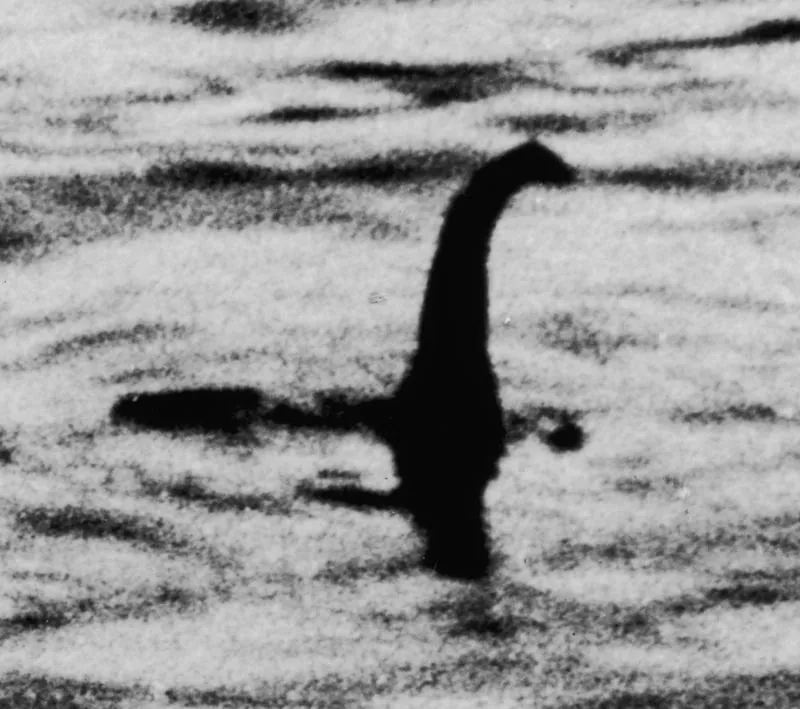
Misidentification, optical effects and hoaxes are the explanation the researchers who study the reports favour, in combination[3][7]. Ronald Binns made the sceptical case at book length in 1983[14]. Paxton counts more than 85 published theories and concludes that no single identity fits the reports[3]. Proposed specific mechanisms include boat wakes, wind slicks, mirages, floating debris and vegetation, deer, otters and diving birds, and, for twilight sightings in summer, reflections of noctilucent clouds[7][3]. Seals, which enter the loch from the sea almost every year, may account for some strong sonar contacts[4].
Published claims
| Year | Who | Claimed | Status | Reason |
|---|---|---|---|---|
| 1934 | Robert Kenneth Wilson, through the Daily Mail[16] | A photograph taken at the loch shows the head and neck of a large animal rising from the water. | Ruled out | Christian Spurling confessed before his death in 1993 that it was a model head and neck on a toy submarine, made for Marmaduke Wetherell[15] |
| 1975 | Peter Scott and Robert Rines[10] | Underwater photographs from 1972 and 1975 show a large animal with diamond-shaped flippers, which they named Nessiteras rhombopteryx. | Disputed | The flipper images were computer-enhanced, and a 1987 investigation found that some of the most striking photographs probably showed a log[17] |
| 1983 | Ronald Binns[14] | The sightings come from misidentifications, hoaxes and the press, and the classic photographs do not show an animal. | Accepted | Later analysis of the full sighting record reached the same view, with no single cause[3][7] |
| 1987 | Adrian Shine (Operation Deepscan)[4] | Three sonar contacts, deeper and stronger than fish echoes and gone when revisited, could not be explained. | Still possible | Seals that enter the loch from the sea, fish schools or acoustic artefacts could account for them, but none has been shown to[4] |
| 2019 | Neil Gemmell[18] | Environmental DNA sampled across the loch contains no reptile DNA, and eel DNA at every site sampled. | Most likely | The results were announced and later described by the team, but not published in a peer-reviewed paper with the data[5] |
| 2019 | Neil Gemmell[18] | The eel DNA leaves open that some sightings are of very large eels, which can be tested further. | Disputed | A statistical analysis of eel lengths puts the chance of an eel over 6 metres at essentially zero[13] |
| 2022 | Charles Paxton[3] | Across 1,452 encounters and more than 85 theories, no single identity fits the reports, and the monster is a matter of human psychology. | Accepted | It agrees with the sceptical studies and the expert consensus summarised in a later peer-reviewed review[14][7] |
| 2023 | Floe Foxon[13] | A 1-metre eel in the loch is plausible, at about 1 in 50,000, but one over 6 metres is essentially impossible, so eels can explain only smaller sightings. | Accepted | It is the only peer-reviewed test of the eel idea and has not been challenged[13] |
| 2023 | Oliver Smith[7] | Reflections of noctilucent clouds on the water explain some sightings made at twilight between May and August. | Still possible | The idea is testable against the dates and times of reports but has not yet been tested[7] |
What would settle it
The large-animal question is effectively settled by biomass and DNA; it would reopen only with a specimen or with DNA from an unknown large vertebrate. Two things would close what remains. Publication of the 2018 eDNA sequence data with the methods, and a repeat survey over seasons as Gemmell plans, would show whether anything unexpected was missed[5]. For the reports, a matched analysis of the register against boat traffic, weather, time of day and season would test the specific prosaic mechanisms, including the noctilucent-cloud proposal, which predicts twilight sightings between May and August[8][7].
Questions
1 of 4 questions are answered.
Evidence 20 findings
Artifacts
The films, photos, papers and objects this mystery rests on, each with its own key and its distance from the original.
See also
References
- 1.Murray, J., Pullar, L. 1910. Bathymetrical Survey of the Scottish Fresh-Water Lochs, vol. 2. Challenger Office, Edinburgh.doicited 4 times hereSRC0CRFX3843Y8Y
- 2.Shine, A. n.d.. Fieldwork and Groundtruth. Loch Ness Project (lochnessproject.org).cited 1 time hereSRC0CRFX3ZJ73MN
- 3.Paxton, C. 2022. The Loch Ness monster: a modern history. The Conversation, 12 May 2022.doicited 15 times hereSRC0CRFX1S83P0N
- 4.Shine, A. n.d.. Operation Deepscan. Loch Ness Project (lochnessproject.org), Fieldwork and Groundtruth.cited 18 times hereSRC0CRFX1HE49S7
- 5.Illumina 2025. If there is a monster in Loch Ness, this geneticist will find it. Illumina News Center, feature article, 10 January 2025.cited 11 times hereSRC0CRFX0T00STD
- 6.Shine, A. n.d.. The Loch Ness eDNA Project. Loch Ness Project (lochnessproject.org), Fieldwork and Groundtruth.cited 3 times hereSRC0CRFX19M4DN6
- 7.Smith, O. 2023. Nessie and Noctilucent Clouds. Coolabah 34: 25–45.doicited 3 times hereSRC0CRFX28W2FBQ
- 8.The Official Loch Ness Monster Sightings Register n.d.. The Official Loch Ness Monster Sightings Register. lochnesssightings.com.cited 7 times hereSRC0CRFX3FY6XXX
- 9.Edgerton, H., Wyckoff, C. 1978. Loch Ness revisited: Fact or fantasy? Science uses sonar and camera to probe the depths of Loch Ness in search of its resident monster. IEEE Spectrum 15(2): 26–29.doicited 2 times hereSRC0CRFX2RG02W8
- 10.Scott, P., Rines, R. 1975. Naming the Loch Ness monster. Nature 258: 466–468.doicited 8 times hereSRC0CRFX2GP3E5J
- 11.Gutierrez, F., Gutowski, M., Ganther, S. et al. 2014. Deep rippled bedforms in Loch Ness: Evidence from an AUV bathymetry survey. 2014 IEEE/OES Autonomous Underwater Vehicles (AUV), pp. 1–3.doicited 2 times hereSRC0CRFX30A1Q0Y
- 12.Gemmell, N. 2018. Monster hunt: using environmental DNA to survey life in Loch Ness. The Conversation, 26 June 2018.doicited 2 times hereSRC0CRFX11T7BA2
- 13.Foxon, F. 2023. The Loch Ness Monster: If It's Real, Could It Be an Eel?. JMIRx Bio 1: e49063.doicited 8 times hereSRC0CRFX2124F3T
- 14.Binns, R. 1983. The Loch Ness Mystery Solved. Open Books, Shepton Mallet (later editions Prometheus, 1984).cited 1 time hereSRC0CRFX3QR0N52
- 15.Reuters 1994. Loch Ness is a 14-inch submarine!. Deseret News, 14 March 1994.cited 2 times hereSRC0CRFX4YT4HN9
- 16.Wetherell, M. 1934. File:Loch Ness Monster Surgeon's photograph.jpg. Wikimedia Commons.cited 4 times hereSRC0CRFX4Q01ES0
- 17.Naone, E. 2007. The Nessie Quest. MIT Technology Review, 15 October 2007.cited 1 time hereSRC0CRFX56M27KD
- 18.Euronews, Associated Press 2019. Watch: Monster blow for Nessie fans as scientists find 'no DNA evidence'. Euronews, 5 September 2019.cited 2 times hereSRC0CRFX5EE7D20