The Marfa lights
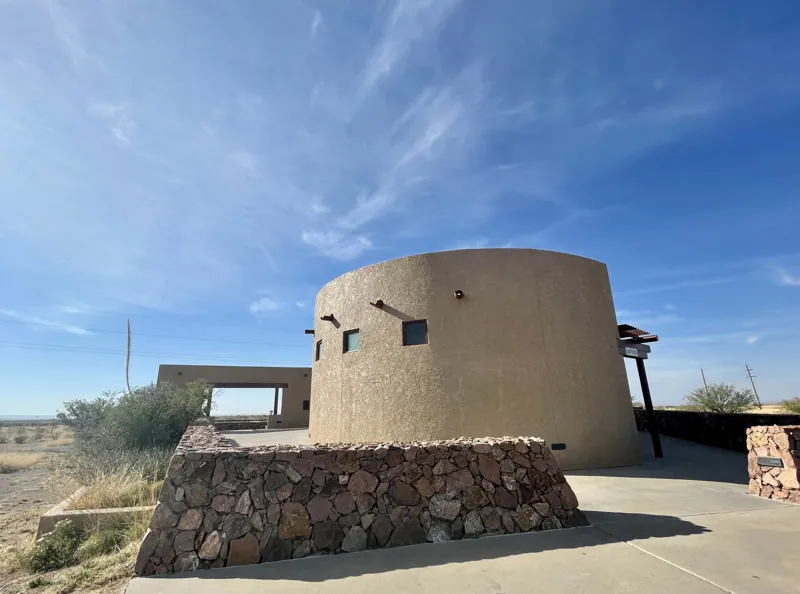
Marfa is a town in Presidio County, west Texas. East of it, US 90 crosses Mitchell Flat, a plain of grass and scrub, and from a roadside viewing area about 9 miles (14 km) from town visitors watch for lights on the horizon to the south and south-west that seem to move, split, merge and vanish[1][2]. The lights are the town's best-known attraction: the first roadside viewing area was built in 1986, the year of the first Marfa Lights Festival, and the present viewing centre opened in 2003[3][1].
The usual story says that a young cowhand, Robert Reed Ellison, saw the lights in 1883[1]. His own memoir of that journey, written in 1937, does not clearly mention them; the account comes from his family, and the earliest written report anyone has found is a San Angelo Times story of February 1945[3]. The first magazine account, in Coronet in 1957, described a single light in the Chinati Mountains[4].
Studies with instruments have found ordinary sources. In 2004 students from the University of Texas at Dallas sent a car down US 67 and watched its headlights become a Marfa light[2]; in 2008 a Texas State University team identified every candidate light in 20 nights as headlamps, streetlamps or fires[5]. James Bunnell, who ran unattended cameras on Mitchell Flat from 2003, holds that a rare residue is real[6]; a 2020 re-analysis matched the best of his photographs to vehicles on local roads[7]. The strongest remaining case is a light of about 10 kW that shone for over three hours during a thunderstorm on 3 June 2005, which may have been a power-line arc[8]. Of the 6 questions on this site, 0 are answered.
Key questionsset by the editors
What happened
The lights are seen at night over Mitchell Flat, the plain between Marfa and Paisano Pass, and towards the Chinati Mountains to the south-west[1][4]. Most are watched from the viewing area on US 90. The UT Dallas group found that all the lights it filmed from there lay along one line of sight, towards a lighted radio tower east of US 67, and appeared and disappeared at fixed places on the horizon[2]. Bunnell describes lights of varying colour and brightness, most often orange to red, that hold their place in the wind or move across country, switch off and on, and last from under a second to seven hours[8].
The written history is short. The earliest known report is a San Angelo Times story of February 1945, "Ghost Light Appears in Marfa Area"; the earliest Michael Hall found in the Marfa Public Library was the Coronet article of July 1957[3]. That article described "a weird Cyclopean eye" in the Chinati Mountains, plainly visible from Highway 90, that vanished when approached by land or air, and concluded that no one knew what it was[4]. Hall notes that the early tales describe a single light and the modern ones several fast-moving lights[3]. Interest grew in the early 1980s with press coverage and promotion by the town; the first roadside viewing area and the first Marfa Lights Festival date from 1986, and the Marfa Lights Viewing Center from 2003[3][1].
Timeline
The accounts
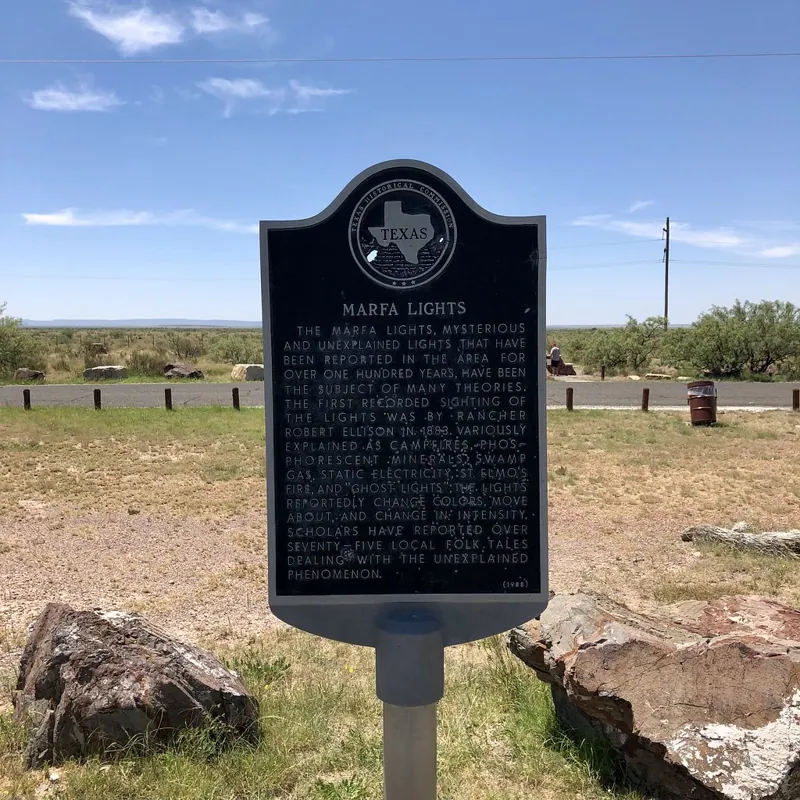
The 1883 sighting attributed to Robert Reed Ellison, a sixteen-year-old cowhand driving cattle through Paisano Pass, has no first-hand record. His granddaughter recalled him telling of "lights down there they couldn't explain" that the family took for Indian fires, but his 1937 memoir of the drive mentions a full moon and mountains that seemed to move closer, and no lights[3][7]. A plaque at the viewing centre says O. W. Williams wrote of the lights in the 1880s; his grandson thinks Williams saw them but probably never wrote about them[3]. Coronet's statement that settlers first reported the light "more than 70 years ago" gives no source[4].
Later accounts are first-hand but often recalled long after. Hallie Stillwell, a teacher and rancher, told Unsolved Mysteries in 1989 that in 1916, driving near Marfa, she and her companions saw lights over the Chinati Mountains that moved as no campfire would, and called them ghost lights[9]. Two geologists, Pat Kenney and Elwood Wright, reported that in 1973 two cantaloupe-sized lights came towards them at about 200 mph and one hovered nearby[3]. The writer Gary Cartwright watched from US 90 in August 1983 as lights appeared one to three at a time, about as bright as second-magnitude stars, and could not match them to any ranch house, road or railway he knew of[10].
Some accounts have since been explained. In 1989 a watch for Unsolved Mysteries by scientists from McDonald Observatory and Sul Ross State University recorded a globe of light on Mitchell Flat that observers were certain was not man-made; Edwin Barker, the astronomer who led it, later wrote that he was certain it was the rotating headlamp of a passing train[7]. Hall's 2006 investigation of the legend ended with him taking Venus, bright at dawn, for a Marfa light[3].
What was recorded
Donald Witt, a physicist at Sul Ross State University, traced lights to a ranch and to US 67 in the early 1970s; a larger effort he coordinated in March 1975 found nothing but ranch lights and headlights passing behind obstructions on US 67[10][7]. In March 1994 Paul Devereux and Hal Puthoff found that mirages lift lights from beyond the horizon, that headlights 30 miles or more away on the Marfa–Presidio road can look anomalous, and that vehicles on ranch tracks across Mitchell Flat look like lights skimming the ground; Devereux still judged from witnesses that genuine lights probably appeared now and then[7].
About a dozen members of the UT Dallas Society of Physics Students spent 10 to 14 May 2004 at the viewing area with two video cameras, a traffic counter on US 67 and a chase car in radio contact[2]. Played at high speed, the video showed the lights moving from left to right along one path; their numbers fell as traffic on US 67 fell after dusk; and the chase car's flashing headlights appeared in the same place as the lights, of similar brightness and colour. A light seen passing the chase car's position matched another car passing it. The group attributed every light it observed to headlights on US 67 between Marfa and Presidio[2].
James Bunnell, a retired aerospace engineer, began studying the lights in 2001 and from 2003 ran unattended low-light cameras on Mitchell Flat, later three stations with nine cameras[8][6]. On the night of 2–3 June 2005, during intense thunderstorms, two stations photographed an extremely bright object that shone for over three hours. Strokes in the National Lightning Detection Network match its origin in time and place; triangulation put it on the ground about 28 km from the farther station, and its peak output was about 10 kW of visible light[8]. The same camera system recorded the first gigantic jet seen over continental North America, on 13 May 2005[11].
In May and June 2008 a Texas State University team watched for 20 nights with a Schmidt-Cassegrain telescope, a CCD spectrometer, logged bearings and video. It identified streetlamps, headlamps and fires, saw nothing that met the criteria for a genuine Marfa light, and showed that the absorption of atmospheric oxygen gives the distance of a continuum source to 6% or better beyond 4 km[5][12][13]. The team noted that such lights had appeared on only about 0.9% of the nights Bunnell's cameras monitored between November 2000 and May 2008[7].
In 2020 Manuel Borraz Aymerich and Vicente-Juan Ballester Olmos re-examined 17 photographs from 2003 and 2004 that Bunnell counts among his best images of genuine lights. They found errors in the recorded bearings and times, and matched every track they could check to vehicles on Nopal/Escondido Road across Mitchell Flat and on ranch roads farther south, 8 to 30 km away. Bunnell's reply, printed with the report, disputes their reading[7].
How the lights have been pictured
The earliest published picture found is an uncredited strip at the foot of the 1957 Coronet article: one bright light low against dark mountains, beside a road and a line of poles[4]. The earliest photograph found with its details on record is James Crocker's time exposure of September 1986, taken about 10 miles into Mitchell Flat with a 50 mm lens at f/1.8 for under three minutes; its light traces loops, and lights at the upper right were taken to be cars on US 67[14]. In 1989 night-viewing equipment used for Unsolved Mysteries recorded a globe of light on Mitchell Flat that was later identified as a train's headlamp[7].
Systematic pictures came with the instrumented studies. The UT Dallas students filmed from the viewing area in May 2004[2]. Bunnell's 35 mm time exposures of 2003 and 2004, which he counts among his best images of genuine lights, are reproduced in the 2020 re-analysis beside Google Earth views of the roads they match[7]. His unattended cameras' stacked frames of 3 June 2005 show the bright object with stars, an aircraft track and a mercury-vapour lamp 16 km away for scale[8], and the 2008 Texas State campaign paired video with spectra[5]. None of these pictures is freely licensed, so they are linked from their artifact pages rather than shown here.
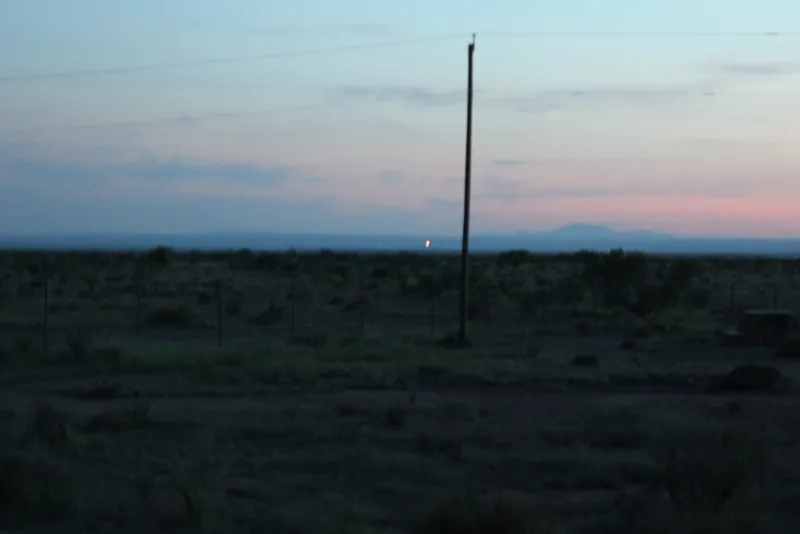
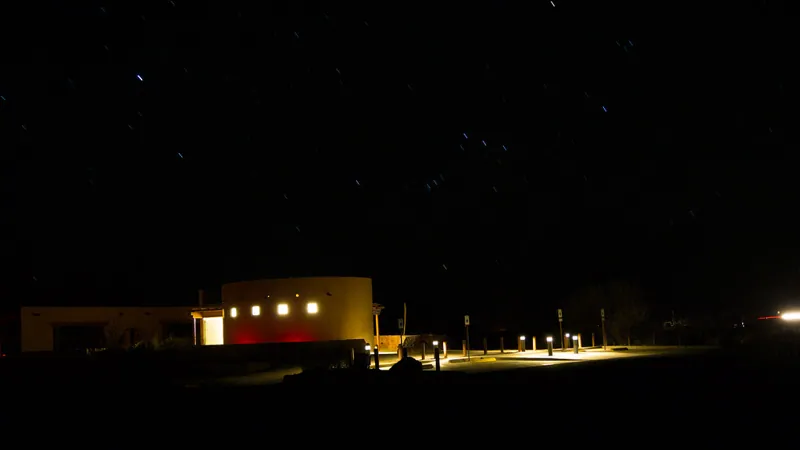
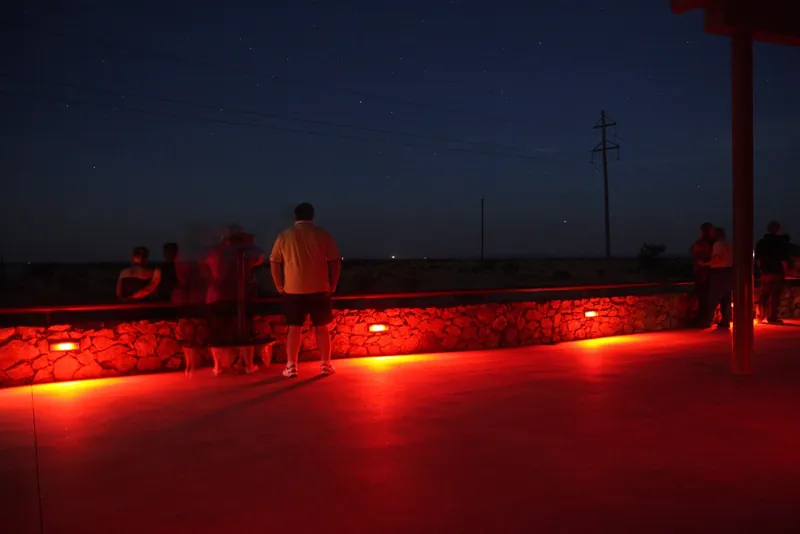
The pictures shown are visitors' photographs from the viewing area, all under free licences: a point of light low on the horizon at dusk, and the viewing centre at night.
The explanations
Headlights. On the evidence of every instrumented study, the lights seen towards US 67 and the Chinati Mountains are the headlights of vehicles on the highway[2][5][7]. Vehicles on ranch roads across Mitchell Flat, trains and fires account for others[7][5]. The idea is not new: Coronet in 1957 already weighed a mirage of artificial lights, and set it aside only because the light was said to predate any light brighter than a kerosene lantern[4].
Refraction and mirages. Distance alone does not explain why headlights seem to hover, jump and split. Layers of cold and warm air bend light, lifting distant lights into view and making them shimmer[7]; the Handbook of Texas calls this the most plausible explanation[1]. Dunning attributes the lights' behaviour to a superior mirage, having withdrawn an earlier suggestion of a Fata Morgana as unlikely at Marfa[15], and Darack describes refraction and several kinds of mirage acting on headlights on US 67[16]. An airborne survey in 2000 proposed instead that headlights reflect off curved, reflective soil beside the highway; Bunnell replied that the lights are seen directly and flicker as the road bends and passes behind terrain[7].
Natural light sources. Those who think a residue is real have offered several mechanisms. Bunnell argues for a light with electric-plasma and burning qualities and a geological cause[17]; the plasma physicist Yoshi-Hiko Ohtsuki compared such lights to ball lightning and kept cameras running at Marfa in 1989 and 1992[7]. Stephan found that burning methane could power many but not all of Bunnell's observations, and with colleagues judged a vortex-fireball model consistent with the 2005 object[18][8]. Ball lightning from piezoelectric effects in quartz bedrock has also been suggested; Dunning rejects it because no triangulation has ever located the lights[15]. No study reviewed here tests any of them against a recorded light.
The unexplained remainder. What is left is a handful of witness accounts and the 2005 object. Stephan and colleagues judge a portable lamp unreasonable and argue against a power-line arc, but a 14.4 kV distribution line crosses the object's error ellipse and the local electricity co-operative's manager called an arc "not out of the question"[8]. Borraz and Ballester Olmos conclude that there is no objective evidence of an unexplained phenomenon[7].
Published claims
| Year | Who | Claimed | Status | Reason |
|---|---|---|---|---|
| 1957 | Paul Moran (Coronet)[4] | A light in the Chinati Mountains, first reported by settlers more than 70 years earlier, has no known source. | Disputed | No written report earlier than 1945 has been found, and Ellison's 1937 memoir of the 1883 drive does not clearly mention the lights[3]. |
| 1984 | Gary Cartwright[10] | Lights seen from US 90 in 1983 could not be matched to any ranch house, road, railway or US 67. | Disputed | Later chase-car and photographic studies matched comparable lights to US 67 and to ranch roads across Mitchell Flat[2][7]. |
| 2005 | Society of Physics Students, UT Dallas[2] | Every light the group saw from the viewing area in May 2004 was a headlight on US 67 between Marfa and Presidio. | Accepted | A chase car's headlights became a Marfa light on cue, and later spectroscopic and photographic studies found the same sources[5][7]. |
| 2006 | Karl Stephan[18] | Headlights and mirages are easy to tell from the phenomenon, and burning methane could power many of the lights but not all. | Still possible | Stated in a meeting abstract; the 2011 paper says none of the mechanisms considered is developed enough to predict a recorded light in detail[8]. |
| 2006 | Michael Hall (Texas Monthly)[3] | The 1880s accounts were not written down at the time; the earliest known written report is from 1945. | Most likely | Ellison's memoir is silent, and Borraz and Ballester Olmos, reviewing the literature in 2020, also found no first-hand account from the time[7]. |
| 2007 | Brian Dunning (Skeptoid)[15] | The lights are US 67 headlights made to hover and shimmer by a superior mirage, and no report predates motor traffic. | Most likely | The headlights are confirmed by the chase-car test[2]; a later correction withdrew the Fata Morgana part of the argument[15]. |
| 2008 | Ed Darack (Weatherwise)[16] | Refraction and several kinds of mirage make distant US 67 headlights shimmer, bloom, jump and split. | Most likely | Fits the headlight identifications; the one reported attempt to measure inversions during a campaign, by a high-school group in 1999, failed[7]. |
| 2009 | Karl D. Stephan, Sagar Ghimire, William A. Stapleton and James Bunnell[5] | Bearings, video and spectra identify false positives such as headlamps, streetlamps and fires, and oxygen absorption gives a light's distance; no genuine light appeared in 20 nights. | Accepted | The method was checked against known sources at mapped distances[12]. |
| 2009 | James Bunnell[19] | Most lights have ordinary explanations, but about three per cent are a real unexplained phenomenon of Mitchell Flat. | Disputed | A re-analysis of his best 2003–2004 photographs matched every checkable track to a road and found errors in the bearings behind his triangulations; Bunnell disputes it[7]. |
| 2011 | Karl D. Stephan, James Bunnell, John Klier and Laurence Komala-Noor[8] | A light of about 10 kW that shone for over three hours near a lightning strike on 3 June 2005 was neither a portable lamp nor, probably, a power-line arc. | Still possible | A distribution line crosses the error ellipse and the utility called an arc "not out of the question"; the paper gives no fault record for the night[8]. |
| 2015 | James Bunnell[20] | The lights are real, with electric-plasma and burning qualities and a geological cause. | Still possible | Offered from photographs and infrared images without a physical test; a reviewer called it speculative but rational[17]. |
| 2020 | Manuel Borraz Aymerich and Vicente-Juan Ballester Olmos[7] | Bunnell's best photographs of genuine lights show vehicles on local roads, and there is no objective evidence of an unexplained phenomenon. | Most likely | The road matches can be repeated with the same views; the 2005 bright object, which they set aside, remains unresolved[8]. |
What would settle it
The tools exist. Two or more cameras with clocks and bearings checked against the stars would turn sightings into positions, and a published catalogue of every detection, classified against roads, ranch lights, trains, aircraft and the sky with the rules fixed before the data are seen, would show whether any residue exists at all[7]. Oxygen-band spectroscopy can give the distance of a light from a single site, and a resolved spectrum would separate lamps, flames and glowing air[5]. For the 2005 object, the co-operative's fault records for that night would test the arc directly[8]. For the history, a search of Presidio County newspapers and papers from before about 1920 would show whether anyone wrote of the lights before there were cars to make them[3].
Questions
0 of 6 questions are answered.
Evidence 41 findings
Artifacts
The films, photos, papers and objects this mystery rests on, each with its own key and its distance from the original.
See also
References
- 1.The Texas State Historical Association's encyclopedia entry (1995, revised 2017), used for the traditional history and the viewing area on US 90.cited 6 times hereSRC0DCKDDRFTSCP
- 2.The UT Dallas Society of Physics Students report on their May 2004 video, traffic-count and chase-car experiments, which attributed every light they saw to headlights on US 67.cited 18 times hereSRC0DCKDE6BATSV
- 3.Texas Monthly, June 2006: traces the history behind the legend, finding the 1883 Ellison story absent from his 1937 memoir and the earliest known newspaper report in 1945.cited 20 times hereSRC0DCKDEXQ20GZ
- 4.Coronet 42(3), July 1957: the first known magazine account, a single light in the Chinati Mountains seen from Highway 90, read here in the Internet Archive's scan of the issue.cited 11 times hereSRC0DCKD34BQRHN
- 5.American Journal of Physics 77(8), 697–703: the Texas State 20-night telescope-and-spectrometer study, which identified streetlamps, headlamps and fires and ranged continuum sources by oxygen absorption.doicited 14 times hereSRC0DCKDGY0S85X
- 6.Foreword Clarion review of Bunnell's 2009 book, used for his three camera stations, his 34 witnesses and his estimate that three per cent of the lights are unexplained.cited 5 times hereSRC0DCKDSKAP1P2
- 7.176-page re-analysis of Bunnell's best photographs of "genuine" lights, matching every checkable track to roads, with a review of earlier investigations and Bunnell's 2018 reply; read in full at https://www.ufoscans.com/raw/academia_edu_UFO/THE_MARFA_LIGHTS_Examining_the_Photograp.pdf.cited 47 times hereSRC0DCKDX42K774
- 8.Journal of Atmospheric and Solar-Terrestrial Physics 73(13), 1953–1958: triangulation and photometry of a light that shone for over three hours during a thunderstorm on 3 June 2005; read in the accepted manuscript at https://www.ceticismoaberto.com/research/fotocat/marfa.pdf.doicited 22 times hereSRC0DCKDTYXS3ZM
- 9.Fan wiki summary of the Unsolved Mysteries segment first aired on 25 October 1989, used only for Hallie Stillwell's account of 1916 as she told it on the programme.cited 8 times hereSRC0DCKDXSQT9QW
- 10.Texas Monthly, November 1984: the author's own sighting from US 90 in August 1983 and an account of Donald Witt's Sul Ross State investigation of the early 1970s.cited 9 times hereSRC0DCKDDFAMCTF
- 11.Journal of Geophysical Research 112, D20104: a gigantic jet above a thunderstorm on 13 May 2005, filmed by Bunnell's unattended cameras near Marfa, which shows what the stations could record.doicited 2 times hereSRC0DCKDVGCWTKF
- 12.Meeting abstract reporting that none of the lights seen in 20 nights met the criteria for true Marfa lights, and that oxygen-band ranging matched map distances to about 1.4 km beyond 4 km.cited 6 times hereSRC0DCKDGDNS06Q
- 13.Texas State master's thesis behind the 2008 field study, describing the oxygen A-band method for identifying false positives and estimating their distance.cited 3 times hereSRC0DCKDT69EMZH
- 14.Newsletter item of May–June 1987 describing James Crocker's time exposure of a light on Mitchell Flat in September 1986, with the photograph on its web page credited to Crocker.cited 4 times hereSRC0DCNY8HQJB2R
- 15.Sceptical podcast transcript arguing the lights are US 67 headlights seen through a superior mirage, with a later correction withdrawing the Fata Morgana suggestion.cited 10 times hereSRC0DCKDFE4QFK9
- 16.Weatherwise 61(3), 36–43: argues that refraction and mirages make distant US 67 headlights shimmer, jump and split; known here through its DOI record and the summary in Borraz and Ballester Olmos (2020).doicited 1 time hereSRC0DCKDG0A2JJC
- 17.Kirkus Indie review (30 November 2015) summarising Bunnell's conclusion that the lights have electric-plasma and burning qualities and a geological cause.cited 4 times hereSRC0DCKDWNKTHCQ
- 18.Meeting abstract (APS Texas Section, 2006) in which Stephan reviews Bunnell's data and weighs headlights, mirages, methane, antimatter and black holes.cited 5 times hereSRC0DCKDEK9MA4C
- 19.Bunnell's account of his 2001–2009 observations and monitoring stations on Mitchell Flat (Lacey Publishing, ISBN 9780970924940); not read here, cited for his claims as reported by reviewers and later studies.cited 4 times hereSRC0DCKDHC0F845
- 20.Bunnell's book of his best photographs and video of 2003–2007 and his case for a real, geological phenomenon (Lacey Publishing, ISBN 9780970924971); not read here, cited for his claims as reported by reviewers and later studies.cited 4 times hereSRC0DCKDW11ZXGR