Glozel: the inscribed tablets of the Fradin field
Glozel is a hamlet in the commune of Ferrières-sur-Sichon, about 30 km from Vichy. On 1 March 1924 a cow drawing a plough broke into a cavity in the Fradins' field, and the family uncovered a clay-lined chamber with bones and pottery[1][2]. From May 1925 Antonin Morlet, a doctor and amateur prehistorian from Vichy, leased the digging rights and with the young Émile Fradin produced a stream of objects: clay tablets and bricks inscribed with rows of signs, clay idols, face urns, bone harpoons, engraved pebbles and reindeer carvings. Morlet published them within months as a Neolithic station whose inscriptions were the ancestor of the Phoenician alphabet[3]. By 1927 the finds numbered in the thousands and the question of whether they were genuine divided French learning into "glozéliens" and "antiglozéliens"[4][5].
The sceptics' case was built in 1927 and 1928. René Dussaud, the Louvre's Semitic epigrapher, showed that the signs matched late rather than archaic Phoenician letter forms and that new types of sign appeared only after the relevant publications had reached Morlet[6][7]. An international commission of seven prehistorians dug under guard for four days in November 1927 and reported that the objects were not ancient, citing the undisturbed state of the soil, fresh roots and soft clay[8][9]. Salomon Reinach, director of the national antiquities museum, led the defence[10]. The dispute moved to the courts: Fradin sued Dussaud for libel, the police searched the Fradin museum on 25 February 1928, a forensic report by Gaston Bayle found modern fibres and fresh plant matter in the tablets, Fradin was indicted for fraud in 1929 and discharged in 1931, and Dussaud was convicted of libel in 1932 with a symbolic penalty[1][2]. Morlet dug on until 1936; a 1941 law then put all excavation under state licence.
Physics reopened the file. In 1974 Hugh McKerrell, Vagn Mejdahl, Henri François and Guy Portal reported thermoluminescence dates on Glozel ceramics between about 700 BC and AD 100, and declared the objects authentic[11][4]. The Oxford laboratory replied that TL on objects of unknown burial history and possible reheating could not be trusted, and Colin Renfrew argued that the archaeology still failed on its own terms[12][13]. By 1979 some 39 dates on 27 objects fell into three groups: Iron Age to Gallo-Roman, medieval and modern[1][14]. The Ministry of Culture's team of 1983 to 1990, summarised in 1995 and published in full in 2023, found a medieval glassworks in the field and no prehistoric deposit, dated two inscribed tablets to the early twentieth century, and concluded that a prehistoric civilisation is excluded and that modern manipulation of a small older core is the credible account[15][16].
The script itself has had one computational test and one sustained decipherment. T. D. Crawford analysed 34 tablets from Morlet's Corpus in 1977 and found none of the statistical properties of natural-language text[17]. Hans-Rudolf Hitz has read the tablets since 1979 as a Celtic language in an alphabet of Etruscan and Lepontic descent, in volumes that no Celtic epigrapher has endorsed[18][19]. Morlet's Corpus des inscriptions (1965) remains the only edition, and the Fradin family's private museum still holds the collection and maintains that it is genuine[20][21]. Of the 7 questions on this site, 0 are answered.
Key questionsset by the editors
Research sessions1 so far · last 31 Oct
S-001Glozel seeded: corpus, readings and open data
The object
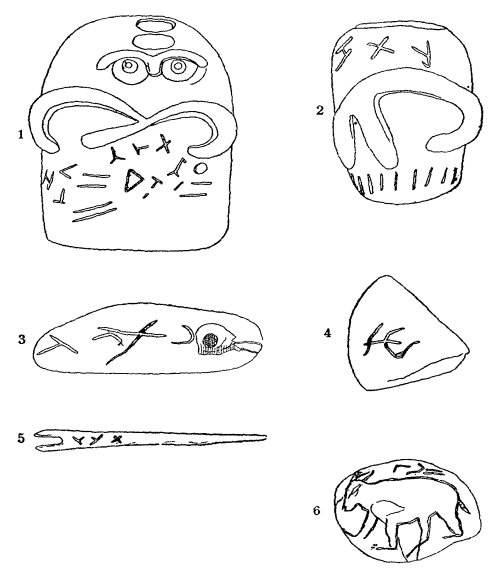
The Glozel collection is about 3,000 objects dug from one field and its surroundings between 1924 and 1936, almost all of them by Morlet and Fradin without a recorded stratigraphy[1][22]. The inscribed pieces are the heart of it. About 100 are flat fired-clay tablets, most inscribed on one face with six or seven lines of signs cut before firing; some bricks and vases carry signs as well, and there are inscribed bone, pebbles and stone[1][23]. Around them is a mixed assemblage that the sceptics found impossible as one culture: Upper Palaeolithic-looking engravings of reindeer, bone harpoons of Mesolithic type, Neolithic-looking flint and stone, clay idols with exaggerated sex, face urns, hand-printed tablets and glass[22][13]. Dussaud noted that only about half a dozen tablets were found in front of witnesses other than Morlet and Fradin[6].
The only edition is Morlet's Corpus des inscriptions of 1965, with drawings of the tablets on pages 69 to 90, the other inscribed objects on pages 25 to 68, and a sign table of 111 signs[20][19]. Crawford found 44 tablets usable in it, two inscribed on both faces, and rejected several as too damaged to read[17]. There is no photographic corpus, no database of sign occurrences and no agreed transliteration. The collection is held by the Fradin family in their private museum at Glozel; institutional archives are at the Musée d'Archéologie nationale, the Archives nationales and the Épernay museum, and more than 100 contemporary publications are digitised on the Maison de l'Orient's Reinach portal[21][24].
Timeline
What is known
The signs are linear, made of strokes, and most resemble letters of early Mediterranean alphabets. Morlet compared them to Phoenician and claimed near identity[3]. Dussaud agreed that the 22 letter-shapes on the first tablets matched Phoenician, but the Phoenician of the Eshmunazar sarcophagus of the fifth century BC rather than the archaic script of Ahiram, which he had just published; a Neolithic ancestor should not look like a late descendant[6]. Later tablets added Iberian-looking signs and five-point pebbles, which Dussaud and Vayson de Pradenne tied to publications that had reached Morlet in the meantime[6][7]. Isserlin's 1976 comparison, commissioned alongside the TL work, found only partial resemblances to Greek, Etruscan and Latin and closer but still partial ties to the Iberian scripts[25]. Camille Jullian read the signs in 1926 as late Latin cursive carrying magical formulas, a reading nobody else has reproduced[19].
Of the physical dates the firm points are these. Thermoluminescence (TL) measures the radiation dose a fired clay has absorbed since it was last heated, so it dates the last firing, not the making. About 40 TL dates exist on Glozel ceramics; they fall into an Iron Age to Gallo-Roman group, a medieval group centred on the thirteenth century, and a modern group, with two inscribed vitrified tablets at AD 1910 and 1920[15][14]. Only one date, a pooled bone sample of about 17,000 years that its own authors discount, is older than the Iron Age[15]. Radiocarbon on bone, charcoal and ivory gives the third to twentieth centuries AD[15][1]. The field contains glassworking debris in every trench within the site, and the Ministry's team judged medieval glassmaking the only undisputed activity there[15]. Neutron activation at Toronto confirmed that tablets and an idol were made of local Glozel clay[14].
What has been tested
Three kinds of test have been run. The first is excavation under control. The 1927 commission dug a trench for four days with the ground guarded at night and found objects only in loose, recently disturbed earth, together with fresh root fragments and clay still soft enough to mark; it concluded that the objects were not ancient[8][9]. Morlet's supporters answered with their own Comité d'études in April 1928, which reached the opposite conclusion[10]. The state's five trenches of December 1983 were the first with modern recording; the two outside the traditional limits were sterile and the three inside produced glassworking waste, a few sherds and no Neolithic or Palaeolithic layer[15].
The second is laboratory dating. The 1974 TL programme at Edinburgh, Risø and the French atomic energy laboratories gave Iron Age dates and was presented as proof of authenticity[11][4]. Zimmerman's zircon test excluded artificial irradiation as a way of faking age[26]. Aitken and Huxtable pointed out that objects dug up in the 1920s have no measurable burial dose-rate and that any reheating resets the clock[12]. Barbetti's archaeomagnetic study then found one tablet heated twice[27], and the Oxford laboratory in 1983 to 1985 obtained medieval dates for three inscribed pieces and twentieth-century dates for two vitrified tablets[15][14]. Risø and Oxford disagreed on the same tablet by over a thousand years[15]. Gaston Bayle's 1929 forensic examination had already found modern dyed wool and cotton fibres and fresh plant matter inside the tablets[1].
The third is analysis of the signs. Crawford's 1977 computer study compared the sign sequences of 34 tablets with Basque, Berber, Chinese, Finnish and Iberian corpora and found none of the distributional properties of a natural-language text; he suggested a non-linguistic function or a syllabary and said linguistics alone could not decide authenticity[17]. No later statistical study has been published.
The readings
On authenticity four positions have been held. Morlet and Reinach held that the site was Neolithic and its alphabet the oldest known; no Neolithic deposit or date has ever been found, and the position is abandoned[3][10][15]. The 1927 commission, Dussaud, Vayson de Pradenne and most prehistorians since have held that the whole collection was made in the 1920s[8][6][22]. The TL team and the pro-authenticity colloquia at Vichy argue for a genuine Celtic and Gallo-Roman occupation of about 300 BC to AD 300, with the medieval and modern dates explained by later fires and kilns reheating old objects[28][14]. The state's position since 1995 is a middle one: the field held a medieval glassworks, some Iron Age and medieval objects may be genuine, and the collection as a whole, the inscribed tablets included, was enlarged by forgery in or after the late nineteenth century[15][16]. Sociologists of science have treated the affair as a case where no shared criterion of authenticity existed[5].
On the script three readings exist. Hitz derives a 17-letter primary alphabet of about 300 BC from Lepontic and Etruscan models, expanded by about 200 BC to 26 letters and 40 to 50 ligatures, and reads Celtic dedications such as nemu Chlausei, which he renders as the sacred grove of Glozel[18][29][19]. The reading has no support among Celtic epigraphers and depends on many signs assigned ad hoc. Jullian's Latin magical reading and the Semitic, Basque, Berber and Turkic proposals of the 1920s are not pursued[19]. The alternative, held by Dussaud and by Jean-Pierre Adam, is that the signs were borrowed from published alphabet tables and arranged without linguistic order, which is what Crawford's statistics would predict[6][17].
Published claims
| Year | Who | Claimed | Status | Reason |
|---|---|---|---|---|
| 1926 | Antonin Morlet and Émile Fradin[3] | Glozel is a Neolithic station and its tablets carry the alphabet from which Phoenician descends. | Ruled out | No Neolithic deposit or date has been found at the site, and the state team judged a prehistoric civilisation excluded[15]. |
| 1927 | René Dussaud[6] | The signs copy late Phoenician letter forms and the tablets were made in the 1920s by one hand. | Most likely | Two inscribed tablets have TL dates of 1910 to 1920 and the state team holds modern manipulation to be the credible account[15]. |
| 1927 | Pedro Bosch Gimpera, Dorothy Garrod and the international commission[8] | Controlled digging shows the objects lie in recently disturbed soil and are not ancient. | Most likely | The state trenches of 1983 likewise found no undisturbed prehistoric layer, only medieval glassworking debris[15]. |
| 1928 | Salomon Reinach[10] | The finds are authentic and the commission's verdict should be reversed. | Ruled out | Every dating method since has excluded a Neolithic date, which was the heart of Reinach's position[15]. |
| 1930 | André Vayson de Pradenne[22] | The assemblage mixes Palaeolithic, Neolithic and alphabetic material no culture could have produced, and each new class appeared after its model was published. | Most likely | Renfrew restated the stylistic incoherence in 1975 and no later work has reconciled the assemblage[13]. |
| 1968 | Dorothy Garrod[9] | The commission's trench was guarded and the objects found were in loose earth; the accusation that she planted finds is false. | Accepted | Her account agrees with the published report and no evidence of planting was ever produced[8]. |
| 1974 | Hugh McKerrell, Vagn Mejdahl, Henri François and Guy Portal[11] | Thermoluminescence dates the Glozel ceramics between about 700 BC and AD 100, so they are authentic. | Disputed | Later TL from the same and other laboratories split into Iron Age, medieval and twentieth-century groups, and Oxford and Risø disagreed on the same tablet[15]. |
| 1975 | Martin Aitken and Joan Huxtable[12] | TL on objects of unknown burial history is unreliable, and reheating resets the TL clock. | Accepted | Archaeomagnetism found a tablet heated twice and Oxford later dated vitrified tablets to 1910 and 1920[27][15]. |
| 1975 | Colin Renfrew[13] | The archaeological case against Glozel stands whatever the TL says, and the two must be reconciled. | Most likely | The state's medieval-core-plus-forgery account is such a reconciliation[15]. |
| 1976 | B. S. J. Isserlin[25] | The signs show only partial resemblances to Greek, Etruscan and Latin and closer but still partial ties to Iberian scripts. | Still possible | It is a formal comparison without a test of sequence structure, and the Iberian analogy has not been followed up[17]. |
| 1977 | T. D. Crawford[17] | The sign sequences of 34 tablets show none of the statistical properties of natural-language text. | Still possible | It is the only computational study, rests on 34 tablets and five comparison corpora, and has not been repeated with modern methods[17]. |
| 1979 | Hans-Rudolf Hitz[18] | The tablets record a Celtic language in an alphabet derived from Etruscan and Lepontic, with dedications of a sanctuary. | Disputed | No Celtic epigrapher has accepted it, the system needs 40 to 50 ligatures assigned case by case, and the inscribed tablets dated by TL are medieval or modern[19][15]. |
| 1995 | Jean-Pierre Daugas, Jean-Paul Demoule, Jean Guilaine, Didier Miallier, Pierre Pétrequin and Jean-Claude Poursat[15] | The site is a medieval glassworks with some Iron Age material; a prehistoric civilisation is excluded and modern forgery enlarged the collection. | Most likely | It rests on the only controlled excavation and on about 40 dates, but the full data waited until 2023 and the pro-authenticity side disputes the reheating explanation[16][14]. |
| 2004 | Alice Gerard, Robert Gerard and Hugh McKerrell[14] | Glozel had a genuine Celtic occupation of about 300 BC to AD 300; the medieval and modern dates come from reheating in later fires. | Disputed | Reheating cannot explain the modern fibres and plant matter found inside tablets in 1929 or the inscribed tablets with twentieth-century TL dates[1][15]. |
| 2023 | Jean Guilaine and Didier Miallier[16] | The full state report finds the site neither Palaeolithic nor Neolithic and the documents the work of forgers of the last century. | Most likely | It is the fullest study, but the Fradin heirs and the Vichy colloquia reject it and the question of a genuine medieval or Iron Age core is left open[21]. |
What would settle it
The authenticity question could be closed by dating the inscription rather than the clay. A TL or archaeomagnetic date fixes the last firing; a sign cut into wet clay before firing is as old as that firing, but a sign scratched after firing is not, and the two cases have not been separated systematically across the corpus. Microscopy of sign floors on the dated tablets, with the Risø and Oxford samples re-measured on the same surfaces, would show whether the Iron Age group carries inscriptions made before firing[12][15]. The Ministry team recommended technological and typological study rather than more dates, and in particular a study of medieval and modern glassmaking in the Bourbonnais hills, which would explain the kilns and the vitrified tablets[15].
The script question can be tested now. A machine-readable transcription of Morlet's Corpus, with a sign list keyed to his 111 signs and Hitz's 80, would allow Crawford's 1977 test to be repeated on all the tablets with modern methods: sign-frequency distributions, conditional entropy and repeated-sequence counts against natural-language controls and against random draws from a Phoenician or Iberian alphabet table[17][25]. If the sequences behave like a language, Hitz's Celtic reading can be scored on held-out tablets. If they behave like random draws, the forgery account gains a quantitative footing. A find of a Glozel-type inscribed object in a dated context outside the Fradin collection would change everything; none has been reported in a century[16].
Questions
0 of 7 questions are answered.
Evidence 22 findings
Artifacts
The films, photos, papers and objects this mystery rests on, each with its own key and its distance from the original.
See also
References
- 1.Reference article with the discovery and legal timeline (police search 25 February 1928, Bayle report 1929, indictment 4 June 1929, dismissal 1931, Dussaud libel verdict 1932), Fradin's dates, and the 1995 Arizona AMS dates; used for dates that the primary sources give piecemeal. The French article's bibliography (Bibliographie sur Glozel) lists about 140 items with links.cited 10 times hereSRC0DEDKMG0NXP9
- 2.Politika (EHESS), 10 October 2023. A historian's account of the 1927-1928 affair from the press archive: the commission, Dussaud's pamphlet and clipping file, the Reinach-Dussaud dispute, the police search and trials, and the origins of French excavation law.cited 8 times hereSRC0DEDK7NPVVKH
- 3.Vichy: Octave Belin, 24 pp., 20 illustrations. The second of Morlet's fascicles, which first presented the tablet signs as a Neolithic alphabet ancestral to Phoenician. Digitised by the MOM Reinach library.cited 3 times hereSRC0DEDK523KRBS
- 4.Revue archéologique du Centre de la France 15(1-2): 5-28 (two linked parts, DOIs 10.3406/racf.1976.2017 and 10.3406/racf.1976.2018). The full French report of the TL programme: the quartz and feldspar inclusion method, dosimetry, the objects tested (inscribed tablets, face urns, idols, lamps, bobbins) and the date table. Open access on Persée.doicited 6 times hereSRC0DEDHRKN8QDW
- 5.Ethnologie française 23(3): 399-426. A sociology-of-science study of why the Glozel collection could never be classified: how each camp's criteria of authenticity (stratigraphy, style, laboratory dates) failed to convince the other.cited 1 time hereSRC0DEDKKHPNGTQ
- 6.Paris: Armand Colin, 57 pp. Dussaud's epigraphic case for forgery: the 22 letters on the first tablets match late Phoenician (Eshmunazar) rather than archaic (Ahiram) forms, new sign types appear in step with publications reaching Morlet, and the tablets share one hand. Digitised by the MOM Salomon Reinach library.cited 9 times hereSRC0DEDJP4XXMKB
- 7.Bulletin de la Société préhistorique française 24(9): 293-319. A dated chronology of the finds and publications 1924-1927, used to argue that each new class of object appeared after the relevant comparanda had been published or sent to Morlet. Open access on Persée.doicited 4 times hereSRC0DEDJQCBRA5V
- 8.Bulletin de la Société préhistorique française 24(12): 437-456 (also issued as a supplement to the Revue anthropologique 10-12, 1927). The report of the international commission that dug at Glozel on 5-8 November 1927 and concluded that the objects studied were not ancient, on the evidence of the soil, fresh root fragments and the state of the finds.doicited 5 times hereSRC0DEDJNXDSP88
- 9.Antiquity 42(167): 172-177. Garrod's first-hand account, forty years on, of the 1927 commission's dig: how the trench was guarded, what the members saw in the soil, and the night-time incident Morlet later used to accuse her of planting objects.doicited 4 times hereSRC0DEDK3PS8267
- 10.Paris: KRA, 45 pp. Reinach's statement of the case for authenticity after the 1927 commission, written by the director of the Musée des Antiquités nationales and the most prominent defender of the finds. Digitised on Gallica.cited 2 times hereSRC0DEDJPD678K5
- 11.Antiquity 48(192): 265-272. The first thermoluminescence (TL) results on Glozel ceramics, from the Edinburgh, Risø and Saclay/Fontenay laboratories, placing the fired clay objects tested between about 700 BC and AD 100 and reopening the authenticity question.doicited 6 times hereSRC0DEDHPBC6CAF
- 12.Antiquity 49(195): 223-226. The Oxford laboratory's response to the 1974 TL results, setting out the sources of error (unknown burial environment, possible reheating, dose-rate assumptions) that make a TL date on an object of unknown find context unreliable.doicited 3 times hereSRC0DEDHPRE33G2
- 13.Antiquity 49(195): 219-222. Renfrew's editorial on the clash between the physical dates and the archaeological case, arguing that Glozel fails on stylistic coherence and stratigraphy whatever the TL says, and that the two kinds of evidence must be reconciled rather than one discarded.doicited 2 times hereSRC0DEDHQ9YRJ7M
- 14.Actes du 6e Colloque de Glozel, Vichy, 2004. A pro-authenticity compilation of every TL, radiocarbon, archaeomagnetic, petrographic and glass analysis to 2004, with sample numbers and laboratories (Risø, Edinburgh, Oxford, Arizona AMS, Toronto SLOWPOKE); useful as a date table, to be read against the 1995 and 2023 state reports.cited 11 times hereSRC0DEDK60WJEK6
- 15.Revue archéologique du Centre de la France 34(1): 251-259. The official nine-page summary of the Ministry of Culture programme: the December 1983 trial trenches, the medieval glassworking debris, 19 new TL dates, 3 radiocarbon dates, and the conclusion that a prehistoric civilisation is ruled out while a medieval core enlarged by modern forgeries remains the credible account. Open access on Persée.cited 26 times hereSRC0DEDJ8461BM1
- 16.Clermont-Ferrand: Presses universitaires Blaise-Pascal, collection Terra Mater 4, 320 pp., ISBN 978-2-38377-096-1. The full report of the 1983-1990 state excavations, dating programme (TL, archaeomagnetism, AMS radiocarbon) and typological study, published 28 years after the summary; concludes the site is not prehistoric and the documents are not authentic.cited 5 times hereSRC0DEDJ9F43PS6
- 17.Revue archéologique du Centre de la France 16(3-4): 377-389. The first computational study: 34 tablets from Morlet's 1965 Corpus analysed by computer and compared statistically with Basque, Berber, Chinese, Finnish and Iberian corpora, concluding the sign sequences show none of the features of natural-language text. Open access on Persée.doicited 7 times hereSRC0DEDHS3DCJ7S
- 18.Revue archéologique du Centre de la France 18(1-2): 73-84. Hitz's first published reading of the tablets as a Celtic (proto-Celtic or Gaulish) language written in an alphabet derived from Etruscan and Lepontic models. Open access on Persée.doicited 4 times hereSRC0DEDJ6B5NVRQ
- 19.Kadath, online articles, January 2015. A sympathetic summary of Hitz's system (17-letter primary alphabet c. 300 BC, 26 letters plus 40-50 ligatures by c. 200 BC, Celtic readings such as nemu Chlausei) and bibliography 1979-2013; also records Jullian's Latin-cursive reading, Isserlin's and Crawford's results. Used for Hitz's later works, which are self-published and hard to obtain.cited 5 times hereSRC0DEDKKVED623
- 20.Montpellier: Causse et Castelnau, 1965 (reprinted Marsat: Éditions de la Source, 1969, 124 pp.; Horvath, 1978). The only corpus edition: drawings of the inscribed tablets (pp. 69-90), the other inscribed objects (pp. 25-68), the Puyravel and Chez Guerrier finds, and Morlet's sign table of 111 signs. Digitised copy of the 1969 printing on the MOM Reinach portal.cited 7 times hereSRC0DEDK4A3NFH6
- 21.Booklet of the centenary colloquium held at Vichy on 12-13 December 2024: lists the archival fonds (MAN, Archives nationales, Épernay, Audollent, Breuil, Peyrony), the script-comparison paper by Zurbach, and the state's position that the 2023 volume closes the controversy.cited 4 times hereSRC0DEDKKNN50WZ
- 22.Antiquity 4(14): 201-222. The leading French sceptic's English-language summary of the archaeological case against Glozel: incoherent association of Palaeolithic, Neolithic and alphabetic material, fresh breaks, soft unfired clay, and the pattern of finds.doicited 2 times hereSRC0DEDJQ6TVZS8
- 23.Paris: KRA, 288 pp. Reinach's day-by-day chronicle of the affair with 24 figures, including the plates of inscribed tablets, stones, bone and pebbles from which the Commons images derive. Digitised on Gallica; public domain.cited 3 times hereSRC0DEDJPR8F26G
- 24.Omeka S portal of the Maison de l'Orient (Lyon) holding more than 100 digitised Glozel items from the Salomon Reinach bequest: Morlet's fascicles, Dussaud, Peyrony, Reinach, Jullian's Notes gallo-romaines, the 1927 commission report, the 1976 TL studies, colloquium acts, press cuttings and photographs. Public API at /api/items?search=Glozel.cited 3 times hereSRC0DEDKM8PY290
- 25.Revue archéologique du Centre de la France 15(1-2): 31-41. A Semitic epigrapher's formal comparison of the Glozel signs with Phoenician, Greek, Etruscan, Latin and Iberian letter forms, commissioned alongside the TL study; finds only partial resemblances, closest to Iberian scripts.doicited 5 times hereSRC0DEDJ51DB792
- 26.Revue archéologique du Centre de la France 15(1-2): 29-30. Zircon-grain TL on two Glozel samples (a vitrified fragment and a bisexual idol), run to test whether a forger could have irradiated the objects artificially to fake an old TL signal.doicited 4 times hereSRC0DEDJ5D5J899
- 27.Journal of Archaeological Science 3: 137-151. Archaeomagnetic study of six ceramic objects: five were fired to at least 500 °C and one tablet showed two heating episodes, which bears on whether TL ages record the original firing or a later reheating.doicited 5 times hereSRC0DEDK6S7H6VF
- 28.Antiquity 49(196): 267-272. The TL team's reply to Aitken and Huxtable and to Renfrew, defending the measurements and asking that judgement wait for the fuller study.doicited 1 time hereSRC0DEDHR00CW2H
- 29.Zurich: Juris, 186 pp., ISBN 3-260-04914-2 (reprinted 1986). Hitz's book-length Celtic decipherment; followed by Les inscriptions de Glozel I-II (1997-1998), Dictionnaire des inscriptions de Glozel (2006) and Der altkeltische Hintergrund der Inschriften von Glozel (2007), all self-published.cited 3 times hereSRC0DEDJ6WRW0J3