The 1908 Tunguska event
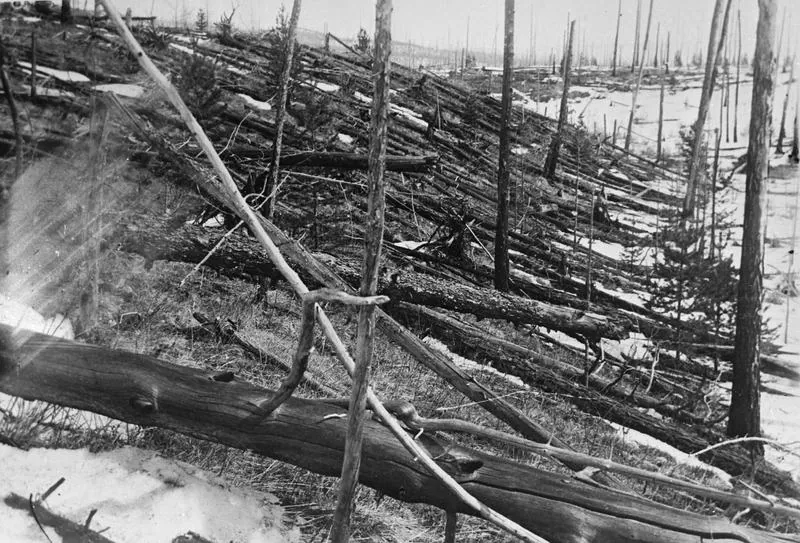
Early on 30 June 1908 a cosmic body exploded above the taiga in the basin of the Podkamennaya Tunguska River in central Siberia. The blast flattened 2,150 ± 50 km² of forest, about 8.5 km below the point of the explosion, and sent air waves and seismic waves that were recorded across Eurasia and in Britain[1][2]. For several nights afterwards the sky over Europe and western Asia was unusually bright[3]. The region was remote, and the first scientific expedition, led by the geologist Leonid Kulik, reached the site only in 1927; he found the radial tree fall but no crater and no meteorite[1].
A century of work has turned the event into the reference case for an atmospheric airburst. Seismic, barometric and forest-damage data give an energy of 10–40 megatons, most probably about 15[4], and an explosion height near 8.5 km[5]. Models show that a stony asteroid a few tens of metres across disrupts at about that height[6], while hydrocode simulations find that both rocky and icy bodies can produce the tree fall[7]. The pattern of fallen trees fixes the epicentre and shows that the body came in from the east-south-east[1][8].
Several questions remain open. No fragment of the body has been identified, so its composition rests on microscopic particles and models[9]. Whether Lake Cheko, about 8 km from the epicentre, is a crater left by a surviving fragment has been argued since 2007[10][11][12]. And a small number of researchers still argue for non-cosmic causes[13][14]. The newest field data are a lake-sediment record of the 1908 erosion layer[15] and a drone magnetometer survey of the epicentre[16]. Of the 5 questions on this site, 0 are answered. The most likely answer to “What kind of body, if any, caused the Tunguska explosion?”, not yet confirmed: a stony asteroid some 50–80 m across that broke up and exploded about 8.5 km up.
Key questionsset by the editors
What happened
At 00:14:28 UT (07:14 local time) a body estimated at 50–80 m across entered the atmosphere on a trajectory from the east-south-east at an azimuth of about 110°, and exploded about 8.5 km above the ground[1]. These values are averages of many published estimates, tabulated in Longo's 2007 review; the angle of descent is the least certain, with values from about 30° to 45° preferred by modellers[17][1]. The blast and heat felled the forest radially around the epicentre at about 60.886° N 101.894° E; the felled area has the shape of a butterfly with its axis at about 115°, which reflects the combination of the spherical blast and the shock wave of the incoming body[1][18]. The energy, estimated from barograms, seismograms and forest damage compared with nuclear tests, is 10–40 Mt with a most probable value of about 15 Mt[4]; simulations that include the downward momentum of the fireball lower the estimate to 3–5 Mt[19], and tree-resistance modelling points to about 10 Mt[7].
Timeline
The accounts
Siberian witnesses reported several kinds of luminous phenomena in the sky; the accounts gathered in 1908 itself are few, and a newspaper report of a meteorite falling near Kansk was later said to be false[20]. Most accounts were collected about fifty years after the event; they suggest a low-angle flight of 5–17°, which cannot reproduce the observed tree fall, so modellers now take the trajectory from the trees rather than from witnesses[1]. The most complete peer-reviewed compilation, including reported injuries and possible deaths, is that of Jenniskens and colleagues[21]. The observer at the Kezhma weather station, about 215 km south, noted "two huge fiery circles", and the station's log records a sharp increase in cloud on the day and rain and thunderstorms in early July[14]. Evenki accounts collected later describe a stone that appeared in the destroyed forest and fresh furrows with stones in their walls near the epicentre[1].
What was recorded
The event left four kinds of record. The first is instrumental: the air wave on microbarographs in Britain and elsewhere, analysed by Whipple in 1930[2], and seismic waves at four stations, from which Ben-Menahem derived the burst height and energy[5]. The second is the forest itself. Kulik's expeditions from 1927 and his 1938 aerial survey photographed the fallen trees, and in the 1960s teams led by W. G. Fast mapped tree-fall directions at sampling points across the area; these surveys were combined into a single catalogue and map in 2005, and the epicentre position used by later models comes from them[22][8][1]. Tree rings from the 1999 Bologna expedition record the damage and the recovery[23].
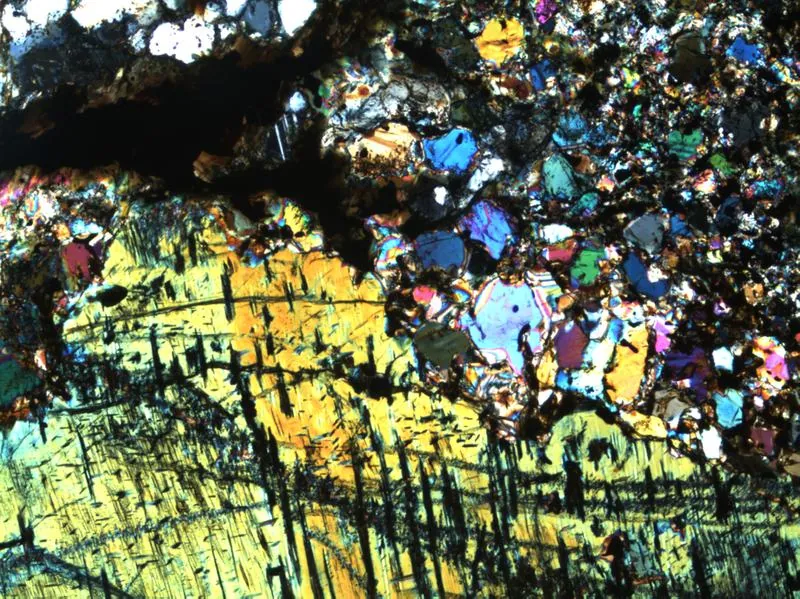
The third is material. No macroscopic meteorite has been found; a large quartzite boulder found near the epicentre in 1972, "John's Stone", is probably terrestrial[1]. Microscopic particles recovered from tree resin and peat have been studied as remnants of the body; an averaged composition is enriched in alkali and alkaline-earth elements and implies a density below 2.8 g/cm³[9]. Nitrate in the GISP2 Greenland ice cores rises in 1908, consistent with nitrogen oxides made by the blast[24]. The fourth is in lakes. A core from Lake Zapovednoye shows a layer rich in soil-derived elements at about 1908, presumably erosion after the tree fall, and a drop in the diversity of lake invertebrates that recovered within 6–10 years[15]. In 2025 a drone magnetometer survey over about 30 km² of the epicentre mapped anomalies that mostly follow the geology[16].
The explanations
A stony asteroid. The most widely held view is that a stony body tens of metres across broke up under aerodynamic pressure and released its energy as an airburst, leaving only vapour and microscopic debris[6][25]. It fits the burst height and the absence of a crater, and the orbital statistics favour an asteroid[1]. Its weakness is that no fragment has been found, although a 2023 model shows that stronger fragments could have survived and fallen in a strewn field about 11 km north-west of the epicentre, where they would now be buried in permafrost[1].
A comet. The absence of fragments and the bright nights have long been read as signs of an icy body[1]. Simulations show that an icy comet could also produce the tree fall[7], and an ammonium spike in Greenland ice has been suggested as a comet signature[24]. Against it, entry models have icy bodies bursting higher than 8.5 km[6].
An iron body that left. One group argues that an iron asteroid passed through the atmosphere on a grazing trajectory down to 10–15 km and returned to space, leaving the shock wave but no debris[26].
A terrestrial cause. Kundt proposed an eruption of natural gas from below[13], and Ol'khovatov argues in a series of preprints for a geophysical event linked to weather and tectonics[14]. These readings have not been developed into quantitative models of the tree fall and seismic records.
Lake Cheko. Gasperini and colleagues read the lake's funnel-shaped floor and sediments as a small crater made by a surviving fragment[10][27], supported by tree-growth patterns near the shore and by a rubble-pile model[23][28]. Collins and colleagues argue that the lake is not crater-shaped, contains no impactor material and is ringed by older trees, and that no plausible fragment could survive[11]; Rogozin and colleagues dated its sediments as older than 1908[12]; and the 2023 strewn-field model places the lake outside the likely fall zone[1].
Published claims
| Year | Who | Claimed | Status | Reason |
|---|---|---|---|---|
| 1930 | F. J. W. Whipple[2] | Air waves recorded on British microbarographs and seismic waves recorded in Europe on 30 June 1908 were produced by the fall of a great meteor in Siberia. | Accepted | Every later account of the event rests on these records[5][4]. |
| 1973 | A. A. Jackson and Michael Ryan[30] | A small black hole passing through the Earth caused the explosion. | Disputed | It was rebutted in Nature the next year and has found no support since; the airburst of a stony body explains the evidence[29][6]. |
| 1974 | William Beasley and Brian Tinsley[29] | The Tunguska event was not caused by a black hole. | Accepted | No later study has revived the black-hole explanation, and models of an asteroid or comet airburst account for the damage[7]. |
| 1975 | Ari Ben-Menahem[5] | The seismograms from four stations and the forest damage place the explosion about 8.5 km above the ground. | Accepted | Later models adopt a burst height of about 8.5 km[1][7]. |
| 1993 | Christopher Chyba, Paul Thomas and Kevin Zahnle[6] | A stony asteroid tens of metres across would break up at the observed height, while comets would burst higher and iron bodies reach the ground. | Accepted | It is the consensus reading, though hydrocode work since shows an icy body can also burst low enough[7][1]. |
| 1996 | V. V. Svetsov[25] | The fragments of the body were heated and vaporised in the expanding cloud, so no macroscopic meteorites survived. | Most likely | It explains the absence of fragments, but others argue stronger pieces could have reached the ground[1][28]. |
| 1998 | N. V. Vasilyev[4] | Barograms, seismograms and the forest damage give an energy of 10 to 40 megatons, most probably about 15. | Accepted | Most later work uses this range, though some models need less[1][19]. |
| 2007 | Luca Gasperini and colleagues[10] | Lake Cheko, about 8 km from the epicentre, fills a crater made by a fragment of the body in soft permafrost ground. | Disputed | Critics find the lake not crater-like and without impactor material, and its sediments have been dated older than 1908[11][12]. |
| 2007 | Wolfgang Kundt[13] | The blast was a terrestrial eruption of natural gas, not the arrival of a cosmic body. | Disputed | Models of an asteroid or comet airburst reproduce the tree fall at the burst height the seismograms give, with no eruption needed[7][5]. |
| 2008 | Gareth Collins and colleagues[11] | Lake Cheko is not an impact crater; it has no impactor material, old trees stand beside it, and no plausible fragment could have reached the ground intact. | Most likely | Sediment dating supports it, while the crater's proponents have replied and still argue for an impact[12][27]. |
| 2008 | Mark Boslough and David Crawford[19] | The fireball's downward momentum means only about 3 to 5 megatons were needed to fell the forest. | Still possible | Other simulations and the tree-fall modelling favour about 10 megatons or more[7][4]. |
| 2010 | Adrian Melott and colleagues[24] | A nitrate rise and an unexplained ammonium spike in Greenland ice at 1908 fit the airburst, and a comet could supply the ammonium. | Still possible | The ice signal is consistent with either a comet or an asteroid, and the comet reading has not been tested further[7]. |
| 2017 | Denis Rogozin and colleagues[12] | Caesium and lead isotope profiles and counted layers show Lake Cheko is much older than 1908, so it cannot be a crater of the event. | Most likely | It agrees with the 2008 critique, but crater proponents read the tree-growth record differently[11][23]. |
| 2018 | Luigi Foschini and colleagues[28] | The body was a rubble pile, and a boulder stripped from it before entry excavated Lake Cheko. | Disputed | Sediment dating makes the lake older than 1908[12]. |
| 2019 | Darrel Robertson and Donovan Mathias[7] | Both a rocky asteroid and an icy comet can burst at the right height without a crater, and the tree damage suggests about 10 megatons. | Most likely | It is the most detailed simulation so far, though it needs tree-size and wind-response data that are missing[7]. |
| 2020 | Daniil Khrennikov and colleagues[26] | The body was an iron asteroid that grazed the atmosphere down to 10 to 15 km and flew back out into space. | Disputed | It conflicts with the burst height and energy derived from the seismic and forest-damage records[5][1]. |
| 2024 | Albino Carbognani, Mario Di Martino and Giovanna Stirpe[1] | Stony fragments could have survived to fall in a strewn field of about 140 km² some 11 km north-west of the epicentre. | Still possible | No search of the computed area has been reported[1]. |
| 2025 | Denis Rogozin and colleagues[15] | A core from Lake Zapovednoye holds a layer of eroded soil at about 1908 and a loss of aquatic species that recovered within 6 to 10 years. | Accepted | The layer is dated within a 2,200-year record and fits the known tree fall[15]. |
| 2025 | Marián Takáč and colleagues[16] | Magnetic anomalies at the epicentre follow the known geology, and none can yet be attributed to the explosion. | Most likely | Some anomalies align with the trajectory, and palaeomagnetic sampling to test them has not been done[16]. |
| 2026 | Andrei Ol'khovatov[14] | The Kezhma weather log and eyewitness accounts are consistent with a geophysical rather than a cosmic cause. | Disputed | Most specialists accept a cosmic airburst, which accounts for the tree fall and the pressure waves[6][1]. |
What would settle it
A fragment would settle the body's nature. The 2023 strewn-field calculation gives a defined search area of about 140 km² north-west of the epicentre, where a magnetometer and ground-penetrating radar survey of the permafrost could look for buried stony or iron meteorites. For Lake Cheko, a long core through the full sediment fill, dated by varves and radionuclides and searched for impactor material at its base, would show whether the lake predates 1908. Digitising Fast's tree-fall vectors and fitting modern airburst models to them, with the seismic and barometric records, would tighten the energy, height and angle. Platinum-group and osmium isotope measurements on the 1908 layer in lake sediment and peat, compared with chondritic and cometary values, would test the composition.
Questions
0 of 5 questions are answered.
Evidence 29 findings
Artifacts
The films, photos, papers and objects this mystery rests on, each with its own key and its distance from the original.
See also
References
- 1.Carbognani, A., Di Martino, M., Stirpe, G. 2024. Computation of a possible Tunguska's strewn field. Icarus 408, 115845.doicited 19 times hereSRC0D4EBX367RST
- 2.Whipple, F. 1930. The great Siberian meteor and the waves, seismic and aerial, which it produced. Quarterly Journal of the Royal Meteorological Society 56(236), 287–304.doicited 4 times hereSRC0D4EBYJ264DM
- 3.Whipple, F. 1934. On phenomena related to the great Siberian meteor. Quarterly Journal of the Royal Meteorological Society 60(257), 505–522.doicited 2 times hereSRC0D4EBYSW6VHB
- 4.Vasilyev, N. 1998. The Tunguska meteorite problem today. Planetary and Space Science 46(2–3), 129–150.doicited 3 times hereSRC0D4EBZ1P3HTE
- 5.Ben-Menahem, A. 1975. Source parameters of the Siberian explosion of June 30, 1908, from analysis and synthesis of seismic signals at four stations. Physics of the Earth and Planetary Interiors 11(1), 1–35.doicited 5 times hereSRC0D4EBYA8784H
- 6.Chyba, C., Thomas, P., Zahnle, K. 1993. The 1908 Tunguska explosion: atmospheric disruption of a stony asteroid. Nature 361, 40–44.doicited 4 times hereSRC0D4EBXB00B7K
- 7.Robertson, D., Mathias, D. 2019. Hydrocode simulations of asteroid airbursts and constraints for Tunguska. Icarus 327, 36–47.doicited 7 times hereSRC0D4EBY2E0M3E
- 8.Longo, G., Di Martino, M., Andreev, G. et al. 2005. A new unified catalogue and a new map of the 1908 tree fall in the site of the Tunguska Cosmic Body explosion. Asteroid-Comet Hazard-2005, Institute of Applied Astronomy of the Russian Academy of Sciences, St Petersburg, 222–225.cited 4 times hereSRC0D4EBZHA5NWC
- 9.Gladysheva, O. 2007. On the problem of the Tunguska meteorite material. Solar System Research 41(4), 314–321.doicited 2 times hereSRC0D4EC3P43NDN
- 10.Gasperini, L., Alvisi, F., Biasini, G. et al. 2007. A possible impact crater for the 1908 Tunguska Event. Terra Nova 19(4), 245–251.doicited 8 times hereSRC0D4EC00Y36BN
- 11.Collins, G., Artemieva, N., Wünnemann, K. et al. 2008. Evidence that Lake Cheko is not an impact crater. Terra Nova 20(2), 165–168.doicited 6 times hereSRC0D4EC08R7ZWP
- 12.Rogozin, D., Darin, A., Kalugin, I. et al. 2017. Sedimentation rate in Cheko Lake (Evenkia, Siberia): new evidence on the problem of the 1908 Tunguska Event. Doklady Earth Sciences 476(2), 1226–1228.doicited 6 times hereSRC0D4EC1063S5M
- 13.Kundt, W. 2007. Tunguska (1908) and its relevance for comet/asteroid impact statistics. Comet/Asteroid Impacts and Human Society, Springer.doicited 2 times hereSRC0D4EC27859RR
- 14.Ol'khovatov, A. 2026. The 1908 Tunguska event in data of the nearest weather station. arXiv:2608.19288.cited 6 times hereSRC0D4EC2F20PEH
- 15.Rogozin, D., Nazarova, L., Rudaya, N. et al. 2025. Tracking Late Holocene climate change and the 1908 Tunguska impact event from lake sediments in Central Siberia. Quaternary Research 125, 1–19.doicited 3 times hereSRC0D4EC1FT0D67
- 16.Takáč, M., Kletetschka, G., Hasson, N. et al. 2025. Exploring potential impact-induced magnetic signatures at the Tunguska event epicenter using UAV-based magnetometry. Earth and Space Science 12(7), e2024EA004194.doicited 7 times hereSRC0D4EC3EA5Y4M
- 17.Longo, G. 2007. The Tunguska event. Comet/Asteroid Impacts and Human Society (Bobrowsky, P. T., and Rickman, H., eds.), Springer, 303–330.doicited 1 time hereSRC0D4EBZ9G1BV1
- 18.Artemieva, N., Shuvalov, V. 2016. From Tunguska to Chelyabinsk via Jupiter. Annual Review of Earth and Planetary Sciences 44, 37–56.doicited 1 time hereSRC0D4EC36G73V6
- 19.Boslough, M., Crawford, D. 2008. Low-altitude airbursts and the impact threat. International Journal of Impact Engineering 35(12), 1441–1448.doicited 4 times hereSRC0D4EBXTM7WQJ
- 20.Ol'khovatov, A. 2023. The 1908 Tunguska event: analysis of eyewitness accounts of luminous phenomena collected in 1908. arXiv:2310.14917.cited 1 time hereSRC0D4EC2PW4AR8
- 21.Jenniskens, P., Popova, O., Glazachev, D. et al. 2019. Tunguska eyewitness accounts, injuries, and casualties. Icarus 327, 4–18.doicited 1 time hereSRC0D4EC2YP56HN
- 22.Longo, G., and the Tunguska expedition teams 2011. Tunguska Home Page (University of Bologna). Department of Physics, University of Bologna / INFN.cited 8 times hereSRC0D4EBZS46Y3G
- 23.Fantucci, R., Serra, R., Kletetschka, G. et al. 2014. The Tunguska event and Cheko lake origin: dendrochronological analysis. International Journal of Astrobiology 14(3), 345–357.doicited 2 times hereSRC0D4EC0RC5XK5
- 24.Melott, A., Thomas, B., Dreschhoff, G. et al. 2010. Cometary airbursts and atmospheric chemistry: Tunguska and a candidate Younger Dryas event. Geology 38(4), 355–358.doicited 4 times hereSRC0D4EC1QM08DE
- 25.Svetsov, V. 1996. Total ablation of the debris from the 1908 Tunguska explosion. Nature 383, 697–699.doicited 2 times hereSRC0D4EBXJT2K02
- 26.Khrennikov, D., Titov, A., Ershov, A. et al. 2020. On the possibility of through passage of asteroid bodies across the Earth's atmosphere. Monthly Notices of the Royal Astronomical Society 493(1), 1344–1351.doicited 4 times hereSRC0D4EC1ZE2PDF
- 27.Gasperini, L., Bonatti, E., Longo, G. 2008. Lake Cheko and the Tunguska Event: impact or non-impact?. Terra Nova 20(2), 169–172.doicited 1 time hereSRC0D4EC0GJ094J
- 28.Foschini, L., Gasperini, L., Stanghellini, C. et al. 2018. The atmospheric fragmentation of the 1908 Tunguska Cosmic Body: reconsidering the possibility of a ground impact. arXiv:1810.07427.cited 2 times hereSRC0D4EC1806JBB
- 29.Beasley, W., Tinsley, B. 1974. Tungus event was not caused by a black hole. Nature 250, 555–556.doicited 1 time hereSRC0D4EC5MM0MXZ
- 30.Jackson, A., Ryan, M. 1973. Was the Tungus Event due to a Black Hole?. Nature 245, 88–89.doicited 1 time hereSRC0D4EC5CT3ZA3