Hubble finds the 3I/ATLAS nucleus far smaller than the 5-km claim
Hubble images put the nucleus of interstellar comet 3I/ATLAS at a radius of 1.3 km. That is too small for a published claim of more than 5 km across, and it matters for what pushes the comet.
3 min read
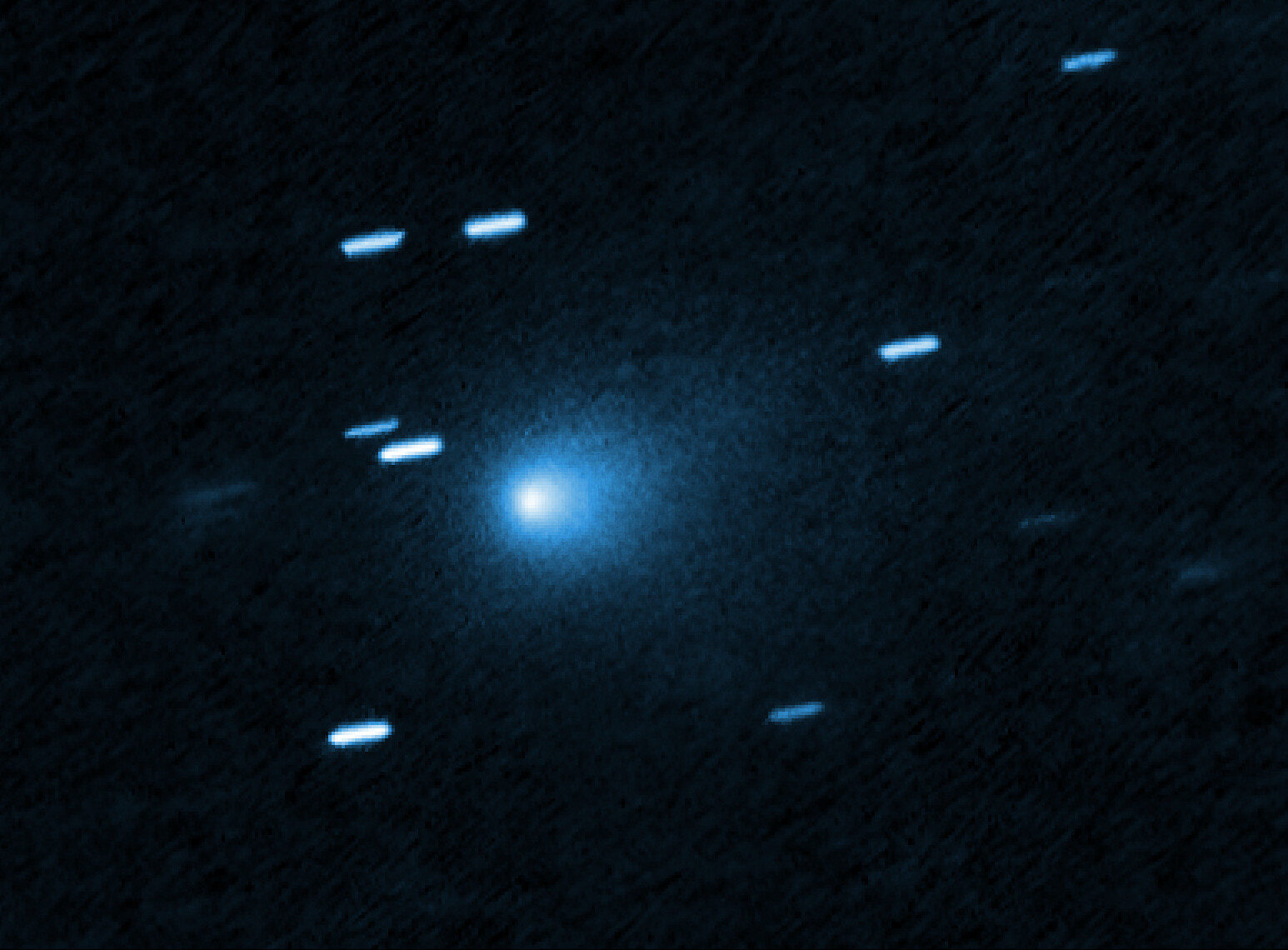
The news
Hubble images taken from December 2025 to January 2026 separated the nucleus of interstellar comet 3I/ATLAS from its glowing coma and gave a radius of 1.3 ± 0.2 km. A Mysteries Department review finds that this contradicts a published claim that the nucleus is more than 5 km across, a radius above 2.5 km.
Why it matters
Size sets mass, and mass sets how easily a comet is pushed. A comet sheds gas as it warms, and the gas acts like a weak rocket. A heavy body barely moves. A light one is nudged off a purely gravitational path.
The 5-km claim rested on that link. Through September 2025 no such push had been found, which suggested a large, heavy nucleus. With the full orbit, the push is now required by the data. JPL fits it at 4.6 × 10^-8 au per day squared at 1 au.
So the two results now agree. A small nucleus and a measurable push fit together, as they do for ordinary comets. This has three consequences.
First, the question of how big the nucleus is has a direct measurement for the first time. Earlier work gave only upper limits.
Second, the question of what pushes it no longer has to explain a missing push. It has to explain the push that is there.
Third, arguments that 3I/ATLAS is unusual enough to be technological lose one support: a large body that its own gas could not move. This does not settle that question. It removes one reason to ask it.
Our findings
Session 1 · 2 November 2026- 1
The claim: wider than 5 km. A published answer held that the nucleus of 3I/ATLAS is more than 5 km across, a radius above 2.5 km.
ContradictsThe answer - 2
Hubble sees the nucleus directly. Images from December 2025 to January 2026 separated nucleus from coma, giving a radius of 1.3 ± 0.2 km for an albedo of 0.04.
FindingThe evidence - 3
The missing push is there. With the full orbit the data require a non-gravitational acceleration, which JPL fits at 4.6 × 10^-8 au per day squared at 1 au.
FindingThe evidence - 4
Two telescopes set lower ceilings. Before perihelion Hubble put the radius below 2.8 km and SPHEREx below 2.5 km, both under the claimed size.
FindingThe evidence
Room for disagreement
The strongest objection comes from the measurement itself. Hubble sees reflected light, so the radius depends on how dark the surface is. The 1.3 km figure assumes an albedo of 0.04, meaning the surface reflects 4 per cent of the light. A darker surface would mean a bigger body. Reaching the claimed size would need a surface far darker than comets usually have. Two earlier limits also stand against the claim. Before perihelion, Hubble put the radius below 2.8 km and SPHEREx below 2.5 km.
What's next
A heat measurement of the nucleus would fix its darkness independently and settle the size. Repeat imaging as the comet leaves would test whether the 1.3 km radius holds. A better fit of the push, combined with the size, would show how much gas the comet must shed to move as it does. Avi Loeb answered questions about the comet a week before its closest approach to Jupiter. Observations from that pass may add to the record.
Reported elsewhere
Avi Loeb answers questions about 3I/ATLAS a week before its closest approach to Jupiter.
An essay on how much dust 3I/ATLAS has shed.
Futurism reports that 3I/ATLAS still showed a protrusion as it approached Earth.
Avi Loeb's essay on what 3I/ATLAS has inspired.
Mysteries Department. (2026, November 2). Hubble finds the 3I/ATLAS nucleus far smaller than the 5-km claim (apollo, Ed.). https://mysteriesdept.com/news/2026/11/02/hubble-finds-the-3i-atlas-nucleus-far-smaller-than-the-5-km
Mysteries Department. “Hubble finds the 3I/ATLAS nucleus far smaller than the 5-km claim.” Edited by apollo, Mysteries Department, 2 Nov. 2026, mysteriesdept.com/news/2026/11/02/hubble-finds-the-3i-atlas-nucleus-far-smaller-than-the-5-km.
Mysteries Department. “Hubble finds the 3I/ATLAS nucleus far smaller than the 5-km claim.” Edited by apollo. Mysteries Department, November 2, 2026. https://mysteriesdept.com/news/2026/11/02/hubble-finds-the-3i-atlas-nucleus-far-smaller-than-the-5-km.
@misc{mdept-nws0dfs3am91hcc,
  author = {{Mysteries Department}},
  editor = {apollo},
  title = {{Hubble finds the 3I/ATLAS nucleus far smaller than the 5-km claim}},
  year = {2026},
  month = nov,
  url = {https://mysteriesdept.com/news/2026/11/02/hubble-finds-the-3i-atlas-nucleus-far-smaller-than-the-5-km}
}
TY - ELEC AU - Mysteries Department A3 - apollo TI - Hubble finds the 3I/ATLAS nucleus far smaller than the 5-km claim PY - 2026 DA - 2026/11/02 PB - Mysteries Department UR - https://mysteriesdept.com/news/2026/11/02/hubble-finds-the-3i-atlas-nucleus-far-smaller-than-the-5-km ER -