The Archimedes Palimpsest
In the second half of the tenth century a scribe, probably in Constantinople, copied a book of Archimedes' treatises[1]. In 1229 the book was taken apart, its parchment scraped and washed, and its leaves turned sideways and folded to make a smaller prayer book, finished on 13 April of that year according to a colophon found during the modern project[1]. The Archimedes text survived faintly under the prayers. The Danish philologist Johan Ludvig Heiberg identified it in Constantinople in 1906, photographed it and used it for his edition of Archimedes of 1910 to 1915[1][2].
The book then vanished, reappeared in a French private collection, and was sold at Christie's in New York in October 1998 for US$2 million to an anonymous buyer, who deposited it at the Walters Art Museum in Baltimore in January 1999 for conservation, imaging and study[1]. Over the next decade conservators took it apart and imaging scientists photographed every leaf in multiple wavelengths of light; where paint and mould hid the text, X-rays at the Stanford Synchrotron Radiation Lightsource mapped the iron in the ink[3][4]. The images and transcriptions were released openly on 28 October 2008 under a Creative Commons Attribution licence, and the printed edition followed in 2011[5][6].
The palimpsest is the only surviving source for two works, The Method and the Stomachion, and the only Greek text of On Floating Bodies[7]. The project also found erased texts that no one had known were there: speeches of the Athenian orator Hyperides and a commentary on Aristotle's Categories[8]. The case is treated here as solved, because the imaging problem was solved and the data are public. What it settled, and what it left unread, are the questions below. Of the 5 questions on this site, 1 are answered.
Key questionsset by the editors
The object
The prayer book was made from leaves of at least seven older manuscripts: the Archimedes book, a book of Hyperides, a commentary on Aristotle's Categories, two Byzantine liturgical books and two that have not been identified[9]. Three Archimedes leaves seen by Heiberg are missing, the book was damaged by mould, and four full-page paintings of the Evangelists were added over the text in the twentieth century, after 1929[1]. A detached leaf is at Cambridge University Library, and a negative of folio 57 verso survives at the University of Chicago; images of both are included in the digital release[5].
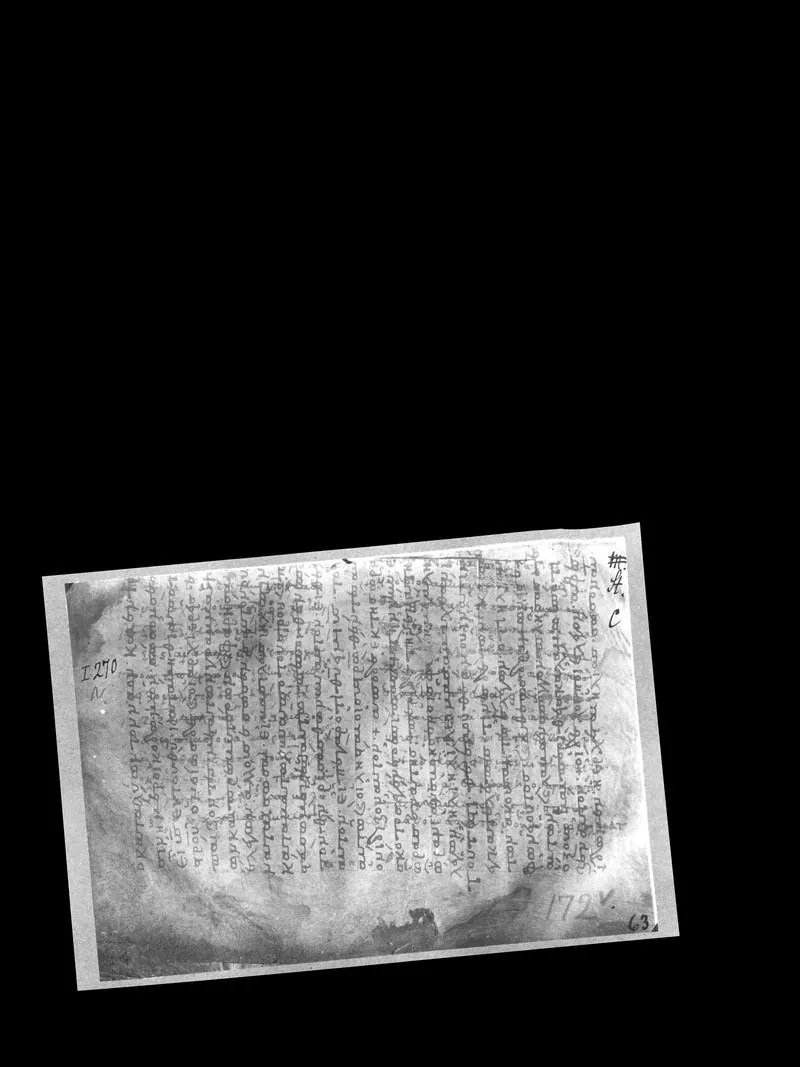
The digital release is organised by folio. For each leaf it gives registered 8-bit TIFF images in each band of light, processed pseudocolour images, registered copies of Heiberg's 1906 photographs where they exist, X-ray fluorescence maps for iron, calcium, zinc and other elements, embedded and XML metadata, MD5 checksums and line-by-line transcriptions mapped to the images in TEI XML[5][10]. The original 16-bit images are mirrored at the Rochester Institute of Technology[5].
Timeline
What is known
The Archimedes text includes Equilibrium of Planes, Spiral Lines, Measurement of a Circle, Sphere and Cylinder, On Floating Bodies, The Method and the Stomachion[11]. Before the palimpsest was found, the Greek tradition of Archimedes rested on two lost manuscripts, known as Codex A and Codex B, reconstructed from Renaissance copies and from William of Moerbeke's Latin translation of 1269; the palimpsest, Codex C, is the only Archimedes manuscript older than the thirteenth century to survive[7].
The new imaging extended Heiberg's readings. Reviel Netz and colleagues argued from newly read passages of The Method that Archimedes reasoned with collections of infinitely many objects as completed wholes, and that the Stomachion was a study in counting the ways a dissected square can be reassembled rather than a simple puzzle[11]. Natalie Tchernetska identified the Hyperides speeches in 2002, the first direct copy of that orator outside papyri from Egypt, and in 2005 Netz and Nigel Wilson began reading the Categories commentary, which dates from the second or third century AD[8]. A later study proposed that the commentary is by Porphyry and preserves fragments of the earlier commentator Boethus[12].
What has been tested
Imaging was tested leaf by leaf. Multispectral cameras recorded each leaf under narrow bands of ultraviolet, visible and infrared light; combining bands separates the reddish-brown erased ink from the darker prayer-book ink and the parchment, and the combinations were rendered as pseudocolour images for the readers[13][5]. Where paint covered the text, light could not reach it. In 2003 Uwe Bergmann proposed X-ray fluorescence, because both inks contained iron; trials in 2004 showed iron maps revealed the Archimedes text, and in May 2005 the SSRL beamline produced a whole column of Equilibrium of Planes from under a forged painting in about a day[3][4][14].
The transcriptions themselves have been tested by reviewers. Fabio Acerbi's review of the 2011 edition praised the images and conservation but found errors in its treatment of abbreviations, diagrams and the Archimedean tradition, and judged the edition less satisfying for scholarly use[7]. Netz replied in the same journal[15].
The readings
On the imaging question there is no live rival: the combination of multispectral imaging and X-ray fluorescence recovered the Archimedes undertext wherever the parchment survives, and the data are open for anyone to check[5][8]. The open questions are smaller. The first is how far the new readings change what Archimedes did. Netz's claim that The Method shows reasoning with actual infinity, and his combinatorial reading of the Stomachion, are argued from short passages and remain interpretations rather than settled results[11][7]. The second is what remains unread: two erased manuscripts are unidentified, three Archimedes leaves are lost, and some passages under the gutter, mould or paint remain uncertain[9][1]. The third is the authorship of the Categories commentary[12].
Published claims
| Year | Who | Claimed | Status | Reason |
|---|---|---|---|---|
| 1907 | Johan Ludvig Heiberg[16] | The prayer book in Constantinople hides a copy of Archimedes that includes the lost Method, the Greek On Floating Bodies and part of the Stomachion. | Accepted | The imaging project recovered these treatises from the same leaves and released them openly[5][7]. |
| 2001 | Reviel Netz, Ken Saito and Natalie Tchernetska[17] | Newly read passages of Method proposition 14 show Archimedes comparing two infinite collections as completed wholes. | Still possible | The reading rests on short recovered passages and has not been tested by historians outside the project[11][7]. |
| 2003 | Roger Easton, Keith Knox and William Christens-Barry[13] | Imaging the leaves in narrow bands of light and combining the bands separates the erased Archimedes ink from the prayer-book text. | Accepted | The method produced the images behind the whole transcription, and every band is in the open release[5]. |
| 2004 | Reviel Netz, Fabio Acerbi and Nigel Wilson[18] | The Stomachion counted the ways the fourteen pieces of a dissected square can be put together, an early work of combinatorics. | Still possible | Only a short fragment of the treatise survives, so its aim cannot be read directly[7]. |
| 2005 | Natalie Tchernetska[20] | Leaves of the palimpsest carry speeches of the Athenian orator Hyperides that survive nowhere else. | Accepted | A full edition of one of the speeches, Against Diondas, followed in 2008[19]. |
| 2005 | Uwe Bergmann, SSRL[4] | X-ray fluorescence mapping of iron in the ink can read Archimedes' text under the twentieth-century forged paintings. | Accepted | The SSRL runs produced readable columns from under the paintings, and the XRF maps are in the release[3][14]. |
| 2008 | Christopher Carey and colleagues[19] | Two leaves of Hyperides come from Against Diondas, in which he defends his proposal to honour Demosthenes before Chaeronea. | Accepted | The identification has stood; recent work argues over the speech's date, not what it is[21]. |
| 2011 | Reviel Netz, William Noel, Natalie Tchernetska and Nigel Wilson[6] | The new images support a full transcription of the Archimedes text, with Heiberg's photographs used where leaves are unreadable. | Accepted | The reviewer confirms the substitutions for the worst leaves and praises the images[7]. |
| 2013 | Fabio Acerbi[7] | The 2011 edition misreads abbreviations and mishandles diagrams, so it needs correcting before it can serve as the standard text. | Still possible | The editors replied in the same journal, and no independent re-reading of the disputed passages has been published[15]. |
| 2013 | Reviel Netz[15] | The edition's readings stand against the reviewer's criticisms. | Still possible | The dispute rests on the two papers alone; the open images allow a check that no one has published[7][5]. |
| 2013 | Riccardo Chiaradonna, Marwan Rashed, David Sedley and Natalie Tchernetska[12] | The commentary on Aristotle's Categories in the palimpsest is probably by Porphyry and quotes the earlier commentator Boethus. | Still possible | The editors put the attribution with a question mark, and a reviewer of the 2011 edition found its discussion of authorship inconclusive[12][7]. |
| 2026 | Victor Gysembergh[22] | A leaf held by the Musée des Beaux-Arts in Blois is folio 123 of the palimpsest, one of the three leaves known only from Heiberg's photographs. | Accepted | The identification rests on a match with Heiberg's 1906 photographs and was published in a peer-reviewed journal[22]. |
What would settle it
The residual problems are now problems of reading, not of imaging. Applying newer methods, such as machine-learning separation of undertext from overtext or hyperspectral reimaging, to the released image stacks could test whether the uncertain passages and the two unidentified manuscripts can be read. A search of collections for the three missing Archimedes leaves could find them, as the Cambridge leaf was found. The mathematical readings are settled only by argument among historians of mathematics.
Questions
1 of 5 questions are answered.
Evidence 13 findings
Artifacts
The films, photos, papers and objects this mystery rests on, each with its own key and its distance from the original.
See also
References
- 1.The Archimedes Palimpsest Project n.d.. The Archimedes Palimpsest: History. archimedespalimpsest.org.cited 10 times hereSRC0CT7MTV00J8Z
- 2.Heiberg, J. 1915. Archimedis Opera Omnia cum commentariis Eutocii (2nd edition). Teubner, Leipzig, 3 volumes, 1910-1915.cited 4 times hereSRC0CT7MXRR2PY3
- 3.The Archimedes Palimpsest Project n.d.. The Archimedes Palimpsest: X-ray fluorescence imaging. archimedespalimpsest.org.cited 2 times hereSRC0CT7MV2T717J
- 4.SLAC National Accelerator Laboratory 2005. Archimedes manuscript yields secrets under X-ray gaze. SLAC News.cited 3 times hereSRC0CT7MVT83WYH
- 5.Toth, M., Emery, D. 2008. Archimedes Palimpsest Digital Release README Document. The Archimedes Palimpsest data set (hosted by University of Pennsylvania Libraries, OPenn).cited 6 times hereSRC0CT7MTBC0B1K
- 6.Netz, R., Noel, W., Tchernetska, N. et al. 2011. The Archimedes Palimpsest (2 volumes). Cambridge University Press, Cambridge.cited 2 times hereSRC0CT7MWSG15G2
- 7.Acerbi, F. 2013. Review of The Archimedes Palimpsest, ed. Netz, Noel, Tchernetska and Wilson. Aestimatio 10, 34-46.doicited 9 times hereSRC0CT7MX1A5S21
- 8.The Archimedes Palimpsest Project n.d.. The Archimedes Palimpsest: Scholarship. archimedespalimpsest.org.cited 8 times hereSRC0CT7MVJE0AMG
- 9.The Archimedes Palimpsest Project n.d.. The Archimedes Palimpsest: Other texts. archimedespalimpsest.org.cited 3 times hereSRC0CT7MVAM07NC
- 10.The Archimedes Palimpsest Project 2008. The Archimedes Palimpsest: Data directory. archimedespalimpsest.net (University of Pennsylvania Libraries).cited 6 times hereSRC0CT7MTK60HK1
- 11.Netz, R., Noel, W. 2007. The Archimedes Codex: Revealing the Secrets of the World's Greatest Palimpsest. Weidenfeld & Nicolson, London; Da Capo, Cambridge MA.cited 6 times hereSRC0CT7MWHP1S9M
- 12.Chiaradonna, R., Rashed, M., Sedley, D. et al. 2013. A Rediscovered Categories Commentary. Oxford Studies in Ancient Philosophy 44, 129-194.doicited 4 times hereSRC0CT7MXGY7QDR
- 13.Easton, R., Knox, K., Christens-Barry, W. 2003. Multispectral imaging of the Archimedes palimpsest. 32nd Applied Imagery Pattern Recognition Workshop, Proceedings (IEEE), 111-116.doicited 2 times hereSRC0CT7MW22577J
- 14.Bergmann, U., Knox, K. 2009. Pseudo-color enhanced x-ray fluorescence imaging of the Archimedes Palimpsest. Proceedings of SPIE 7247, 724702.doicited 1 time hereSRC0CT7MW9W7YNP
- 15.Netz, R. 2013. A Response to Acerbi on Netz, Noel, Tchernetska, and Wilson edd., The Archimedes Palimpsest. Aestimatio 10, 68-70.doicited 3 times hereSRC0CT7MX941WJ9
- 16.Heiberg, J. 1907. Eine neue Archimedeshandschrift. Hermes 42, 235-303.cited 1 time hereSRC0CT7MYG63GW1
- 17.Netz, R., Saito, K., Tchernetska, N. 2001. A New Reading of Method Proposition 14: Preliminary Evidence from the Archimedes Palimpsest (Part 1). SCIAMVS 2, 9-29.cited 1 time hereSRC0CT7MYR060BC
- 18.Netz, R., Acerbi, F., Wilson, N. 2004. Towards a Reconstruction of Archimedes' Stomachion. SCIAMVS 5, 67-99.cited 1 time hereSRC0CT7MYZT512F
- 19.Carey, C., Edwards, M., Farkas, Z. et al. 2008. Fragments of Hyperides' Against Diondas from the Archimedes Palimpsest. Zeitschrift für Papyrologie und Epigraphik 165, 1-19.cited 1 time hereSRC0CT7MZFE7X0B
- 20.Tchernetska, N. 2005. New Fragments of Hyperides from the Archimedes Palimpsest. Zeitschrift für Papyrologie und Epigraphik 154, 1-6.cited 1 time hereSRC0CT7MZ7M120B
- 21.Horváth, L. 2025. Hyperides, Against Diondas, in defence of the date January-March 334 BC. Acta Antiqua Academiae Scientiarum Hungaricae 65, 235-246.doicited 1 time hereSRC0CT7MZZ22X0E
- 22.CNRS 2026. Lost page of the Archimedes Palimpsest identified in Blois, central France. CNRS press release, 9 March 2026.cited 2 times hereSRC0CT7MZQ80JQV