The Rohonc Codex
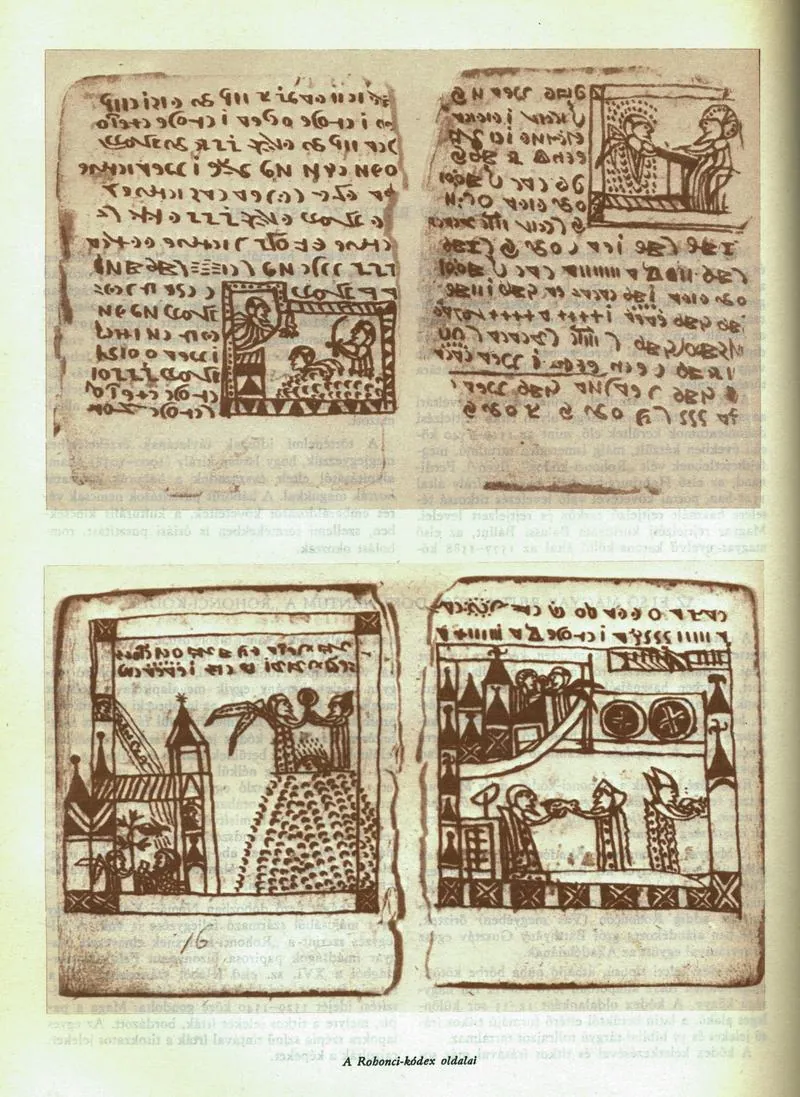
The Rohonc Codex is a duodecimo paper book of 224 leaves, about 12 by 10 cm, in the Library of the Hungarian Academy of Sciences in Budapest (MS K 114). Each page carries nine to fourteen lines of signs written from right to left, and 87 ink drawings show scenes from the Gospels and other Christian subjects: the Annunciation, the entry into Jerusalem, the Crucifixion, figures in conversation[1][2]. The paper's watermark places its manufacture in northern Italy around 1530 to 1540, which is the earliest the text can have been written; the latest is 1838, when the book arrived at the Academy with the 30,000-volume library of Count Gusztáv Batthyány from his house at Rohonc, now Rechnitz in Austria[1][3].
Nobody could read it. Nineteenth-century Hungarian scholars, having first hoped for an early Hungarian text, concluded it was a forgery by Sámuel Literáti Nemes (1794–1842), an antiquarian known for faked documents; Benedek Láng's 2010 review found no evidence connecting Nemes to the book and noted that his forgeries were short and imitated real scripts, which this does not[1][4]. Readings as Hungarian, as Daco-Romanian history and as Sanskrit were published between 1892 and 2005; none supplied a consistent sign table and each read the pictures through its own prior assumptions[1][5]. Láng's conclusion was that the book is probably a designed system, a code in which signs stand for words or notions rather than a cipher on letters, and that its content is probably a religious text such as a life of Christ or a prayer book[1].
In 2018 Király and Tokai published in Cryptologia a partial decipherment that fits that description. They reconstructed the original page order, identified a numeral system, read dates in a calendar counted from the Creation and the Ascension, and gave word-by-word readings of passages including the Lord's Prayer and the parable of the talents, with the text understood as a Christian narrative and prayer collection written in a code whose signs stand for words[6]. Their 2023 follow-up dates the writing to 1593 from a colophon and surveys its theology, which is medieval Catholic with Italian trecento influence in the pictures[2]. The dictionary and grammar on which the readings rest have not been published, and the authors say the author's spoken language is still unidentified[7][2]. Of the 4 questions on this site, 0 are answered. The most likely answer to “Is the Király–Tokai decipherment correct?”, not yet confirmed: the codicology, numerals and some passages are right, but the word-level readings are over-fitted and much of….
Key questionsset by the editors
The object
The codex is bound, small enough to hold in one hand, and written in ink on paper of good quality. The text uses about a hundred frequent signs and several hundred rare ones; many are built from a small set of strokes and some resemble letters or numerals, but there is no word spacing of the ordinary kind[3][1]. The drawings, 87 in all, are in a style that Király attributes to a Central European author who had seen Italian fourteenth-century art, with some Northern Gothic features[2]. The book shows signs of later handling: misplaced bifolios, later foliation and marginalia by owners who could not read it[8]. The library holds a microfilm (MF 1173/II) and page images are in circulation, including a public-domain set on Wikimedia Commons; the Academy library is the rights holder for new photography[3].
Timeline
What is known
The physical facts are settled: the paper is 1530s Italian, the book was in the Batthyány library before 1838, and the pictures are Christian[1]. The writing runs right to left and top to bottom, which earlier would-be decipherers sometimes ignored[1]. Statistical work by Ottó Gyürk and Miklós Locsmándi in the twentieth century found the sign patterns too repetitive for a simple substitution of letters and led both to suspect a constructed language or code rather than a natural language written in cipher[1]. Király and Tokai's 2018 paper adds a reconstructed page order, a numeral system in which numbers are built from sign units with a distinct sign for six, and a dating scheme in which large numbers are years counted from the Creation (so that 5166 is the birth of Christ) and 1560 counts from the Ascension[6]. Their 2023 paper reads a colophon as giving 1560 years after the Ascension, which they equate to 1593, and reports that ink analysis is consistent with the sixteenth century[2].
What has been tested
The forgery hypothesis fails on the evidence available: no document connects Nemes to the codex, the chronology of his life sits badly with the Batthyány provenance, his known forgeries are short and imitate existing scripts, and the codex does not pose as old Hungarian[1]. The Hungarian (Némäti 1892, Nyíri 1996), Romanian (Enăchiuc 2002) and Sanskrit (Singh 2004–05) readings fail for structural reasons: inconsistent sign-to-letter mappings, readings that change the direction of the text, and decodings that could not be reproduced by others from a published table[1][5].
The Király–Tokai decipherment has been tested in public discussion rather than by formal replication. Nick Pelling's review judged the codicology strong and the passage readings, especially the parable of the talents, the most persuasive part, but found the numeral and reversed-digit dating scheme hard to accept, noted that the talents reading gives different numbers from Matthew 25, and objected that word-level readings never reach letters, grammar or the identity of the language[8]. The authors themselves acknowledged at HistoCrypt 2020 that the 2018 readings drew criticism because the dictionary was unpublished and the language unidentified, and said they had since outlined the grammar and would put the dictionary online[7]. As of their 2023 paper the dictionary and grammar were still in preparation and a companion website for checking readings had been released[2].
The readings
Three accounts remain in play. The first, now the leading one, is that the codex is a sixteenth-century Christian text, a life of Christ with prayers and legends, written in a code of word-signs devised by its author, and that Király and Tokai have read a substantial part of it correctly[6][2]. Under this account the open questions are the language the author spoke, the rules of the code, and who and where the author was. The second is Láng's more cautious position: a designed system, probably a code or an artificial "universal character", with religious content, but not yet read in a way that can be independently checked[1]. The third is a hoax of some kind, which would have to explain why a hoaxer produced 448 pages of internally consistent text with numerals, dates and a page order that can be reconstructed; no modern researcher argues for it[1][6].
Published claims
| Year | Who | Claimed | Status | Reason |
|---|---|---|---|---|
| 2010 | Benedek Láng[1] | No evidence connects Sámuel Literáti Nemes to the codex, and the forgery charge does not fit his known work, which was short and imitated real scripts. | Accepted | Nothing found since has linked Nemes to the book, and ink analysis is reported as consistent with the sixteenth century[2]. |
| 2010 | Benedek Láng[1] | The codex is a designed code in which signs stand for words or notions rather than a cipher on letters, and its content is probably a religious text. | Most likely | The 2018 decipherment reads it in exactly this way, though that reading has not been independently replicated[6][8]. |
| 2018 | Levente Zoltán Király and Gábor Tokai[6] | The codex is a Christian narrative and prayer collection in a code of word-signs, with a numeral system and dates counted from the Creation and the Ascension, and passages such as the Lord's Prayer can be read word by word. | Still possible | Several passage readings are persuasive, but the dictionary and grammar remain unpublished, so no one else can test the reading on new pages[8][7]. |
| 2018 | Nick Pelling[8] | The Király–Tokai codicology is strong and the parable of the talents reading persuasive, but the numeral and reversed-digit dating scheme is hard to accept and the readings never reach letters or grammar. | Still possible | A detailed public critique that the authors have answered only in part; the test it asks for waits on the unpublished dictionary[7][2]. |
| 2019 | Benedek Láng[5] | The Hungarian, Daco-Romanian and Sanskrit readings of the codex fail for structural reasons: wrong reading direction, the same signs read as different letters, and no published sign table. | Accepted | No defender of those readings has supplied a consistent table, and the 2018 word-sign reading departs from all of them[6]. |
| 2020 | Levente Zoltán Király and Gábor Tokai[7] | The grammar of the code can now be outlined, but the language the author spoke has not been identified. | Still possible | As of 2023 the grammar and dictionary were still in preparation and the language question unresolved[2]. |
| 2023 | Levente Zoltán Király[2] | A colophon dates the writing to 1593, the theology is medieval Catholic drawing on texts such as the Golden Legend, and the ink is consistent with the sixteenth century. | Still possible | The date depends on the Király–Tokai calendar reading, and the Academy library has published no ink or binding study[8][3]. |
What would settle it
Publication of the full sign dictionary and grammar, with the reading of every page, would let others test the decipherment line by line; the authors have promised both[7][2]. Identification of the source texts the author drew on, which Király suggests include the Golden Legend and medieval mystery plays, would allow a direct comparison of passages[2]. On the object, ink and binding analysis by the Academy library, and a full art-historical study of the drawings, which has not been done, would narrow the date and place[3][2].
Questions
0 of 4 questions are answered.
Evidence 19 findings
Artifacts
The films, photos, papers and objects this mystery rests on, each with its own key and its distance from the original.
See also
References
- 1.Láng, B. 2010. Why Don't We Decipher an Outdated Cipher System? The Codex of Rohonc. Cryptologia.doicited 22 times hereSRC0D8MRPJT4ZVJ
- 2.Király, L. 2023. A Rohonci kódex teológiai karaktere. Közismert és idioszinkratikus mozzanatok azonosításával egy rejtélyes szerző kiléte felé. Hagyomány, Identitás, Történelem 2022, ed. Réka Kiss and Gábor Lányi, KRE HTK Egyháztörténeti Kutatóintézet, Budapest, 363–376.doicited 10 times hereSRC0D0E2W8A36DK
- 3.Schmeh, K. 2023. No 39: The Manuscript That Nobody Can Read (Manuscript of the Month). Centre for the Study of Manuscript Cultures, University of Hamburg.cited 4 times hereSRC0D0E2WZR57PA
- 4.Láng, B. 2021. The Rohonc Code: Tracing a Historical Riddle. Penn State University Press.cited 1 time hereSRC0D0E2W0G3X38
- 5.Láng, B. 2019. Dead Ends in Breaking an Unknown Cipher: Experiences in the Historiography of the Rohonc Codex. Proceedings of the 2nd International Conference on Historical Cryptology (HistoCrypt 2019), Linköping Electronic Conference Proceedings 158.cited 3 times hereSRC0D0E2VRP19P2
- 6.Király, L., Tokai, G. 2018. Cracking the code of the Rohonc Codex. Cryptologia.doicited 10 times hereSRC0D8MRGQA36Z9
- 7.Király, L., Tokai, G. 2020. The language of the Rohonc Codex (HistoCrypt 2020 workshop announcement). HistoCrypt 2020, Uppsala University.cited 6 times hereSRC0D0E2WG41TCX
- 8.Pelling, N. 2018. Rohonc Codex: cracked by Király and Tokai? (Cipher Mysteries). ciphermysteries.com.cited 5 times hereSRC0D0E2WQY1QE7