The Dorabella cipher
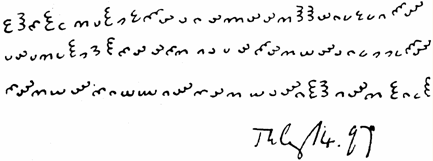
In July 1897 Edward and Alice Elgar stayed for a few days with the family of the Reverend Alfred Penny at Wolverhampton. On 14 July, back in Great Malvern, Alice wrote to thank Mrs Penny; inside the letter was a slip in Edward's hand addressed on the back to "Miss Penny", covered with 87 small marks made of one, two or three semicircles[1][2]. Dora Penny, then 23, kept it for forty years. Elgar later gave her the tenth of his Enigma Variations (1899), "Dorabella".
Dora printed the note as an appendix to her 1937 memoir: "I have never had the slightest idea what message it conveys; he never explained it and all attempts to solve it have failed. Should any reader of this book succeed in arriving at a solution it would interest me very much to hear of it"[1]. The original has since been lost. Eighty-nine years after that appeal there is still no accepted reading[3][4]. Of the 3 questions on this site, 0 are answered. The most likely answer to “What kind of message is the Dorabella note?”, not yet confirmed: english in Elgar's alphabet with irregularities (phonetic spelling, abbreviations, private words, mirrored….
Key questionsset by the editors
The object
The note has three lines of 29, 31 and 27 symbols. Each symbol is one, two or three nested semicircles whose open side faces one of eight directions at 45-degree steps, giving 24 possible symbols, of which 20 appear; a small dot follows the fifth symbol of the last line[4][2]. The orientation of some symbols is ambiguous in the facsimile, and published transcriptions differ at a few places; Hauer and colleagues built a majority transcription from five, which this project uses[4][5].
Elgar used the same symbols elsewhere. In April 1886 he pencilled 18 of them into a Crystal Palace concert programme beside a musical example from Liszt's Les Préludes; they appear again in an exercise book of about 1920, with diagrams like clock faces; and on a card headed "Cryptogram" that belongs with his working of a cipher challenge printed in the Pall Mall Magazine in 1896[6][7][8]. The programme and the exercise book were reported in 2007 to be at the Elgar Birthplace Museum[7].
Timeline
What is known
Elgar was a lifelong maker of puzzles, puns and ciphers; Dora's memoir opens its appendix by saying so, and his 1896 work on the Pall Mall challenge shows he could break a cipher as well as make one[1][6]. The exercise-book pages are the strongest clue to the system: a commenter on Nick Pelling's site reports that they pair the semicircle alphabet with test phrases such as "A very old cipher", "Do you go to London" and "Marco Elgar", which suggests a key that assigns letters to the symbols in a fixed rotational order[9]. If so, the system is a simple alphabet of Elgar's devising, and the difficulty lies in the message, not the cipher.
The frequencies of the 20 symbols resemble a letter distribution in a short English text[10]. The Liszt fragment has been read as "GETS YOU TO JOY, AND HYSTERIOUS" (Anthony Thorley, 1977), a reading Jerrold Northrop Moore printed in his biography of Elgar but which others find unconvincing[7][8].
What has been tested
Klaus Schmeh applied Helen Fouché Gaines's manual methods for monoalphabetic substitution (vowel detection, digram analysis, consonant lining) to the cipher and to a control text of the same length. Vowel detection worked well on the control and gave candidate vowels for Dorabella, but no reading[10].
Hauer, Choi, Sundar, Hindle, Smallwood and Kondrak ran state-of-the-art automatic solvers that reliably break 87-letter English substitutions; none produced readable text from Dorabella. A ciphertext language identifier ranked English as the most likely underlying language; character-model classifiers placed the cipher closer to language than to music; and Dorabella has 13 pairs of mirrored symbols where random English enciphered with these symbols has 3.6 on average, which happens by chance about one time in a thousand. They read the mirrored pairs as structure, perhaps a way of writing double letters, and as evidence against a meaningless hoax[4]. Viktor Wase showed that decipherment algorithms solve English and Latin substitutions as short as Dorabella and fail on Dorabella itself, and concluded it is not a monoalphabetic substitution in either language[11].
In 2007, for the 150th anniversary of Elgar's birth, the Elgar Society ran a Dorabella competition. Several entries came in and none was accepted: entries that matched symbols to letters "invariably ended up with a fairly arbitrary sequence of letters" read as "a disconnected chain of bizarre utterances"[2].
The readings
Eric Sams proposed in 1970 a substitution reading in which phonetic shorthand turns 87 symbols into 109 letters: "Starts: Larks! It's chaotic, but a cloak obscures my new letters..."[12]. Later claims include simple substitutions with nulls (Richard Henderson, 2011; Tim Roberts, about 2012) and a reading by Wayne Packwood (2020) that rearranges the text by its dots and shifts each symbol's value without a stated rule[2][13]. Each needs free choices that allow other readings equally well, and none has been accepted[3][9].
Three broader readings remain. The note is English in Elgar's alphabet but not a plain substitution: it may use phonetic spelling, abbreviations, private jokes, double letters marked by mirroring, or a reading order other than line by line[4][12]. It encodes music: the eight orientations as notes of a scale and the arc count as a modifier, a reading proposed by Javier Atance and tested, without support, by Hauer and colleagues[2][4][5]. Or it means nothing that could be decoded, a joke made to look like a cipher; the non-random mirroring weighs against this[4].
Published claims
| Year | Who | Claimed | Status | Reason |
|---|---|---|---|---|
| 1937 | Dora Powell (née Penny)[1] | The note is a message in Elgar's cipher that she never read and he never explained. | Accepted | Its statistics look like language rather than random marks, and no reading has been accepted since[4][3]. |
| 1970 | Eric Sams[12] | The note is a substitution of English in which phonetic shorthand expands 87 symbols into 109 letters, beginning "Starts: Larks!". | Disputed | The reading needs free choices that allow other texts equally well, and cryptologists judge that it makes little sense[3][9]. |
| 2018 | Klaus Schmeh[10] | Manual methods for simple substitution pick out likely vowels in Dorabella, as they do in an English control text of the same length. | Disputed | Automatic solvers that break English and Latin substitutions of the same length produce no readable text from it[4][11]. |
| 2020 | Wayne Packwood[13] | Rearranged by its dots and with each symbol's value shifted, the note reads "A woman is like chess" with a hidden "rats". | Disputed | The shifts follow no stated rule, so the method can produce other texts as easily, and no specialist has accepted it[2]. |
| 2021 | Bradley Hauer and colleagues[4] | The note is closer to language than to music, most likely English, and its 13 mirrored symbol pairs are structure, not chance, though it is no simple substitution. | Most likely | Wase's tests agree that it is not a plain substitution, but no irregular reading has yet produced a text[11]. |
| 2023 | Viktor Wase[11] | Dorabella is not a monoalphabetic substitution of English or Latin, because solvers that break such ciphers of the same length fail on it. | Accepted | It agrees with the independent solver tests of Hauer and colleagues[4]. |
What would settle it
A key in Elgar's hand that maps his semicircle alphabet to letters, tested on the Liszt fragment and the exercise-book phrases, and then producing a sensible English text from Dorabella without further free choices, would settle it. High-resolution images of the exercise book, the Cryptogram card and the 1886 programme, published with transcriptions, are the most useful single step; the 1937 facsimile is the only image of Dorabella itself, so any lost original resurfacing would also resolve the ambiguous orientations.
Questions
0 of 3 questions are answered.
Evidence 16 findings
Artifacts
The films, photos, papers and objects this mystery rests on, each with its own key and its distance from the original.
See also
References
- 1.Powell, M. 1937. Edward Elgar: Memories of a Variation. Oxford University Press, London.doicited 8 times hereSRC0CRZAG2A7KEB
- 2.Wikipedia contributors n.d.. Dorabella Cipher. Wikipedia.cited 10 times hereSRC0CRZAK7W5CAT
- 3.Schmeh, K. 2017. The Top 50 unsolved encrypted messages: 26. The Dorabella Cryptogram. Klausis Krypto Kolumne (scienceblogs.de), 3 August 2017.cited 3 times hereSRC0CRZAJ0T38SC
- 4.Hauer, B., Choi, C., Sundar, A. et al. 2021. Experimental Analysis of the Dorabella Cipher with Statistical Language Models. Proceedings of the 4th International Conference on Historical Cryptology (HistoCrypt 2021), Linköping Electronic Conference Proceedings 183: 70-79.doicited 10 times hereSRC0CRZAGSR16WS
- 5.Hauer, B., Choi, C., Hindle, A. et al. 2021. Dorabella Cipher as Musical Inspiration. Proceedings of the Workshop on Speech and Music Processing (SMP-2021), pages 33-38.cited 2 times hereSRC0CRZAH1J0G38
- 6.Bauer, C. 2017. Unsolved! The History and Mystery of the World's Greatest Ciphers from Ancient Egypt to Online Secret Societies. Princeton University Press (ISBN 978-0691167671).doicited 6 times hereSRC0CRZAHS00E5Y
- 7.Hartmeier, D. 2017. Clues (or red herrings) to the Dorabella Cipher. benzedrine.ch.cited 6 times hereSRC0CRZAJR87G5P
- 8.Schmeh, K. 2018. Two more unsolved cryptograms created by Edward Elgar. Klausis Krypto Kolumne (scienceblogs.de), 13 July 2018.cited 5 times hereSRC0CRZAJ8M69J2
- 9.Pelling, N. n.d.. Dorabella Cipher. Cipher Mysteries.cited 5 times hereSRC0CRZAJGE1ZDJ
- 10.Schmeh, K. 2018. Examining The Dorabella Cipher with Three Lesser-Known Cryptanalysis Methods. Proceedings of the 1st International Conference on Historical Cryptology (HistoCrypt 2018), Uppsala, Linköping Electronic Conference Proceedings 149: 145-152.cited 5 times hereSRC0CRZAGHY464C
- 11.Wase, V. 2023. Dorabella unMASCed - the Dorabella Cipher is not an English or Latin Mono-Alphabetical Substitution Cipher. Cryptologia (online 20 November 2023; 49: 15-24).doicited 4 times hereSRC0CRZAHH64CP5
- 12.Sams, E. 1970. Elgar's Cipher Letter to Dorabella. The Musical Times 111(1524): 151-154.doicited 6 times hereSRC0CRZAGA45BG6
- 13.Packwood, W. 2020. Elgar as cryptographer - Tuning and Turing. Musical Opinion 143: 34-37.doicited 1 time hereSRC0CRZAK022C12