The Copiale cipher
The Copiale cipher is a bound manuscript of 105 pages, written in ink on good paper with two watermarks, in a script made up of about ninety symbols: Roman and Greek letters, letters with diacritics, and abstract, zodiacal and alchemical signs. Only two short pieces of plain text appear, an owner's mark "Philipp 1866" and the note "Copiales 3" on the last page, which gave the document its name[1]. It surfaced after the Cold War in the archive of the Academy of Sciences in East Berlin and is now in a private collection[2]. The paper has been dated to about 1760 to 1780, the project site gives about 1730, and the historian Andreas Önnerfors has proposed the 1740s from the handwriting[3][1].
In 2011 Kevin Knight of the University of Southern California, with Beáta Megyesi and Christiane Schaefer of Uppsala, read it. They transcribed the whole manuscript into machine-readable form, tried and discarded the idea that the Roman letters carried the message, tested candidate languages statistically, and found that the abstract symbols were a homophonic substitution cipher for German, with the Roman letters serving as nulls that mark word spaces; the first phrases to emerge were "ceremonies of initiation" and "secret section"[4][2]. The plaintext is the law book of a society calling itself the Oculists, with its initiation ritual, its signs and its rules, and, from page 27, a description of the rituals of high Masonic degrees[5][6].
The case is on this site as a control: a document that looked as opaque as the unsolved ones and yielded to a method that can be stated and repeated. Its text, decipherment and translation are published in full, and a related archive of the Oculists at Wolfenbüttel confirms the reading from outside[1]. Of the 4 questions on this site, 2 are answered.
Key questionsset by the editors
The object
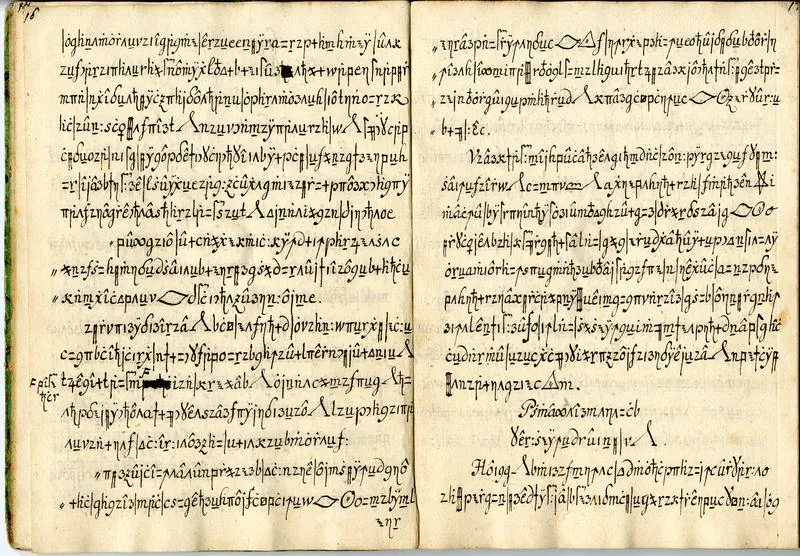
The manuscript is a small bound book in green and gold brocade paper, 105 pages of text in a neat hand, with no illustrations[1][2]. The symbol inventory is about ninety types. Besides the unaccented Roman letters, which occur throughout, there are Roman letters with diacritics, Greek letters, and abstract signs including astrological and alchemical symbols; the text runs left to right in lines with no visible word breaks[4]. The Uppsala and Stockholm project pages publish page images of the whole book, the covers and both watermarks, and the full transcription[1].
Timeline
What is known
The decipherment is established and independently checkable. The cipher is a homophonic substitution for German: each plaintext letter can be written by one of several symbols, common letters having more alternatives, which flattens the frequency distribution that a simple substitution would leave; the unaccented Roman letters stand for nothing and mark the spaces between words; some symbols stand for common digraphs or suffixes[4][5]. The German is of the eighteenth century and the content is the "Gesetzbuch" of the Oculists: the degrees of membership, the ceremony of admission with its blindfold, eye tests and oaths, the signs and words of recognition, and the duties of officers[5][1]. The society was based at Wolfenbüttel; a separate Oculist archive in the Staatsarchiv Wolfenbüttel contains material in the same cipher, which the team transcribed and deciphered in 2012 and published alongside the Copiale text[1]. Önnerfors's reading of the society's insignia, cats watching mice, and of its interest in Masonic ritual suggests an order that observed Freemasonry from inside, whether as a rival, an offshoot or an intelligence operation[6].
What has been tested
The method is the point. The team began with no knowledge of the language. Their first hypothesis, that the Roman letters were the cipher text and the other symbols decoration, was tested by treating the Roman letters as a substitution cipher for German and failed. They then considered the abstract symbols as the carrier and used expectation-maximisation decipherment against language models for some eighty candidate languages, scoring how well each language explained the symbol sequence under an unknown substitution; German scored best. Treating the Roman letters as spaces and allowing several symbols per letter produced readable German, and the first clear phrases confirmed the hypothesis[4][2]. The reading was then checked the way a decipherment should be: every page was read, the German was grammatical throughout, the content was coherent and historically specific, and a second corpus in the same cipher from Wolfenbüttel read correctly with the same key[5][1].
The readings
No rival reading exists. The questions that remain are historical. The date of the manuscript is bracketed between about 1730 and 1780 by paper and hand, and the "Copiales 3" note implies it is a copy, so the original composition may be earlier than the manuscript[1][3]. The Oculists' purpose is argued between a Masonic lodge under another name, a society that collected and recorded Masonic secrets, and an ophthalmological fraternity whose eye imagery was more than metaphor; the ritual's eye tests and the Wolfenbüttel archive are the evidence[6][5]. The identity of the owner "Philipp" of 1866 and the route from Wolfenbüttel to the Berlin academy are not documented[1].
Published claims
| Year | Who | Claimed | Status | Reason |
|---|---|---|---|---|
| 2011 | Kevin Knight, Beáta Megyesi and Christiane Schaefer[4] | The manuscript is a homophonic substitution cipher for German in which the unaccented Roman letters mark spaces and the other symbols carry the text. | Accepted | The published key reads every page as grammatical German and also reads the Oculists' own papers at Wolfenbüttel[1]. |
| 2011 | Kevin Knight, Beáta Megyesi and Christiane Schaefer[4] | Statistical decipherment against language models for about eighty languages can identify the plaintext language with no prior knowledge of the content. | Accepted | German scored best and the first phrases came out of the statistics before the society was identified[2]. |
| 2011 | University of Southern California[2] | The secret society behind the text had a particular interest in eye surgery and ophthalmology, though its members were apparently not eye doctors. | Disputed | Later readings treat the eye tests and imagery as ritual symbolism within a Masonic setting, though the membership has not been studied[5][6]. |
| 2012 | Kevin Knight, Beáta Megyesi and Christiane Schaefer[5] | The plaintext is the law book of the Oculists, with their initiation ritual, and from page 27 the rituals of high Masonic degrees. | Accepted | Every page is published in German and English, and the content matches a society documented at Wolfenbüttel[1]. |
| 2012 | Beáta Megyesi and colleagues (Uppsala)[1] | The Oculist archive in the Staatsarchiv Wolfenbüttel is written in the same cipher and reads correctly with the Copiale key. | Accepted | The transcription and decipherment are published, though part of the extra material is marked as uncorrected[1]. |
| 2012 | Andreas Önnerfors[6] | The Oculists observed Freemasonry from inside, as their insignia of cats watching mice suggests. | Still possible | Reported in the press and not yet tested against the Wolfenbüttel membership records[6]. |
What would settle it
The cipher is settled. The historical questions would be settled by the Wolfenbüttel archive, which names members and dates, and by the Academy's accession records for the manuscript's provenance[1][5]. For the site's purposes the case shows the tests a claimed decipherment of any of the unsolved documents must pass: a stated method, a published key, a reading of the whole text rather than selected passages, grammatical output in an identified language, and confirmation from an independent text or source[4].
Questions
2 of 4 questions are answered.
Evidence 12 findings
Artifacts
The films, photos, papers and objects this mystery rests on, each with its own key and its distance from the original.
See also
References
- 1.Megyesi, B., Stockholm University n.d.. The Copiale Cipher (project page, Decipherment of Historical Manuscripts). su.se.cited 23 times hereSRC0CYVFD0J3F4P
- 2.University of Southern California 2011. USC scientist cracks mysterious 'Copiale Cipher'. USC News.cited 6 times hereSRC0CYVFD8C6ET8
- 3.Optician n.d.. The Oculists' secret society. Optician Online.cited 6 times hereSRC0CYVFDR055EP
- 4.Knight, K., Megyesi, B., Schaefer, C. 2011. The Copiale Cipher. Proceedings of the 4th Workshop on Building and Using Comparable Corpora: Comparable Corpora and the Web.cited 15 times hereSRC0D8MRHYC21DW
- 5.Knight, K., Megyesi, B., Schaefer, C. 2012. The Secrets of the Copiale Cipher. Journal for Research into Freemasonry and Fraternalism.doicited 7 times hereSRC0CYVFCRR40VH
- 6.Schultz, C. 2012. Cracking a German Secret Society's Centuries-Old Encrypted Code. Smithsonian Magazine (Smart News).cited 6 times hereSRC0CYVFDG61JM7