Dead Sea Scrolls: dating, scribes and provenance
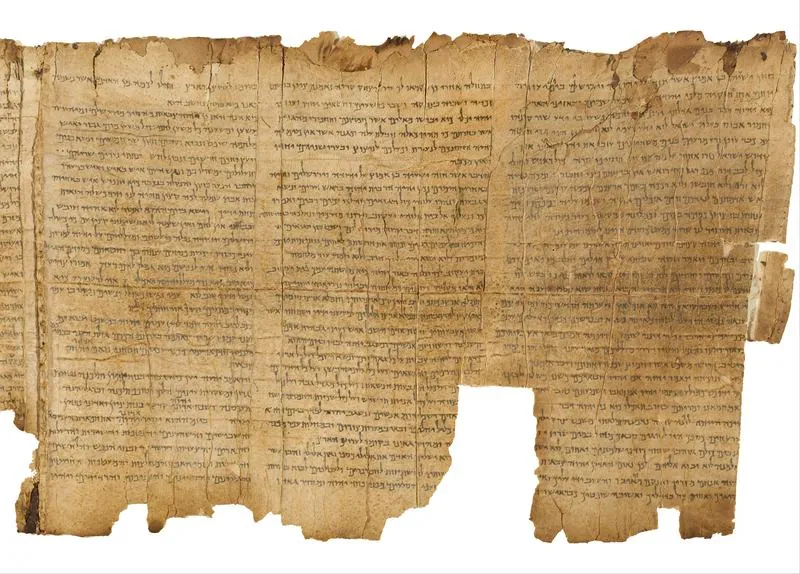
The Dead Sea Scrolls are the oldest substantial body of Jewish manuscripts: copies of every book of the Hebrew Bible except Esther, together with sectarian rules, hymns, commentaries and other works[1]. Most come from eleven caves near the ruins of Qumran on the north-west shore of the Dead Sea; others come from Masada and from refuge caves used in the Bar Kokhba revolt[2]. They are mostly on parchment, some on papyrus and one on copper, and they range from the third century BC to the first century AD[2].
Three questions about them are still open. The first is the date of each manuscript. A few dozen have been radiocarbon dated; the rest are dated by palaeography, the comparison of letter shapes against a sequence built in the 1950s and 1960s[3]. In June 2025 Mladen Popović and colleagues published new radiocarbon dates for 30 manuscripts and a machine-learning model, Enoch, trained on 24 of them to predict dates from handwriting alone. Both the dates and the predictions were often older than the palaeographic estimates[3].
The second question is who wrote the scrolls: how many scribes there were and whether individual hands can be identified[4]. The third is provenance: whether the scrolls were copied by a community living at Qumran or brought from elsewhere, and whether fragments that surfaced on the antiquities market after 2002 are ancient at all[1][5][6][7]. Of the 5 questions on this site, 0 are answered. The most likely answer to “How many scribes wrote the scrolls, and can individual hands be identified?”, not yet confirmed: the library was written by many scribes, and machine features can distinguish hands even where the script….
Key questionsset by the editors
The object
The corpus is held mainly by the Israel Antiquities Authority and the Shrine of the Book at the Israel Museum in Jerusalem; smaller groups are in other museums and in private collections[8][7]. Hebrew is the most common language, with about 15 per cent of the scrolls in Aramaic and a few in Greek; about 230 manuscripts are biblical[2]. The Leon Levy Dead Sea Scrolls Digital Library publishes high-resolution spectral images of the fragments and scans of the 1950s infrared negatives, but its terms forbid reproduction without the IAA's written permission[8][9].
Timeline
What is known
Radiocarbon dating has fixed the broad range. Accelerator dates published in 1992 for 14 scrolls and in 1995 for further scrolls and linen fell between the third century BC and the first century AD and broadly agreed with the palaeographic sequence[10][11]. A proposal in 2004 that the radiocarbon results allowed later, first-century dates for key sectarian texts was answered by a radiocarbon specialist who found that the calibrated dates did not support it[12][13]. Some fragments were treated with castor oil in the 1950s, and tests in 2001 showed that standard cleaning did not remove all of it, so some earlier dates may be too young by an unknown amount[14].
The 2025 study re-sampled 30 manuscripts from Qumran, Masada, Wadi Murabba'at and Nahal Hever, with chemical screening and cleaning for castor oil and other contaminants; 27 gave valid dates and 24 were used to train Enoch[3]. The model binarises an image of the writing with a neural network (BiNet), extracts features of stroke angle and letter shape, and fits a Bayesian ridge regression to the radiocarbon dates. Its mean absolute error against the radiocarbon ranges was 28 to 31 years. On 13 unseen test images its predictions overlapped the radiocarbon distributions by 85 per cent, and palaeographers judged 107 of 135 predictions for undated manuscripts (79 per cent) realistic[3]. The new radiocarbon range for 4Q114, a copy of Daniel, is 230 to 160 BC; Enoch dates 4Q109, a copy of Ecclesiastes, to the third century BC; both halves of the Great Isaiah Scroll (1QIsaa) come out at about 180 to 100 BC[3].
What has been tested
Scribal identity has been tested with the same image tools. A 2021 study found that the columns of the Great Isaiah Scroll fall into two distinct clusters split at the scroll's midpoint, across several independent feature sets, which supports two scribes with very similar hands rather than one[4].
Provenance has been tested with DNA. A 2020 study sequenced the animal skins of fragments and grouped pieces by species and by individual animal. It found that some Jeremiah fragments were on skins that point to an origin outside Qumran, that patterns in non-biblical scrolls such as the Songs of the Sabbath Sacrifice fit a wider Judaean milieu, and that some debated fragments do not belong with the Qumran scrolls at all[6].
Authenticity has been tested on the market fragments. In 2017 Kipp Davis and colleagues argued on material and palaeographic grounds that nine fragments sold after 2002 were modern[7]. In 2020 an investigation commissioned by the Museum of the Bible concluded that all 16 of its "Dead Sea Scroll" fragments were forgeries on ancient leather[15].
The readings
On dating, three positions are in play. The first, from the 2025 authors, is that many manuscripts are older than the traditional palaeographic chronology, sometimes by a century, and that the chronology needs rebuilding on radiocarbon and model dates[3]. The second is that palaeography remains broadly right and that Enoch is a useful aid but too lightly trained to overturn it: 24 training dates span a period of three centuries, and the 79 per cent figure depends on palaeographers' own judgement of what is realistic[16]. Christopher Rollston told Science that such tools should not be the basis for firm conclusions because handwriting is "a deeply human thing"[17]. The third, that key texts are later than the consensus places them, has not survived radiocarbon review[13].
On provenance, the majority view holds that a sectarian community at Qumran collected and partly copied the library, with some scrolls brought in from outside[1]. Norman Golb argued that the scrolls were the libraries of Jerusalem, hidden in the caves during the war with Rome, and that Qumran was not a sectarian settlement[5]. The DNA results fit a mixed library in which some manuscripts were imported[6].
Published claims
| Year | Who | Claimed | Status | Reason |
|---|---|---|---|---|
| 1949 | Solomon Zeitlin[18] | The Cave 1 scrolls are not ancient; they were written in the Middle Ages. | Ruled out | Accelerator radiocarbon dates on the scrolls themselves fall between the third century BC and the first century AD[10][11]. |
| 1951 | Willard F. Libby[19] | Linen wrapping from Qumran Cave 1 dates by radiocarbon to around the turn of the era, within a margin of about two centuries. | Accepted | Accelerator dates on the scrolls themselves confirmed an ancient date with much smaller errors[10][11]. |
| 1961 | Frank Moore Cross[20] | The scrolls' hands follow a datable sequence of archaic, Hasmonean and Herodian scripts, so a manuscript can be dated from its letter forms. | Disputed | The 1990s radiocarbon series broadly agreed with it, but the 2025 dates put several manuscripts earlier than the sequence allows[11][3]. |
| 1973 | Roland de Vaux[21] | Khirbet Qumran was the settlement of a community, identified with the Essenes, that owned the scrolls hidden in the nearby caves. | Most likely | The standard archaeological account still reads the site as sectarian, though skin DNA shows some scrolls were brought from elsewhere[1][6]. |
| 1992 | Georges Bonani and colleagues[10] | Accelerator radiocarbon dates for fourteen scrolls fall between the third century BC and the first century AD and broadly agree with the palaeographic dates. | Accepted | The 1995 Arizona series agreed[11]; whether the agreement holds manuscript by manuscript is what the 2025 study disputes[3]. |
| 1995 | Norman Golb[5] | The scrolls are the libraries of Jerusalem, hidden in the caves during the war with Rome, and Qumran was a fortress, not a sectarian settlement. | Disputed | Most archaeologists still read Qumran as a sectarian site, though skin DNA does show that some scrolls came from elsewhere[1][6]. |
| 1995 | A. J. Timothy Jull and colleagues[11] | Further accelerator dates on scrolls and linen from the Judaean Desert fall in the same range and agree broadly with palaeography. | Accepted | Consistent with the Zurich series; castor-oil contamination may make some of these dates slightly too young[10][14]. |
| 2001 | Kaare Lund Rasmussen and colleagues[14] | Castor oil applied to fragments in the 1950s survives standard cleaning and can make radiocarbon dates too young. | Accepted | The 2025 study screened and cleaned its samples for castor oil for this reason[3]. |
| 2004 | Steve Braunheim, Joseph Atwill and Robert Eisenman[12] | The radiocarbon results allow first-century AD dates for key sectarian scrolls. | Disputed | A radiocarbon specialist found that the calibrated dates do not support the later chronology[13]. |
| 2004 | Yizhar Hirschfeld[22] | Qumran was a Hasmonean fort and then a Herodian manor house, and the scrolls were hidden there by people from Jerusalem. | Disputed | A minority reading of the site; the standard account keeps the sectarian interpretation[1]. |
| 2007 | Johannes van der Plicht[13] | Correctly calibrated, the radiocarbon dates do not support moving key sectarian texts into the first century AD. | Accepted | No later radiocarbon work has revived the later chronology, and the 2025 dates point earlier, not later[3]. |
| 2017 | Kipp Davis and colleagues[7] | Nine fragments sold as Dead Sea Scrolls after 2002 are modern, on material and palaeographic grounds. | Accepted | The later investigation of the Museum of the Bible's fragments found all sixteen forged[15]. |
| 2018 | Yitzhak Magen and Yuval Peleg[23] | Qumran was not a distinctive sectarian settlement, and its residents did not write the scrolls. | Disputed | The excavators' reading is contested; the standard account keeps the sectarian interpretation[1]. |
| 2020 | Art Fraud Insights for the Museum of the Bible[15] | All sixteen of the Museum of the Bible's Dead Sea Scroll fragments are modern forgeries on ancient leather. | Accepted | The museum accepted the finding, which matches the earlier material case against market fragments[15][7]. |
| 2020 | Sarit Anava and colleagues[6] | Animal-skin DNA shows that some scrolls, including copies of Jeremiah, were made outside Qumran and brought there. | Accepted | The genetic grouping is the strongest material evidence on provenance so far and has not been challenged in print[6]. |
| 2021 | Mladen Popović, Maruf A. Dhali and Lambert Schomaker[4] | The Great Isaiah Scroll was written by two scribes with very similar hands, who split the work at the scroll's midpoint. | Most likely | The split holds across several independent feature sets, but the study has not yet been repeated by another group[4]. |
| 2025 | Mladen Popović and colleagues[3] | Many manuscripts are older than palaeography says, and the Enoch model dates handwriting to within about 30 years. | Still possible | The model's accuracy rests on 24 training dates and 13 test images, and critics argue that is too few to overturn palaeography[16][17]. |
| 2025 | Rodrigo Pereira da Silva[16] | Enoch is a useful aid but too lightly trained to overturn the palaeographic chronology, and its 79 per cent figure rests on palaeographers' judgement. | Still possible | No held-out radiocarbon test has yet been run to decide between the model and the palaeographers[3]. |
What would settle it
More radiocarbon dates, sampled with the 2025 cleaning protocol across all script styles, would test Enoch properly, especially on manuscripts it dates earliest. A blind test, in which palaeographers and the model date manuscripts whose radiocarbon results are withheld, would show which is more accurate. Open images under a reuse licence would let other groups train competing models. For provenance, DNA and isotope profiles of skins across the whole corpus, matched against local and imported livestock, would show how much of the library was made at Qumran. Every unprovenanced fragment needs material tests before it is used as evidence.
Questions
0 of 5 questions are answered.
Evidence 18 findings
Artifacts
The films, photos, papers and objects this mystery rests on, each with its own key and its distance from the original.
See also
References
- 1.Magness, J. 2021. The Archaeology of Qumran and the Dead Sea Scrolls (2nd edition). Eerdmans, Grand Rapids.doicited 7 times hereSRC0D484DSJ4QVM
- 2.Israel Antiquities Authority n.d.. Introduction to the Dead Sea Scrolls. deadseascrolls.org.il.cited 1 time hereSRC0D484D9Y4DAM
- 3.Popović, M., Dhali, M., Schomaker, L. et al. 2025. Dating ancient manuscripts using radiocarbon and AI-based writing style analysis. PLOS One 20(6), e0323185.doicited 18 times hereSRC0D4849MR4G48
- 4.Popović, M., Dhali, M., Schomaker, L. 2021. Artificial intelligence based writer identification generates new evidence for the unknown scribes of the Dead Sea Scrolls exemplified by the Great Isaiah Scroll (1QIsaa). PLOS One 16(4), e0249769.doicited 6 times hereSRC0D484AC64RP8
- 5.Golb, N. 1995. Who Wrote the Dead Sea Scrolls? The Search for the Secret of Qumran. Scribner, New York.doicited 4 times hereSRC0D484E1C24H3
- 6.Anava, S., Neuhof, M., Gingold, H. et al. 2020. Illuminating Genetic Mysteries of the Dead Sea Scrolls. Cell 181(6), 1218-1231.doicited 7 times hereSRC0D484BV21WC8
- 7.Davis, K., Rabin, I., Feldman, I. et al. 2017. Nine Dubious "Dead Sea Scrolls" Fragments from the Twenty-First Century. Dead Sea Discoveries 24(2), 189-228.doicited 6 times hereSRC0D484C2W581K
- 8.Israel Antiquities Authority n.d.. The Leon Levy Dead Sea Scrolls Digital Library. deadseascrolls.org.il.cited 4 times hereSRC0D484D244SH0
- 9.Israel Antiquities Authority n.d.. Terms and Conditions, The Leon Levy Dead Sea Scrolls Digital Library. deadseascrolls.org.il.cited 2 times hereSRC0D484DHR6M5E
- 10.Bonani, G., Ivy, S., Wölfli, W. et al. 1992. Radiocarbon Dating of Fourteen Dead Sea Scrolls. Radiocarbon 34(3), 843-849.doicited 4 times hereSRC0D484AM03SE1
- 11.Jull, A., Donahue, D., Broshi, M. et al. 1995. Radiocarbon Dating of Scrolls and Linen Fragments from the Judean Desert. Radiocarbon 37(1), 11-19.doicited 4 times hereSRC0D484AVT58YE
- 12.Braunheim, S., Atwill, J., Eisenman, R. 2004. Redating the Radiocarbon Dating of the Dead Sea Scrolls. Dead Sea Discoveries 11(2), 143-157.doicited 2 times hereSRC0D484BBE78QG
- 13.van der Plicht, J. 2007. Radiocarbon Dating and the Dead Sea Scrolls: A Comment on "Redating". Dead Sea Discoveries 14(1), 77-89.doicited 2 times hereSRC0D484BK803AP
- 14.Rasmussen, K., van der Plicht, J., Cryer, F. et al. 2001. The Effects of Possible Contamination on the Radiocarbon Dating of the Dead Sea Scrolls I: Castor Oil. Radiocarbon 43(1), 127-132.doicited 3 times hereSRC0D484B3M1R74
- 15.Greshko, M. 2020. 'Dead Sea Scrolls' at the Museum of the Bible are all forgeries. National Geographic.cited 5 times hereSRC0D484CAP1B1R
- 16.Silva, R. 2025. Revisitando a datação do livro de Daniel: uma abordagem integrada com radiocarbono, linguística e inteligência artificial. Protestantismo em Revista 51(2), 1-23.cited 4 times hereSRC0D484CTA4XVX
- 17.Anderson, S. 2025. The Dead Sea Scrolls changed our understanding of the Bible. Could some of them be even older than we thought?. Smithsonian Magazine.cited 3 times hereSRC0D484CJG5EPG
- 18.Zeitlin, S. 1949. The Alleged Antiquity of the Scrolls. The Jewish Quarterly Review 40(1), from p. 57.doicited 1 time hereSRC0D484EH071HW
- 19.Libby, W. 1951. Radiocarbon Dates, II. Science 114(2960), 291–296.doicited 1 time hereSRC0D484ERT5M1F
- 20.Cross, F. 1961. The Development of the Jewish Scripts. G. E. Wright (ed.), The Bible and the Ancient Near East, Doubleday, Garden City, pp. 133–202.cited 1 time hereSRC0D484F0M7C7E
- 21.de Vaux, R. 1973. Archaeology and the Dead Sea Scrolls. Oxford University Press for the British Academy (Schweich Lectures).cited 1 time hereSRC0D484F8E2RFD
- 22.Hirschfeld, Y. 2004. Qumran in Context: Reassessing the Archaeological Evidence. Hendrickson Publishers, Peabody, Mass..cited 1 time hereSRC0D484FG82K02
- 23.Magen, Y., Peleg, Y. 2018. Back to Qumran: Final Report (1993–2004). Israel Antiquities Authority.doicited 1 time hereSRC0D484FR25EMW