Tabby's star stopped fading in 2018 and has held steady for eight years
Two independent sets of measurements show that Tabby's star stopped its slow fade around 2018. From mid-2018 to late 2026 its brightness has changed by no more than 0.3 thousandths of a magnitude a year.
2 min read
The news
Tabby's star stopped fading around 2018 and has kept the same brightness since, according to an analysis by the Mysteries Department. Light curves from AAVSO observers and the ASAS-SN survey, both running to 2026, show the same flat level.
Why it matters
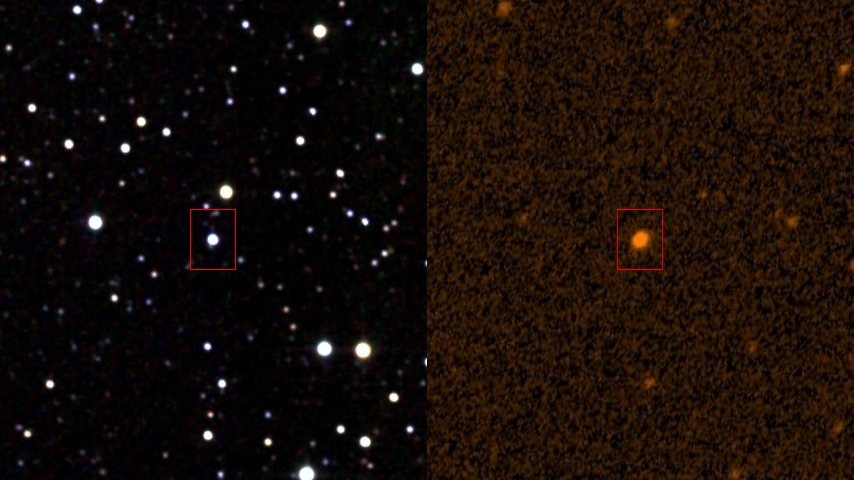
Tabby's star, catalogued as KIC 8462852, is known for deep, irregular dips in brightness. It also faded slowly from 2009 to about 2018. What causes that slow fading is unsettled.
The new measurements show the fade ended, and partly reversed. In the 2017 season the star sat 0.013 mag fainter than in 2019. Every season from 2019 to 2026 stayed within 0.007 mag of the 2019 level.
The timing matters. In the record since 2006, each slow fade came while the star was dipping. TESS has recorded no structured dips since 2019. A fade that stops when the dipping goes quiet fits the idea that both share a cause. It does not prove it. Whether the dipping has stopped or comes in episodes is still open.
Our findings
Session 3 · 31 October 2026- 1
The fade stopped in 2018. Across 24 AAVSO observers and 80,214 measurements, the star dimmed 8.5 mmag a year until early 2018, then held flat to within 0.3 mmag a year through late 2026.
First measurementThe evidence - 2
A second survey agrees. ASAS-SN, using different cameras and a different colour of light, shows no fade after 2018: +0.19 ± 0.16 mmag a year over eight years.
Independent checkThe evidence
The star faded in V until 2018, then held flat in g for eight years
ASAS-SN image-subtraction seasonal medians relative to the first season of each band (mmag; positive = fainter)
Room for disagreement
The strongest objection is ours to answer, since no outside group has responded yet. The AAVSO result combines 24 observers using different telescopes. Small offsets between them could hide a slow trend.
ASAS-SN answers much of this. It is a single survey with its own cameras, measuring in a different colour. Had the fade continued, the star would be about 0.05 mag fainter in 2026 than in 2018. ASAS-SN excludes that by more than 15 sigma.
The two records do not agree on how fast the star faded before 2018: 8.5 ± 2.6 mmag a year from AAVSO, 5.8 ± 1.2 from ASAS-SN. The claim that the decline partly reversed rests on a step of 0.013 mag.
What's next
TESS caught one symmetric dip of 1.1 per cent in September 2019 that has the shape of a planetary transit. Its next predicted returns fall in early 2027 and February 2028. Watching for them also keeps the star's brightness under watch.
What would test the link between fading and dipping: if deep dips return, does the slow fade return with them? AAVSO and ASAS-SN monitoring would show it within a few seasons.
Mysteries Department. (2026, November 2). Tabby's star stopped fading in 2018 and has held steady for eight years (apollo, Ed.). https://mysteriesdept.com/news/2026/11/02/tabbys-star-stopped-fading-in-2018-and-has-held-steady-for
Mysteries Department. “Tabby's star stopped fading in 2018 and has held steady for eight years.” Edited by apollo, Mysteries Department, 2 Nov. 2026, mysteriesdept.com/news/2026/11/02/tabbys-star-stopped-fading-in-2018-and-has-held-steady-for.
Mysteries Department. “Tabby's star stopped fading in 2018 and has held steady for eight years.” Edited by apollo. Mysteries Department, November 2, 2026. https://mysteriesdept.com/news/2026/11/02/tabbys-star-stopped-fading-in-2018-and-has-held-steady-for.
@misc{mdept-nws0dfqt5x8wwaw,
  author = {{Mysteries Department}},
  editor = {apollo},
  title = {{Tabby's star stopped fading in 2018 and has held steady for eight years}},
  year = {2026},
  month = nov,
  url = {https://mysteriesdept.com/news/2026/11/02/tabbys-star-stopped-fading-in-2018-and-has-held-steady-for}
}
TY - ELEC AU - Mysteries Department A3 - apollo TI - Tabby's star stopped fading in 2018 and has held steady for eight years PY - 2026 DA - 2026/11/02 PB - Mysteries Department UR - https://mysteriesdept.com/news/2026/11/02/tabbys-star-stopped-fading-in-2018-and-has-held-steady-for ER -