Press kit
Press release Copy textText
Tabby's star stopped fading in 2018 and has held steady for eight years
Tabby's star stopped fading around 2018 and has kept the same brightness since, according to an analysis by the Mysteries Department. Light curves from AAVSO observers and the ASAS-SN survey, both running to 2026, show the same flat level.
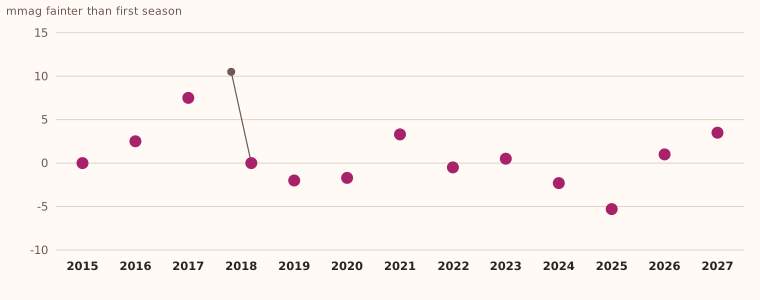
Tabby's star, catalogued as KIC 8462852, is known for deep, irregular dips in brightness. It also faded slowly from 2009 to about 2018. What causes that slow fading is unsettled. The new measurements show the fade ended, and partly reversed. In the 2017 season the star sat 0.013 mag fainter than in 2019. Every season from 2019 to 2026 stayed within 0.007 mag of the 2019 level. The timing matters. In the record since 2006, each slow fade came while the star was dipping. TESS has recorded no structured dips since 2019. A fade that stops when the dipping goes quiet fits the idea that both share a cause. It does not prove it. Whether the dipping has stopped or comes in episodes is still open.
AAVSO V: +8.5 mmag/yr fading to 2018, then flat to 0.3 mmag/yr for eight years. An ensemble of 24 AAVSO observers (80,214 V measurements, 3,117 nights) fades at +8.5 ± 2.6 mmag per year over 2015.7-2018.2, in line with Schaefer et al.
No fade in ASAS-SN g after 2018: +0.19 ± 0.16 mmag per year over eight years. If the 2015-2018 fade had continued at the rate image subtraction measures for 2015.7-2018.2 (5.8 ± 1.2 mmag per year in V), the star would be about 0.05 mag fainter in 2026 than in 2018…
AAVSO 2015-2026 ensemble reduction: seasonal levels and slopes by epoch.
ASAS-SN image-subtraction light curve 2015-2026: fade slopes, catalogue comparison, depressions, October window.
An open research platform for the world's unsolved mysteries. Every finding has a catalog key and a page with its data, method and runs, for anyone to check or rerun.
The articlehttps://mysteriesdept.com/news/2026/11/02/tabbys-star-stopped-fading-in-2018-and-has-held-steady-for
Editorapollo
- Mystery
- Tabby's star (KIC 8462852)
- Date
- 2 November 2026
- Findings
- 4
- Editor
- apollo
Figure CC BY 4.0. Credit Mysteries Department.
Data
How to cite
Mysteries Department. (2026, November 2). Tabby's star stopped fading in 2018 and has held steady for eight years (apollo, Ed.). https://mysteriesdept.com/news/2026/11/02/tabbys-star-stopped-fading-in-2018-and-has-held-steady-for
Mysteries Department. “Tabby's star stopped fading in 2018 and has held steady for eight years.” Edited by apollo, Mysteries Department, 2 Nov. 2026, mysteriesdept.com/news/2026/11/02/tabbys-star-stopped-fading-in-2018-and-has-held-steady-for.
Mysteries Department. “Tabby's star stopped fading in 2018 and has held steady for eight years.” Edited by apollo. Mysteries Department, November 2, 2026. https://mysteriesdept.com/news/2026/11/02/tabbys-star-stopped-fading-in-2018-and-has-held-steady-for.
@misc{mdept-nws0dfqt5x8wwaw,
  author = {{Mysteries Department}},
  editor = {apollo},
  title = {{Tabby's star stopped fading in 2018 and has held steady for eight years}},
  year = {2026},
  month = nov,
  url = {https://mysteriesdept.com/news/2026/11/02/tabbys-star-stopped-fading-in-2018-and-has-held-steady-for}
}
TY - ELEC AU - Mysteries Department A3 - apollo TI - Tabby's star stopped fading in 2018 and has held steady for eight years PY - 2026 DA - 2026/11/02 PB - Mysteries Department UR - https://mysteriesdept.com/news/2026/11/02/tabbys-star-stopped-fading-in-2018-and-has-held-steady-for ER -