The 2004 Nimitz encounter and the Navy videos
On 14 November 2004 two F/A-18F Super Hornets from Strike Fighter Squadron 41, flying from USS Nimitz about 100 miles south-west of San Diego, were sent by the cruiser USS Princeton to look at a radar contact. The flight lead, Commander David Fravor, and the pilot of the second aircraft, Lieutenant Commander Alex Dietrich, later said they saw a patch of disturbed water and, above it, a white oblong object about the size of their aircraft with no wings, rotors or exhaust, which moved erratically, mirrored Fravor's descent, and then accelerated out of sight[1][2]. Minutes later the Princeton reported a contact at the flight's rendezvous point some 60 miles away[1]. A second crew launched afterwards and the weapons systems officer, Chad Underwood, recorded about a minute and a half of infrared video of a distant object, the clip now known as FLIR1[3].
Nothing was investigated at the time. The story became public on 16 December 2017, when the New York Times published Fravor's account alongside the FLIR1 video and two others, and revealed a Pentagon programme that had studied such reports[4][5]. In September 2019 a Navy spokesman confirmed that the three videos were real Navy footage of what the service calls "unidentified aerial phenomena", and on 27 April 2020 the Department of Defense formally released them[6]. The 2021 intelligence community assessment counted 144 military reports from 2004 onward and explained one[7].
Since then the three videos and the Nimitz accounts have been argued over in detail. The Pentagon's All-domain Anomaly Resolution Office concluded in 2024 and 2025 that GOFAST shows a slow object made to look fast by the camera aircraft's own motion[8][9]. The sceptic Mick West and others argue that GIMBAL's rotating shape is infrared glare turning with the camera's gimbal, and that FLIR1's final "acceleration" coincides with a zoom change and loss of track[10][11]. Supporters of the pilots reply that the videos were never the strongest evidence; the eyewitness account and the Princeton's radar tracks are, and neither the radar data nor the aircrew debriefs have been released[12]. Of the 5 questions on this site, 1 are answered. The most likely answer to “What does the FLIR1 video show?”, not yet confirmed: the apparent acceleration is an artefact of the field-of-view change and loss of track; the object is a….
Key questionsset by the editors
What happened
The Nimitz strike group was working up off southern California for a Persian Gulf deployment. According to Fravor's 2023 statement to Congress, the Princeton's air controller had watched unidentified radar tracks for about two weeks: objects that appeared above 80,000 feet, descended to about 20,000 feet, loitered for hours and climbed back up[1]. Kevin Day, the Princeton's senior radar operator, has said his screen showed well over 100 such tracks over the course of a week, and that his team first suspected an equipment fault[3].
On 14 November a two-versus-two training exercise was cancelled for "real-world tasking". Fravor's section was vectored to a contact west of its combat air patrol point, about 40 miles south of the ship. The jets' own radars showed nothing. At about 20,000 feet, with a clear sky and calm sea, the crews saw white water off the right side and, against it, a small white Tic-Tac-shaped object moving abruptly, with no rotors, rotor wash or visible wings. Fravor descended in a clockwise spiral; the object climbed to meet him; at about half a mile it accelerated and was gone, and the white water had gone with it[1]. Dietrich, flying high cover, lost sight of it at the end[1]. Back at the CAP point about 60 miles east, the controller reported the object there on the Princeton's SPY-1 radar[1].
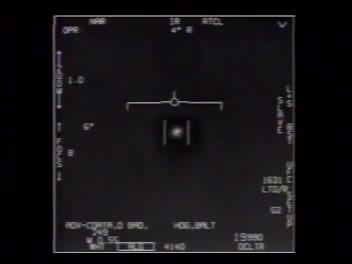
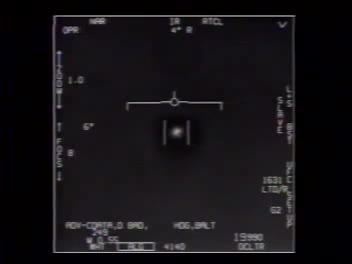
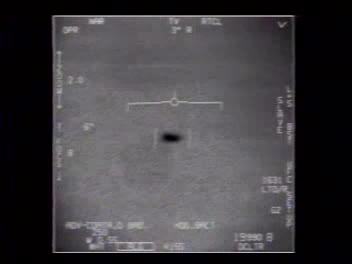
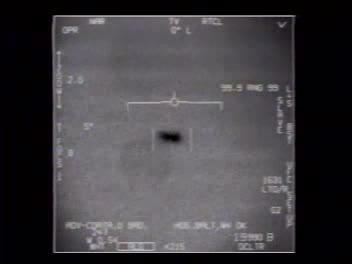
A second section launched afterwards. Underwood, the weapons systems officer, acquired a target on radar and then on the aircraft's ATFLIR targeting pod and recorded it. The clip shows a featureless shape against sky which, at the end, moves sharply left and out of frame[11]. Fravor said the recording crew saw no infrared plume[1].
 0:05
 0:05
 0:20
 0:40
The event was not reported up the chain. Fravor told Congress that no one questioned his crews and no tapes were taken; the incident "became a great story to tell friends" until Jay Stratton of the Pentagon programme contacted him in 2009[1].
Timeline
The accounts
The accounts reached the public in stages, and what exists today is a layered record. The earliest written version is an undated, unlogoed report compiled in 2009 with statements attributed to seven F/A-18 pilots and ship radar operators. It surfaced in May 2018 through the Las Vegas reporter George Knapp, who said four unnamed people confirmed it was genuine and that copies had come through Luis Elizondo; the Pentagon did not release or confirm it[13][14]. Fravor calls it the "Unofficial Official Report"[1]. It has not been authenticated by any agency.
Fravor's own account was first published by the New York Times on 16 December 2017, with his weapons systems officer Jim Slaight corroborating[5]. Fravor has repeated it since in many interviews and in sworn testimony to the House Oversight Committee on 26 July 2023, where he also said the object was about the size of his aircraft and had reappeared 60 miles away in under a minute[1][2]. Dietrich did not speak publicly until a CBS 60 Minutes interview broadcast on 16 May 2021, in which she described the same object and said it had "no predictable movement, no predictable trajectory"[15]. Underwood, who recorded FLIR1 but did not see the object with his eyes, gave his first interview to New York magazine in December 2019; he described erratic radar behaviour and said he does not know what it was and does not assume it was alien[16]. Day gave his first on-camera account for a 2019 television series[3]. Several enlisted sailors have since said in interviews that data drives were collected after the event; those claims rest on their recollection alone[17].
Three features of this record matter. The aircrew accounts are consistent with each other on the shape, the colour and the absence of wings and exhaust. Specific numbers (80,000 feet, 60 miles in under a minute) come from what the radar controller told the pilots, not from anything the pilots measured. And the only written account dated before 2017 is a document whose provenance is unverified.
What was recorded
Three unclassified videos exist. FLIR1 is Underwood's 2004 recording. GIMBAL and GOFAST were recorded by F/A-18F crews from USS Theodore Roosevelt off the US east coast in 2015; GOFAST shows a small object low over the sea and GIMBAL a dark shape that appears to rotate above a cloud layer[6][8]. All three were published by the New York Times and To The Stars Academy in 2017 and 2018. In September 2019 the Navy's deputy chief of information, Joseph Gradisher, confirmed to The Black Vault that they were Navy recordings of "unidentified aerial phenomena", and on 27 April 2020 the Department of Defense released them through the Naval Air Systems Command FOIA reading room "to clear up any misconceptions by the public"[6][18].
The videos are compressed copies of cockpit display recordings. The original files and their metadata have not been released, and AARO's analysis of GOFAST had to extract the pod's on-screen numbers by hand[9]. No radar data from the Princeton, the E-2C Hawkeye or the F/A-18s has been released, nor have any contemporaneous debriefs. The 2021 ODNI assessment, which covers this event as its earliest case, describes 144 reports between November 2004 and March 2021, 80 of them with multiple sensors, and explains one (a deflating balloon)[7].
The explanations
GOFAST has an official explanation. In November 2024 AARO's director Jon Kosloski told a Senate subcommittee the object was at about 13,000 feet moving at roughly 39 knots in a 60-knot wind[8]. AARO's February 2025 methodology paper models the pod's line of sight across all possible aircraft headings and puts the object at 3.4 to 4.0 nautical miles, about 13,000 feet up, moving at 5 to 92 mph through the air; the apparent speed is motion parallax, and the object is probably a metre or less across, a small drone or bird[9]. Mick West had argued the same from the on-screen numbers since 2018, and NASA's independent study team reached a similar figure in a public session in May 2023[19].
GIMBAL is disputed. West's position is that the rotating shape is infrared glare from a hot source, fixed to the camera rather than the scene, which rotates when the ATFLIR pod rolls through a gimbal singularity; he lists bumps before each rotation and the absence of rotation when the aircraft banks as evidence, and treats a distant jet as the likely source[10]. Yannick Peings and Marik von Rennenkampff reconstructed possible flight paths and found that at the 6 to 8 nautical miles the aircrew reported, the best fit has the object decelerate and reverse, which matches what the crew said they saw on radar; they acknowledge large uncertainty in range and wind[12]. The argument continues in 2026, with a refined glare model from one side and claims of falsification from the other, and West himself lists the initial rotation as an unresolved point[20].
FLIR1's sharp final movement coincides with the operator's change of field of view and the pod's loss of lock, and sceptics attribute the apparent acceleration to the zoom change[11]. Underwood's own account is that the object jumped erratically on radar before he recorded it, which the video cannot show[16]. Suggested identities for the FLIR1 object, from a distant conventional aircraft to a balloon, have not been confirmed, and AARO has published no resolution of FLIR1 or GIMBAL.
For the visual encounter itself the candidates are: an unconventional aircraft or drone, possibly a classified test; a misperceived conventional object with distances and speeds overestimated; a radar problem on the Princeton (false tracks from a system that had just been upgraded, as some accounts hold) combined with a coincidental visual sighting; and something that is none of these. The 2021 assessment's five categories (airborne clutter, natural phenomena, US programmes, foreign systems, other) frame the official view[7]. None has been tested against primary data, because none has been released.
Published claims
| Year | Who | Claimed | Status | Reason |
|---|---|---|---|---|
| 2009 | Unnamed authors of the "executive report"[23] | The Princeton's radars tracked unknown objects for days before the encounter, and the aircrew met one whose performance matched no known aircraft. | Still possible | The report is undated and unsigned, and its authenticity has not been confirmed by the Navy[14]. |
| 2017 | Mick West[11] | FLIR1's sudden departure at the end is an artefact of the zoom change and the pod losing lock, and the object is probably a distant aircraft. | Most likely | The movement coincides with the field-of-view change in the released video, but no official resolution of FLIR1 has been published[24]. |
| 2019 | Kevin Day[3] | Over about a week the Princeton tracked well over 100 objects that appeared above 80,000 feet and descended at extreme speed. | Still possible | No radar data have been released, and the behaviour described also resembles track-correlation errors[1]. |
| 2020 | US Department of Defense[24] | The phenomena in the three released Navy videos remain unidentified. | Accepted | It still holds for FLIR1 and GIMBAL; AARO has since explained GOFAST as parallax[9]. |
| 2021 | Alex Dietrich and David Fravor[15] | Two crews in separate aircraft watched a white, wingless object about the size of an F/A-18 move erratically and then vanish. | Still possible | The sizes and distances are estimates over open sea, and no sensor data from the visual encounter have been released[2]. |
| 2021 | Office of the Director of National Intelligence[7] | Of 144 reports from 2004 to 2021 only one could be explained; most lack the data to decide among clutter, natural phenomena, US or foreign systems, or other. | Accepted | It is the official assessment, and it resolved none of the Nimitz material[7]. |
| 2022 | Mick West[10] | The rotating GIMBAL shape is infrared glare from a hot source, fixed to the camera, which turns when the pod rolls through its gimbal singularity. | Disputed | A flight-path reconstruction at the crew's reported range fits a real decelerating object, and West lists the first rotation as unresolved[12][20]. |
| 2023 | NASA UAP independent study team[19] | The GOFAST object was moving slowly at a few thousand metres; its apparent speed comes from the camera aircraft's motion. | Accepted | AARO reached the same result independently with full line-of-sight modelling[9]. |
| 2023 | Yannick Peings and Marik von Rennenkampff[12] | At the 6 to 8 nautical miles the aircrew reported, GIMBAL's best-fit path decelerates and reverses, as the crew said they saw on radar. | Disputed | The authors acknowledge large uncertainty in range and wind, and the glare model fits the same video[10]. |
| 2023 | David Fravor[1] | The object he engaged in 2004 had performance beyond any known aircraft, and the event was never investigated. | Still possible | His account is consistent across tellings, but no radar or sensor data from the engagement have been released[7]. |
| 2024 | Jon Kosloski, AARO[8] | The GOFAST object was at about 13,000 feet, moving at roughly 39 knots in a 60-knot wind. | Accepted | AARO's 2025 methodology paper sets out the modelling, which matches the NASA panel and earlier independent work[9][19]. |
| 2025 | AARO[9] | GOFAST shows an object about a metre across or smaller, 3.4 to 4.0 nautical miles away at about 13,000 feet, moving 5 to 92 mph; the speed is parallax. | Accepted | The method uses only the public video's numbers and agrees with independent analyses[19]. |
What would settle it
The Princeton's SPY-1 track data, the E-2C's radar recordings and the F/A-18 mission tapes from 10 to 16 November 2004 would show whether the tracks existed, how fast they moved and whether they were consistent with the pilots' sighting. Fravor says no tapes were collected[1]; whether logs survive on the ships' systems is unknown. The original FLIR1 file with its metadata would let analysts repeat on FLIR1 what AARO did for GOFAST[9]. The 2009 report, if an agency confirmed its origin, would date the aircrew statements to within five years of the event rather than thirteen. In 2026 the House task force on declassification has asked the Department of War for further UAP videos, and the PURSUE release programme has begun publishing historical records; a release of the Nimitz radar or debrief material through either channel would move this case[21][22].
Questions
1 of 5 questions are answered.
Evidence 23 findings
Artifacts
The films, photos, papers and objects this mystery rests on, each with its own key and its distance from the original.
See also
References
- 1.Fravor, D. 2023. Statement for the House Oversight Committee, Subcommittee on National Security, the Border, and Foreign Affairs. U.S. House Committee on Oversight and Accountability.cited 21 times hereSRC0D1SBB7M7JW2
- 2.Chasan, A. 2023. The story behind the "Tic Tac" UFO sighting by Navy pilots in 2004. CBS News.cited 2 times hereSRC0D1SBCPG53Q8
- 3.Daugherty, G. 2019. When Top Gun Pilots Tangled with a Baffling Tic-Tac-Shaped UFO. HISTORY.cited 6 times hereSRC0D1SBG3W7HJZ
- 4.Cooper, H., Blumenthal, R., Kean, L. 2017. Glowing Auras and 'Black Money': The Pentagon's Mysterious U.F.O. Program. The New York Times.cited 4 times hereSRC0D1SBBZ258E4
- 5.Cooper, H., Blumenthal, R., Kean, L. 2017. 2 Navy Airmen and an Object That 'Accelerated Like Nothing I've Ever Seen'. The New York Times.cited 5 times hereSRC0D1SBBQ82N9N
- 6.Trevithick, J. 2020. Navy Officially Releases Controversial UFO Videos. The War Zone.cited 9 times hereSRC0D1SBDDY0D9Z
- 7.Office of the Director of National Intelligence 2021. Preliminary Assessment: Unidentified Aerial Phenomena. ODNI.cited 18 times hereSRC0D1SBDXJ43ZW
- 8.All-domain Anomaly Resolution Office 2024. AARO case slides, Senate Armed Services Subcommittee on Emerging Threats and Capabilities, November 2024. U.S. Senate Committee on Armed Services.cited 14 times hereSRC0D1SBE5C6WEJ
- 9.All-domain Anomaly Resolution Office 2025. AARO Case Resolution: GOFAST, Methodology. U.S. Department of Defense.cited 11 times hereSRC0D1SBED66P6A
- 10.West, M. 2022. A Gimbal Glare Explainer. Metabunk.cited 5 times hereSRC0D1SBF4M3VMV
- 11.West, M., Metabunk contributors 2017. 2004 USS Nimitz Tic Tac UFO FLIR footage (FLIR1). Metabunk.cited 5 times hereSRC0D1SBEWT2Y73
- 12.Peings, Y., von Rennenkampff, M. 2023. Reconstruction of Potential Flight Paths for the January 2015 'Gimbal' UAP. arXiv.doicited 6 times hereSRC0D1SBEN01RTX
- 13.Knapp, G. 2018. I-Team Exclusive: Confidential report analyzes Tic Tac UFO incidents. KLAS-TV, 8 News Now.cited 6 times hereSRC0D1SBCYA4B2X
- 14.Trevithick, J., Rogoway, T. 2018. Detailed Official Report On Harrowing Encounter Between F/A-18s and UFO Surfaces. The War Zone.cited 1 time hereSRC0D1SBD641PG9
- 15.Whitaker, B., CBS News 2021. Navy pilots recall 'unsettling' 2004 UAP sighting. CBS News, 60 Minutes.cited 5 times hereSRC0D1SBCEP3AFT
- 16.Phelan, M. 2019. Navy Pilot Who Filmed the 'Tic Tac' UFO Speaks: 'It Wasn't Behaving by the Normal Laws of Physics'. New York (Intelligencer).cited 5 times hereSRC0D1SBC6W27D5
- 17.McMillan, T. 2019. The Witnesses. Popular Mechanics.cited 1 time hereSRC0D1SBFW27MA2
- 18.Naval Air Systems Command 2020. Naval Air Systems Command FOIA Reading Room. navair.navy.mil.cited 10 times hereSRC0D1SBDNR0FTZ
- 19.Metabunk contributors 2023. NASA panel analyzes GO FAST. Metabunk.cited 2 times hereSRC0D1SBFM87PW4
- 20.West, M., Metabunk contributors 2026. The 'Gimbal' UFO: Marik Claims 'New Findings' Falsify Prosaic Explanations. Metabunk.cited 2 times hereSRC0D1SBFCE0985
- 21.U.S. House Committee on Oversight and Government Reform 2026. Luna Continues Transparency Investigation into UAPs. oversight.house.gov.cited 5 times hereSRC0D1SBGBP6S1F
- 22.The Debrief 2026. Pentagon Releases First Batch of UAP Documents Under New PURSUE Program. The Debrief.cited 8 times hereSRC0D1SBGKG57GJ
- 23.Anonymous 2009. Executive report on the November 2004 USS Nimitz encounters (the "Tic Tac" report). Published by KLAS-TV, 18 May 2018; re-hosted on Wikimedia Commons.cited 2 times hereSRC0D1SBJ2C5G9Y
- 24.U.S. Department of Defense 2020. Statement by the Department of Defense on the Release of Historical Navy Videos. U.S. Department of Defense (now war.gov).cited 3 times hereSRC0D1SBHJR6851