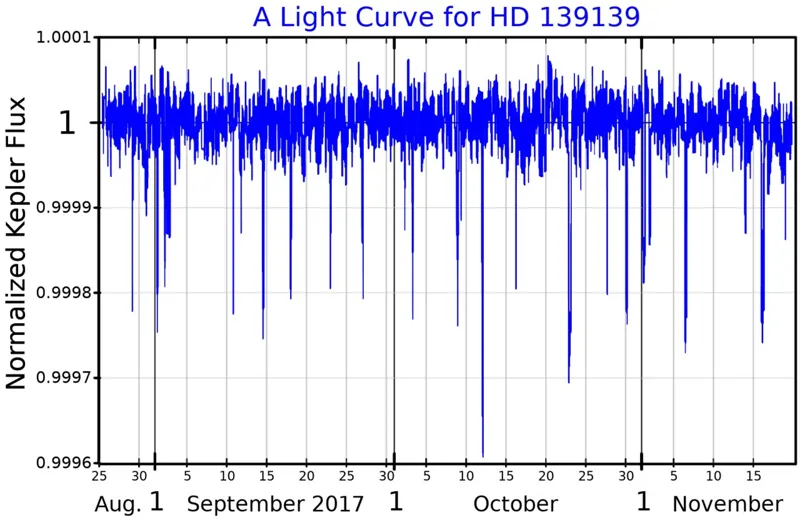
Method · astronomy: pixel-level photometry K2 pixel forensics for a saturated star
Test instrumental explanations for the dips with the original pixels, and try to tell star A from star B.
Questions it answers
Runs and results 2 runs
Run Mystery Measured Result Against Date RUN0DD2GWDZD632 HD Chi2 of stacked 27-dip deficit vs 'real dimming' and 'bleed column only' (null covariance); depth chi2 vs one amplitude; timing KS/permutation p-values {'pointing_p': [0.93, 0.96], 'arclength_p': 0.73, 'column_only': {'dof': 2, 'chi2': 0.55}, 'real_dimming': {'dof': 2, 'chi2': 1.03, 'depth_ppm': 211}, 'spot_level_p': 0.3, 'no_signal_chi2': 324, 'thruster_phase_p': 0.52, 'depth_chi2_rednoise': '124/26', 'depth_chi2_published_errors': '184/26'} 600 random non-dip epochs with the same procedure RUN0DD2GWQFDB7N HD Chi2 of stacked per-pixel deficits vs PRF patterns for A, B and column-only; robustness of chi2(B) - chi2(A) {'col7_ppm': [153, 33], 'wings_ppm': [101, 71], 'baseline_features14': {'A': 11.6, 'B': 89.6, 'dof': 13, 'column_only': 12.9}, 'dchi2_B_minus_A_range_under_robustness': [-52, 84]} 1000 random non-dip epochs, 5000 null stacks
Applied to
2 datasets K2 Campaign 15 light curves of EPIC 249706694 (pipeline, K2SFF and EVEREST), Table of the 28 transit-like events (times, durations, depths)
References
Rappaport, S., Vanderburg, A., Kristiansen, M. et al. 2019. The Random Transiter – EPIC 249706694/HD 139139. Monthly Notices of the Royal Astronomical Society 488(2), 2455–2465. Alonso, R., Hoyer, S., Deleuil, M. et al. 2023. No random transits in CHEOPS observations of HD 139139. Astronomy & Astrophysics 680, A78. Defines the Kepler PRF models; the module 13 output 2 PRF (kplr13.2_2011265) was used to model stars A and B in the K2 pixels of HD 139139.
Downloads are for beta members
We're in a private beta while we get things right. Everything here is free to read; downloading datasets, sources and code is open to members for now.
It takes a couple of minutes. We'll reply by email.