HD 139139, the "Random Transiter"
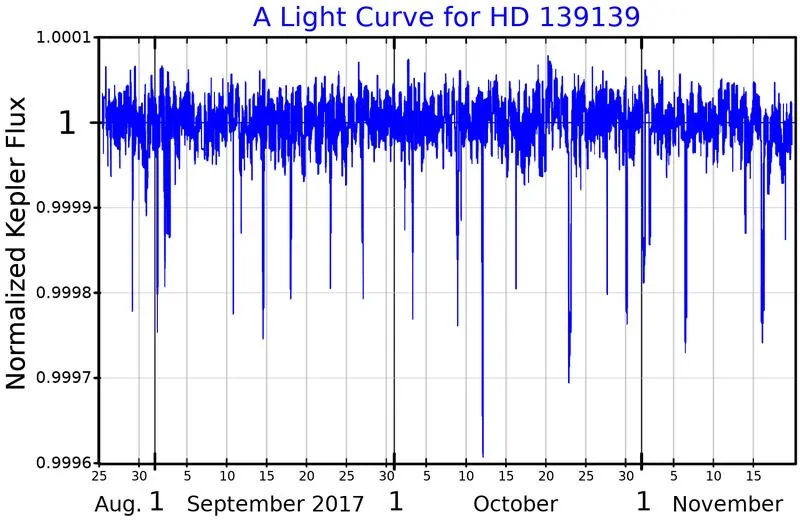
The Kepler telescope's extended mission, K2, pointed at a new field roughly every three months after 2014, recording the brightness of thousands of stars every 30 minutes to find planets[1]. In Campaign 15, in 2017, it recorded HD 139139, a star about 107 parsecs away of nearly the Sun's temperature and about 1.5 billion years old[2]. Volunteers who inspect K2 light curves by eye noticed that its brightness dropped briefly, by about 200 parts per million, 28 times in 87 days. Each dip looked like the transit of a planet about twice the size of Earth. Automatic searches for periodic transits had not flagged it, because the dips were not periodic[2].
Saul Rappaport, Andrew Vanderburg and colleagues published the case in 2019 as "the Random Transiter". They showed that the dip times are consistent with a random-number generator and that no more than four can be fitted by a single period. They checked the obvious instrumental causes and found none, while noting that they could not be certain the dips are astrophysical. A fainter star 3.3 arcseconds away falls in the same photometric aperture and is probably a bound companion, so either star could be the host[2].
They then tried to explain the dips: several planets, planets around each star, planets with huge timing variations, planets in a close binary, a circumbinary planet, a disintegrating planet, a swarm of dust-emitting asteroids, the dipping seen in young stars, and short-lived starspots. Each failed on the data or needed special assumptions[2]. Two short notes have proposed other scenarios[3][4], and a radio search for technosignatures has been made[5]; these are the published follow-ups. Of the 5 questions on this site, 0 are answered. The most likely answer to “Are the 28 dips real changes in starlight, or an instrumental effect?”, not yet confirmed: the dips are astrophysical, on star A or star B.
Key questionsset by the editors
What happened
K2 Campaign 15 observed the field from August to November 2017; HD 139139 was proposed as a target by three guest-observer programmes[2]. The dips were first seen in the Kepler pipeline light curve during a visual survey using the LcTools software, then analysed in a light curve rebuilt from the pixels with the K2SFF method and high-pass filtered to remove starspot modulation[2][6]. In 2018 the team took spectra with the TRES spectrograph on Mount Hopkins and the 2.7-metre telescope at McDonald Observatory, and imaging to measure the neighbour's motion[2]. The paper was posted in June 2019[2].
Timeline
The accounts
The discovery paper is the only full account. Its authors include the citizen scientists who found the dips through a long-running visual survey of K2 light curves, which has also found unusual eclipsing systems and multi-planet systems that automated searches missed[2]. Its stated purpose is to bring the object to wider attention and to ask for better spectra of both stars and high-precision monitoring of the fainter one[2].
What was recorded
The record is one 87-day light curve at 30-minute cadence. Of the 28 events, all but two are 200 ± 80 ppm deep; durations range from 0.75 to 7.4 hours; the mean interval is about three days; depth and duration are not correlated[2]. Box-least-squares and other period searches find no significant period[2]. Tests for rolling-band artefacts, centroid shifts during dips, electronic cross-talk from bright stars and bad pixels found nothing; nearby stars on the detector do not show the dips[2]. Independent reductions of the same pixels, such as the EVEREST light curve, are public alongside the pipeline and K2SFF light curves[7][8][9].
The two stars are well characterised. Star A, HD 139139 itself, is a G-type star of about 5,800 K with solar metallicity, a rotation period of about 14.5 days and a gyrochronological age of 1.5 ± 0.4 billion years, at 106.7–107.8 pc from Gaia. Star B is a K5–K7 star of about 4,400 K, 3.3 arcseconds away and 2.7 magnitudes fainter in the Gaia red band, at a photometric distance of 115 ± 20 pc, with a similar radial velocity and proper motion; the pair is probably bound at about 400 au[2]. Radial velocities rule out stellar or brown-dwarf companions to star A on orbits shorter than about 10 days and low-mass stars on orbits under about 100 days[2]. Century-long DASCH plate photometry and five years of ASAS-SN data show nothing unusual[2].
If the dips are on star A, the bodies would be about twice Earth's radius; if on star B, whose light is diluted about fifteen times by star A, they would be one to two times the size of Jupiter[2]. TESS observed the field in Sector 91 in 2025, and full-frame-image light curves for two catalogue entries at the position are in MAST[8][10].
The explanations
Planets fail on timing. Multiple planets, planets around both stars, and a few planets with very large timing variations cannot reproduce more than about four or five of the dip times; an eccentric planet in a close binary, which would scramble transit times, still left a detectable period in simulations and is opposed by the radial velocities and the single-star spectrum; a circumbinary planet is ruled out by the lack of velocity variation[2].
A disintegrating planet on an orbit of under about 5 hours, transiting only when it happened to be shedding dust, would need to be visible in only 7 per cent of more than 400 transits, near the limit at which a periodicity search would still find it; the average dip profile also lacks the asymmetry such dust tails produce[2]. A swarm of dust-emitting asteroids on many orbits could give random times, but not so many dips of almost the same depth[2].
Two stellar explanations remain open. The dipping seen in young stars with disks could occur on star B and be diluted, but diluted light curves of ten known dippers do not resemble this one and there is no model that explains dippers quantitatively[2]. Spots larger than Earth (on A) or Jupiter (on B) that appear within half an hour, last a few hours and vanish would break no physical law, and such events could have gone unnoticed in other stars; this hypothesis is new and untested[2]. Instrumental origin cannot be fully excluded with one data set[2]. Other scenarios have been put forward in two research notes[3][4]; a technosignature search with the Green Bank Telescope has been reported[5].
Published claims
| Year | Who | Claimed | Status | Reason |
|---|---|---|---|---|
| 2019 | Saul Rappaport and colleagues[2] | The 28 dips are real changes in the light of one of the two stars; data-quality tests found no instrumental cause. | Disputed | CHEOPS saw none of the dips in 2021 and 2022 when it had a 95 per cent chance of seeing one, and lists unidentified K2 noise as one explanation[11]. |
| 2019 | Saul Rappaport and colleagues[2] | No model of planets, planets in or around a binary, a disintegrating planet or dusty asteroids reproduces the random times and near-equal depths of the dips. | Accepted | No later work has found a planetary model that fits, and Schneider withdrew his own close-in planet for the main star[4]. |
| 2019 | Saul Rappaport and colleagues[2] | Short-lived dark spots that appear within half an hour and vanish after a few hours, or dipper behaviour on the fainter star, could explain the dips. | Still possible | Neither has been tested, and without a second detection there is nothing to test them on[11]. |
| 2019 | Jean Schneider[3] | A close-in planet orbiting HD 139139 could produce the dips. | Disputed | Schneider set it aside for HD 139139 after radial velocities over four days showed no such planet, though it may still apply to the fainter star[4]. |
| 2019 | Jean Schneider[4] | The dips might come from an eccentric belt of bodies around HD 139139, from interstellar objects, or from objects in our own Solar System. | Still possible | These are tentative scenarios that no observation has yet tested[4]. |
| 2019 | Bryan Brzycki and colleagues (Breakthrough Listen)[5] | Green Bank observations found no narrowband radio signals from the star, limiting any transmitter to an equivalent isotropic power of 10 TW. | Accepted | It is a straightforward non-detection that no one has disputed[5]. |
| 2023 | Roi Alonso and colleagues (CHEOPS)[11] | CHEOPS saw no dips in 12.75 days of monitoring, so either the dipping stopped or became shallower, the observers were unlucky, or the K2 dips were instrumental noise. | Accepted | The non-detection stands; the 2025 TESS light curve has not yet been searched in a published study[8]. |
What would settle it
A second detection is the first need. High-precision photometry of the pair over several days, resolving the two stars, would show which star dips and whether the dips still occur, which the discovery team asked for directly[2]. A search of the 2025 TESS light curve for dips of the same depth and duration, with injected test dips to measure sensitivity, would show whether TESS can see them at all. If the dips recur, their colour would distinguish dust (deeper in blue), solid bodies (grey) and dark spots (dependent on spot temperature); more radial velocities would tighten the limits on hidden companions. If they never recur in a sensitive search, an undetected instrumental cause in the single K2 data set becomes more likely.
Questions
0 of 5 questions are answered.
Evidence 17 findings
Artifacts
The films, photos, papers and objects this mystery rests on, each with its own key and its distance from the original.
See also
References
- 1.Howell, S., Sobeck, C., Haas, M. et al. 2014. The K2 Mission: Characterization and Early Results. Publications of the Astronomical Society of the Pacific 126(938), 398–408.doicited 2 times hereSRC0D79RVQE0171
- 2.Rappaport, S., Vanderburg, A., Kristiansen, M. et al. 2019. The Random Transiter – EPIC 249706694/HD 139139. Monthly Notices of the Royal Astronomical Society 488(2), 2455–2465.doicited 45 times hereSRC0D79RTR64N25
- 3.Schneider, J. 2019. A Possible Scenario for the Random Transiter EPIC 249706694/HD 139139. Research Notes of the AAS 3(7), 108.doicited 1 time hereSRC0D79RV000BDF
- 4.Schneider, J. 2019. What is Transiting HD 139139?. Research Notes of the AAS 3(9), 141.doicited 1 time hereSRC0D79RV7T0TV6
- 5.Brzycki, B., Siemion, A., Croft, S. et al. 2019. Breakthrough Listen Follow-up of the Random Transiter (EPIC 249706694/HD 139139) with the Green Bank Telescope. Research Notes of the AAS 3(10), 147.doicited 5 times hereSRC0D79RVFM3P1R
- 6.Vanderburg, A., Johnson, J. 2014. A Technique for Extracting Highly Precise Photometry for the Two-Wheeled Kepler Mission. Publications of the Astronomical Society of the Pacific 126(944), 948–958.doicited 4 times hereSRC0D79RVZ83K4W
- 7.Luger, R., Kruse, E., Foreman-Mackey, D. et al. 2018. An Update to the EVEREST K2 Pipeline: Short Cadence, Saturated Stars, and Kepler-like Photometry Down to Kp = 15. The Astronomical Journal 156(3), 99.doicited 2 times hereSRC0D79RW722573
- 8.Space Telescope Science Institute 2026. Mikulski Archive for Space Telescopes (MAST): K2 and TESS light curves. MAST, STScI.cited 11 times hereSRC0D79RWPP39Y5
- 9.NASA Exoplanet Science Institute 2026. K2 Mission Data Resources in the NASA Exoplanet Archive. NASA Exoplanet Archive, Caltech/IPAC.cited 1 time hereSRC0D79RWYG5Z7Z
- 10.Huang, C., Vanderburg, A., Pál, A. et al. 2020. Photometry of 10 Million Stars from the First Two Years of TESS Full Frame Images: Part I. Research Notes of the AAS 4(11), 204.doicited 2 times hereSRC0D79RWEW3N5K
- 11.Alonso, R., Hoyer, S., Deleuil, M. et al. 2023. No random transits in CHEOPS observations of HD 139139. Astronomy & Astrophysics 680, A78.doicited 7 times hereSRC0D79RXE47SN4