ConceptsHomophonic substitution
Concept · cryptography · in 4 mysteries
Homophonic substitution
A cipher in which one plaintext letter can be written as any of several cipher signs.
A substitution cipher that gives the common letters several cipher signs each, so that the cipher text no longer shows the plaintext's letter frequencies. It defeats plain frequency counting, which is why so many of the unread texts on this site have been tested against it: a text whose signs are more numerous than any alphabet, and whose frequencies are flatter than any language's, looks the way a homophonic cipher looks. Breaking one needs more text and a model of the language underneath, or a key.
Where it comes up

Voynich Manuscript
The text is a known language under a homophonic/verbose cipher (several ciphertext units per plaintext letter), units being glyphs, slot-fillers, BPE tokens or whole words.
A known language under a homophonic cipherA published mechanical procedure produced itPeriod practice as a re-spaced stream gives the closest held-out fit to the herbal pages yetNo simulated procedure reproduces the statisticsEndings are more concentrated than Italian'sHomophonic substitution of five languages fails

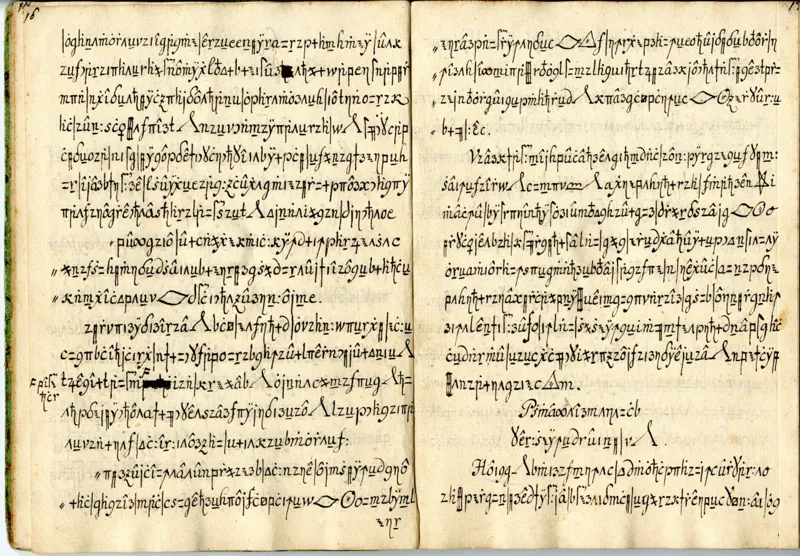
Copiale cipher
The manuscript is a homophonic substitution cipher for eighteenth-century German, with Roman letters as spaces, and the published key reads the whole text.
Methods that use it 1
Cite it
Mysteries Department. (2026). Homophonic substitution [Concept CPT0DECVZY0W38A]. https://mysteriesdept.com/r/CPT0DECVZY0W38A
@misc{mysteriesdept_cpt0decvzy0w38a,
  title     = {Homophonic substitution},
  author    = {{Mysteries Department}},
  year      = {2026},
  note      = {Concept, catalog key CPT0DECVZY0W38A},
  url       = {https://mysteriesdept.com/r/CPT0DECVZY0W38A}
}