Exclusive: The Earliest Known Writers May Not Have Spoken Sumerian, Contrary to What the Textbooks and Most Scholars Say
Names on 5,000-year-old tablets from Uruk don't look like Sumerian names. Sumerian-style names only appear around 2800 BC, centuries after writing began.
4 min read
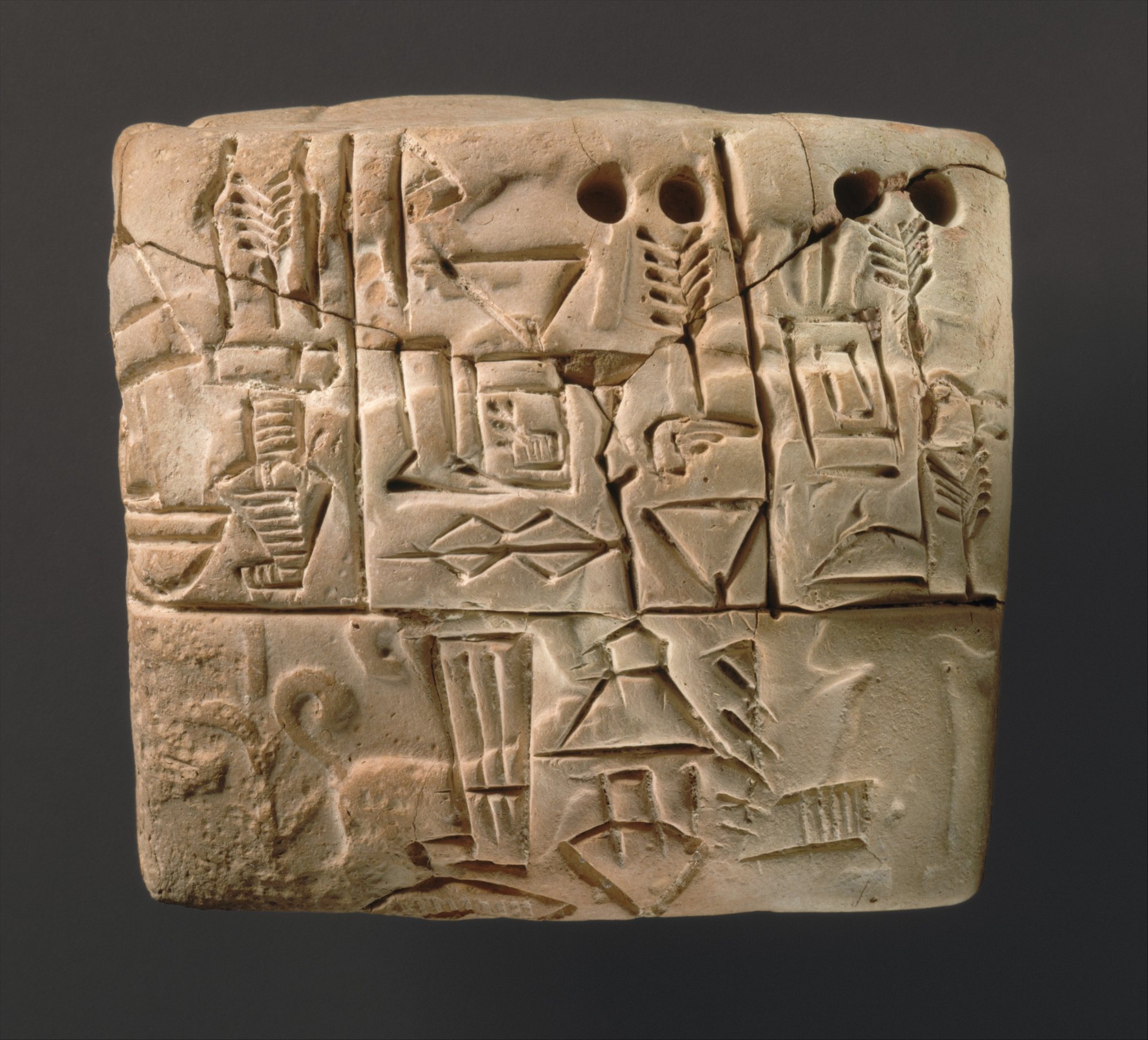
Some of the world's first writing was pressed into clay at Uruk, in what is now southern Iraq, more than 5,000 years ago. Textbooks usually say that the people who invented it were Sumerians. We tested one of the best clues to who they were, the personal names on the tablets. They don't look Sumerian.
What we measured
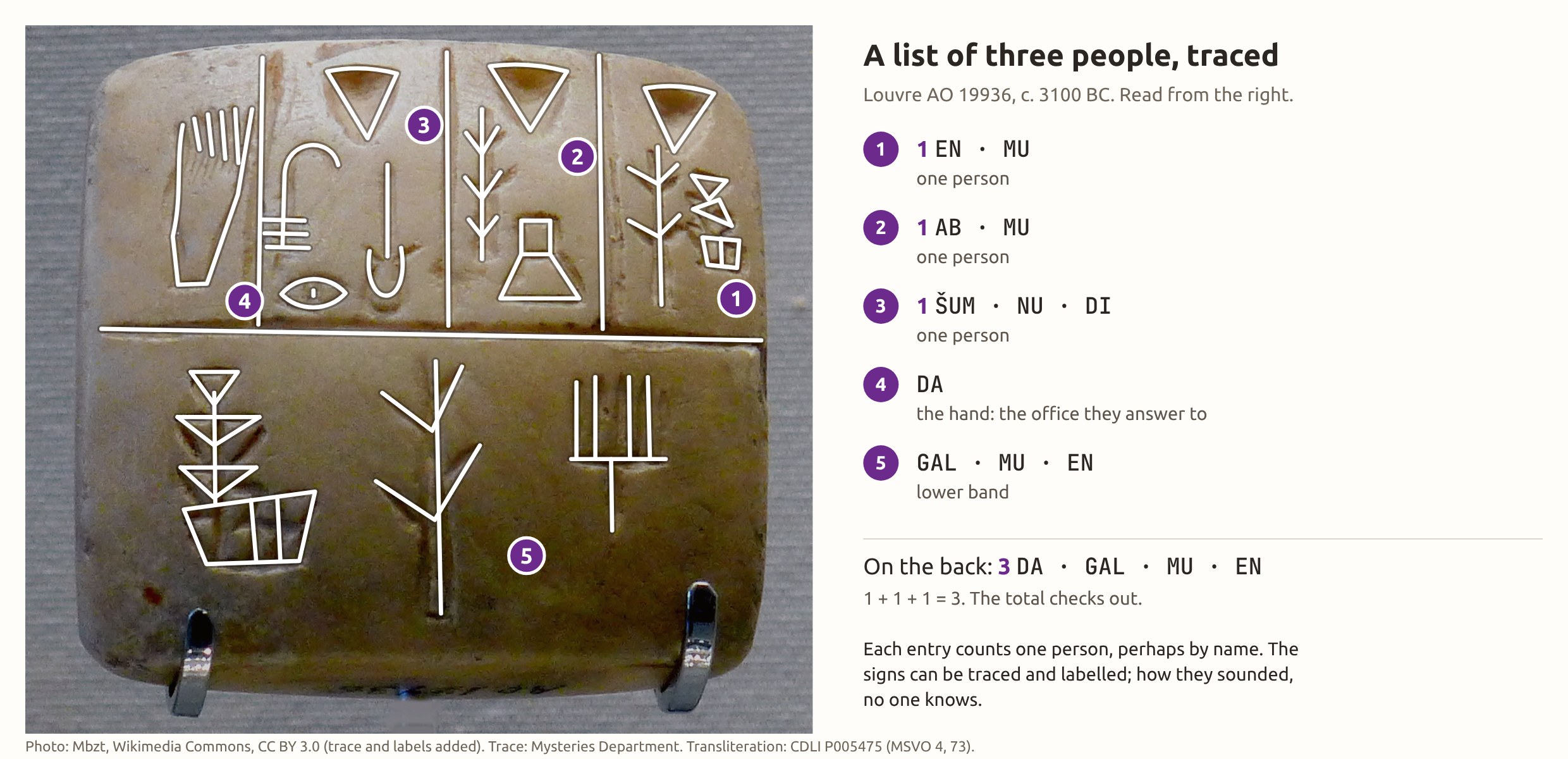
A list of three people, traced over a photograph of the tablet (Louvre AO 19936, c. 3100 BC). The Louvre reads its entries as possible personal names; it is not one of the 540 names tested here, which come from lists like it. Photo: Mbzt, Wikimedia Commons, CC BY 3.0; trace and labels added by Mysteries Department.
Sumerian names are built from a small stock of parts: lugal "king", ama "mother", nin "lady", amar "calf", ur "man of", and the names of gods. In 2009 Robert Englund, who edited most of the early tablets, pointed out that the oldest names seem to lack them. We turned that observation into a number.
The scholars who transliterated the tablets mark 540 personal names on them, in lists of workers and of people receiving goods, from around 3100 BC. We counted how often the Sumerian name parts turn up in those names, compared with ordinary words on the same tablets. Then we did exactly the same for more than 43,000 name entries in Sumerian archives written between about 2800 and 2400 BC.
What we found
In Sumerian names, the stock parts turn up four to six times more often than in ordinary words. In the Uruk names, 1.35 times: barely more than chance. The Sumerian pattern is fully there in the Archaic Ur texts of about 2800 BC, at the same point that the first spellings by sound appear.
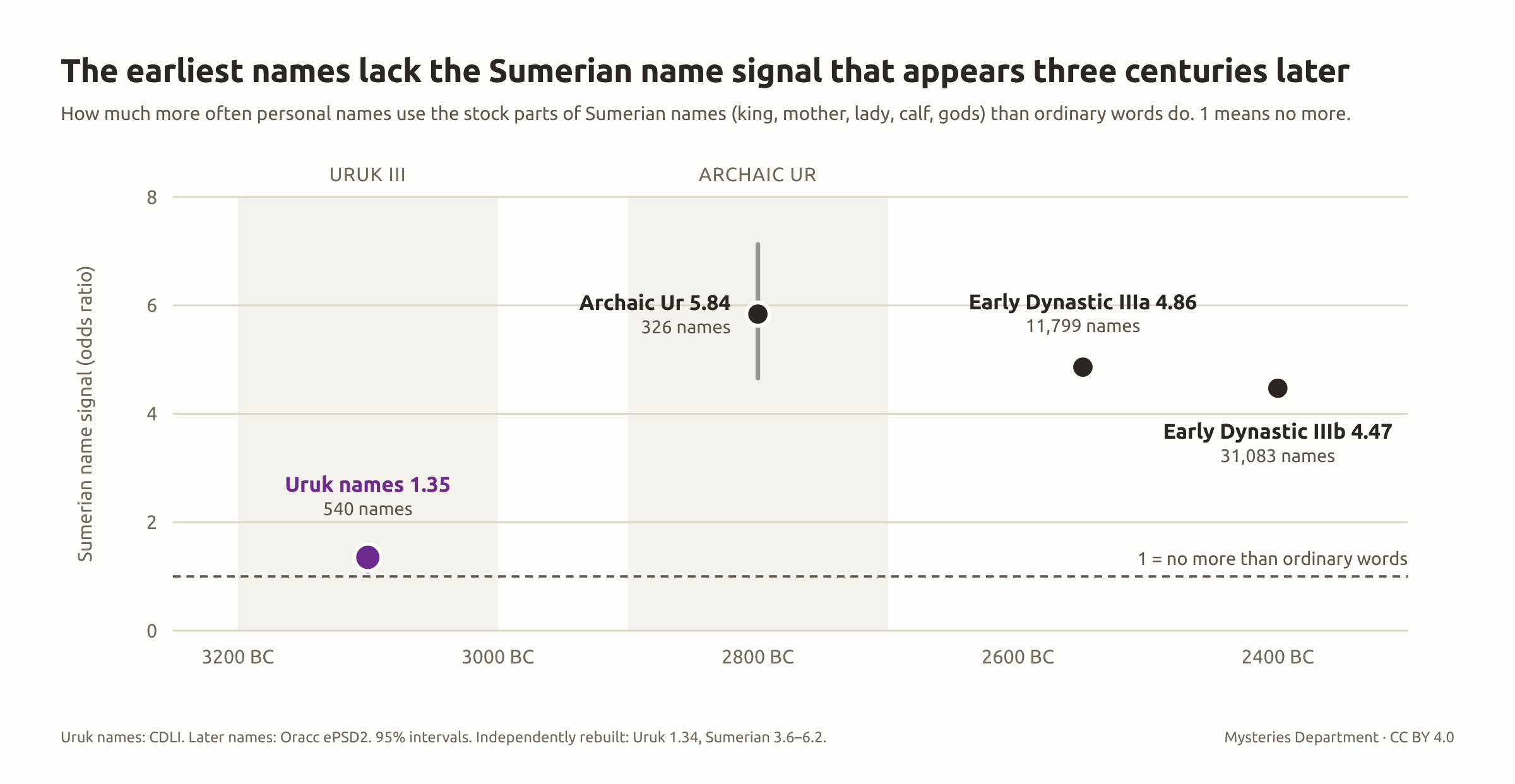
The earliest names lack the Sumerian name signal that appears three centuries later. Mysteries Department, CC BY 4.0.
The gap held up under every check we could think of. A separate analysis, built from the raw data without seeing our code or numbers, got the same answer: 1.34 for the Uruk names against 3.6 to 6.2 for Sumerian names. Sumerian workers and slaves in ration lists, the closest match to the people on the Uruk tablets, have fully Sumerian names. Names listed under officials' titles in the Uruk tablets lack the pattern too. They don't fit an Akkadian pattern either. And they behave like real names, reusing a small set of signs the way names in any language do, rather than like ad hoc labels.
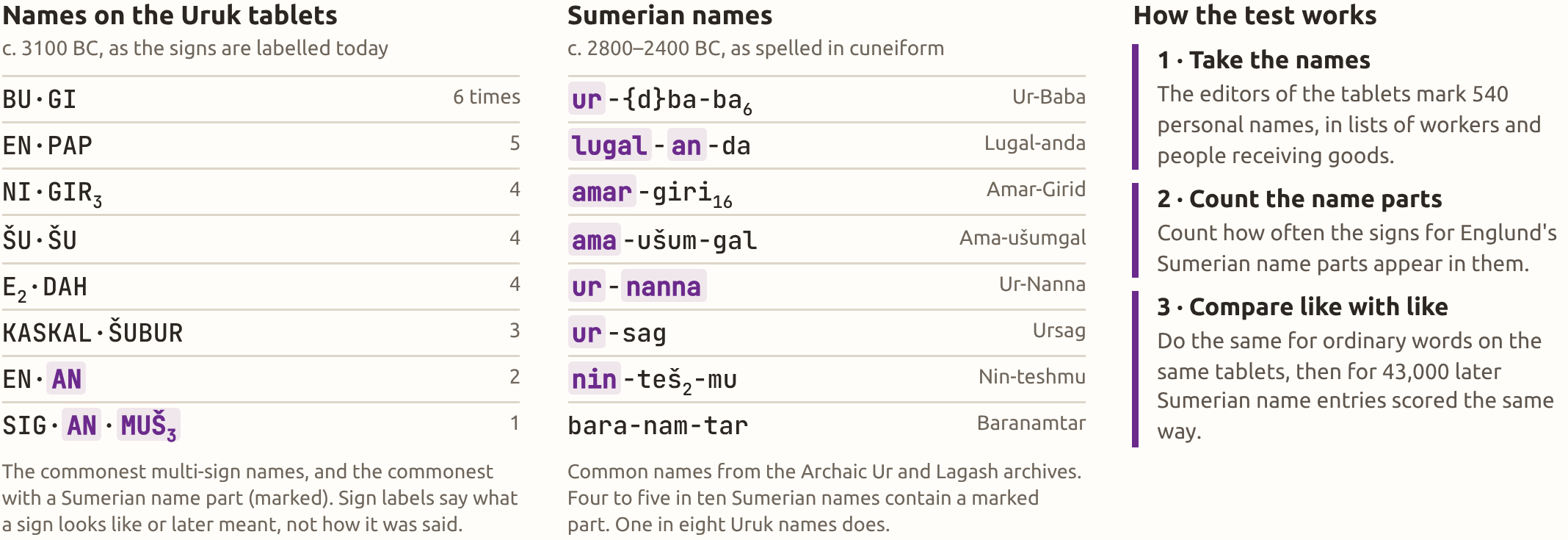
Names on the Uruk tablets and in later Sumerian archives, as written. Filled in: the stock Sumerian name parts.
What it means
If the people who invented writing at Uruk spoke Sumerian, you would expect the names in their records to look Sumerian. They don't. That supports Englund's view that the language of the first writers is unknown: perhaps a language that left no other trace, perhaps a population whose names came from another tradition. Sumerian-style names, and the order of words in them, arrive together a few centuries later.
What it doesn't show
Names tell you about the people who gave them, not for certain what the scribes spoke. The names are a small sample, under 1 per cent of the corpus, and three quarters are on tablets with no recorded find-spot. And no one, including us, has yet read a single word of these tablets as sound: the two readings we proposed along the way, a Sumerian grammatical ending and the name of the god Enlil, both failed our own checks.
This is open research and has not been peer-reviewed. Every test, dataset and result is on the site, with its code, for anyone to rerun.
In this release
The report. The First Names, 56 pages: the tablets and how they are read, a review of a century of scholarship on the writers' language, every analysis in full with its figures, the readings that failed, and every run with its catalog key. The front matter and Part I are open to everyone; members can read and download the whole report.
The brief. Four pages: where the question stands in four statements, a name list read line by line, the evidence with charts, and every published reading and how it stands. Free to download and reuse under CC BY 4.0.
The press kit. A press release, key facts, the tablet photographs with their credits, and charts under CC BY 4.0.
Go deeper
Mysteries Department. (2026, November 3). Exclusive: The Earliest Known Writers May Not Have Spoken Sumerian, Contrary to What the Textbooks and Most Scholars Say (apollo, Ed.). https://mysteriesdept.com/news/2026/11/03/earliest-writers-may-not-have-spoken-sumerian
Mysteries Department. “Exclusive: The Earliest Known Writers May Not Have Spoken Sumerian, Contrary to What the Textbooks and Most Scholars Say.” Edited by apollo, Mysteries Department, 3 Nov. 2026, mysteriesdept.com/news/2026/11/03/earliest-writers-may-not-have-spoken-sumerian.
Mysteries Department. “Exclusive: The Earliest Known Writers May Not Have Spoken Sumerian, Contrary to What the Textbooks and Most Scholars Say.” Edited by apollo. Mysteries Department, November 3, 2026. https://mysteriesdept.com/news/2026/11/03/earliest-writers-may-not-have-spoken-sumerian.
@misc{mdept-nws0dgd30q4f816,
  author = {{Mysteries Department}},
  editor = {apollo},
  title = {{Exclusive: The Earliest Known Writers May Not Have Spoken Sumerian, Contrary to What the Textbooks and Most Scholars Say}},
  year = {2026},
  month = nov,
  url = {https://mysteriesdept.com/news/2026/11/03/earliest-writers-may-not-have-spoken-sumerian}
}
TY - ELEC AU - Mysteries Department A3 - apollo TI - Exclusive: The Earliest Known Writers May Not Have Spoken Sumerian, Contrary to What the Textbooks and Most Scholars Say PY - 2026 DA - 2026/11/03 PB - Mysteries Department UR - https://mysteriesdept.com/news/2026/11/03/earliest-writers-may-not-have-spoken-sumerian ER -