Press kit: Proto-cuneiform: the archaic texts of Uruk
Press release Copy textText
The earliest known writers may not have spoken Sumerian, contrary to what the textbooks and most scholars say
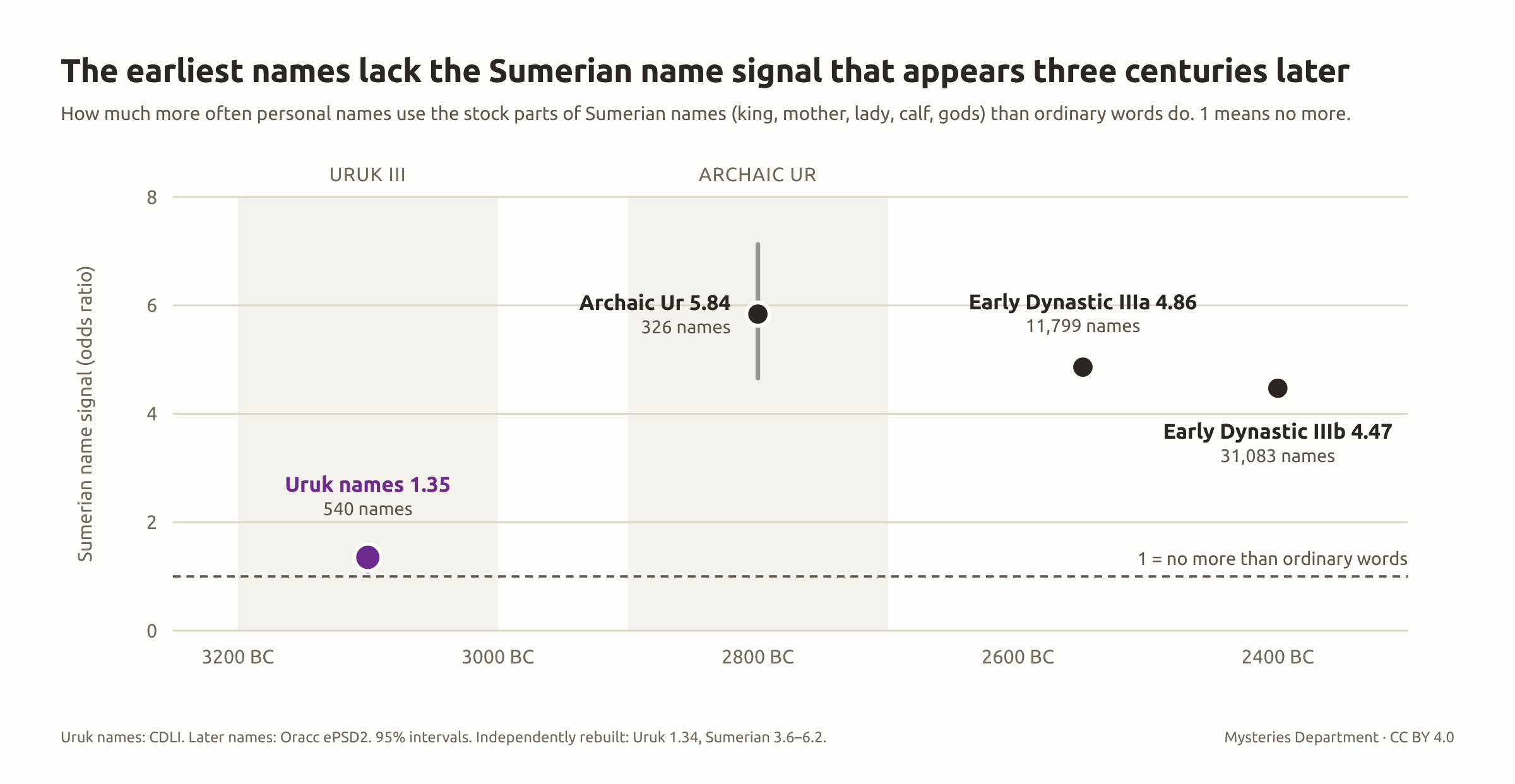
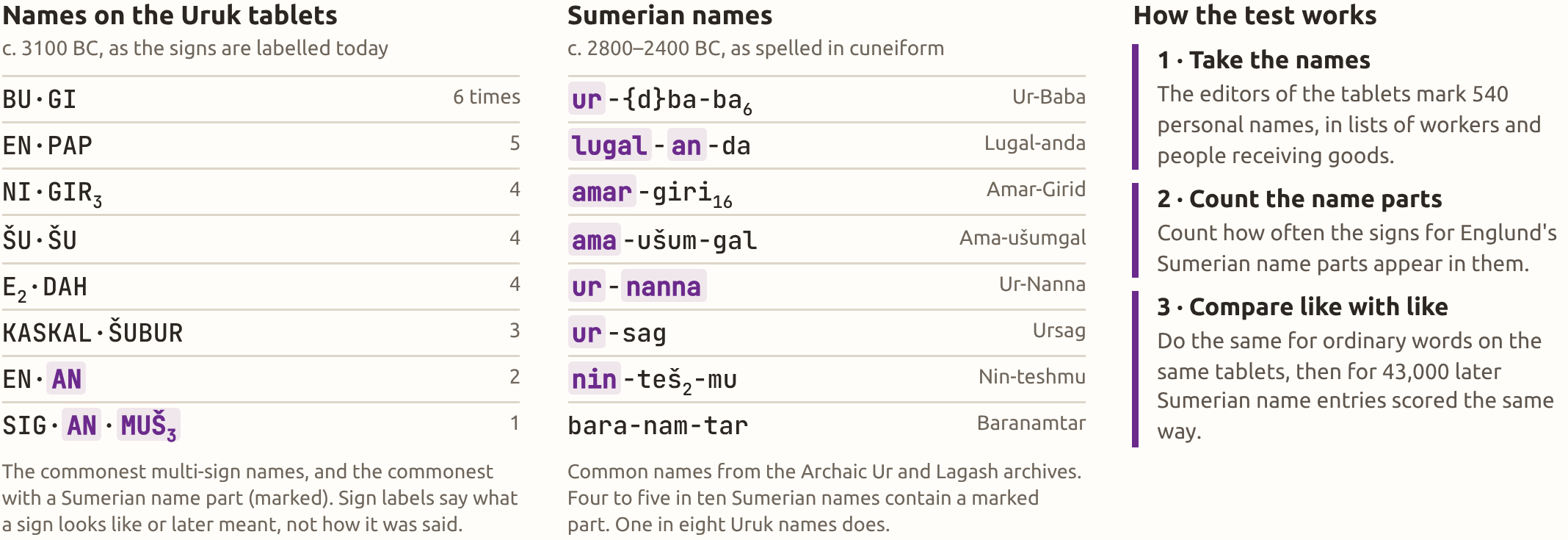
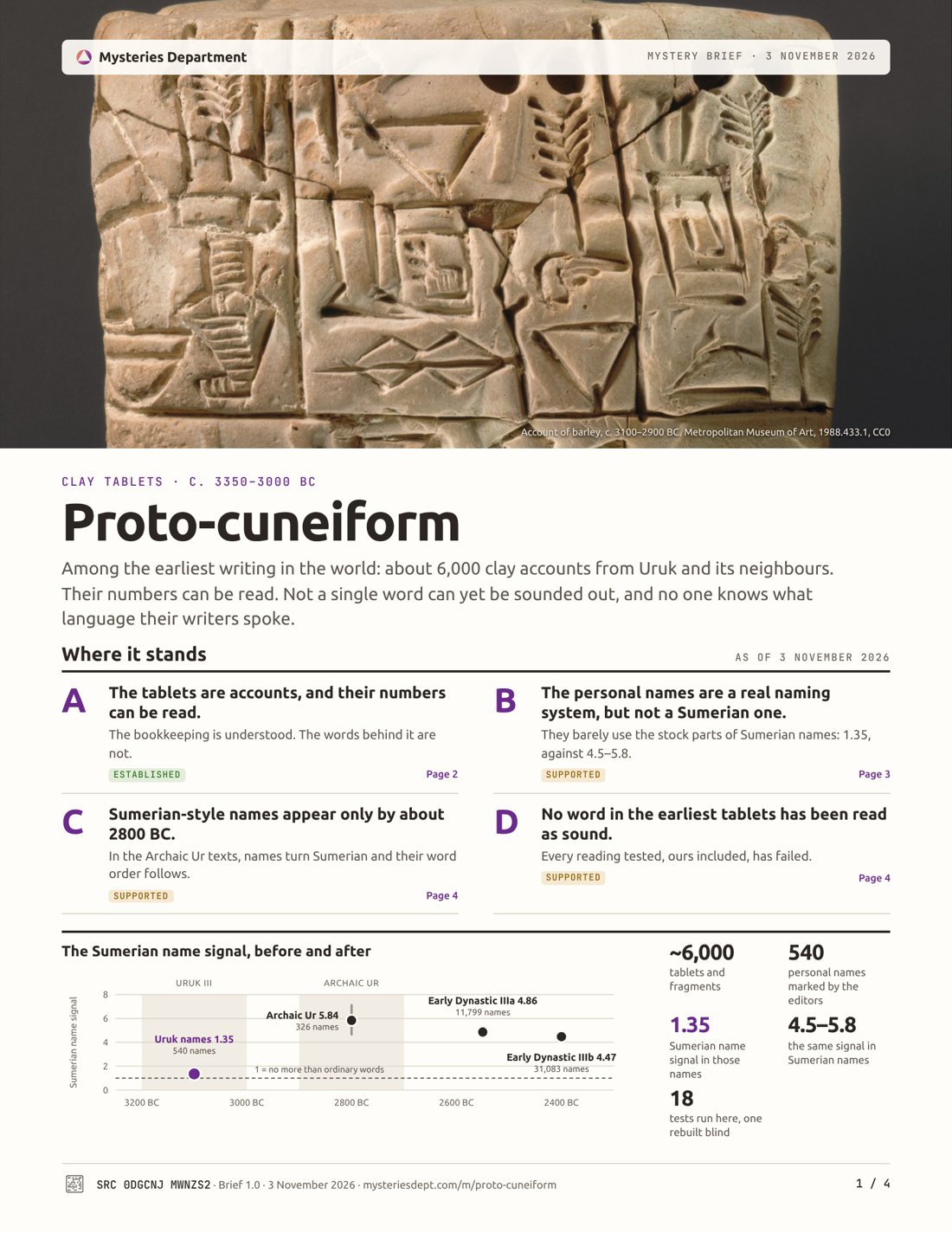
The personal names recorded on some of the world's first written documents, clay tablets from Uruk in southern Iraq written around 3100 BC, do not follow the pattern of Sumerian names, according to an analysis published today by Mysteries Department, an open research platform for unsolved mysteries. Sumerian names use their stock parts, such as "king", "mother" and the names of gods, four to six times more often than ordinary words do. The Uruk names use them 1.35 times as often, barely more than chance.
The Sumerian pattern is fully present in the Archaic Ur texts of about 2800 BC, when the first spellings by sound also appear. An independent re-analysis, built from the raw data without access to the original code or results, reproduced the finding. The gap is not explained by the social class of the people named, by officials' names, or by an Akkadian naming pattern.
The result supports the view of Robert Englund, who edited most of these tablets, that the language of the first writers is unknown, against the long-standing assumption that they were Sumerian speakers. It does not identify their language, and no word of the tablets has yet been read as sound. The work is open research and has not been peer-reviewed; every test, dataset and result is public at mysteriesdept.com.
The earliest writing of Mesopotamia: about 6,000 clay tablets from Uruk, Jemdet Nasr, Umma and other sites, c. 3350–3000 BC, almost all administrative. Their numbers can be read; their words cannot be sounded out.
Mysteries DepartmentAn open research platform for the world's unsolved mysteries. Sources, data and methods are shared, and every result can be rerun from its code and data.
- Mystery
- Proto-cuneiform: the archaic texts of Uruk
- Version
- 1.0
- Date
- 3 Nov 2026
- Findings
- 53, of which 2 established
- Questions
- 10; 5 key
- Editor
- apollo
Key facts
Images Free to use with the credit shown on each.All images (ZIP)
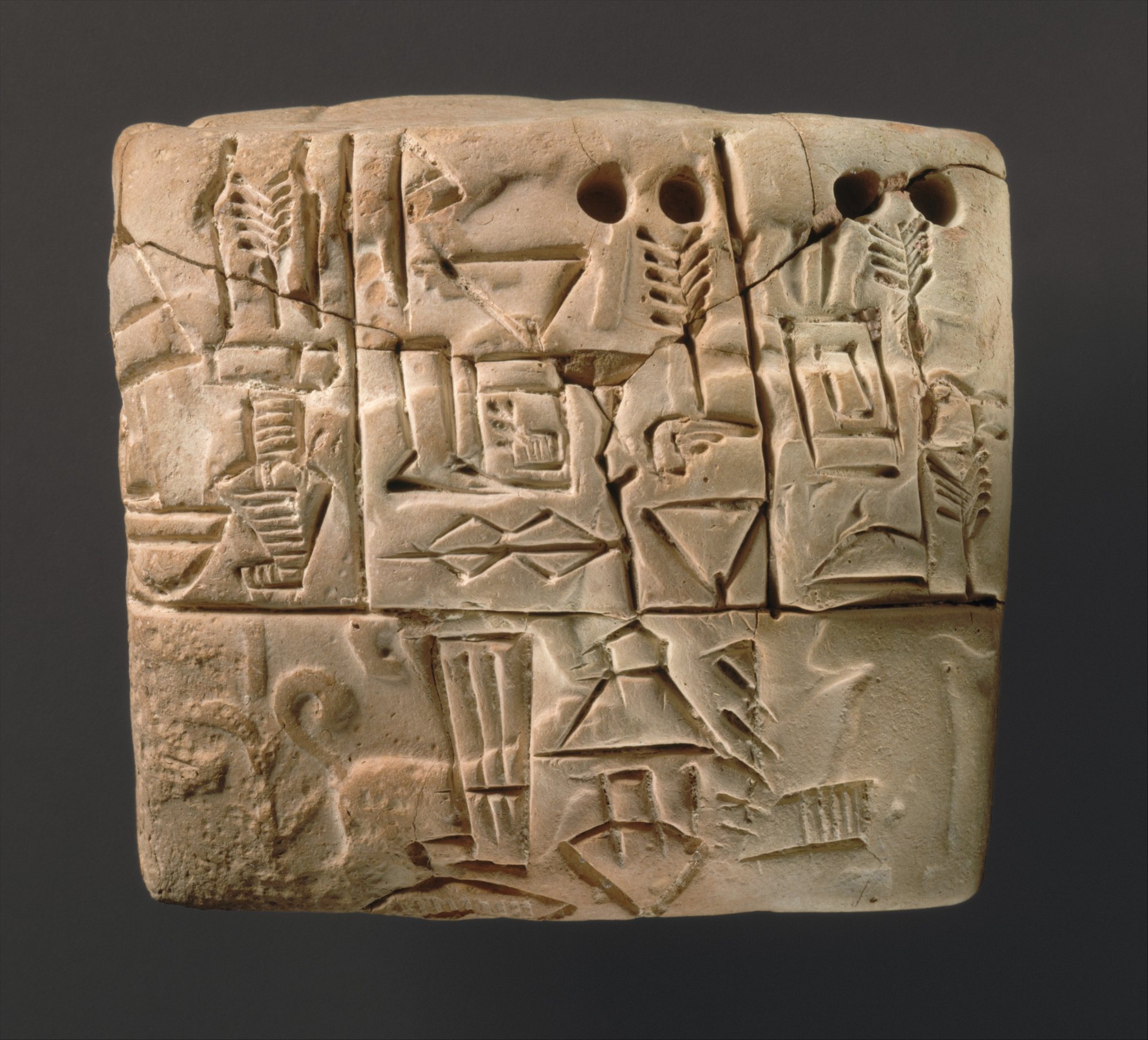 tablet
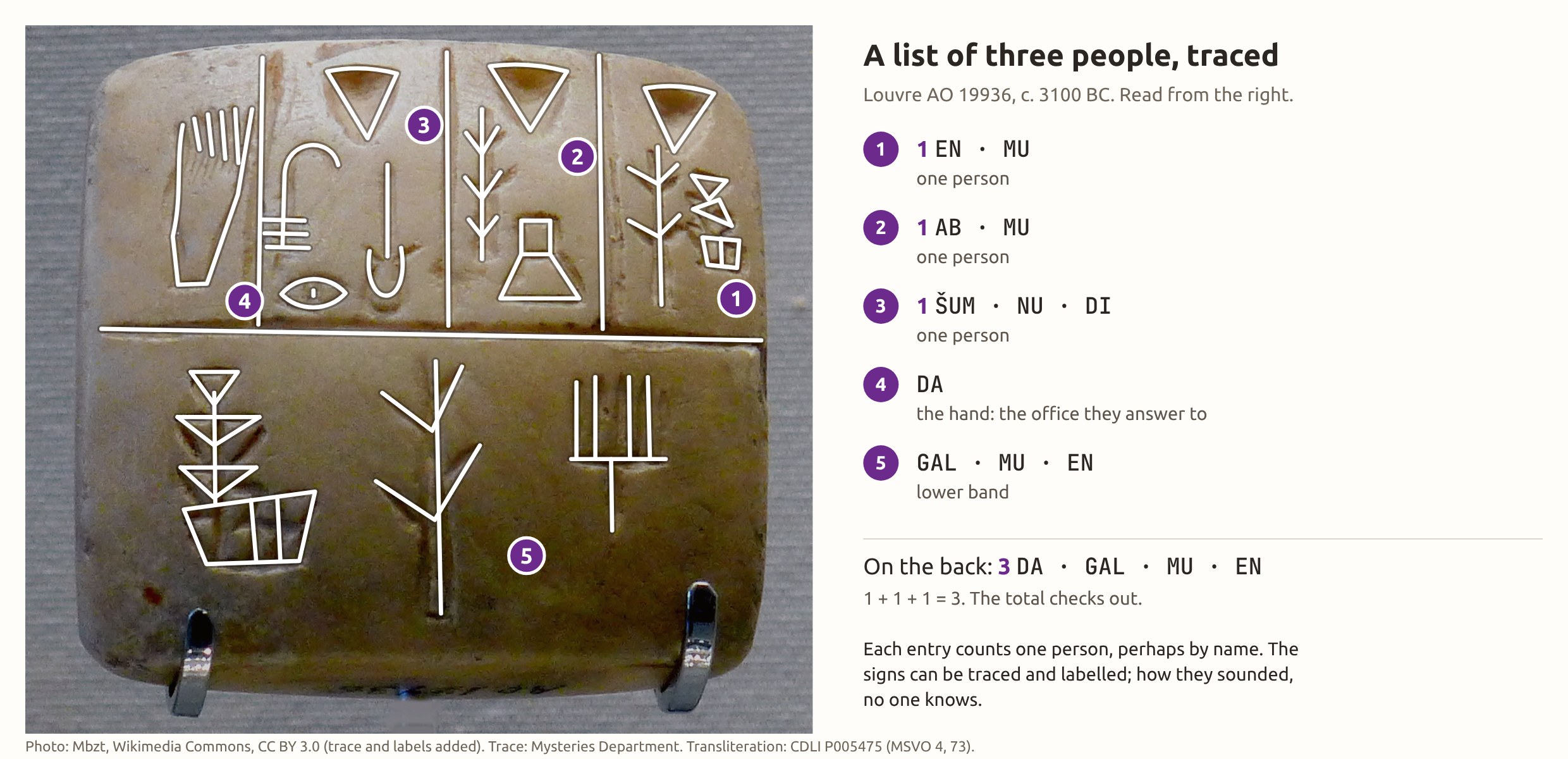 traced
Charts CC BY 4.0. Credit Mysteries Department.All charts (ZIP)
Documents
Using these
Metropolitan Museum of Art, 1988.433.1 (CC0) · Photo Mbzt, Wikimedia Commons (CC BY 3.0), trace Mysteries Department
Mysteries Department, mysteriesdept.com (CC BY 4.0)
How to cite
Mysteries Department. (2026). Proto-cuneiform: the archaic texts of Uruk: Press kit (Version 1.0) [SRC0DGCNJMWNZS2]. https://mysteriesdept.com/mysteries/proto-cuneiform/releases/press-kit/1.0
Mysteries Department. “Proto-cuneiform: the archaic texts of Uruk: Press kit.” Version 1.0. 3 November 2026. https://mysteriesdept.com/mysteries/proto-cuneiform/releases/press-kit/1.0.
@misc{mysteriesdept_proto_cuneiform_the_archaic_texts_of_uruk_press_kit_2026,
  author    = {{Mysteries Department}},
  title     = {Proto-cuneiform: the archaic texts of Uruk: Press kit},
  version   = {1.0},
  year      = {2026},
  note      = {SRC0DGCNJMWNZS2},
  url       = {https://mysteriesdept.com/mysteries/proto-cuneiform/releases/press-kit/1.0}
}
TY - GEN TI - Proto-cuneiform: the archaic texts of Uruk: Press kit AU - Mysteries Department PY - 2026 ET - 1.0 UR - https://mysteriesdept.com/mysteries/proto-cuneiform/releases/press-kit/1.0 ER -