The Pictish symbol stones
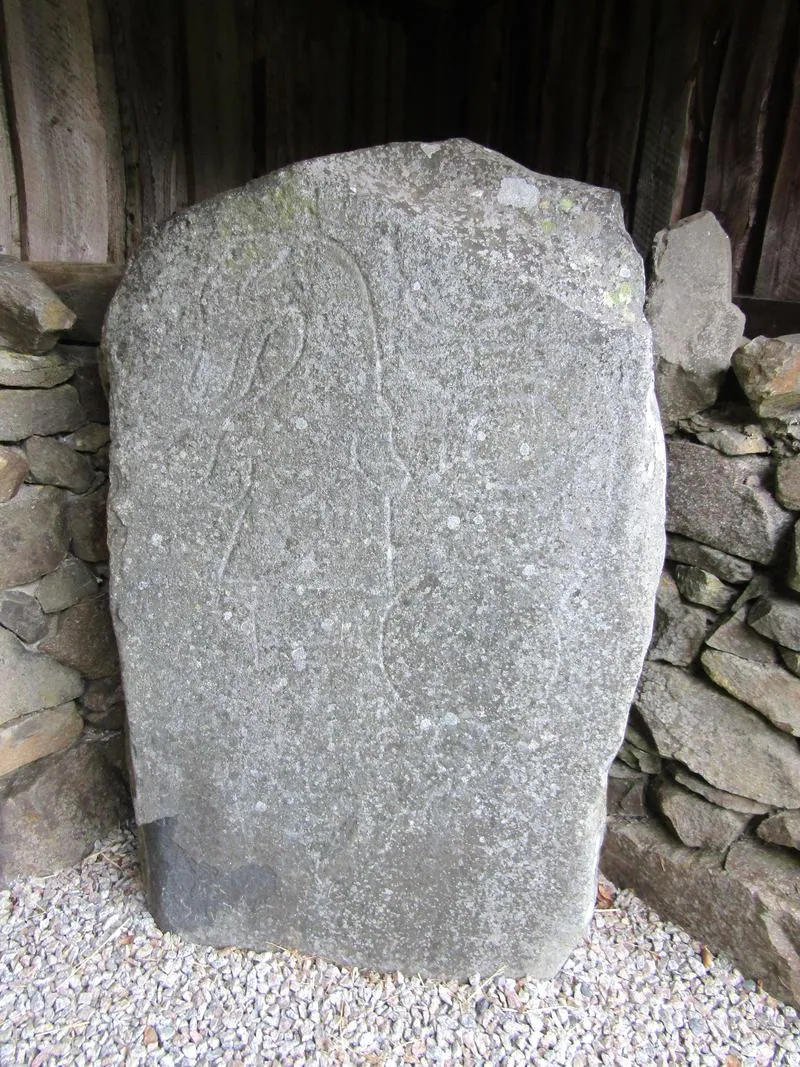
The Picts were the people of northern and eastern Scotland in the late Roman and early medieval periods. Their most distinctive remains are stones carved with symbols: a crescent crossed by a V-shaped rod, a double disc crossed by a Z-shaped rod, a comb and mirror, a fish, a snake, a beast often called the Pictish beast, and a few dozen others[1][2]. About 200 such stones are known[2]. The same symbols, drawn to the same conventions, appear across northern and eastern Scotland, and on silver ornaments and cave walls as well as stone[1][3].
Most stones carry one to three symbols, typically a pair, sometimes with a comb and mirror added, and Lee and colleagues reported regularities in how symbols combine[4][3]. That regularity is why many scholars think the symbols record something specific, and the most common proposal is personal names[5][6]. Others have treated them as emblems that need not encode words[7].
In 2010 Rob Lee, Philip Jonathan and Pauline Ziman argued from a measure of information entropy that the symbol sequences have the statistics of written language, not of heraldry or random marks[4]. Richard Sproat disputed the method, and in 2014, testing on a larger set of written and non-linguistic corpora, found that the best-performing measures classify the Pictish symbols as non-linguistic[8][9]. In 2018 Gordon Noble and colleagues published radiocarbon dates showing that the symbols were in use by the third or fourth century AD, centuries earlier than had been assumed[6]. Of the 4 questions on this site, 1 are answered. The most likely answer to “Are the Pictish symbols a writing system?”, not yet confirmed: the symbols are emblems of rank, kin group, office or territory that do not encode words.
Key questionsset by the editors
The object
The stones were classified in 1903 by J. Romilly Allen and Joseph Anderson into three groups that are still used: Class I, undressed boulders or slabs incised with symbols only; Class II, dressed slabs carved in relief with a cross and symbols; and Class III, cross-slabs without the symbols[10]. The national catalogue, The Pictish Symbol Stones of Scotland, published by the Royal Commission on the Ancient and Historical Monuments of Scotland in 2008, lists every known stone with photographs and locations[1]. Each stone also has a record in Canmore, the national record of the historic environment, maintained by Historic Environment Scotland[11].
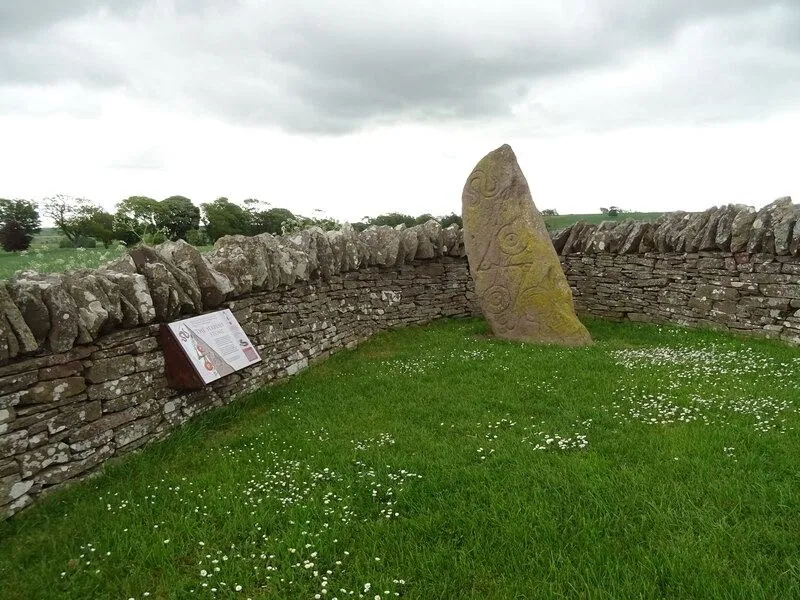
New stones still turn up. In 2022 a team led by Gordon Noble of the University of Aberdeen excavated a symbol stone at Aberlemno in Angus, carved with triple ovals, a comb and mirror, a crescent and V-rod and double discs, some cut over others; it had been reused as paving in an eleventh- or twelfth-century building[2][12].
Timeline
What is known
The symbol inventory is small and stable. Lee and colleagues built a pictorial corpus of every symbol on stones, metalwork and caves, defined a catalogue of symbol types from it, and found the corpus to be short (one to three symbols per stone) and small, under a thousand symbols in all[4][3].
The dating changed in 2018. Earlier art-historical work placed the start of the system in the sixth or seventh century AD. Noble, Goldberg and Hamilton dated symbol-bearing contexts directly: the carvings from the promontory fort of Dunnicaer near Stonehaven came from a settlement at its height in the third to fourth centuries AD; bone objects and settlement layers in the Northern Isles showed the symbols in use in the fifth century; and Bayesian modelling dated the fort at Rhynie, with its symbol stones, to the late fourth to early sixth century[6][13]. The authors argued that the symbols formed a naming system that developed at the same time as Irish ogham and Scandinavian runes, beyond the Roman frontier[6]. Excavation at Rhynie had already linked symbol stones to a high-status settlement[14].
What has been tested
The main computational test is the 2010 entropy study. Lee, Jonathan and Ziman built a two-parameter decision tree, based in part on bigram conditional entropy, that sorts small symbol corpora by the kind of communication system they come from, calibrated on known writing systems and non-linguistic sets. It placed the Pictish symbols with writing and not with random or heraldic systems[4][9]. A longer companion paper concluded that the symbols are most likely words and mostly names[3].
The method was challenged at once. A linguist's comment argued that turning carvings into linear symbol strings and the features of archaic writing systems could bias the result, that the line between writing and drawing is less sharp than the method assumes, and that the conclusion remained pending[15]; the authors replied[16]. Sproat questioned the method and the review practices of general science journals that published such claims[8]; Lee and colleagues responded[17]. In 2014 Sproat tested the published measures on a larger set of written and non-linguistic corpora and found none of them useful as published. One of Lee's measures with a different cut-off, and a new measure based on repetition, did separate the two groups, and both classified the Pictish symbols as non-linguistic[9].
The readings
Three readings are live. The first is that the symbols are a writing system for names. Ross Samson argued in 1992 that the paired symbols record personal names; the 2010 statistics and the 2018 dating were read in the same direction[5][3][6]. The second is that they are emblems, standing for rank, kin group, office or territory without encoding words, which is consistent with Sproat's 2014 classification[7][9]. The third, that they are decoration or religious images without a fixed meaning, is hard to square with the strict conventions and pairing[4]. Readings of individual symbols, for example the crescent and V-rod as a name element or a rank, have not been tested in a way that could fail.
Published claims
| Year | Who | Claimed | Status | Reason |
|---|---|---|---|---|
| 1903 | J. Romilly Allen and Joseph Anderson[10] | Pictish stones fall into three classes in date order: symbols alone (Class I), symbols with a relief cross (Class II), and crosses without symbols (Class III). | Disputed | The classes are still used as labels, but Class I and Class II stones are now thought to have been made over overlapping periods[18]. |
| 1963 | Charles Thomas[7] | The symbols are a non-alphabetic system of emblems with roots in Iron Age art, not a form of writing. | Most likely | Sproat's 2014 test classes the symbols as non-linguistic, which fits, but nothing yet shows what the emblems stood for[9]. |
| 1984 | Anthony Jackson[19] | Each symbol pair records a marriage alliance between matrilineal lineages. | Still possible | It has not been tested, and the purpose of the stones is still only slightly understood[18]. |
| 1992 | Ross Samson[5] | The paired symbols are a writing system that records personal names. | Disputed | The 2018 dating fits a naming system that arose beside ogham and runes, but the best statistical test classes the symbols as non-linguistic[6][9]. |
| 2010 | Rob Lee, Philip Jonathan and Pauline Ziman[4] | An entropy-based decision tree shows the symbol sequences have the statistics of written language, not of heraldry or random marks. | Disputed | Tested on a larger set of written and non-linguistic corpora, the published measures did not separate the two reliably[9]. |
| 2014 | Richard Sproat[9] | The published measures cannot tell writing from non-linguistic symbols, and the measures that can classify the Pictish symbols as non-linguistic. | Most likely | It rests on many more test corpora than the 2010 study, but the Pictish corpus is under a thousand symbols, which limits any statistic[3]. |
| 2018 | Gordon Noble, Martin Goldberg and Derek Hamilton[6] | Radiocarbon dates show the symbols were in use by the third or fourth century AD, centuries earlier than art-historical dating allowed. | Accepted | Dates from Dunnicaer, the Northern Isles and Rhynie agree, and Rhynie's excavation had already tied symbol stones to a fifth to sixth-century high-status site[14]. |
What would settle it
A bilingual would settle it: a stone with symbols and a Latin or ogham inscription naming the same person. Short of that, two tests can be run. One is whether symbol pairs pattern like name elements, with constraints on which symbol takes first and second place similar to those in recorded Pictish and Celtic names. The other is a corrected version of the statistical test, run with a null model built from non-linguistic emblem systems of similar size and pairing structure, which would show whether the 2010 result survives Sproat's objection. Systematic radiocarbon dating of more symbol-bearing contexts would show how the inventory changed over time.
Questions
1 of 4 questions are answered.
Evidence 12 findings
Artifacts
The films, photos, papers and objects this mystery rests on, each with its own key and its distance from the original.
See also
References
- 1.Fraser, I. 2008. The Pictish Symbol Stones of Scotland. Royal Commission on the Ancient and Historical Monuments of Scotland, Edinburgh.cited 2 times hereSRC0CQHA9Q22KP8
- 2.University of Aberdeen 2022. Stone me! Rare Pictish symbol stone found near potential site of famous battle. University of Aberdeen News.cited 3 times hereSRC0CQHAAEG2VZQ
- 3.Lee, R. 2010. The use of information theory to determine the language character type of Pictish symbols. Scottish Archaeological Journal 32(2), 137-176.doicited 2 times hereSRC0CQHA7GR32SM
- 4.Lee, R., Jonathan, P., Ziman, P. 2010. Pictish symbols revealed as a written language through application of Shannon entropy. Proceedings of the Royal Society A 466(2121), 2545-2560.doicited 8 times hereSRC0CQHA78Y1Y9C
- 5.Samson, R. 1992. The Reinterpretation of the Pictish Symbols. Journal of the British Archaeological Association 145(1), 29-65.doicited 4 times hereSRC0CQHA8ZM2TW2
- 6.Noble, G., Goldberg, M., Hamilton, D. 2018. The development of the Pictish symbol system: inscribing identity beyond the edges of Empire. Antiquity 92(365), 1329-1348.doicited 14 times hereSRC0CQHA6SA1V57
- 7.Thomas, C. 1963. The Interpretation of the Pictish Symbols. Archaeological Journal 120(1), 31-97.doicited 4 times hereSRC0CQHA97E3WCS
- 8.Sproat, R. 2010. Ancient Symbols, Computational Linguistics, and the Reviewing Practices of the General Science Journals. Computational Linguistics.doicited 6 times hereSRC0D8MT1HT76XS
- 9.Sproat, R. 2014. A Statistical Comparison of Written Language and Nonlinguistic Symbol Systems. Language.doicited 20 times hereSRC0D8MT1SM3EB0
- 10.Allen, J., Anderson, J. 1903. The Early Christian Monuments of Scotland. Society of Antiquaries of Scotland, Edinburgh.cited 8 times hereSRC0CQHA9F832Z5
- 11.Historic Environment Scotland 2026. Canmore: National Record of the Historic Environment (point data). Historic Environment Scotland.cited 7 times hereSRC0CQHA9YW03PJ
- 12.Geggel, L. 2022. Unknown symbols written by the lost 'painted people' of Scotland unearthed. Live Science.cited 2 times hereSRC0CQHAAPA7BMP
- 13.Medievalists.net 2018. Pictish stone symbols date back hundreds of years earlier than first believed, study shows. medievalists.net.cited 1 time hereSRC0CQHA71476XD
- 14.Noble, G., Gondek, M., Campbell, E. et al. 2013. Between prehistory and history: the archaeological detection of social change among the Picts. Antiquity 87(338), 1136-1150.doicited 3 times hereSRC0CQHAA6P269V
- 15.Fournet, A. 2010. A linguist's comment on 'Pictish symbols revealed as a written language through application of Shannon entropy'. Proceedings of the Royal Society A 467(2126), 305-308.doicited 2 times hereSRC0CQHA7RJ0WKY
- 16.Lee, R., Jonathan, P., Ziman, P. 2010. Reply to Fournet: Pictish symbols revealed as a written language through application of Shannon entropy. Proceedings of the Royal Society A 467(2126), 309-313.doicited 1 time hereSRC0CQHA80C2SZK
- 17.Lee, R., Jonathan, P., Ziman, P. 2010. A Response to Richard Sproat on Random Systems, Writing, and Entropy. Computational Linguistics 36(4), 791-794.doicited 1 time hereSRC0CQHA8G03ASJ
- 18.Wikipedia contributors n.d.. Pictish stone. Wikipedia.cited 1 time hereSRC0CQHAB5Y00JX
- 19.Jackson, A. 1984. The Symbol Stones of Scotland: A Social Anthropological Resolution to the Problem of the Picts. Orkney Press, Kirkwall.cited 1 time hereSRC0CQHAAY44H4T