The Flor de la Mar
The Flor de la Mar (Frol de la Mar in the chronicles) was built at Lisbon in 1502 for the India run, at about 400 tons the largest Portuguese nau of her day and, from her first return voyage, known to leak when laden[1][2]. Kept in the East after 1507, she served at Socotra, Muscat and Ormuz, was Almeida's flagship at Diu in 1509 and Albuquerque's at Goa in 1510 and Malacca in 1511[1].
After the capture of Malacca, Albuquerque embarked in her for India with the Trindade, the Enxobregas and a laden junk. The Commentaries compiled by his son say the governor, steering for the channel by which he had come, "was wrecked on some shallows off the coast of Sumatra, and miraculously saved": the ship broke up in a storm at night, Albuquerque reached the Trindade on a raft with two mariners, the men left on the wreck built a second raft from the mast and yard, and the junk sailed on and was lost to a mutiny[3]. Gaspar Correia, quoted in Birch's notes, has the fleet leaving Malacca on 1 December 1511 and reaching Cochin in January 1512 with the surviving ships half lost[3]. Modern references give the night of 20 November 1511 and a position off the kingdom of Aru; the chronicles do not agree on the date and give no position closer than the Sumatran coast between Pasai and Aru[1].
What was aboard is the mystery's substance. The Commentaries devote a chapter to "what was lost in the ship Flor de la Mar": the spoils of the Malacca palace and city, gifts and curiosities Albuquerque was sending to King Manuel, among them a bracelet he prized and bronze lions from the sultan's palace, with a crown, a gold sword and a ruby ring from the King of Siam among the few things saved[3][1]. No inventory, weight or value is given. The figures in circulation, from "60 tons of gold" to "$2.6 billion", are twentieth-century estimates by treasure hunters[1]. Of the 3 questions on this site, 0 are answered. The most likely answer to “What was lost with the ship?”, not yet confirmed: a selection of valuable objects and gifts (the bracelet, the bronze lions, Malacca palace goods) and a share….
Key questionsset by the editors
What is known
The loss is as well attested as any event of the Portuguese expansion: it is in the Commentaries, in Barros's Décadas, in Correia's Lendas da Índia and in the letters to the king that these drew on, and Albuquerque's own survival on a raft became a set piece of his legend[3][1]. The chronicles agree that the ship struck shoals off the north-east coast of Sumatra in bad weather at night, that she broke up, that the governor and some of the company were taken off by the Trindade, and that the cargo went down[3]. They disagree on the date by about a fortnight and are vague on the place: the Sumatran coast between the kingdom of Pasai (Pacem), where the Portuguese had dealings that year, and Aru to the south-east[3][1].
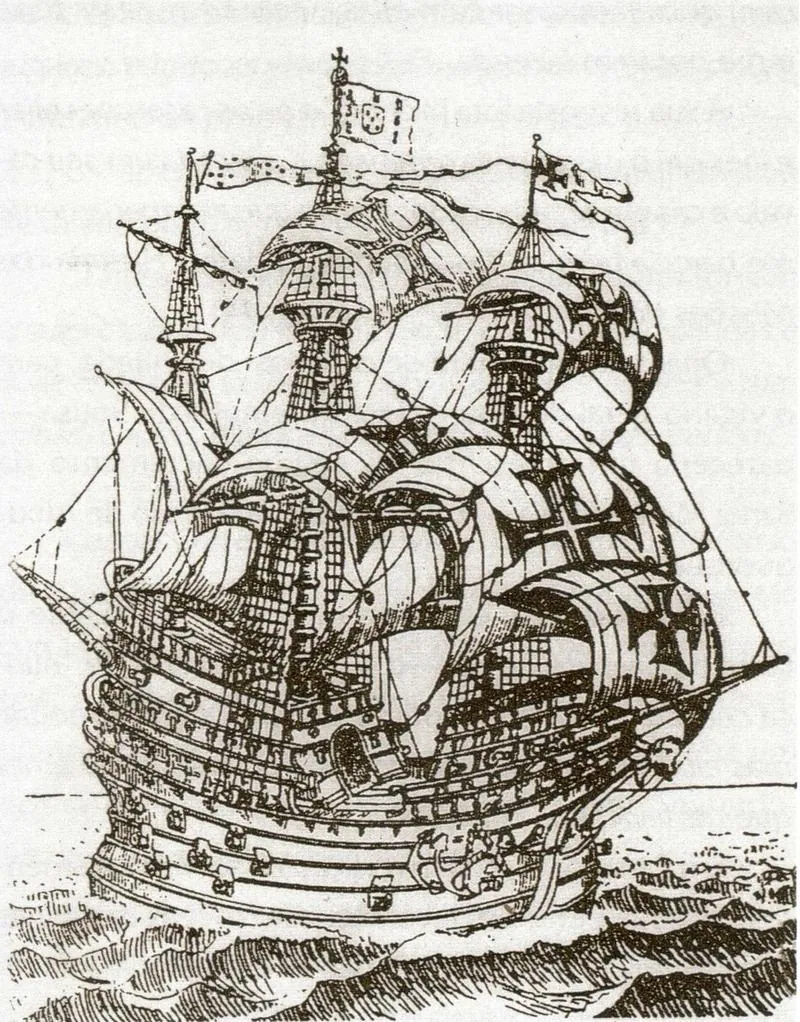
The cargo is described, not listed. It consisted of what Albuquerque had chosen from the sack of Malacca for the king and for himself, and of diplomatic gifts; the chronicler names a few objects and says the rest was lost[3]. Portuguese royal accounts of what the Malacca expedition yielded, and what reached Lisbon, exist in the Torre do Tombo and would bound the figure; they have not been brought to bear on the treasure claims. The ship herself was a tired vessel, nine years old when naus were built for three or four, and already known to open her seams when loaded, which the chroniclers' remarks on her state bear out[1].
Timeline
The search
No wreck has been located. The search history is a matter of claims: a Portuguese article of 1989, surveys and announcements by treasure hunters in the late 1980s and 1990s under Indonesian licence, and periodic assertions since, none accompanied by a published site, artefact or report[1]. The area is a shallow, silted coast with strong currents, where a wooden ship broken up on a bank five centuries ago would have left ballast, guns, ceramics and metal scattered and buried; the Malacca plunder, if it included Chinese porcelain, bronze and gold, would survive, but its bulk is unknown[3].
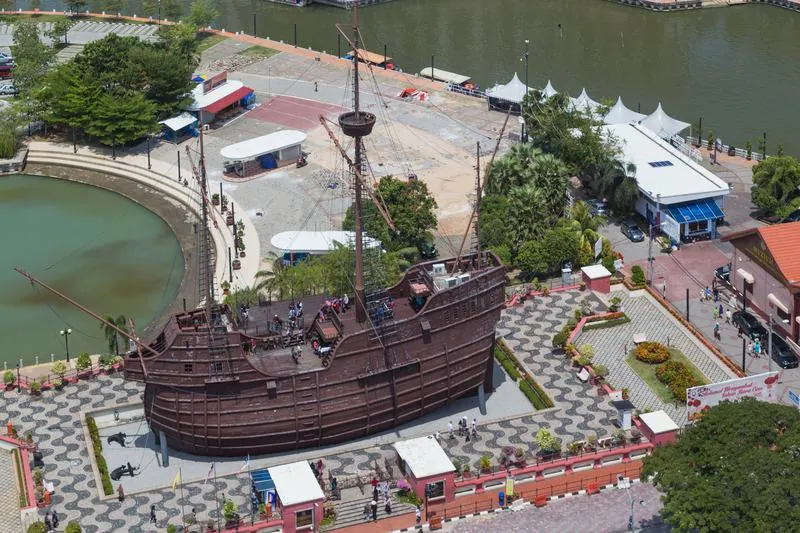
The claims to the wreck are three. Portugal regards her as a state vessel and is party to the 2001 UNESCO Convention, which requires in situ preservation and forbids commercial exploitation of wrecks over a hundred years old; Indonesia, in whose waters the coast lies, and Malaysia, whose sultanate's treasure it was, are not parties and assert their own rights, Malaysia through a replica-ship museum at Malacca and Indonesia through salvage licensing[4][1][5]. Any find would start a dispute of the kind now running over the San José.
The explanations
That the ship lies, broken and buried, on the shoals somewhere along 150 kilometres of Sumatran coast is the only reading the chronicles support; it predicts a scattered site of ballast, ordnance and durable cargo under sediment, findable by magnetometer and sub-bottom survey if the stretch of coast could be narrowed[3]. That the wreck was salvaged by local people soon after, as the Pasai raft episode and the coast's population make plausible, predicts that any site would hold little metal and that Malacca-palace objects might appear in Sumatran royal collections or trade[3]. That the cargo was the fabulous treasure of the treasure hunters' estimates predicts a very large gold and jewel deposit; the chronicles' silence on quantity and the king's own accounts, if read, would test it[1].
Published claims
| Year | Who | Claimed | Status | Reason |
|---|---|---|---|---|
| 1557 | Brás de Albuquerque[3] | The Flor de la Mar broke up at night on shoals off the coast of Sumatra, carrying the pieces Albuquerque had chosen from the sack of Malacca for the king; a few named objects were saved and the rest went down. | Most likely | Barros and Correia agree on the loss, but the chronicles name objects, not quantities, and no wreck has been found[3][1]. |
| 1858 | Gaspar Correia[6] | Albuquerque's fleet left Malacca on 1 December 1511, after the 20 November date usually given for the wreck. | Still possible | The chronicles disagree on the date by about a fortnight, and no one has reconciled them against the letters to the king[3][1]. |
| 1992 | Robert Marx[7] | Brought in by the Indonesian government, he found the wreck site within three days, about 100 miles from where it had been searched for. | Disputed | No site, artefact or survey report has been published since, and the wreck is still listed as unlocated[1]. |
| 2017 | Allison McNearney (The Daily Beast)[8] | The wreck still holds a treasure worth about 2.6 billion dollars. | Disputed | The figure is a modern treasure-hunting estimate; the chronicles describe the cargo but never give its quantity[3][1]. |
What would settle it
Two things, in order. A reading of the Portuguese chronicles and royal accounts for the exact route, date and landmarks of the loss, and for what Albuquerque reported lost and what reached Lisbon from Malacca, would narrow the search area and bound the cargo[3]. Then a licensed, published archaeological survey of the candidate coast under the 2001 Convention's rules, with any find reported to all three states, would settle whether a site survives[4]. A wreck of 1511 with Portuguese bronze guns and Malaccan material would be the earliest European shipwreck in Southeast Asia, which is the real prize.
Questions
0 of 3 questions are answered.
Evidence 9 findings
Artifacts
The films, photos, papers and objects this mystery rests on, each with its own key and its distance from the original.
See also
References
- 1.Wikipedia contributors n.d.. Flor de la Mar. Wikipedia.cited 15 times hereSRC0D2BHD6W21AT
- 2.Manguin, P. 1980. The Southeast Asian Ship: An Historical Approach. Journal of Southeast Asian Studies 11(2): 266-276.doicited 1 time hereSRC0D2BHCQ83W8Y
- 3.Albuquerque, B., Birch, W. 1880. The Commentaries of the Great Afonso Dalboquerque, Second Viceroy of India, vol. III. Hakluyt Society, first series no. 62, London (translated from the Lisbon edition of 1774).cited 16 times hereSRC0D2BHCFE2WYG
- 4.UNESCO 2001. Convention on the Protection of the Underwater Cultural Heritage (2001). UNESCO Legal Affairs.cited 5 times hereSRC0D2BHCZ24YPV
- 5.Perbadanan Muzium Melaka 2020. Muzium Samudera (Flor de la Mar). Muzium & Galeri Melaka (archived).cited 3 times hereSRC0D2BHDEP3FN8
- 6.Correia, G., Felner, R. 1858. Lendas da India. Typographia da Academia Real das Sciencias, Lisbon.cited 1 time hereSRC0D2BHDPG0S2G
- 7.Divernet 2019. Outstanding wreck-hunter Bob Marx dies. Divernet, 14 July 2019.cited 2 times hereSRC0D2BHDYA6TFD
- 8.McNearney, A. 2017. The $2.6 Billion Treasure Still Lost at the Bottom of the Sea. The Daily Beast, 8 January 2017.cited 1 time hereSRC0D2BHE641034