The Franklin expedition (HMS Erebus and HMS Terror)
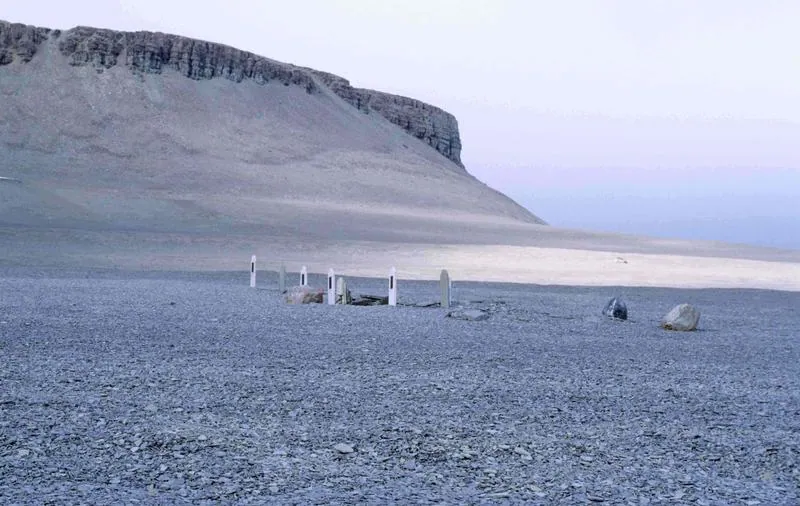
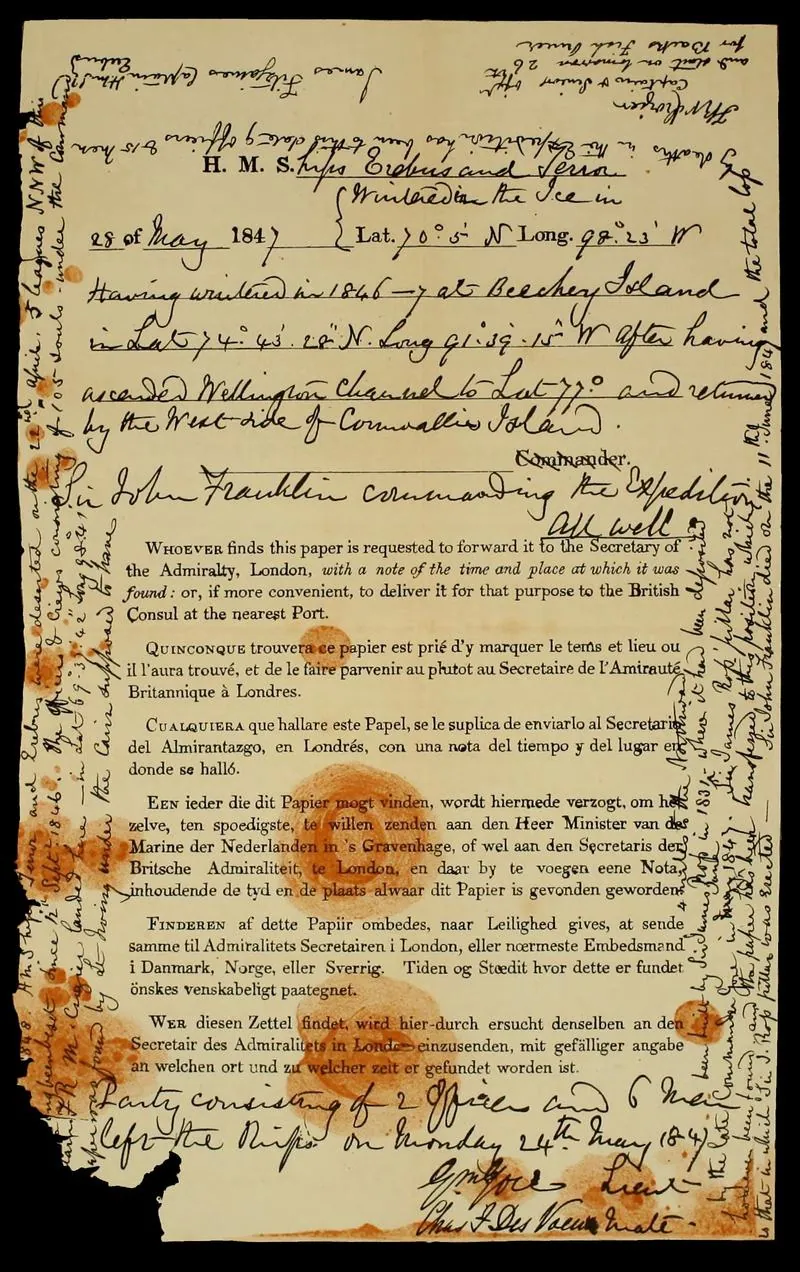
In 1845 HMS Erebus and HMS Terror, under Sir John Franklin, left England to complete the discovery of a Northwest Passage through the Canadian Arctic. They wintered at Beechey Island in 1845-46, where three men died and were buried, and in September 1846 were trapped in the ice of Victoria Strait off the north-west coast of King William Island[1]. On 24 May 1847 a party left a note reporting "All well". By the time the note was reopened and amended in the margin in April 1848, nine officers, Franklin among them, and fifteen men had died, and on 22 April the 105 survivors abandoned the ships[2][3]. They set off south, dragging boats on sledges, toward the Back River. None reached help[3].
Search expeditions over the next fifteen years found the Beechey Island graves, relics traded by Inuit, bodies and boats along the island's west and south coasts, and in 1859 the Victory Point record itself[4][5]. Inuit testimony, collected from 1854 onward, described starving men walking south, bodies, cut bones and a ship that sank with a dead man aboard[6]. Skeletal studies have since confirmed cut marks on bones of the crew[7][8].
Two finds changed the case. In September 2014 a Parks Canada-led search found Erebus south of King William Island, and in September 2016 Terror was found in Terror Bay, both guided in part by Inuit knowledge[9]. Since 2019 a team led by Douglas Stenton has matched DNA from skeletons on King William Island with descendants of the crew, and has named six men[3]. The broad outline is known. The causes, the sequence of the last months and the fate of most individuals are not. Of the 5 questions on this site, 0 are answered. The most likely answer to “What did the survivors do after leaving the ships in April 1848?”, not yet confirmed: some men returned to the ships, and one or both were sailed or drifted south with men aboard.
Key questionsset by the editors
What is known
The expedition's last known plan is in the Victory Point record: a printed Admiralty form filled in on 24 May 1847, recovered by the McClintock search of 1857-1859, with a marginal note added in April 1848 when the ships were deserted[4][3]. Mortality before the desertion was extraordinary: 24 deaths among 129 men aboard ships that had wintered without disaster, against the low rates of other Arctic expeditions that stayed longer, and at least 24 more men died within about 100 km of the ships after they left[2].
The dead are scattered along the route of the retreat, from the Victory Point area down the west coast of King William Island to Erebus Bay and around to Simpson Strait and the mainland[5]. At Erebus Bay bones of at least eleven individuals bear cut marks consistent with defleshing, and some show the polish of boiling, the signs of cannibalism in the last stage of starvation[7][8]. The identified men are Warrant Officer John Gregory, Captain James Fitzjames, Subordinate Officers' Steward John Bridgens, Able Seaman William Orren and Boy David Young of Erebus, and Captain of the Foretop Harry Peglar of Terror[10][11][12][13]. Fitzjames's DNA came from a mandible with cut marks, so the expedition's second-in-command was among those whose bodies were eaten[11]. Five of the six died within two kilometres of each other, all from Erebus[3].
The ships outlasted their crews. On Erebus, south of King William Island, divers are excavating the lower deck, where a seaman's chest, officers' tableware, cabin furniture and instruments survive; the coal bunkers below are empty[14].
Timeline
The search
The nineteenth-century searches, Admiralty and private, found the first winter camp and graves on Beechey Island, Inuit reports and relics collected by John Rae in 1854, and the Victory Point record, bodies and a boat found by McClintock's party in 1859[6][4][15]. Skeletons and scattered bones continued to turn up through the twentieth century; Stenton's inventory lists the recorded finds and their later fate[5].
Modern work has three strands. Physical anthropology: the Beechey Island sailors were exhumed in the 1980s and their tissues analysed for lead, and remains on King William Island have been excavated and studied for cut marks, pathology and lead[16][7][1]. Underwater archaeology: Parks Canada searched from 2008, found Erebus in 2014 and Terror in 2016, and with Inuit partners has returned to the wrecks in most seasons since[17][9]. In 2024 the team made 50 dives on Erebus and used an ROV on the orlop deck and engine room[14]. Genetics: the Stenton team has built an archaeological DNA dataset from 50 tooth and bone samples at ten sites and a reference set from descendants of 33 crew members, and compares them[3][18].
The explanations
Why did so many die aboard before April 1848? Lead poisoning was proposed after lead isotope ratios in the Beechey Island sailors matched the solder of the tinned food[16]. A synchrotron study of lead in bone microstructure found lead present but not markedly raised near death, no worse on King William Island than at Beechey, and not high compared with a contemporary Royal Navy sample from Antigua, and concluded it was not pivotal[1]. Poor nutrition and scurvy are supported by skeletal signs and by the thumbnail record of one Beechey sailor[7][20]. Park and Stenton argue that something particular to these ships, rather than the Arctic itself, must explain the death rate, and the question remains open[2].
What happened after the desertion? The standard reading follows the Victory Point record: the men left together for the Back River and died along the way[3]. Inuit testimony and the position of Erebus, far south of where the ships were abandoned, support a second phase in which some men returned to the ships, one or both of which drifted or were sailed south[6][9]. The DNA results add a pattern: all five identified men who died near Erebus Bay were from Erebus, which raises the question whether the two crews travelled separately[3].
How did most of the men die? Starvation, scurvy and cold, with cannibalism among the last survivors, are established for some groups[7][8]; for most of the crew there is no identified skeleton and no cause.
Published claims
| Year | Who | Claimed | Status | Reason |
|---|---|---|---|---|
| 1854 | John Rae[22] | Inuit reports show that a party of about forty men starved to death on the mainland, and the state of the bodies shows they had resorted to cannibalism. | Accepted | Cut marks and polished, boiled bone from Erebus Bay, and the cut marks on Fitzjames's jaw, confirm cannibalism[7][8][11] |
| 1854 | Charles Dickens[23] | Franklin's men would not have eaten their dead, and the Inuit who said so were not to be trusted. | Ruled out | Butchery marks on the expedition's own bones show the cannibalism happened[7][8] |
| 1859 | Francis Leopold McClintock[24] | The crews left the ships on 22 April 1848 and died on the march south towards the Back River. | Disputed | The record proves the desertion, but Erebus lies far south of where it was left, and Inuit accounts describe men back aboard a ship[9][6] |
| 1987 | Owen Beattie and John Geiger[26] | Lead from the solder of the tinned food poisoned the crews and was a major cause of the disaster. | Disputed | Later bone and nail studies found lead no higher than in other sailors of the time and rising only near death[1][25] |
| 1991 | Walter Kowal and colleagues[16] | The lead in the Beechey Island sailors' tissues matches the lead of the solder in the expedition's tins. | Disputed | The isotope match stands, but later work shows the amounts were not unusual for the period[1] |
| 1991 | David Woodman[6] | Inuit testimony shows that some men went back to the ships after the 1848 desertion, and one ship was sailed or drifted south with men aboard. | Most likely | The wreck of Erebus far to the south, near where Inuit placed a ship, fits it, though no record of a return has been found[9] |
| 1997 | Anne Keenleyside, Margaret Bertulli and Henry Fricke[7] | Bones of at least eleven men at Erebus Bay bear cut marks from defleshing, with signs of scurvy and high lead. | Accepted | The cut marks were confirmed by a later study of the same bones and by the Fitzjames mandible[8][11] |
| 2016 | Simon Mays and Owen Beattie[8] | Breakage and "pot polish" on Erebus Bay bones show they were boiled for marrow in the last stage of starvation. | Accepted | Pot polish is a recognised sign of boiling, and the find fits the cut marks recorded earlier[7] |
| 2016 | Jennie Christensen and colleagues[25] | John Hartnell was severely short of zinc, and his lead rose only in his last weeks, so zinc deficiency mattered more than lead. | Still possible | It rests on one sailor's nails, and its reading of the time series was disputed in a reply[20] |
| 2018 | Treena Swanston and colleagues[1] | Lead in the crews' bones and teeth was no higher than in other Royal Navy sailors of the time and did not play a pivotal role. | Most likely | It agrees with the nail study, though lead from the tins is still argued to have added to other harm[25][16] |
| 2019 | Robert Park and Douglas Stenton[2] | The 24 deaths aboard before April 1848 far exceed the losses of other Arctic expeditions, so something particular to these ships made the crews ill. | Most likely | The comparison holds, but what that something was is not settled[2] |
| 2021 | Douglas Stenton and colleagues[10] | Remains from King William Island are those of John Gregory, engineer of Erebus, by a Y-chromosome match with a descendant. | Accepted | Five more men have since been identified the same way[3] |
| 2024 | Douglas Stenton and colleagues[11] | A mandible with cut marks from Erebus Bay is that of Captain James Fitzjames. | Accepted | The Y-DNA match with a paternal relative is direct, and the cut marks show an officer was not spared[11] |
| 2026 | Douglas Stenton and colleagues[13] | The skeleton found in 1859 near Gladman Point with Harry Peglar's papers is Peglar himself, not a shipmate carrying them. | Accepted | The DNA match settles the 167-year-old question[13] |
| 2026 | Douglas Stenton[3] | The five identified men who died near Erebus Bay all served on Erebus, which suggests the two crews may have travelled separately. | Still possible | Six identifications are a pattern, not a proof[3] |
What would settle it
The ships' papers would answer most of it. Officers' logs, letters or a later record left on board, if preserved in the sediment-filled cabins of Erebus or Terror, would date the deaths, the decision to leave and any return. The excavation of the officers' cabins on Erebus is under way, and Terror, deeper and better sealed, has barely been entered[14]. More DNA reference samples from descendants would extend the identifications and test whether the two crews travelled apart. A larger, comparable sample of lead, zinc and collagen measurements from identified men of known date of death would separate the lead, nutrition and disease readings, as the Antigua comparison began to do[1]. Dating of the sediment and biological growth on the wrecks could show when each ship sank.
Questions
0 of 5 questions are answered.
Evidence 19 findings
Artifacts
The films, photos, papers and objects this mystery rests on, each with its own key and its distance from the original.
See also
References
- 1.Swanston, T., Varney, T., Kozachuk, M. et al. 2018. Franklin expedition lead exposure: New insights from high resolution confocal x-ray fluorescence imaging of skeletal microstructure. PLOS ONE 13(8): e0202983.doicited 6 times hereSRC0D59JP2W0Z70
- 2.Park, R., Stenton, D. 2019. Use your best endeavours to discover a sheltered and safe harbour. Polar Record 55(6): 361-372.doicited 7 times hereSRC0D59JJDP1W9W
- 3.Stenton, D. 2026. New DNA analysis identifies more members of the ill-fated Franklin expedition. The Conversation.doicited 12 times hereSRC0D59JJNG3QYJ
- 4.Royal Museums Greenwich 2026. Record case (AAA2344), Polar Equipment and Relics collection. Royal Museums Greenwich collections.cited 5 times hereSRC0D59JJ5W10A8
- 5.Stenton, D. 2018. Finding the dead: bodies, bones and burials from the 1845 Franklin northwest passage Expedition. Polar Record 54(3): 197-212.doicited 2 times hereSRC0D59JMC65VG1
- 6.Woodman, D. 1991. Unravelling the Franklin Mystery: Inuit Testimony. McGill-Queen's University Press.doicited 12 times hereSRC0D59JPJG4QSK
- 7.Keenleyside, A., Bertulli, M., Fricke, H. 1997. The Final Days of the Franklin Expedition: New Skeletal Evidence. ARCTIC 50(1): 36-46.doicited 6 times hereSRC0D59JN3M37TJ
- 8.Mays, S., Beattie, O. 2016. Evidence for End-stage Cannibalism on Sir John Franklin's Last Expedition to the Arctic, 1845. International Journal of Osteoarchaeology 26(5): 778-786.doicited 2 times hereSRC0D59JNBE2B3V
- 9.Parks Canada 2023. Discoveries: Wrecks of HMS Erebus and HMS Terror National Historic Site. Parks Canada.cited 12 times hereSRC0D59JH6M6CJV
- 10.Stenton, D., Fratpietro, S., Keenleyside, A. et al. 2021. DNA identification of a sailor from the 1845 Franklin northwest passage expedition. Polar Record 57: e14.doicited 4 times hereSRC0D59JK541ZAZ
- 11.Stenton, D., Fratpietro, S., Park, R. 2024. Identification of a senior officer from Sir John Franklin's Northwest Passage expedition. Journal of Archaeological Science: Reports 59: 104748.doicited 6 times hereSRC0D59JKCY2VCH
- 12.Stenton, D., Fratpietro, S., Gorsalitz, K. et al. 2026. DNA identifications of three 1845 Franklin expedition sailors from HMS Erebus. Journal of Archaeological Science: Reports 72: 105739.doicited 2 times hereSRC0D59JKMR4AHR
- 13.Stenton, D., Fratpietro, S., Gorsalitz, K. et al. 2026. "Some very hard ground to heave": DNA identification of Harry Peglar, Captain of the Foretop, HMS Terror. Polar Record 62: e17.doicited 2 times hereSRC0D59JKWJ3WWX
- 14.Parks Canada 2024. Exploration 2024: Wrecks of HMS Erebus and HMS Terror National Historic Site. Parks Canada.cited 6 times hereSRC0D59JHY268G2
- 15.Stenton, D., Keenleyside, A., Park, R. 2015. The "Boat Place" Burial: New Skeletal Evidence from the 1845 Franklin Expedition. ARCTIC 68(1): 32.doicited 1 time hereSRC0D59JMM058NY
- 16.Kowal, W., Beattie, O., Baadsgaard, H. et al. 1991. Source identification of lead found in tissues of sailors from the Franklin Arctic Expedition of 1845. Journal of Archaeological Science 18(2): 193-203.doicited 4 times hereSRC0D59JNV25W71
- 17.Parks Canada 2024. Ongoing exploration: Wrecks of HMS Erebus and HMS Terror National Historic Site. Parks Canada.cited 1 time hereSRC0D59JHP81FRJ
- 18.Stenton, D., Keenleyside, A., Fratpietro, S. et al. 2017. DNA analysis of human skeletal remains from the 1845 Franklin expedition. Journal of Archaeological Science: Reports 16: 409-419.doicited 2 times hereSRC0D59JJXA5YHW
- 19.Stenton, D., Park, R. 2024. Integrating Oral History and Archaeology of the 1845 Franklin Expedition: The Case From Kungearkbeearu. ARCTIC 76(4).doicited 1 time hereSRC0D59JMVT250S
- 20.Millar, K., Bowman, A. 2017. "Hartnell's time machine" reprise: Further implications of zinc, lead and copper in the thumbnail of a Franklin expedition crewmember. Journal of Archaeological Science: Reports 13: 286-290.doicited 2 times hereSRC0D59JPAP1FBP
- 21.Parks Canada 2026. Wrecks of HMS Erebus and HMS Terror National Historic Site. Parks Canada.cited 2 times hereSRC0D59JHEE2510
- 22.Rae, J. 1854. Report to the Secretary of the Admiralty and the Hudson's Bay Company on the fate of the Franklin expedition. Further Papers Relative to the Recent Arctic Expeditions in Search of Sir John Franklin (House of Commons Sessional Papers, Eyre and Spottiswoode, 1855), 835–844; text on Canadian Mysteries.cited 1 time hereSRC0D59JR1C6RJR
- 23.Dickens, C. 1854. The Lost Arctic Voyagers. Household Words X (245), 361, 2 December 1854.cited 1 time hereSRC0D59JR9658GX
- 24.McClintock, F. 1859. The Voyage of the 'Fox' in the Arctic Seas: A Narrative of the Discovery of the Fate of Sir John Franklin and His Companions. John Murray, London.cited 1 time hereSRC0D59JRH04E3H
- 25.Christensen, J., McBeth, J., Sylvain, N. et al. 2016. Hartnell's time machine: 170-year-old nails reveal severe zinc deficiency played a greater role than lead in the demise of the Franklin Expedition. Journal of Archaeological Science: Reports 16, 430–440.doicited 1 time hereSRC0D59JS0M7GN5
- 26.Beattie, O., Geiger, J. 1987. Frozen in Time: The Fate of the Franklin Expedition. Bloomsbury, London.cited 2 times hereSRC0D59JRRT6EYA