Method · astronomy: time-series photometry Single-event dip search with injection-recovery and fair nulls
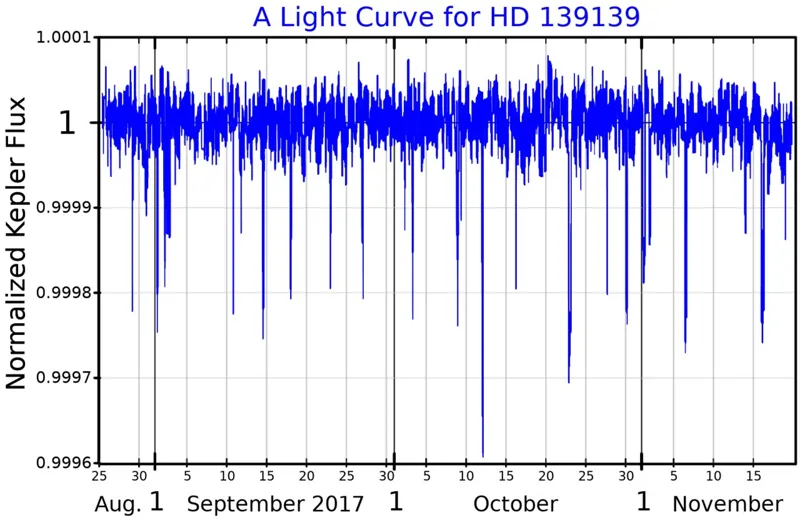
Test whether HD 139139's 2017 dips recur in later photometry, and whether dips like them are common in other bright K2 stars.
Questions it answers
Runs and results 3 runs
Run Mystery Measured Result Against Date RUN0DD2GVJ41GHK HD Dips vs sign-flipped bumps at >=5.5 sigma; published dips recovered {'EVEREST': [19, 4], 'K2SFF_all': [23, 12], 'K2SFF_ge1.5h': [21, 6], 'recovered_K2SFF': 22, 'recovered_EVEREST': 17} Sign-flipped search with symmetric outlier handling RUN0DD2GVRRESBS HD Per-dip completeness and expected detections at the K2 rate (>=4.5 sigma); detections in real data {'candidate': {'btjd': 3778.5485, 'depth_ppm': 507, 'duration_h': 2.24, 'depth_err_ppm': 105}, 'expected_A': 0.44, 'expected_B': 0.7, 'completeness_A': 0.094, 'completeness_B': 0.149, 'fap_independent': '0.5-2%', 'real_detections': 1} Noise-only false alarms at >=4.5 sigma: 0.014 per 13.5 d (circular-shift null) · independent check with white and phase-randomised nulls gives FAP 0.6-1.6% for the candidate RUN0DD2GW3R2EAJ HD Excess = dips - sign-flipped bumps at >=5.5 sigma, events >=1.5 h, K2SFF {'rank': 5, 'n_stars': 619, 'HD139139': 15, 'population_quantiles_50_90_99': [0, 1, 9.6]} The same statistic across 619 stars of Tmag 8.6-9.7 in C15
Applied to
3 datasets K2 Campaign 15 light curves of EPIC 249706694 (pipeline, K2SFF and EVEREST), TESS Sector 91 full-frame-image light curves at the position of HD 139139 (2025), Table of the 28 transit-like events (times, durations, depths)
References
Rappaport, S., Vanderburg, A., Kristiansen, M. et al. 2019. The Random Transiter – EPIC 249706694/HD 139139. Monthly Notices of the Royal Astronomical Society 488(2), 2455–2465. Alonso, R., Hoyer, S., Deleuil, M. et al. 2023. No random transits in CHEOPS observations of HD 139139. Astronomy & Astrophysics 680, A78.
Downloads are for beta members
We're in a private beta while we get things right. Everything here is free to read; downloading datasets, sources and code is open to members for now.
It takes a couple of minutes. We'll reply by email.