Method · space photometry / transit modelling
Dip-shape model comparison and asymmetry statistic
Ask whether a dip's shape is that of a hard body crossing a limb-darkened disc or of a diffuse cloud, independently of colour information, and place it among the Kepler dips.
Questions it answers
Code Python
Runs and results 1 run
Applied to
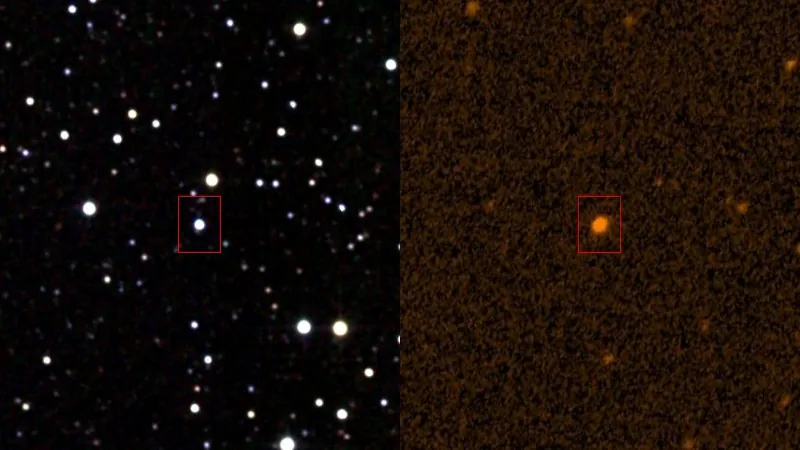
2 datasetsKepler long-cadence light curve of KIC 8462852, Quarters 0-17, as one CSV, TESS light curves of TIC 185336364 (KIC 8462852), Sectors 14-82, as flat CSV
References
- Boyajian, T., LaCourse, D., Rappaport, S. et al. 2016. Planet Hunters IX. KIC 8462852 – where's the flux?. Monthly Notices of the Royal Astronomical Society 457(4), 3988–4004.
- arXiv:2607.20643 (July 2026). Models the symmetric 1.1 per cent dip in TESS Sector 15 (September 2019) as a planetary transit and combines it with archival and new radial velocities: a 2.3-sigma companion of about 9 Jupiter masses and 1.7 Jupiter radii with a period of at least about 1030 days, in several allowed period windows. Independently recovered in this department's TESS search.
- arXiv:2610.34806 (October 2026). Fits the 2019 TESS transit with a 1.1 Jupiter-radius planet carrying a ring out to 3-4 planetary radii.